


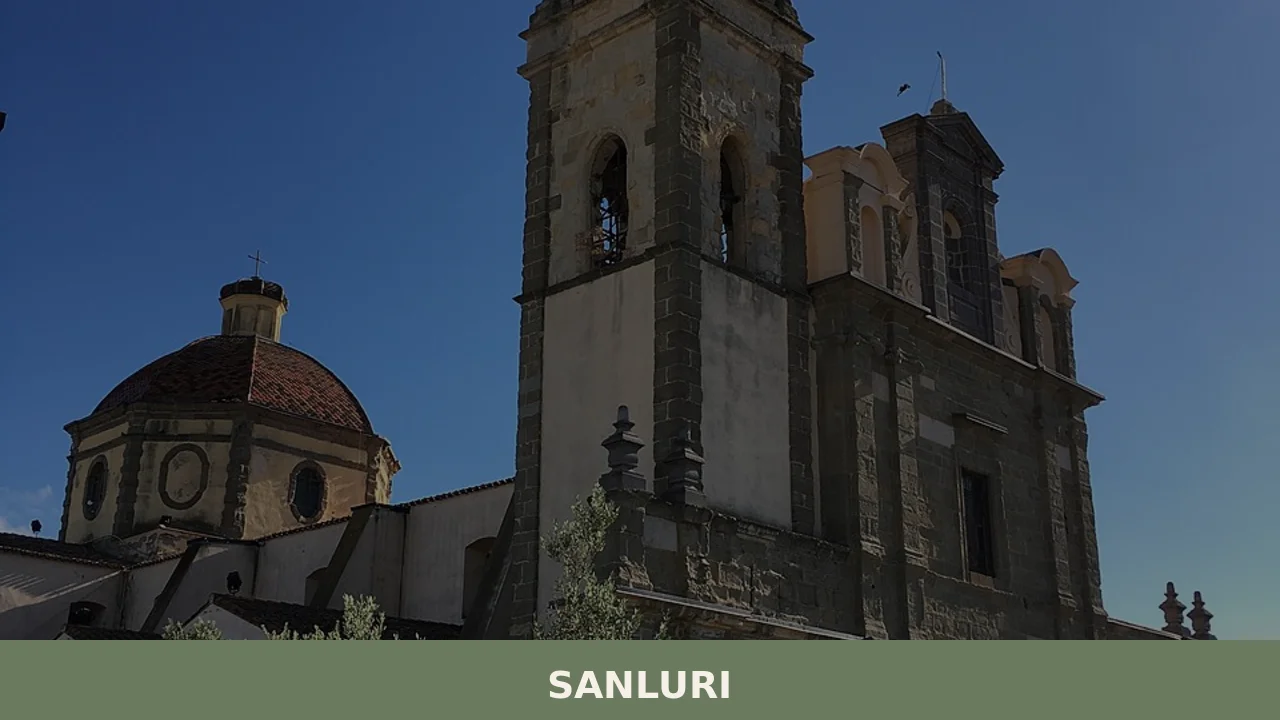
Sanluri
Discover Sanluri, a charming village in Sardegna, Italy, rich in history, culture, and stunning landscapes. Plan your visit today!
Discover Sanluri
At 135 metres above sea level, in the heart of the Campidano plain, Sanluri is one of the most significant centres in the province of Medio Campidano, with a population of 8,429 that makes it a point of reference for the entire surrounding territory.
Those wondering what to see in Sanluri will find a town that has lived through Aragonese rule, decisive battles and centuries of intense rural life, leaving concrete traces in the urban landscape and cultural fabric of the place.
The Campidano, with its open horizons and wheat fields, has provided Sanluri with the geographical backdrop that shaped its economy and identity for centuries.
History and Origins of Sanluri
The origins of the name “Sanluri” are interpreted differently across historical sources.
Some reconstructions link it to a pre-Latin or archaic Sardinian root, common to many centres of the Campidano, while other theories associate it with linguistic changes that occurred during the medieval period under successive foreign rule.
What the sources document with certainty is that the settlement already existed and was populated before the Aragonese arrived on the island, forming part of a network of villages that organised the Campidano territory around agro-pastoral activities and commercial exchanges along the natural routes of the plain.
The historical event that defined Sanluri more than any other is the Battle of Sanluri of 1409, one of the most significant military confrontations in medieval Sardinian history. On 30 June of that year, Aragonese forces led by Martin the Younger, King of Sicily, met and defeated the army of the Giudicato of Arborea, effectively ending Arborean resistance and consolidating the Crown of Aragon’s dominion over Sardinia.
The battle was fought near the castle that still stands over the town today, and its outcome irreversibly determined the political structure of the island for the centuries that followed.
Sanluri thus became a pivotal point in the transition between the era of the Giudicati and that of Iberian rule — a phase that profoundly transformed the administrative, linguistic and cultural structures of Sardinia.
Through the early modern period, Sanluri followed the fortunes of the Kingdom of Sardinia, passing first under Spanish rule and then under the House of Savoy, with the Treaty of Utrecht of 1713 formally transferring the island to the Savoys.
During the eighteenth and nineteenth centuries, the town consolidated its role as an agricultural centre in the Campidano plain, with an economy based on cereal farming and livestock.
The current urban layout reflects this layered evolution: the medieval castle stands alongside churches built during the Spanish period and nineteenth-century buildings in the historic centre.
A comparable pattern, with different historical layers coexisting side by side, characterises Oristano as well — the ancient capital of the Giudicato of Arborea and Sanluri’s principal opponent in the battle of 1409.
What to See in Sanluri: Main Attractions
Castle of Eleonora d’Arborea
Sanluri’s medieval castle is the only medieval castle in Sardinia that has never fallen into ruin and has remained continuously inhabited to the present day. The structure dates to the fourteenth century and was the direct setting of the Battle of 1409.
Today it houses the Museum of the Risorgimento and Wax Figures, which holds a collection of historical relics, military uniforms, weapons and documents relating to the Risorgimento campaigns and the World Wars.
The castle takes its popular name from Eleonora d’Arborea, the judge-queen who enacted the celebrated Carta de Logu, although the direct connection between the historical figure and the building is mediated through the battle that brought the Arborean kingdom to an end.
A visit allows exploration of well-preserved medieval rooms and access to one of the most distinctive historical collections on the island.
Sanctuary of the Madonna delle Grazie
The Sanctuary of the Madonna delle Grazie is the most important place of worship in Sanluri and is directly linked to the devotion that reaches its height at the patron feast on 31 May. The church preserves the venerated image of the Madonna, around which a strong popular devotion has developed over the centuries, drawing not only Sanluri’s residents but also worshippers from neighbouring towns across the Campidano. The architecture reflects the character of Sardinian religious building in the Spanish tradition, with decorative elements accumulated across the centuries.
The area around the sanctuary forms the focal point of the town’s religious and civic life, above all during the days of the patron feast.
Church of San Pietro
The Church of San Pietro is one of the oldest religious buildings in Sanluri’s historic centre and stands as one of the most significant examples of medieval sacred architecture in the Campidano.
The structure displays constructive features that recall the Romanesque-Pisan building style widespread across the island between the twelfth and thirteenth centuries, with the formal simplicity typical of Sardinian rural churches.
The building is integrated into the urban fabric of the historic centre and serves as a visual and cultural reference point for anyone walking through the town’s streets. Its presence documents the continuity of human settlement in the area well before the medieval events surrounding the battle of 1409.
Historic Centre and Main Square
Sanluri’s historic centre retains an urban layout that reflects its history as an agricultural Campidano settlement. The main streets converge on the central square, around which the public buildings, churches and most notable historic residences are arranged.
The constructions in local stone and brick display architectural features ranging from the Spanish period to the post-Unification nineteenth century.
Exploring the historic centre on foot allows visitors to trace the succession of building layers and understand how Sanluri evolved from a medieval stronghold into a modern agricultural centre. For those wondering what to see in Sanluri beyond the main attractions, the historic centre offers glimpses of daily life and minor architecture of genuine documentary interest.
Ethnographic and Territorial Museum
Alongside the castle museum, Sanluri has facilities dedicated to documenting the traditional rural life of the Campidano.
The collections bring together agricultural tools, household objects, traditional clothing and materials that illustrate the daily practices of the farming communities of the area.
This kind of documentation is essential for understanding the economic and social context that shaped Sanluri throughout the nineteenth and early twentieth centuries.
A visit to these spaces completes the historical picture offered by the castle and connects the great military and political events to the concrete reality of local people’s lives. Those with an interest in Sardinian ethnography will find here comparative material that is useful for understanding other centres of the Campidano as well.
Traditional Food and Products of Sanluri
Sanluri’s cuisine is rooted in the gastronomic tradition of the Campidano, the great cereal-growing plain that has long served as Sardinia’s breadbasket.
This geographical area developed, over the centuries, a cuisine closely tied to cereal production, sheep and cattle farming, and the processing of derived products, with influences that reflect the succession of historical rulers: the medieval Arborean kitchen, the Spanish contributions of the Aragonese and Catalan period, and the gradual integration with mainland food practices that followed Italian unification.
The result is a solid gastronomic repertoire, unadorned but full of flavour, built on quality raw materials produced locally.
Among the dishes most deeply embedded in local tradition, malloreddus holds a central place: these are small ridged semolina dumplings shaped using a traditional wicker tool, dressed with Sardinian sausage ragù and generous amounts of grated pecorino, in the preparation known elsewhere on the island as malloreddus alla campidanese.
Fregola, a toasted semolina pasta formed into irregular granules, appears frequently in fish broth in coastal areas, but in the inland Campidano it is served with meat or legume sauces. Seadas, large fried ravioli filled with tangy fresh cheese and drizzled with bitter strawberry-tree or chestnut honey, are the defining dessert of Sardinian cuisine and appear regularly on tables in Sanluri and the surrounding towns.
Another traditional Campidano sweet is pardulas, small shortcrust pastry baskets filled with ricotta or fresh cheese flavoured with citrus zest and saffron, prepared above all for the Easter celebrations.
Lamb and pork hold an important place in the traditional diet: porceddu, suckling pig roasted on a spit over holm oak or myrtle wood, is found across the island but in the Campidano takes on particular characteristics related to the local pig breeds raised in the area.
Sheep’s milk cheeses, in particular the various aged forms of pecorino sardo, accompany meals from breakfast to dinner and are produced by livestock farms operating in the area. No DOP, IGP or PAT certifications specifically associated with the municipality of Sanluri have been identified in available records, but the Medio Campidano territory participates in the production chain of products covered by designations recognised at a Sardinian regional level.
Visitors to Sanluri in spring and summer can find seasonal fresh produce in local markets and shops in the historic centre: cheeses at various stages of ageing, pane carasau and pane coccoi, artisan sweets and preserves.
The local festivals and patron feasts of the surrounding Campidano towns, concentrated mainly between May and September, provide the opportunity to taste traditional preparations in a festive setting.
A similar gastronomic tradition, rooted in cereal-growing plains and sheep farming, can also be found in villages in northern Sardinia such as Benetutti, where the inland kitchen shares comparable characteristics while maintaining its own local variations.
Festivals, Events and Traditions of Sanluri
Sanluri’s patron feast is dedicated to the Madonna delle Grazie and is celebrated on 31 May.
The occasion is the most important event in the town’s civil and religious calendar, drawing the participation of the entire community as well as worshippers from neighbouring Campidano towns. The celebrations include a solemn Mass, a procession carrying the statue of the Madonna through the streets of the historic centre, and moments of communal gathering that extend throughout the entire day.
Devotion to the Madonna delle Grazie has been rooted in the Sanluri community for centuries and represents one of the town’s strongest identity markers, reflecting the popular piety typical of agricultural centres in southern Sardinia.
Beyond the patron feast, the traditional calendar of Sanluri and the Campidano includes celebrations tied to the agricultural cycle and the Christian liturgical calendar.
The Easter period is accompanied by the preparation of ritual sweets and processions involving local confraternities. The Christmas season and New Year celebrations retain the communal character typical of rural Sardinian centres. Summer provides the context for local food festivals and events celebrating the territory’s products, occasions on which the traditional Campidano kitchen is showcased and shared with visitors.
The network of patron feasts across the surrounding towns creates a full calendar of events distributed throughout the year, with a greater concentration in the months of May, June and September.
When to Visit Sanluri and How to Get There
The best time to visit Sanluri is spring, between April and June, when temperatures are mild, the Campidano landscape is green and in bloom, and the festive calendar includes the patron celebration on 31 May.
Autumn, between September and October, offers similar climatic conditions with pleasant temperatures and favourable light for exploring the historic centre. The Sardinian summer, with the intense heat of the Campidano plain that in July and August can exceed 35 degrees, is less suitable for extended visits, although those already in Sardinia for a summer holiday can easily include Sanluri as a stop on a broader itinerary through the island’s interior. Winter is quiet with little tourist traffic, suited to those looking for direct contact with the town’s daily life.
For those arriving by car, Sanluri is easily reached via the State Road 131 Carlo Felice, the main artery running through Sardinia from Cagliari to Sassari.
The Sanluri exit is approximately 40 kilometres north of Cagliari, a journey of around 35 to 40 minutes in normal traffic. From Cagliari, the regional capital and main arrival hub in the south of the island, Sanluri is reached directly without the need to use secondary roads.
Cagliari-Elmas Airport is the reference airport for those arriving by air, located approximately 45 kilometres from Sanluri.
For those who prefer the train, Sanluri railway station is served by the Cagliari–Oristano–Sassari line operated by Trenitalia, with regular connections to the regional capital. The Municipality of Sanluri provides up-to-date information on events, services and points of interest on its official website.
Those planning an itinerary through inland Sardinia can combine a visit to Sanluri with other centres in the Campidano and the central-western part of the island. Heading north along the SS 131, visitors reach Bonnanaro, in the Meilogu, which shares with the Campidano a rural character and a cereal-farming vocation, while displaying the distinct landscape and cultural features of the hilly areas around Sassari.
In Sardinia More villages to discover
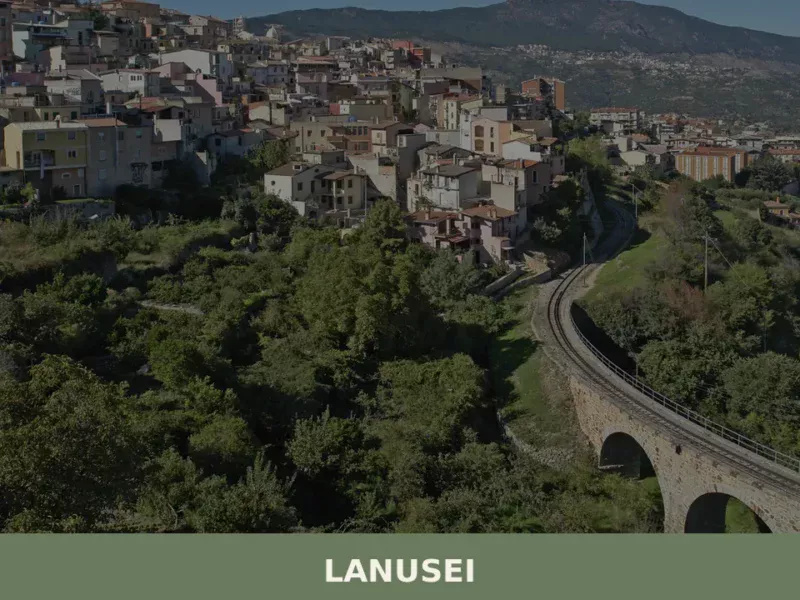
Lanusei
What to see in Lanusei, a Sardinian town at 595 m with 5,468 residents. Visit the Cathedral of Santa Maria Maddalena, the Natural History Museum and Gorropu Gorge. Plan your trip now.
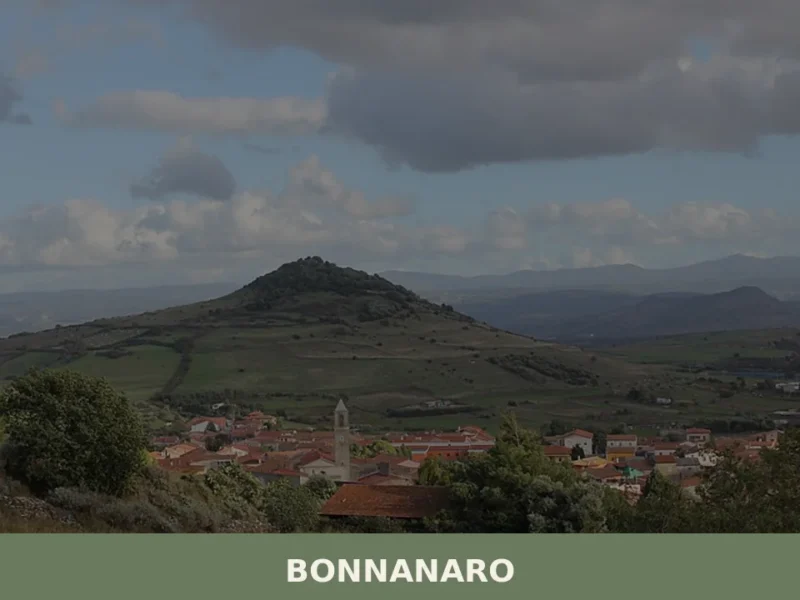
Bonnanaro
In 1388, when representatives of the Sardinian villages signed the peace treaty with the Crown of Aragon, among the signatories was the village of Bonnanaro, an agricultural centre already known for the fertility of its volcanic soils on the slopes of Monte Pelao. Today this village of 921 inhabitants, situated at 405 metres above sea […]
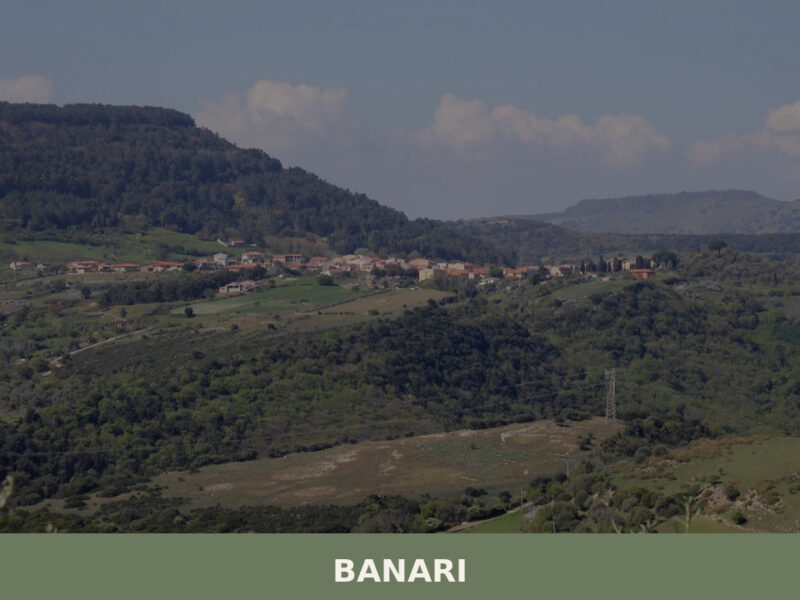
Banari
Morning light catches the limestone facades along Via Roma, turning them the colour of raw honey. A rooster calls from behind a courtyard wall. Somewhere below, the Meilogu plain stretches north toward Sassari, its patchwork of olive groves and grain fields still holding the night’s mist. Banari — population 516, perched at 419 metres above […]
📝 Incorrect information or updates?
Help us keep the Sanluri page accurate and up to date.