


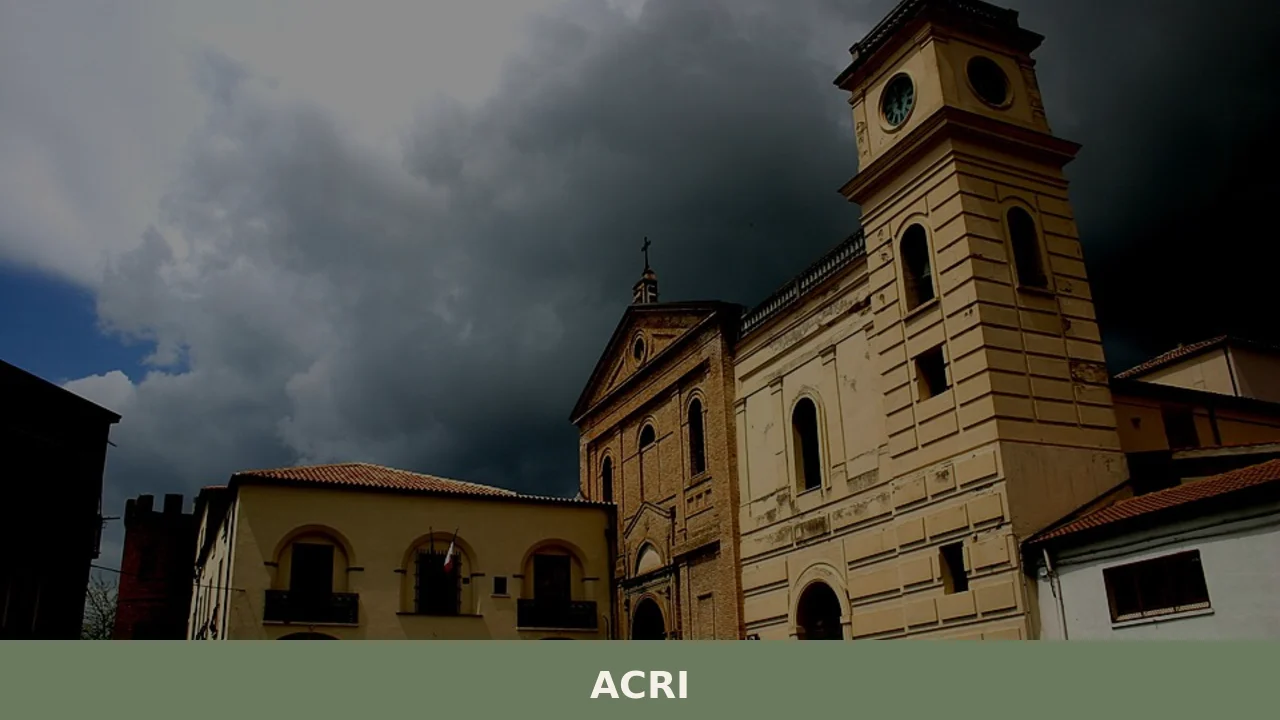
Acri
Acri is a town in the province of Cosenza with over 21,000 inhabitants, located in the Calabrian interior of the Sila Greca area, on a territory that passed through Norman, Swabian and Aragonese rule, leaving concrete traces in the local architecture and culture. For anyone approaching this corner of the province of Cosenza, the question […]
Discover Acri
Acri is a town in the province of Cosenza with over 21,000 inhabitants, located in the Calabrian interior of the Sila Greca area, on a territory that passed through Norman, Swabian and Aragonese rule, leaving concrete traces in the local architecture and culture.
For anyone approaching this corner of the province of Cosenza, the question of what to see in Acri finds answers in the lanes of the historic centre, in Baroque churches, in noble palaces and in a religious tradition that still organises community life around precise rituals.
The town spreads across a hillside at around 720 metres above sea level and serves as a reference point for the entire Sila Greca area of the Cosenza province.
History and Origins of Acri
The origins of the name Acri are debated among scholars.
One of the most widely held theories links it to the Greek word akra, meaning “height” or “promontory”, referring to the elevated position of the site. The Greek presence in this part of Calabria is documented from the classical period, and the local place names reflect the linguistic substratum that characterised Magna Graecia colonisation along the Ionian coast and the Sila hinterland.
The settlement developed gradually throughout the Middle Ages, consolidating as a defensive nucleus on the hills overlooking the Crati Valley.
During the Norman period, Acri was part of the feudal organisation of southern Italy. The territory passed through the hands of several noble families during the late Middle Ages and the early modern period. A significant figure associated with Acri is Blessed Angelo d’Acri, born Luca Antonio Falcone in Acri in 1669. A Capuchin preacher of great renown in the eighteenth-century south, he was beatified by Pius VI in 1825, and his memory remains very much alive in the town through places of worship and dedicated celebrations.
His spiritual example helped strengthen the Franciscan presence in the area and established Acri as a religious reference point for northern Calabria.
Between the eighteenth and nineteenth centuries, Acri underwent the changes typical of Calabrian towns: the earthquake of 1783 damaged many buildings in the historic centre, setting off a phase of reconstruction that shaped the current appearance of numerous structures.
Following Italian unification, the town took on important local administrative functions.
In the twentieth century, like many inland Calabrian municipalities, Acri experienced significant migration flows towards northern Italy and abroad, while maintaining a population that today exceeds 21,000 — making it one of the most populous towns in the province of Cosenza outside the provincial capital.
What to See in Acri: Main Attractions
Sanctuary and Convent of Sant’Angelo d’Acri
The convent complex dedicated to Blessed Angelo d’Acri is one of the most important religious landmarks in the town. The sanctuary holds the remains of the Capuchin preacher beatified in 1825 and draws pilgrims from across Calabria. The building, laid out in the Franciscan convent tradition, sits within the urban fabric of the historic centre with its restrained façade and interior spaces marked by popular devotion.
Visitors to Acri will find here one of the most tangible expressions of eighteenth-century religious history in southern Italy.
Palazzo Sanseverino-Falcone
This noble palace, connected to the Falcone family to which Blessed Angelo belonged, is one of the most significant historic buildings in central Acri.
The structure reflects the residential architecture of the southern Italian aristocracy between the seventeenth and eighteenth centuries, with decorative elements typical of late Calabrian Baroque.
A visit to the palace offers insight into the social stratification of the town in the early modern period and the role that local noble families played in shaping the urban fabric. The building is located in the historic centre and can easily be reached on foot by walking through the streets of the old quarter.
Church of Santa Maria Maggiore
The Church of Santa Maria Maggiore is one of the oldest places of worship on the territory of Acri. The building has undergone alterations over the centuries, and its current appearance reflects construction phases layered over a medieval core.
The interior preserves works of sacred art of historical interest, including paintings and sculptures attributable to Calabrian craftsmen active between the sixteenth and eighteenth centuries.
It is worth pausing to observe the details of the interior furnishings, which document local religious patronage across several centuries.
Historic Centre and Medieval Quarter
The old core of Acri extends across hillside slopes with an urban morphology typical of Calabrian Apennine towns: narrow streets, tightly grouped houses, glimpses over the Crati valley and the ridges of the Sila Greca.
Walking through the historic centre means observing portals in local stone, staircases, internal courtyards and smaller churches distributed across the different districts. This part of the town retains the urban structure that consolidated between the Middle Ages and the early modern period, and it is one of the main reasons why exploring what to see in Acri calls for more than a single day.
The Sila Greca Territory
Acri sits at the edge of the Sila Greca, a section of the Sila massif extending across the northern part of Calabria.
The surrounding territory offers forested landscapes with beech, Turkey oak and silver fir, areas suited to hiking and nature-based activities. The Sila National Park encompasses portions of the territory around Acri, protecting the mountain ecosystems and providing access to marked hiking trails.
Visitors who come to Acri intending to combine urban sightseeing with outdoor activity will find a concrete set of excursion options in this area.
Local Food and Products of Acri
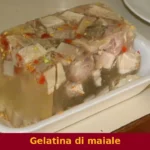
The cuisine of Acri belongs to the gastronomic tradition of the Cosenza hinterland, rooted in a rural and pastoral approach that for centuries drew on the resources of the Sila environment: sheep and pork, pulses, cereals, and wild herbs gathered from the forests and upland meadows.
The Greek influence present in the very history of the territory, combined with that of the Calabrian inland kitchen, has produced a repertoire of robust, seasonal dishes tied to the agricultural cycle.
The hilly and mountain geography isolated certain local products, which have retained their own distinct character compared to those of the coast.
Among the dishes most deeply embedded in local tradition is pitta ‘mpigliata, a Calabrian Christmas pastry made from shortcrust dough filled with dried figs, walnuts, honey and spices, widespread throughout the Cosenza area and present in Acri households.
Lagane e cicciari is a broad pasta dish with chickpeas, seasoned with garlic, chilli and olive oil, one of the most enduring cucina povera dishes of the Calabrian rural tradition.
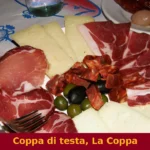
Frittola, a preparation based on pork offal, and artisan cured meats — soppressata, capocollo, and the ‘nduja variants of the Cosenza hinterland — round out the range of meats processed using traditional methods.
Pulse soups with spelt or barley are another established feature of this mountain cuisine.
No DOP, IGP or PAT certifications specifically attributed to Acri appear in the sources consulted. However, Calabria is a producer of extra virgin olive oil under several designations of origin, and the Cosenza area falls within this production context. Calabrian liquorice, grown mainly in the Ionian coastal strip, is a regional IGP product that can also be found in inland markets.
For locally produced goods, visiting the food shops of the historic centre or going directly to producers at seasonal fairs and markets is the most reliable approach.
Autumn is the best time to find porcini mushrooms gathered in the surrounding Sila forests, along with chestnuts and small-batch artisan products. Several municipalities in the area organise food events between September and November focused on forest produce and traditional pork processing — practices that once marked the rural calendar and that some local communities have preserved as public events.
Visitors to Acri during this period can check upcoming dates on the Acri municipal website.
Festivals, Events and Traditions of Acri
The feast of Blessed Angelo d’Acri is the religious event most deeply felt by the local community.
The Capuchin friar, beatified in 1825 by Pius VI, is celebrated with a liturgical occasion that draws the faithful from across the province of Cosenza and from other parts of Calabria.
The celebrations include religious services at the Sanctuary, processions through the historic centre and acts of popular devotion that take place over the course of the feast period. The figure of Blessed Angelo sits at the centre of Acri’s religious identity, and his memory is kept alive both through the liturgy and through oral transmission within families.
Inland Calabria has a deeply rooted tradition of patron saint festivals, and Acri is no exception. Celebrations in honour of local patron saints bring together moments of communal gathering that include music, processions with statues of saints carried on the shoulders of the faithful, and in some cases evening fireworks.
Traditions tied to the agrarian calendar — such as Easter celebrations and summer feasts — retain ritual elements that have been passed down over time.
The Sila Greca area, of which Acri is both geographically and culturally a part, shares with nearby villages such as Acquaformosa certain festive practices linked to the liturgical calendar and to the Albanian-Calabrian culture that characterises several municipalities in the area.
When to Visit Acri and How to Get There
The most favourable period for visiting Acri runs from late spring through to autumn. From May to June the territory offers mild temperatures, flowering vegetation and an absence of tourist crowds. July and August are lively months for summer festivals and events, while temperatures in the mountain zone remain cooler than on the Calabrian coast.
September and October are ideal for those combining a visit to the historic centre with excursions into the Sila Greca: the autumn foliage in the forests around Acri produces a notable display of colour.
Winter can bring snow to the Sila plateau, making road connections to higher areas more difficult.
To reach Acri by car, the main route is via the Autostrada del Mediterraneo (A2), with the Cosenza Nord junction as the reference point for those arriving from the north, and Cosenza Sud for those coming from the south.
From Cosenza, Acri is around 30 kilometres away along the SS 177 state road. The nearest railway station is Cosenza, served by Trenitalia with regional and intercity connections. From Cosenza it is necessary to continue by car or local bus.
The main airport is Lamezia Terme International Airport, around 90 kilometres from Acri, which offers the greatest range of domestic and international flights into Calabria.
Those arriving from the Ionian coast can also reach Acri via the SS 106 and then head inland.
Anyone planning an itinerary through the Cosenza hinterland can include the nearby village of Albidona, which shares with Acri a position in the mountainous inland area of the province of Cosenza, or travel towards the Tyrrhenian coast to visit Belmonte Calabro, a village that offers an entirely different landscape overlooking the Tyrrhenian Sea.
For those wishing to explore the spa and seaside side of the Cosenza area, Acquappesa is a stop along the Tyrrhenian coast that rounds out a varied itinerary through the province. Knowing what to see in Acri in relation to the surrounding territory helps build a more complete journey through the Calabrian interior.
In Calabria More villages to discover
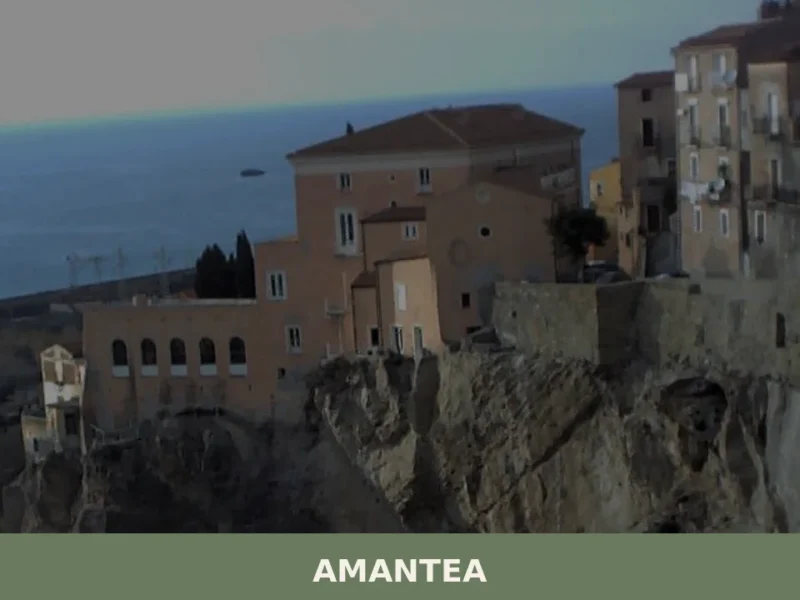
Amantea
Explore the picturesque village of Amantea Calabria. Discover its historic center, beautiful beaches, and authentic Italian charm. Plan your perfect trip to this hidden gem on the Tyrrhenian coast.
Amendolara
Explore Amendolara village, a charming Italian gem nestled in Calabria. Discover its rich history, stunning landscapes, and authentic local culture. Plan your visit today!
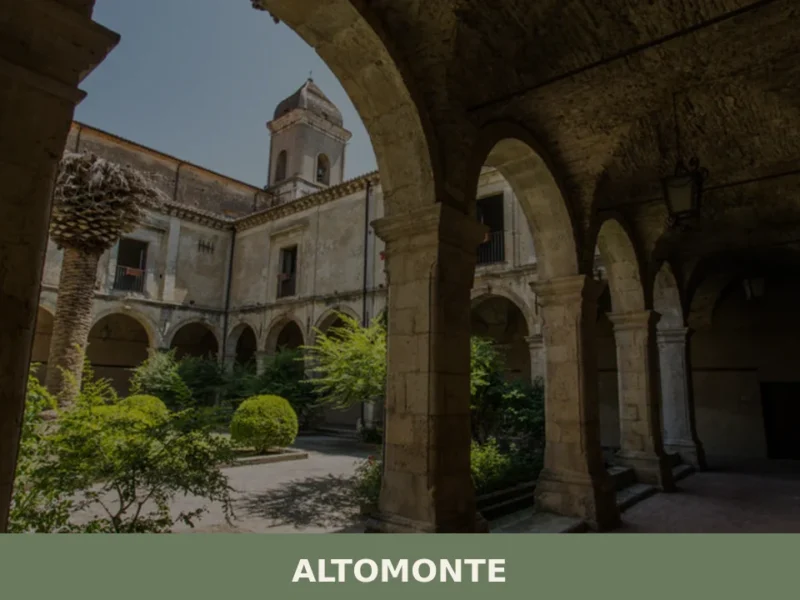
Altomonte
What to see in Altomonte: a hill village at 455m in Calabria with a 14th-century Gothic church, Civic Museum and medieval castle. Plan your visit today.
📝 Incorrect information or updates?
Help us keep the Acri page accurate and up to date.