


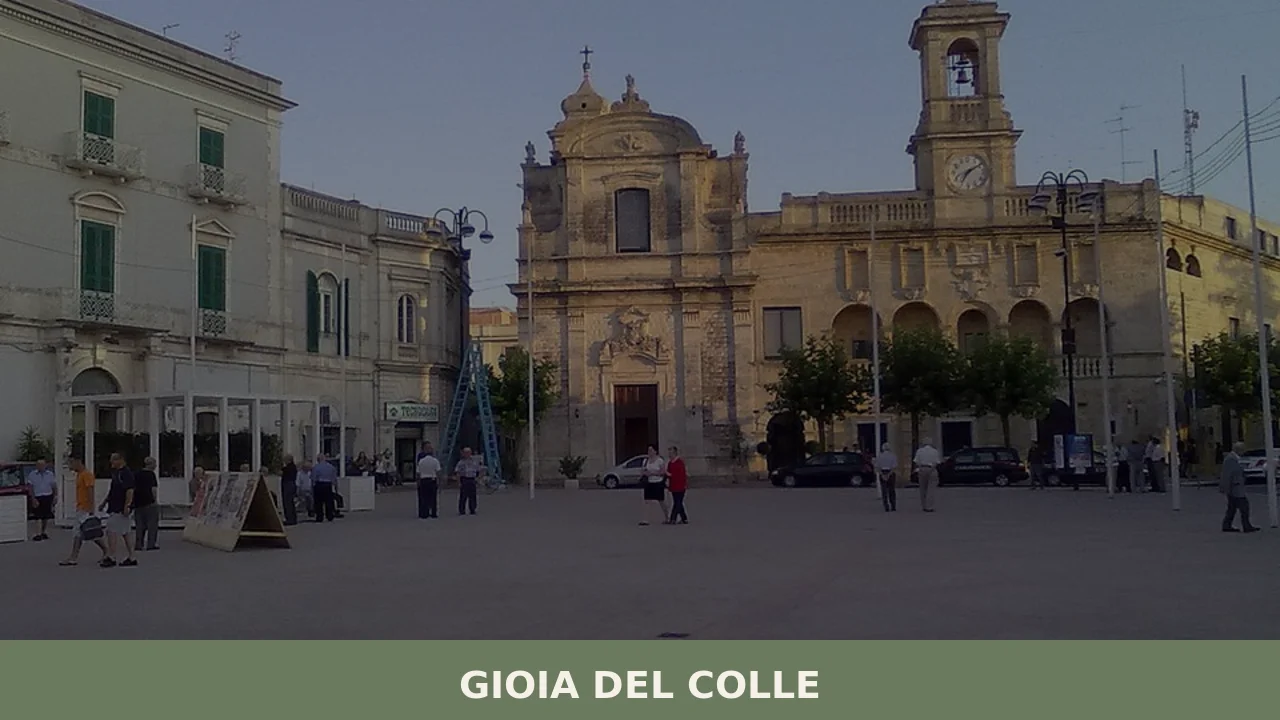
Gioia del Colle
What to see in Gioia del Colle: hilltop town at 362m on the Murgia. Explore the Swabian castle, Monte Sannace park, Primitivo DOC wines and local PAT dishes.
Discover Gioia del Colle
In 1105, the Norman count Riccardo Siniscalco had a fortress built in the Murgia area near Bari — a fortress that would become the core of the Norman-Swabian Castle of Gioia del Colle, the same building that Frederick II of Swabia transformed in the 13th century into one of his favourite residences. Today that castle still dominates Piazza dei Martiri del 1799, and anyone crossing its threshold walks the same ground once trodden by emperors and queens.
Understanding what to see in Gioia del Colle means starting right here, from this precisely cut limestone, and then broadening your gaze to a hilly territory at 362 metres above sea level where farmsteads, pastoral enclosures and an agricultural landscape of olive groves, vineyards and almond orchards coexist.
History and origins of Gioia del Colle
The place name “Gioia” has prompted several hypotheses among scholars. The most widely accepted traces it back to the medieval term Joha or Joja, documented in Norman-Swabian records from the 11th and 12th centuries, probably derived from the Latin iuba — meaning ridge or highland — referring to the raised position of the settlement on the Murgia.
The addition “del Colle” was formalised by royal decree in 1863, to distinguish the town from other Italian places with the same name, further confirming the hilly nature of the site. Traces of human activity in the area date back to the Bronze Age: Peucetian remains found at the site of Monte Sannace, about seven kilometres from the current town centre, document an Apulian settlement between the 6th and 3rd centuries BC, with a peak expansion phase in the 4th century, when the site probably had several thousand inhabitants and a defensive wall circuit.
The medieval period marked the definitive transformation of the town. With the arrival of the Normans in the 11th century, Gioia del Colle acquired a strategic role in controlling the territory between Bari and Taranto. The castle, radically restructured by Frederick II between approximately 1230 and 1240, became the seat of a local court.
Popular tradition — not supported by verified documentary sources — associates these walls with the story of Bianca Lancia, a noblewoman linked to the Swabian emperor, and the birth of their son Manfredi. After the Swabian period, the fief passed to the Angevins and then to the De Mari, Ferrillo and finally the Acquaviva d’Aragona families, who held it until the abolition of feudalism in 1806. Each of these families left building interventions and urban modifications still legible in the fabric of the historic centre.
Between the 18th and 19th centuries, the town took part in the uprisings that shook southern Italy: in 1799 a local revolt against the Bourbons cost the lives of several patriots, commemorated in the city’s street names. Throughout the 19th century, the population grew steadily thanks to the agricultural vocation of the area — particularly viticulture and dairy production — surpassing 20,000 inhabitants by the early 20th century.
The 20th century brought light industrialisation, the development of the military airfield (founded in 1917 and still operational) and the urban growth that has brought Gioia del Colle to its current population of 26,562. The city was the birthplace of the jurist and politician Emanuele Pugliese and the musician Niccolò van Westerhout (1857–1898), an opera composer well regarded in late-19th-century musical circles.
What to see in Gioia del Colle: 5 essential attractions
1. Norman-Swabian Castle
Built in its earliest phase between the 9th and 11th centuries and significantly expanded under Frederick II of Swabia in the 13th century, the Norman-Swabian Castle stands at the highest point of the historic centre, on Piazza dei Martiri del 1799. The layout is trapezoidal, with four corner towers, the main one — the so-called Torre De Rossi — reaching a height of approximately 28 metres.
Inside are the National Archaeological Museum, which houses Peucetian artefacts from the excavations at Monte Sannace, and the Throne Room with its pointed arch. The inner courtyard, with its cistern for collecting rainwater, allows visitors to read the building’s constructive layers from the Norman to the Swabian period.
2. Monte Sannace Archaeological Park
About seven kilometres north-west of the town centre, the Monte Sannace Archaeological Park documents one of the major Peucetian settlements in southern Puglia. The area covers approximately 30 hectares and includes an acropolis, a necropolis with painted chamber tombs dating from the 6th to the 3rd century BC, and a wall circuit extending over two kilometres. Excavations, systematically begun in the 1950s by the University of Bari, have uncovered red-figure ceramics, funerary goods and residential structures. The site offers an open-air visiting route, with explanatory panels that illustrate the daily life of an Apulian community active in trade with the Greek colonies of Taranto and Metaponto.
3. Chiesa Madre di Santa Maria della Purificazione
Located in the historic centre, the Chiesa Madre was founded in the 12th century in Romanesque forms and modified several times up to the 18th century. The current façade, in local limestone, retains the 13th-century portal with an archivolt decorated with phytomorphic motifs. The three-nave interior houses Baroque altars in polychrome marble and a 17th-century canvas attributed to the Neapolitan school. Beneath the high altar, an underground crypt preserves fragments of medieval frescoes. The church is the main place of worship in the town and the venue for celebrations honouring the patron saint San Filippo Neri, celebrated on 26 May with a solemn procession and on 16 August with a second summer feast.
4. Historic centre and medieval quarter
The old core of Gioia del Colle develops concentrically around the castle, with an urban layout that preserves its medieval structure despite later transformations. The historic rioni — including Sott’Arco and the quarter around Via Virgilio Carducci — feature tuff-stone houses with shared internal courtyards, connecting arches between buildings and external staircases. Palazzo Ferrante and Palazzo Tateo, both dating to the 17th–18th centuries, bear witness to the presence of a landowning class tied to the agricultural economy. The itinerary is completed by visits to several noble townhouses with carved portals, wrought-iron balconies and loggias overlooking the narrow streets of the centre.
5. Church of San Rocco
Built in the 16th century outside the medieval walls, the Church of San Rocco was commissioned by the local community as a votive offering during a plague epidemic. The sober façade, in keeping with the devotional architecture of 16th-century southern Italy, contrasts with the single-nave interior, which houses polychrome wooden statues and a high altar in carved stone. The building stands along the route connecting the historic centre to the more modern part of the city. In the immediate vicinity is also the Church of the Cappuccini, with a 17th-century cloister now restored, which together with San Rocco documents the 16th- and 17th-century urban expansion beyond the medieval perimeter.
What to eat in Gioia del Colle: local cuisine and regional products
The cuisine of Gioia del Colle reflects the geographical conditions of the territory: a hilly Murgia landscape at 362 metres above sea level, where cereal farming coexists with sheep herding and olive cultivation. The gastronomic tradition belongs to inland Puglia, and is therefore more closely tied to durum wheat, wild greens and lamb than to coastal cooking. Dishes are built around humble ingredients — broad beans, chicory, lampascioni (wild hyacinth bulbs), grano arso (toasted grain) — prepared with techniques that require long times and slow cooking, often in the wood-fired ovens of farmsteads. The result is a robust cuisine, calibrated to the demands of agricultural labour, where animal fat and extra virgin olive oil serve as the binding element between ingredients.
Among the dishes most deeply rooted in local tradition, Acquasale (PAT) stands out — a peasant recovery preparation: stale bread soaked in hot salted water, dressed with tomato, raw onion, oregano and olive oil, sometimes enriched with a beaten egg.
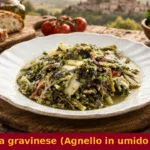
It was historically consumed during the hottest hours of summer, when labourers could not light a fire in the fields. Oven-roasted lamb with potatoes Lecce-style (PAT, also known as Auniceddhru allu furnu) is the celebratory dish: pieces of young lamb slow-cooked with potatoes, cherry tomatoes, onion and grated pecorino, until a golden crust forms and the meat falls off the bone. Lamb Gravina-style (PAT), a braised variant from nearby Gravina, involves cooking in a casserole with vegetables and cheese, and is frequently found on the menus of trattorias in Gioia del Colle as well.
The territory contributes to the wealth of products certified as PAT (Traditional Agri-Food Products) of Puglia. Africani (PAT) are typical sweets made from chocolate, almonds and sugar, with a rounded shape and dark colour — hence the name — widespread in the Murgia area during festive periods. Wild asparagus (PAT), gathered between March and May on the limestone terrain of the Murgia, is eaten in frittatas, preserved in oil, or used as a sauce for orecchiette.
Asparagus preserved in oil (PAT) is the conserved version, traditionally prepared in farmsteads to ensure availability throughout the year. Also worth mentioning is Anisetta (PAT), an anise-based liqueur widespread throughout Puglia as a digestif, served neat or with ice at the end of a meal.
The most significant food event is the festival dedicated to mozzarella di Gioia del Colle, a stretched-curd dairy product with a strong regional reputation. The cow’s milk comes largely from local farms, and artisanal production still takes place in numerous dairies in the town centre and its outlying districts. The dairy shops open to the public from early morning, and fresh mozzarella is sold still warm.
During summer, the city hosts food festivals and events dedicated to dairy products and traditional Murgia dishes, concentrated mainly between June and September. The weekly Wednesday market offers further opportunities to buy directly from producers.
On the wine front, Gioia del Colle lends its name to the Gioia del Colle DOC designation, established in 1987, which covers red, rosé, white and Primitivo wines. It is Primitivo — a red grape variety cultivated here for centuries — that is the defining wine of the territory: vinified as a varietal, it displays an intense ruby colour, aromas of ripe fruit and sweet spices, with a full body suited to pairing with the lamb and aged cheeses of the Murgia. Several local wineries offer guided tours and tastings, making the area a concrete destination for wine tourism in Puglia.
When to visit Gioia del Colle: the best time
Spring, from April to June, offers ideal conditions for exploring what to see in Gioia del Colle without the intense heat of the summer months.
During this period temperatures range between 14 and 25 degrees, the Murgia countryside is in full bloom, and on 26 May the feast of San Filippo Neri, patron saint of the city, is celebrated with a religious procession, illuminations and market stalls in the historic centre. The altitude of 362 metres ensures a cooler climate than the coastal plain, with pleasant evenings even in midsummer. On 16 August the second patronal feast is held, part of the calendar of summer celebrations that enliven the city throughout the month.
Autumn — particularly October and November — is the time of the grape harvest and olive picking, and the wineries of the Gioia del Colle DOC organise public tasting events. Winter on the Murgia can be harsh, with night-time temperatures close to zero and occasional snowfall, but it offers in return a quieter atmosphere and the chance to visit the castle and archaeological museum without crowds.
Those seeking a combination of mild weather, cultural events and seasonal produce will find the windows of May–June and September–October the most balanced compromise between accessibility and the liveliness of the local calendar.
How to reach Gioia del Colle
Gioia del Colle is connected to the motorway network via the Gioia del Colle exit on the SS100 state road (Bari–Taranto), linking it to Bari in approximately 40 minutes (45 km) and to Taranto in approximately 35 minutes (40 km). Alternatively, from the A14 Adriatica motorway you can reach Bari and then continue on the SS100 heading south. Those coming from Matera take the SS99 to join the SS100, with a travel time of approximately 50 minutes for 60 kilometres.
The Gioia del Colle railway station, on the Bari–Taranto line operated by Trenitalia, is served by regional trains running approximately every hour during peak times: the journey from Bari Centrale takes 35–40 minutes, from Taranto around 30 minutes. The nearest airport is Karol Wojtyła Bari-Palese, 55 kilometres away and reachable in 45–50 minutes by car. Regional bus services connect Gioia del Colle with the main towns of the Murgia and the coast, although frequency decreases on public holidays and during the winter months.
Other villages to discover in Puglia
Visitors to Gioia del Colle who wish to continue exploring inland Puglia can head north, into the province of Foggia, where the landscape changes dramatically.
Roseto Valfortore, in the Daunia Apennines, lies about 200 kilometres away and represents an example of a mountain village in Puglia, with its sandstone houses and tradition of woodcraft. The contrast with the limestone Murgia of Gioia del Colle is stark: you move from 362 metres of altitude to over 600 at Roseto, from expanses of vineyards to oak and beech forests of the Sub-Apennine range.
Along the same route, Casalnuovo Monterotaro sits on the northern Tavoliere plain, about 180 kilometres from Gioia del Colle, reachable in just over two hours by car. The village preserves a medieval urban layout with a mother church of Norman foundation, offering a privileged vantage point over the Foggia plain. An itinerary combining the Murgia around Bari with the villages of the Daunia Sub-Apennines allows you to cross at least three distinct Puglian landscapes — the limestone hills, the cereal-growing Tavoliere and the wooded Apennines — in a route that reveals the geographical and cultural variety of a region often perceived as uniform.
In Apulia More villages to discover
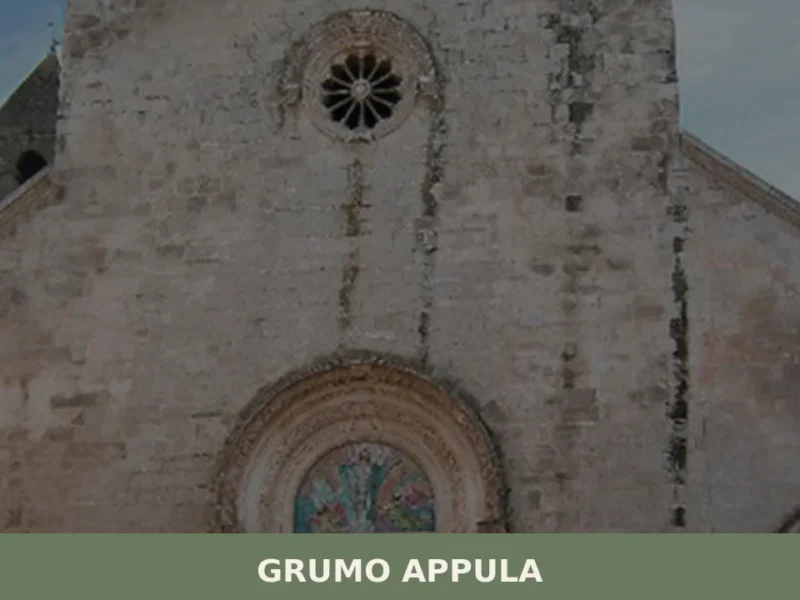
Grumo Appula
In the heart of the Murgia Barese, 181 meters above sea level, Grumo Appula was first mentioned in an official document from 1071, the Codice Diplomatico Barese, under the name “Grumum”. This historical fact introduces a plain village with a population of 12,899 inhabitants, where the layering of eras has left visible traces. For those […]
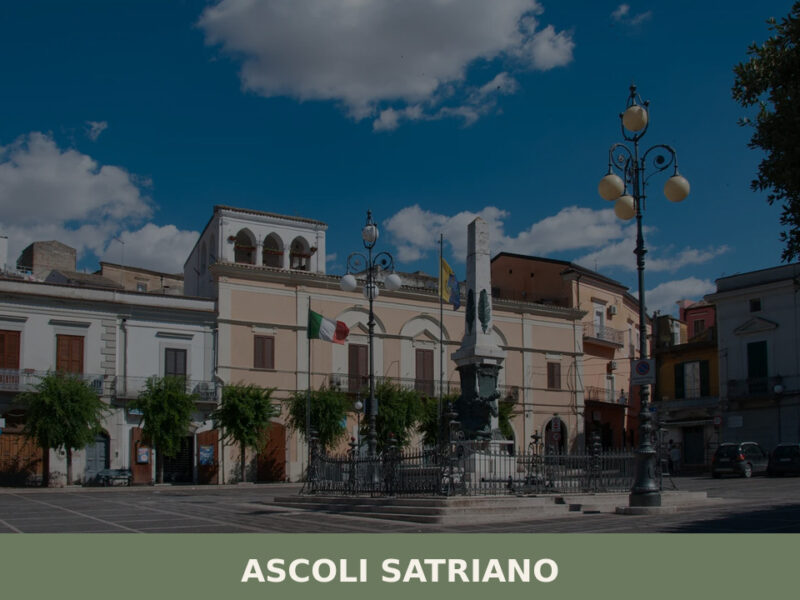
Ascoli Satriano
Discover Ascoli Satriano, an ancient hilltop village in Puglia's Daunia hills. From Roman bridges to Daunian treasures, here's your complete guide.
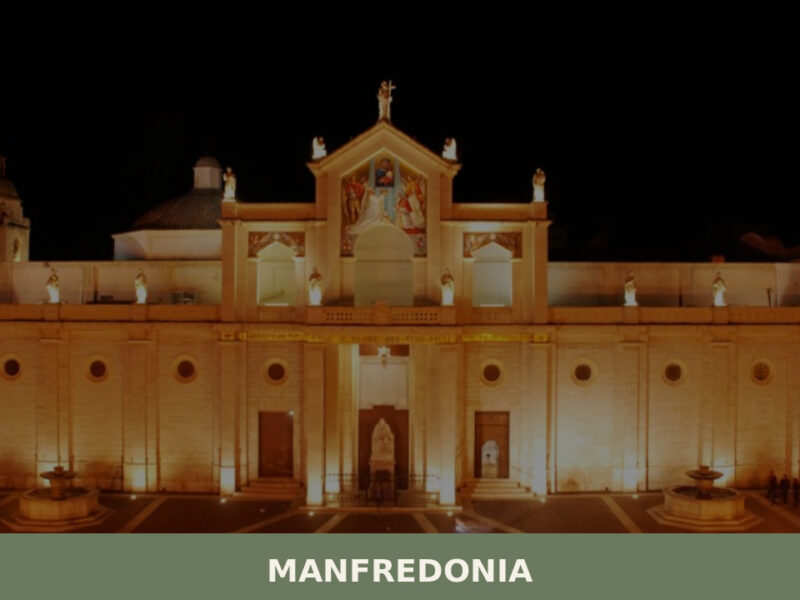
Manfredonia
A port city founded by King Manfred on the Gargano coast, Manfredonia holds a medieval castle, pre-Roman carved stele, and one of Puglia's oldest carnivals.
📝 Incorrect information or updates?
Help us keep the Gioia del Colle page accurate and up to date.