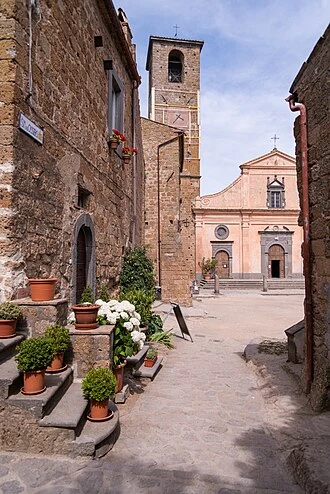
Perched on the edge of a volcanic tufa cliff that crumbles a little more with each passing year, the centro storico di Bagnoregio defies gravity, time, and the very logic of human settlement. This is not a village that chose a comfortable hillside or a sheltered valley — it chose the most precarious, wind-lashed ridge in the Lazio badlands, and it has clung there stubbornly for nearly three thousand years. Long before tourists began crossing its famous pedestrian footbridge, this ancient heart of Bagnoregio was already earning its tragic nickname: La Città che Muore — the Dying City.
The Centro Storico di Bagnoregio: A City Born from Etruscan Clay
The story of this extraordinary place begins not with medieval knights or Renaissance lords, but with the Etruscans, who recognized the defensive genius of this isolated tufa promontory as far back as the 9th century BCE. They carved their homes, tombs, and water cisterns directly into the soft volcanic rock — a material so workable with bronze tools that entire chambers could be hollowed out in days.
The settlement the Romans would later call Balneum Regis — the King’s Bath, a reference to the thermal springs that once bubbled in the surrounding valleys — grew into a significant town during the early medieval period. By the 6th century CE, it was prosperous enough to become a bishopric, drawing ecclesiastical authority and the construction of its first cathedral dedicated to San Donato.
The medieval street plan that visitors walk today follows a logic dictated entirely by the cliff edge: one long spine of road running northwest to southeast, flanked by narrow alleys dropping steeply toward the calanchi — those eerie, deeply eroded clay ravines that make the surrounding landscape look like a scene from another planet. Buildings were pressed so tightly together that neighbors could hand objects across the street through upper-floor windows without leaning very far at all.
The famous Italian-American writer Bonaventura Tecchi was born in Bagnoregio in 1896. His lyrical descriptions of the crumbling cliff city brought it to national literary attention decades before tourists discovered it. He called it “a city of silence and memory,” a phrase that still resonates with every visitor who crosses the bridge at dawn.
The Architecture of Survival: What the Historic Center Tells Us
Walking through the centro storico di Bagnoregio is an exercise in reading geological anxiety written in stone. Almost every building shows some evidence of repair, reinforcement, or partial reconstruction — because on this ridge, the ground itself is an unreliable partner.
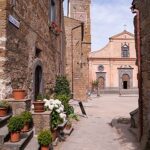
The most dramatic architectural moment is the Piazza San Donato, the small but perfectly proportioned central square that anchors the entire settlement. Here, the Cattedrale di San Donato presides with a Romanesque-Renaissance façade that was rebuilt after a catastrophic earthquake in 1695 destroyed much of the original structure. The bell tower, slightly tilted from centuries of ground subsidence, gives the square a quietly surreal quality — as if the whole city is slowly, gently bowing.
Flanking the cathedral are several noble palazzi whose ground floors have been repeatedly lowered as the surrounding terrain eroded away, leaving doorsteps that now open onto nothing but air on their outer edges. Structural iron ties — those long metal rods with decorative anchor plates visible on the exterior walls — are everywhere, holding the older masonry together like stitches in aging skin.
Among the most significant surviving medieval elements are:
- The Porta Santa Maria and Porta dei Morti, two original city gates with Etruscan-era stonework visible in their lower courses
- The Palazzo Alemanni, a Renaissance residence with intact carved stone window surrounds and a loggia overlooking the valley
- The underground Etruscan tunnels beneath the eastern quarter, some of which still connect private cellars
- The Chiesa di San Francesco, a compact Franciscan oratory that retains its medieval vaulted interior and several ex-votos dating to the 17th century
The Great Fracture: How Bagnoregio Lost Its Population
The decisive blow to the city’s viability came not in a single dramatic event but through a slow accumulation of disasters. Earthquakes in 1695 and again in 1764 caused enormous sections of the cliff to collapse into the valleys below, taking entire city blocks with them. What had once been a settlement of several thousand inhabitants shrank generation by generation as families relocated to the newer, safer town of Bagnoregio proper on the adjacent plateau.
By the early 20th century, the historic center was home to fewer than one hundred permanent residents. The footbridge — originally a dirt path across the saddle connecting the two plateaus, later formalized as a narrow pedestrian walkway — became the only access route after the last road crumbled away in the 1940s. Today, permanent residents number fewer than ten.
This dramatic depopulation, counterintuitively, preserved the medieval urban fabric almost perfectly. There was no money for modernization, no demand for parking garages or concrete apartment blocks. The buildings that survived the earthquakes simply remained as they were — and that freezing-in-time quality is precisely what makes the centro storico so extraordinary to visit today.
Access: The pedestrian footbridge is open year-round. Entry fee: €5 for adults, €3 for children (fees may vary seasonally — check the Comune di Bagnoregio official website for current information). Best time to visit: Early morning (before 9am) or late afternoon (after 5pm) to avoid crowds. Parking: Available at the visitor center in modern Bagnoregio, approximately 15 minutes’ walk from the bridge entrance.
Exploring the Surroundings: The Badlands Landscape and Nearby Villages
The cliffs that threaten to destroy Bagnoregio are also among the most visually spectacular landscapes in central Italy. The calanchi — deep gullies carved by centuries of rain into soft grey clay — create an almost lunar topography that glows silver in morning light and turns deep amber at sunset. Several marked trails wind through this protected area, offering viewpoints that photographers chase from across the world.
The broader Valle dei Calanchi connects Bagnoregio to a constellation of smaller medieval settlements that are equally fascinating but far less visited. Just a short drive away, the village of Villa San Giovanni in Tuscia preserves an intact medieval quarter with a remarkable Lombard-era church and a dramatically scenic position above the valley. Its pace is even slower than Bagnoregio’s — and its crowds are essentially nonexistent.
Further south, Bomarzo offers one of Italy’s most eccentric cultural experiences: the Parco dei Mostri, a 16th-century “garden of monsters” commissioned by the grieving Duke Orsini and filled with enormous stone sculptures of dragons, giants, and mythological creatures that emerge from the forest undergrowth. The combination of Bagnoregio’s geological drama and Bomarzo’s Renaissance surrealism makes for one of the most memorably strange day-trips in Lazio.
To the northwest, the village of Gradoli sits above Lake Bolsena — Italy’s largest volcanic lake — and offers a completely different historical atmosphere centered on the Palazzo Farnese, a Renaissance fortress-palace designed by Antonio da Sangallo the Younger. The lakeside views and local Aleatico di Gradoli wine make it an ideal complement to a Bagnoregio itinerary.
The Fight to Save It: Conservation, Tourism, and the Future
Bagnoregio’s candidacy for UNESCO World Heritage status — which has been under consideration for several years — reflects both the site’s extraordinary cultural value and the urgency of its preservation challenges. The tufa cliff continues to erode at an accelerating rate, partly due to climate change increasing the intensity of rainfall events that undermine the rock structure.
Italian and European engineering teams have spent decades devising interventions: rock bolting, drainage systems to redirect water away from vulnerable cliff faces, and the installation of protective netting over the most fragile sections. The FAI — Fondo Ambiente Italiano has been involved in advocacy and funding efforts to ensure that conservation resources reach this often-overlooked corner of Lazio.
Tourism itself has become a double-edged tool. The revenue from the bridge entry fee and visitor spending in the small cafés and craft shops of the historic center funds essential maintenance. But the sheer volume of visitors on peak summer weekends — the footbridge has recorded over 700,000 crossings per year in recent seasons — creates physical stress on the infrastructure and threatens the fragile quiet that is, paradoxically, Bagnoregio’s greatest attraction.
Local administrators have begun experimenting with timed entry slots and promotional campaigns aimed at distributing visitors more evenly across the calendar year, particularly encouraging visits in autumn and early spring when the calanchi landscape is at its most dramatically beautiful and the crowds are a fraction of peak season levels.
Frequently Asked Questions
How do you get to the historic center of Bagnoregio?
The only access to the medieval historic center is via the pedestrian footbridge, approximately 300 meters long, which departs from the visitor area near the modern town of Bagnoregio. The nearest train station is Orvieto, about 30 km away; from there, buses run to Bagnoregio town. By car, the town is easily reached via the SS71 road and is approximately 1.5 hours from Rome by car.
Is it worth paying the entry fee to cross the bridge?
Absolutely. The entry fee — currently around €5 for adults — is modest by any standard and contributes directly to the maintenance of the bridge and the historic buildings. The experience of walking through an almost entirely intact medieval settlement with views over the calanchi is genuinely unlike anything else in Italy.
Are there restaurants or places to eat in the historic center?
Yes — despite having fewer than ten permanent residents, the historic center has several small cafés and restaurants that operate seasonally, primarily spring through autumn. They typically serve local Viterbese cuisine: acquacotta, pasta with cinghiale (wild boar), and local cheeses. For a wider selection, the modern town of Bagnoregio has several well-regarded trattorie.
When is the best time to visit Bagnoregio?
Late September through November and March through May are the ideal months: the light is softer, the calanchi vegetation is either richly green or golden, and visitor numbers are dramatically lower than in July and August. Arriving before 9am on any day allows you to experience the historic center in near-complete silence — a quality that is becoming increasingly rare and precious.
There are places in Italy that are beautiful, and then there are places that feel like they exist at the intersection of beauty and time itself — where every stone carries the weight of centuries and every step forward feels like a step back into a world that has almost vanished. The centro storico di Bagnoregio belongs unmistakably to this second, rarer category. To walk its single ancient street, with the wind coming off the calanchi and the cathedral square lying hushed and golden ahead, is to feel something that no photograph has ever fully captured: the strange, bittersweet joy of being present in a place that has decided, against all odds, to keep existing. Plan your visit, cross the bridge, and let it surprise you.