Morning light catches the volcanic tufa in shades of ochre and rust, and the only sound rising from the gorge below is the intermittent call of a jay echoing off ancient rock. Barbarano Romano sits on a plateau in the province of Viterbo, a settlement of barely a thousand souls whose streets still follow the […]
Morning light catches the volcanic tufa in shades of ochre and rust, and the only sound rising from the gorge below is the intermittent call of a jay echoing off ancient rock. Barbarano Romano sits on a plateau in the province of Viterbo, a settlement of barely a thousand souls whose streets still follow the logic of medieval defence and Etruscan drainage. Knowing what to see in Barbarano Romano means looking both above and below ground — at churches built over cisterns, at forests hiding necropolises, at a landscape shaped by civilisations that precede Rome by centuries.
The origins of Barbarano Romano reach deep into the Etruscan period. The surrounding tufa plateau, carved by the Biedano river and its tributaries, provided natural fortification that attracted settlement long before Roman expansion. The nearby necropolis of San Giuliano, with its rock-cut tombs dating to the seventh and sixth centuries BCE, confirms that this area was part of the broader Etruscan cultural sphere, likely under the influence of the powerful city of Tarquinia. The name “Barbarano” is thought to derive from a Late Latin personal name or a reference to lands occupied during the early medieval migrations — the so-called “barbarian” settlements that followed the fall of the Western Roman Empire.
During the medieval period, Barbarano passed through the hands of various feudal lords and ecclesiastical authorities, a common trajectory for small centres in the Tuscia region. The Di Vico family, powerful prefects of Viterbo, exerted control over the area for much of the fourteenth and fifteenth centuries. When their influence waned, the Papal States absorbed the village into direct governance, a status it would retain, with interruptions, until Italian unification in 1861. The suffix “Romano” was appended in the modern era to distinguish it from other Italian settlements sharing the name.
What remains today is a compact historic centre where layers of construction — Etruscan foundations, medieval walls, Renaissance-era churches — coexist in a settlement that never grew large enough to erase its own past. With a current population of approximately 1,054, Barbarano Romano belongs to that category of Italian villages where demographic decline has, paradoxically, preserved the built environment with unusual completeness.
The most significant Etruscan burial site in the immediate area, San Giuliano features hundreds of rock-cut tombs spread across a tufa ravine. The Tomba della Regina, with its elaborate carved façade imitating domestic architecture, is among the most important examples of sixth-century BCE funerary design in central Italy. The site is accessible on foot through the Marturanum Regional Park and requires sturdy shoes and a willingness to navigate uneven terrain.
Established to protect both the archaeological heritage and the mixed oak-and-beech woodland that surrounds the village, the park covers roughly 1,240 hectares of ravines, plateaus, and watercourses. Trails follow the gorges carved by the Biedano river, passing Etruscan roads cut directly into the rock — wheel ruts still visible in the tufa surface. It is a landscape where natural history and human history are genuinely inseparable.
Located just outside the historic centre, this Romanesque church dates to the twelfth century and features a simple stone nave that has survived largely without Baroque alteration. The façade is plain, almost austere — an honest record of rural medieval construction in the Viterbo province. Fragments of early frescoes survive on interior walls, partially obscured by later plaster but visible in raking light.
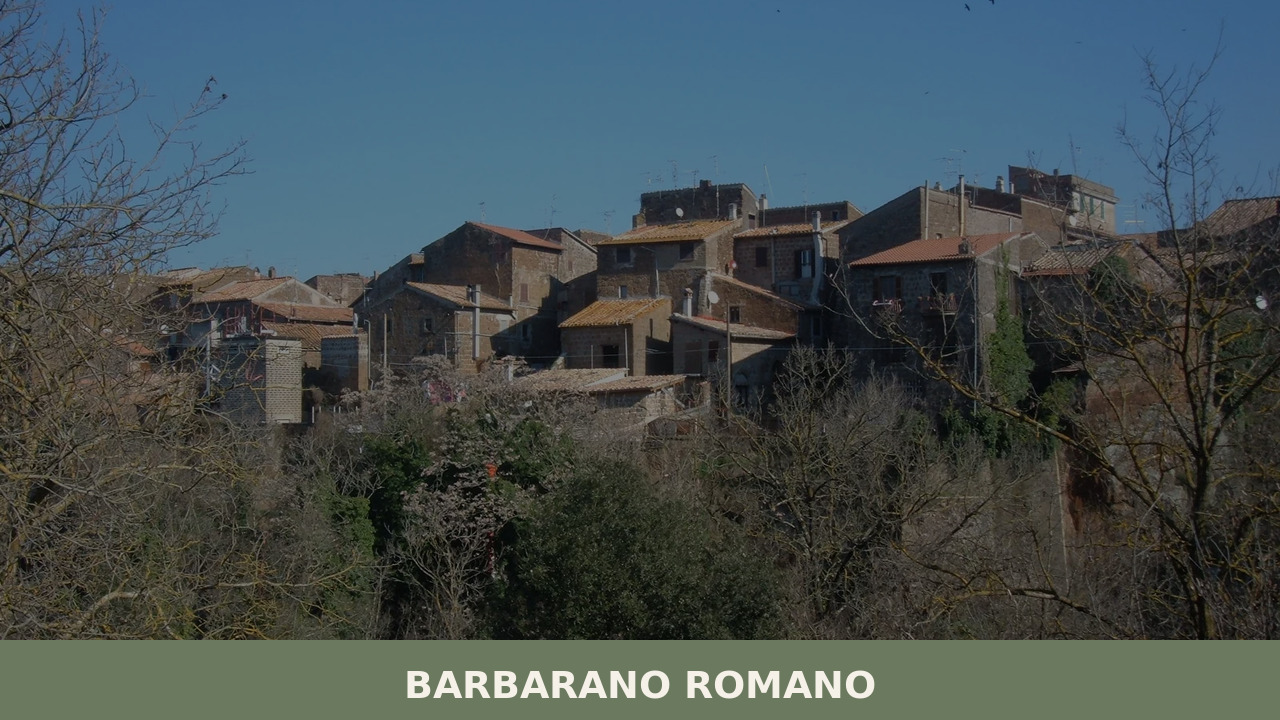
The old village itself rewards slow walking. Streets are narrow and often stepped, following the contour of the tufa ridge. Sections of medieval defensive walls remain intact, punctuated by arched gateways that once controlled access. Domestic architecture in the centre is predominantly built from local tufa blocks, giving the village a uniform warm-grey palette that shifts in colour with the time of day.
Surrounding Barbarano Romano, several deep passages have been carved directly through the tufa bedrock — corridors whose walls rise several metres overhead and whose original function remains debated. Some scholars interpret them as sacred processional routes linking settlements to necropolises; others suggest practical drainage or transport purposes. Walking through these shadowed cuts, with ferns growing from the damp walls, is one of the more striking experiences the area offers.
The cuisine here belongs firmly to the tradition of the Tuscia — robust, seasonal, and built around a limited number of high-quality ingredients. Olive oil produced from local Caninese and Leccino cultivars is the foundation of most cooking. Pasta dishes tend toward simplicity: pici or other hand-rolled formats dressed with wild boar ragù or with a sauce of foraged mushrooms gathered from the surrounding oak woodlands. Chestnuts appear in autumn preparations, and the local bread, baked in wood-fired ovens, has the dense crumb and thick crust typical of the region. Hazelnuts from the Cimini hills, a short distance east, also find their way into local pastries and confections.
Barbarano Romano is not a village with a long restaurant strip — dining options are limited and often informal. A handful of trattorie and agriturismi in the surrounding countryside serve meals that follow the rhythm of local production: artichokes and fava beans in spring, tomatoes and courgettes in summer, porcini and game in autumn. The wines of the broader Lazio wine region, particularly those from nearby appellations, accompany most meals — look for whites from the Tuscia area, often blends based on Trebbiano and Malvasia grapes.
Spring — specifically late April through June — offers the most comfortable conditions for exploring both the village and the surrounding park. Temperatures are moderate, wildflowers carpet the ravines, and the forest canopy has not yet grown dense enough to obscure the Etruscan tombs and carved roads. Autumn, from late September through November, brings a second ideal window: the oak and chestnut forests turn colour, the light takes on a particular golden clarity, and the village hosts seasonal food events tied to the olive and chestnut harvests.
Summer can be hot and dry, with temperatures in July and August regularly exceeding 30°C. The tufa ravines offer shade, but midday excursions to exposed archaeological sites become uncomfortable. Winter is quiet — some facilities may reduce hours — but the village has an austere beauty in low-angle December light, and the absence of other visitors means the necropolises can be experienced in near-total solitude. The Festa di San Pantaleo, the patron saint celebration, typically draws the village together in late July, offering a rare glimpse of communal life in a settlement this small.
Barbarano Romano lies in the province of Viterbo, approximately 70 kilometres northwest of Rome. By car, take the A1 motorway (Autostrada del Sole) toward Florence, exit at Magliano Sabina, and follow the SP Teverina and local roads westward — the journey from central Rome takes roughly one hour and fifteen minutes depending on traffic. Alternatively, the Via Cassia (SS2) provides a slower but more scenic route through the Tuscia countryside.
The nearest railway station with regular service is Barbarano Romano–Vejano, on the Rome–Capranica–Viterbo regional line operated by Trenitalia. Trains run from Roma Ostiense and Roma San Pietro stations, though frequency is limited — check timetables in advance and allow approximately 75 minutes for the journey. The nearest major airport is Rome Fiumicino (FCO), about 100 kilometres to the south. A rental car is strongly recommended for exploring the park and surrounding archaeological sites, as local public transport is minimal.
The territory around Barbarano Romano belongs to the Tuscia, a region dense with small settlements built on tufa outcrops, each with its own layered history. To the north, Blera shares the same volcanic geology and Etruscan heritage — its own rock-cut tombs and ancient bridge foundations make it a natural companion visit. The two villages are separated by less than ten kilometres of parkland and can be combined in a single day on foot or by car.
Further afield but still within easy reach, the village of Vejano sits along the same rail line and offers another perspective on life in the northern Lazio hill towns. Together, these settlements form a constellation of places where the relationship between landscape and human habitation has remained remarkably legible across millennia — a quality that larger, more visited towns in the region have long since lost.
📝 Incorrect information or updates?
Help us keep the Barbarano Romano page accurate and up to date.