The chiesa madre di San Giorgio Martire stands at the physical and ceremonial centre of Locorotondo, a whitewashed hill town in the Valle d’Itria whose circular street plan has been documented since the twelfth century. This article examines the church not as a monument frozen in amber but as a living institution — its architecture, its patron saint, its annual festa on 23 April, and the way it organises the daily life of roughly 14,258 residents. If you are planning a visit to Locorotondo, understanding this church means understanding the town itself.
Origins and construction: how the parish church took shape
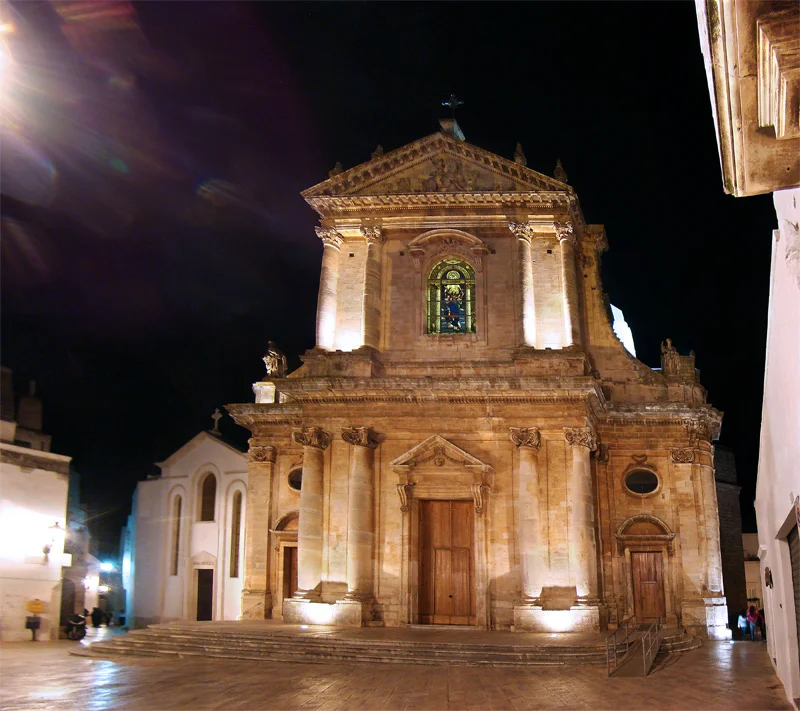
The earliest documented religious community in Locorotondo was Benedictine, active in the area from at least the tenth century. The monks were drawn to this elevated limestone ridge — sitting at 410 metres above sea level — for practical reasons: visibility, defensibility and the proximity of productive agricultural land already marked out with the dry-stone walls that still divide the Valle d’Itria below. Their presence established a liturgical geography for the settlement long before any formal parish structure existed.
The current chiesa madre di San Giorgio Martire was not, however, a medieval foundation. The building as it stands today belongs overwhelmingly to the eighteenth century, a period when Locorotondo was experiencing its most significant demographic and economic expansion. Viticulture and cereal farming were generating enough surplus income for the community to undertake ambitious sacred architecture, and the commission for a new, enlarged parish church reflected that confidence. Construction proceeded in phases across the 1700s, with the most substantial interventions concentrated in the second half of the century, a pattern common to many ecclesiastical building projects in the Kingdom of Naples, under whose administration Apulia then fell.
The choice of San Giorgio Martire as titular patron is itself historically revealing. George’s cult spread through southern Italy via Byzantine and later Norman channels; the Normans who passed through Apulia in the eleventh and twelfth centuries brought with them a particular devotion to the soldier-saint, associating his image with military protection over newly conquered territories. By the time the medieval nucleus of Locorotondo was consolidating around its castle — the fortified structure that gave the town its circular street plan — a dedication to Giorgio would have been entirely natural for the principal place of worship.
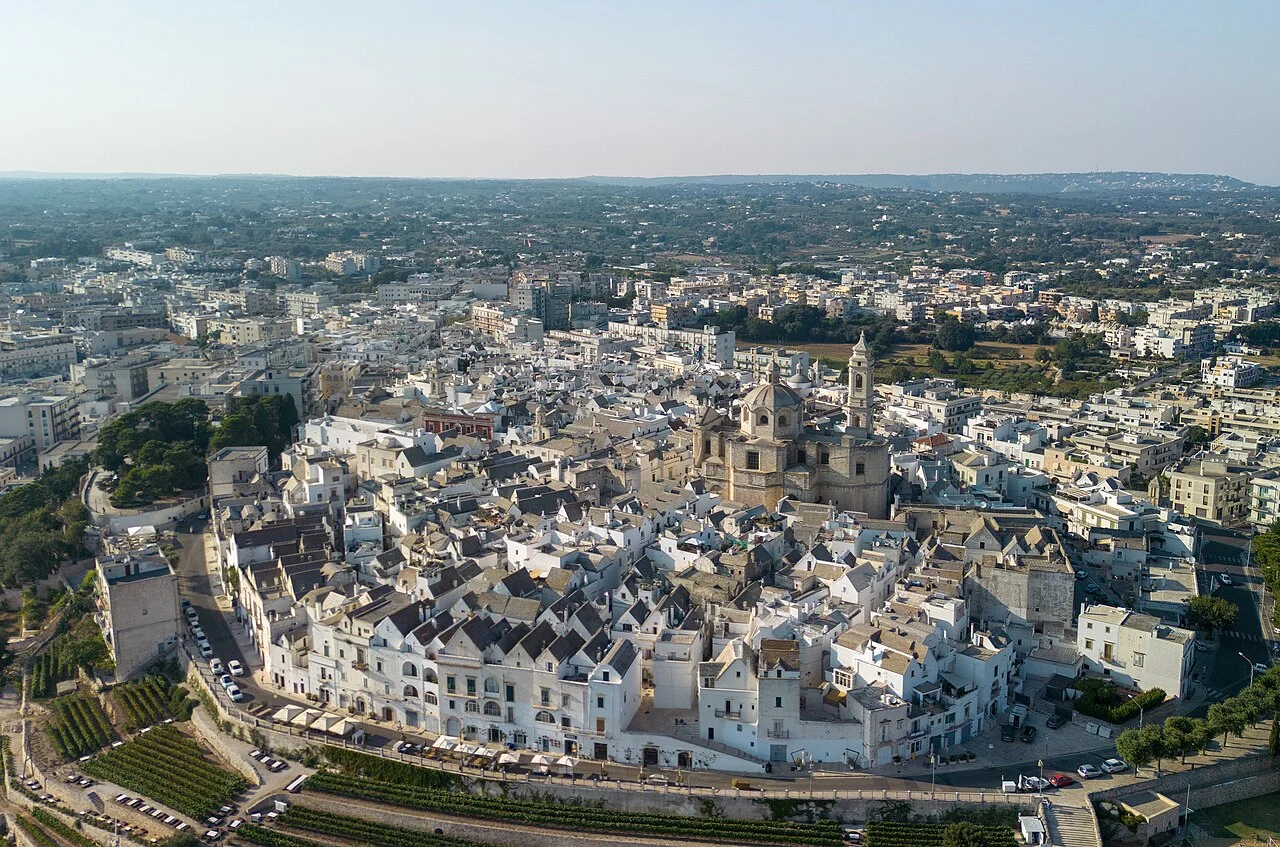
The site of the chiesa madre di San Giorgio occupies the highest point of the circular historic centre, a positioning that is urbanistically deliberate. In Apulian hill towns of the Norman and Swabian periods, the parish church and the civic castle frequently competed for, or shared, the dominant elevation. In Locorotondo’s case the church eventually took over that symbolic summit, and the town’s concentric streets radiate outward below it in a way that makes the bell tower visible from most angles of approach.
Architecture in detail: façade, nave and the Neapolitan influence
The façade of the chiesa madre di San Giorgio Martire is executed in the local golden limestone — the same pietra di Apricena-adjacent material that gives the entire historic centre its distinctive warm tonality when the afternoon sun hits it from the west. The composition is a restrained late Baroque exercise: a central portal framed by pilasters, a pediment carrying sculptural decoration, and a rose window or oculus above that draws filtered light into the interior. The overall effect is one of studied proportionality rather than theatrical exuberance — a provincial interpretation of the Neapolitan Baroque idiom that was filtering north through the Kingdom during the mid-eighteenth century.
Inside, the plan is a Latin cross with a single nave and lateral chapels — a configuration that was both liturgically orthodox and structurally practical given the constraints of the site. The chapels are of particular interest because they represent successive layers of patronage: wealthy farming families and confraternities each claimed a chapel as a form of social display and spiritual investment, furnishing them with altarpieces, votive lamps and marble decoration over several generations. Reading the chapels chronologically is effectively reading the social history of Locorotondo’s landowning class from the seventeenth century onward.
The ceiling decoration follows the tradition of illusionistic painting that was fashionable in southern Italian churches of the period. Quadratura-style architectural perspectives and figural scenes extend the perceived volume of the nave upward, a technique that arrived in Apulia primarily through Neapolitan workshops whose painters would travel on commission to provincial towns. The specific painters responsible for the decoration at Locorotondo’s chiesa madre are not universally documented in accessible public sources, which is precisely the kind of lacuna that local archival research — the parish records held in the diocesan archive at Conversano-Monopoli — could potentially resolve.
The bell tower, a campanile rising in stages with decorative corbelling and arched belfry openings, is visually the most recognisable element of the church when seen from outside the historic centre. Its profile appears in virtually every aerial photograph of Locorotondo, including the drone images that now circulate widely as the town’s primary visual identifier. The tower was completed, or substantially modified, in the nineteenth century, adding a layer of Romantic-era stonework over the earlier Baroque body.
The organ and its liturgical furniture
Southern Italian parish churches of the eighteenth century typically invested heavily in their pipe organs, which served both liturgical and social functions — an impressive instrument was a marker of a community’s ambition and resources. The chiesa madre di San Giorgio Martire possesses an historic organ whose precise construction date and builder attribution would require direct consultation with the Associazione Italiana Organisti or the relevant diocesan commission for sacred art, but its presence in the loft above the entrance is consistent with the church’s overall eighteenth-century programme of furnishing. The choir stalls, the pulpit and the main altar — likely in polychrome marble — complete a liturgical ensemble that rewards careful, slow examination rather than a quick walk-through.
San Giorgio Martire: the patron saint and his iconography inside the church
George of Lydda — San Giorgio Martire in the Italian tradition — was a Roman soldier executed for his Christian faith around 303 CE under the Emperor Diocletian, according to hagiographic sources compiled in the fourth and fifth centuries. The dragon episode, which became the saint’s definitive iconographic signature in western European art, was a later medieval addition to the legend, codified most influentially in Jacobus de Voragine’s Legenda Aurea of around 1260. By the time Apulian churches were commissioning their altarpieces in the seventeenth and eighteenth centuries, the dragon-slaying image was so thoroughly established that any depiction of Giorgio without it would have been considered incomplete.
Inside the chiesa madre di San Giorgio Martire, the titular saint appears in multiple registers. The main altarpiece — the central painting or sculptural group above the high altar — presents Giorgio in his military attributes: armour, lance, horse and, almost certainly, the prostrate dragon. The scale and positioning of this work is designed to be the visual terminus of the nave, drawing the eye of anyone entering through the main portal directly toward the patron’s image. Secondary representations of the saint appear in the lateral chapels and, crucially, in the processional statue used during the April festa.
The processional statue of San Giorgio is a distinct object from the altarpiece, specifically designed for outdoor display and public ceremony. These statues in Apulian devotional culture are typically figures of considerable technical accomplishment — carved in wood, polychromed, sometimes incorporating real fabric for drapery — and they are treated as objects of direct relationship between the community and the sacred. The statue of San Giorgio emerges from the church on 23 April each year; its annual journey through the streets of Locorotondo is, for many residents, the most significant religious event in the calendar.
It is worth noting the distinction between the cult of San Giorgio and the separate, older cult of the Madonna della Greca, whose church — the oldest in Locorotondo, established between the seventh and eighth centuries and reconstructed in the fifteenth — represents a different devotional strand entirely. The Madonna della Greca church predates the current chiesa madre di San Giorgio by several centuries and carries the Byzantine devotional legacy of the area, while the parish church of Giorgio reflects the later Norman and subsequent Catholic reform traditions. The two cults coexist but occupy distinct liturgical and social roles in the community.
The festa of 23 April: ritual, procession and the role of the church square
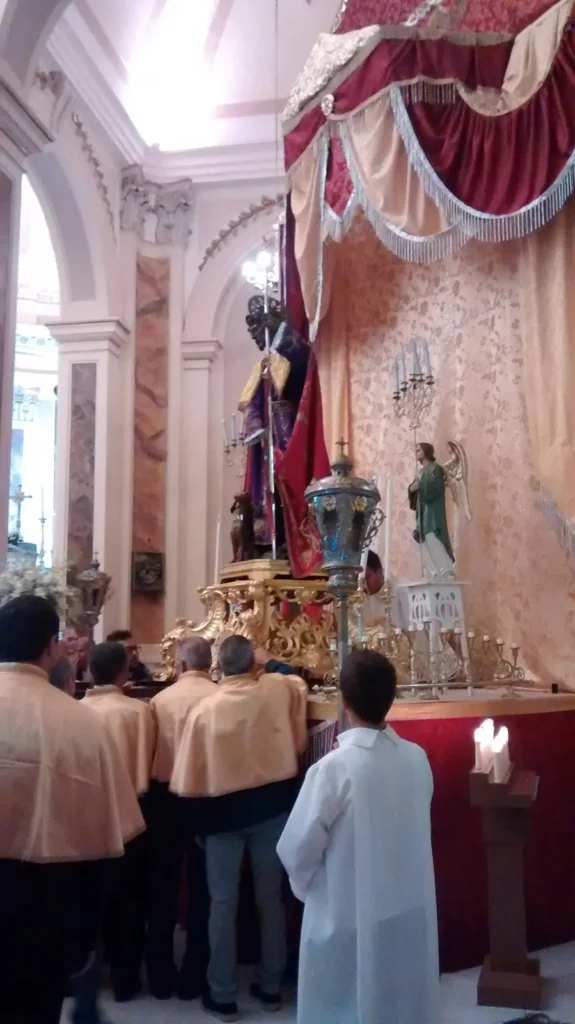
The feast day of San Giorgio Martire falls on 23 April in the Roman Catholic liturgical calendar, a date that in Locorotondo triggers one of the more elaborate local celebrations in the Valle d’Itria. The festa is not a generic southern Italian sagra with food stalls grafted onto a religious occasion; it is a structured liturgical and civic event with specific ritual sequences that the community has maintained and modified over generations.
The day begins with a solemn Mass inside the chiesa madre di San Giorgio Martire, celebrated with full musical accompaniment. The interior of the church, which on ordinary days receives a modest flow of visitors and daily worshippers, is filled to capacity on 23 April, with residents standing in the side aisles and gathering in the doorway. This compression of the community into the physical space of the church is itself a form of collective ritual, a literal enactment of the parish as a body.
The procession that follows takes the statue of the patron saint through the concentric streets of the historic centre and down into the newer parts of town. The route is not arbitrary: it follows a logic of territorial consecration, with the statue passing the principal civic buildings, the older palazzi and the boundaries of the original medieval settlement. Brass bands — the bande musicali that are fundamental to southern Italian festa culture — accompany the procession, and the specific pieces played have in many cases been associated with particular feast days for over a century.
The statue of San Rocco, documented in Wikimedia photographic sources as being enthroned during a Locorotondo festa, provides a useful comparative reference. San Rocco’s celebration follows a similar processional logic, and the visual language of intronizzazione — the formal enthronement of a saint’s statue on a raised platform before the procession begins — is shared between the two. For San Giorgio, the intronizzazione takes place on the square in front of the chiesa madre di San Giorgio Martire, making that space the ceremonial hinge between the interior sacred space and the outdoor civic one.
Fireworks in the evening close the official programme of 23 April. In the Valle d’Itria, pyrotechnic displays are commissioned from specialist firms — often family businesses operating from towns like Rutigliano or Grumo Appula — and their quality is treated as a direct reflection of the community’s investment in its patron. The spatial arrangement of the fireworks, typically launched from a point outside the historic centre to avoid fire risk to the limestone buildings, means that the best viewing position is often from the church square itself, looking outward over the illuminated countryside below.
The chiesa madre di Locorotondo within its ecclesiastical context
Locorotondo falls within the Diocese of Conversano-Monopoli, one of the smaller dioceses of the Puglia ecclesiastical province, which is suffragant to the Archdiocese of Bari-Bitonto. This administrative structure matters for understanding the chiesa madre di San Giorgio Martire because decisions about its maintenance, liturgical programme and potential heritage designation pass through the diocesan curia at Conversano, not through the municipal administration in Locorotondo itself.
The parish of San Giorgio is the dominant ecclesiastical unit in the town, but it is not the only one. The Church of Madonna della Greca, as noted, represents an independent and older devotional strand. There are also smaller votive chapels and oratories scattered through the historic centre and the surrounding countryside — the typical capillary religious infrastructure of a southern Italian agricultural community — each associated with specific confraternities or family lineages. The chiesa madre di San Giorgio sits at the top of this hierarchy both physically and institutionally.
The confraternities (confraternite) associated with the chiesa madre di San Giorgio Martire are lay religious organisations that have historically managed specific devotional practices, charitable functions and processional responsibilities. In Locorotondo, as in most Apulian towns of comparable size, these bodies have varied in vitality over time — suppressed during the Napoleonic period, revived in the nineteenth century, diminished again in the mid-twentieth century and, in some cases, experiencing renewed interest among younger residents in recent decades. Their registers and archives, held partly in the church sacristy and partly in the diocesan archive, constitute an underexplored source for the social history of the town.
The relationship between the chiesa madre di San Giorgio and the civic administration of Locorotondo has evolved considerably since Italian unification in the 1860s. The formal separation of church and state under the Savoy monarchy changed the legal basis of the church’s property holdings and its relationship to municipal public space, including the piazza in front of the building. Today the municipality of Locorotondo — now under a new administration following the June 2026 elections that brought the Smaltino government to power — and the parish cooperate on the management of the feast day and on heritage protection questions without the church having any formal civic authority.
The church’s position in regional sacred architecture
The chiesa madre di San Giorgio Martire is one of dozens of parish churches in the Valle d’Itria that were substantially rebuilt or enlarged during the eighteenth-century economic upswing. Comparable examples in the immediate area include the parish churches of Alberobello, Martina Franca and Cisternino — each reflecting the same general programme of Neapolitan Baroque influence mediated through local workshops and materials. What distinguishes Locorotondo’s chiesa madre di San Giorgio from these regional parallels is partly its elevated site — no other main church in the valley sits so dramatically at the apex of its town’s circular plan — and partly the specific quality of the local limestone, which takes carved detail with particular sharpness and weathers to a colour that shifts from pale gold in summer light to near-white after winter rain.
Visiting today: hours, access and what to look for inside
The chiesa madre di San Giorgio Martire is open for visitors outside Mass times, though the hours are not standardised in the way that a museum’s would be. The practical reality for visitors to Locorotondo is that the church is most reliably accessible in the morning between roughly 8:30 and 12:00 and in the late afternoon between 16:30 and 19:00, following the pattern of southern Italian parish life. Masses on weekdays typically fall at 8:00 or 9:00 in the morning and at 18:00 or 19:00 in the evening; on Sundays there are multiple morning Masses and the evening celebration is more formal. Checking with the parish notice board at the entrance, or with the sacristan, is the only reliable way to confirm current schedules.
Dress code expectations at the chiesa madre di San Giorgio Martire follow standard Italian Catholic conventions: shoulders and knees covered. This is not merely a tourist instruction; it reflects the fact that the church is in active liturgical use, and residents attending daily Mass will notice and, depending on the individual, may comment on visitors who arrive inappropriately dressed. Carrying a lightweight scarf or overshirt is the simplest solution for summer visitors arriving directly from the beach towns of the Adriatic coast, roughly 30 kilometres to the east.
Once inside, the aspects of the interior that reward the most attention are as follows:
- The main altarpiece: the quality of the central painting or sculptural group dedicated to San Giorgio is the artistic centrepiece of the interior, and it should be examined for both iconographic detail — the specific treatment of the dragon, the armour’s period attribution, the landscape background — and technical execution.
- The lateral chapels: each chapel tells a different story about the families and confraternities that funded it. Look for heraldic details, inscriptions with dates, and the range of altarpiece styles, which will span at minimum two centuries of local patronage.
- The ceiling decoration: illusionistic Baroque ceiling painting requires standing still in the nave and looking directly upward — a posture that most rushed visitors skip. Give it at least three minutes of sustained attention.
- The organ loft: visible from below near the entrance, the organ case is typically carved and painted and represents a significant investment of the eighteenth-century parish.
- The sacristy: if accessible, the sacristy of a southern Italian chiesa madre often contains vestments, silver processional objects and ex-voto plaques that are more revealing of local devotional history than the main altar.
Photography inside the church is generally tolerated for non-flash personal use, but checking with whoever is present — a sacristan, a volunteer guide, a nun — before raising a camera is straightforward courtesy. During Mass, photography is obviously inappropriate.
The square in front of the chiesa madre di San Giorgio Martire is worth time in itself. The elevated position offers a view over the surrounding Valle d’Itria that encompasses both the landscape of trulli and vineyard and the immediate fabric of the whitewashed historic centre. Mornings, when the light falls from the east and the stone is still cool, are the best time to observe the façade; late afternoons, when the western light warms the limestone, are better for understanding the colour relationships between the church and its urban setting.
FAQ: questions tourists actually ask about the church
Is the chiesa madre di San Giorgio Martire the oldest church in Locorotondo?
No. The oldest church in Locorotondo is the Church of Madonna della Greca, which was first established between the seventh and eighth centuries and substantially reconstructed in the fifteenth century. The current building of the chiesa madre di San Giorgio Martire dates primarily from the eighteenth century, making it considerably more recent in its present form, though the parish itself has much earlier origins linked to the Norman period.
Can I attend Mass at the chiesa madre di San Giorgio Martire as a visitor?
Yes, and many visitors do. Sunday morning Mass in particular provides an opportunity to observe the church in full liturgical use, with the local community present and the full complement of music and ceremony. If you attend, sit quietly, follow the congregation’s movements without necessarily participating in the Eucharist if you are not Catholic, and plan to stay for the full duration of approximately 45 to 60 minutes.
When is the best time to visit if I want to see the chiesa madre di San Giorgio in its full ceremonial context?
23 April, the feast day of San Giorgio Martire, is the obvious answer. The combination of the solemn Mass, the procession through the historic centre, the brass band accompaniment and the evening fireworks provides a concentrated experience of how the chiesa madre di San Giorgio functions as the organisational centre of the community’s religious and social life. Be aware that accommodation in Locorotondo and the surrounding Valle d’Itria fills up for this date; booking several weeks in advance is advisable.
Is there an entrance fee to visit the chiesa madre di San Giorgio Martire?
No entrance fee is charged for visiting the church. A voluntary contribution to the parish — using the donation box near the entrance — is conventional and appreciated. If you are requesting a guided visit or access to normally restricted areas such as the sacristy, a more specific conversation with the parish staff about any contribution expected is worth having directly.
How do I get to the chiesa madre di San Giorgio Martire from the train station?
Locorotondo is served by the Ferrovie del Sud-Est regional rail line, which connects the Valle d’Itria towns between Bari and Taranto. The station sits below the historic centre, and the walk uphill to the chiesa madre di San Giorgio takes approximately 10 to 15 minutes on foot, following the main road into the old town and then ascending through the concentric streets toward the highest point. The bell tower is visible as a navigational reference from most points along the approach. There is no regular shuttle service between the station and the historic centre, so plan for the walk or arrange a taxi in advance.
Does the chiesa madre di San Giorgio Martire have any connection to the Trulli di Alberobello UNESCO site?
No direct institutional connection, though the geographic and cultural context is shared. Alberobello, whose trulli district received UNESCO World Heritage designation in 1996, is approximately 15 kilometres north of Locorotondo. The chiesa madre di San Giorgio Martire is an Apulian Baroque parish church operating within the same Valle d’Itria cultural landscape, but it is a distinct heritage category — sacred architecture of the eighteenth century rather than vernacular rural building — and falls under different heritage protection frameworks managed by the Diocese of Conversano-Monopoli and the Ministero della Cultura’s Apulia regional office.
Are there guided tours of the chiesa madre di San Giorgio Martire?
Formal guided tours are not offered on a regular timetable in the way that a major urban cathedral might organise them. Local guides registered with the Puglia regional professional association (guide turistiche abilitate) can arrange visits with specialist commentary, and booking through a local tourism office or accommodation provider in Locorotondo is the most practical route. The Proloco association, which organises local cultural activities in many Apulian towns, occasionally provides volunteer-guided church visits during the summer months and around the April festa; enquiring locally on arrival is worth the effort.
What other churches are worth visiting near the chiesa madre di Locorotondo?
Within the historic centre of Locorotondo itself, the Church of Madonna della Greca is the essential complement — its Byzantine foundation and fifteenth-century reconstruction represent a completely different architectural and devotional register from the Baroque chiesa madre di San Giorgio. In the wider Valle d’Itria, the collegiate church of San Martino in Martina Franca, rebuilt in the late seventeenth and eighteenth centuries in a more elaborate Baroque register, provides a useful regional comparison point. Cisternino’s parish church and the various masseria chapels scattered through the olive and vineyard landscape complete a picture of how sacred architecture was distributed across an agricultural territory that had no dominant urban centre but many competing local communities, each investing in its own place of worship as a form of collective identity.