


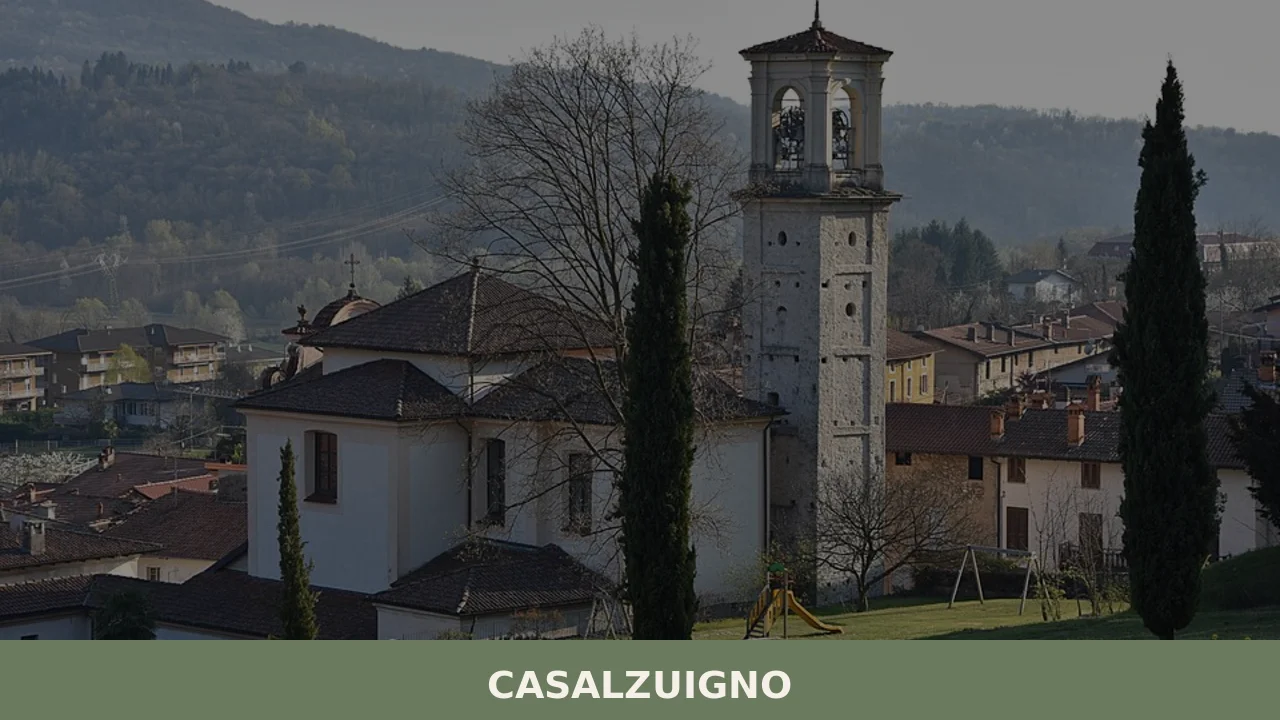
Casalzuigno
Cosa vedere a Casalzuigno: borgo a 350m nel Varesotto con Villa della Porta Bozzolo (FAI), chiesa di San Vittore e Parco Campo dei Fiori. Guida completa.
Discover Casalzuigno
In 1645, the nobleman Marquard Rudolf von Rodt, Bishop of Constance, travelled through the Varese area, leaving behind documentary evidence that attests to the vitality of the small hilltop centres along the eastern slope of Campo dei Fiori. Casalzuigno, located at an altitude of 350 metres in the province of Varese, was already a well-structured settlement back then, featuring a church dedicated to its patron saint and a network of noble villas that distinguished it from the surrounding agricultural villages.
Today, with its 1,321 inhabitants, the village preserves that historical stratification in a clearly legible way: visiting it means encountering 17th and 18th-century architecture in a hilly setting overlooking Lake Varese. Understanding what to see in Casalzuigno requires a slow approach, focusing on the details.
- History and Origins of Casalzuigno
- What to See in Casalzuigno: 5 Must-See Attractions
- What to Eat in Casalzuigno: Local Cuisine and Regional Products
- When to Visit Casalzuigno: The Best Time
- How to Get to Casalzuigno
- Other Villages to Discover in Lombardy
IN THIS ARTICLE
History and Origins of Casalzuigno
The name “Casalzuigno” likely derives from two distinct elements: casale, a medieval Latin term indicating a rural settlement dependent on a larger centre, and a second element—perhaps a Germanic personal name like Wiching or Wizo—which entered the local lexicon during the Lombard and Frankish rules that affected the entire Varese region between the 6th and 9th centuries. This onomastic structure is common in Lombardy for centres established as appendages to agricultural estates belonging to aristocratic families.
The municipality is part of the Valli del Verbano mountain community, and its hilly position, close to the Campo dei Fiori massif, has influenced both its settlement history and traditional economic activities. During the Middle Ages, the territory was part of the domains of the Archbishopric of Milan, which exercised detailed control over these hills through parishes (pievi) and curtes. The pieve of Cuvio, the religious and administrative hub for the area, held jurisdiction over several hilltop settlements, including Casalzuigno.
Between the 17th and 18th centuries, Casalzuigno experienced its period of greatest architectural splendour, as noble families from Milan and Varese chose these hills to build their holiday villas. The proximity to Varese and accessibility from the routes connecting the capital to Lake Maggiore made the site attractive to the wealthy classes. Like much of the Varese province, the village was affected by troop movements during the wars of the 17th and 18th centuries, particularly during the War of the Spanish Succession (1701–1714).
What to See in Casalzuigno: 5 Must-See Attractions
1. Villa della Porta Bozzolo
Villa della Porta Bozzolo is the most significant monument in the village, now owned by the FAI (Fondo Ambiente Italiano). Built in the 17th century and expanded during the 18th century by the Della Porta family, the villa features a spectacular layout with sloping terraces, fountains, and a formal Italian garden—among the best-preserved in the pre-alpine Lombardy region. The interior houses frescoes, period furnishings, and a private chapel. The FAI has restored the complex with philological care, making it a masterpiece of 18th-century noble life.
2. Church of San Vittore il Moro
Dedicated to the village’s patron saint, San Vittore il Moro, the parish church of Casalzuigno is the religious heart of the community. The building features a Baroque structure, with subsequent modifications layering interventions from the 17th to the 19th centuries. The interior features side altars in stucco and paintings of the Lombard school. The patronal feast on May 8th is a moment of collective celebration involving the entire village, with a traditional procession through the streets of the historic centre.
3. The Historic Core and Town Alleys
The urban fabric of Casalzuigno preserves the characteristics of pre-alpine hilltop villages: semi-enclosed courtyards, local granite portals, and external stone staircases connecting the floors of rural homes. The historic centre is structured around a system of pedestrian paths that climb the terrain using typical Lombard vernacular building solutions. Walking through these alleys allows one to observe how rural and noble architecture have coexisted for centuries.
4. Campo dei Fiori Regional Park
Casalzuigno is a gateway to the Campo dei Fiori Regional Park, a protected area established by the Lombardy Region that includes the namesake massif, with its main peak at 1,226 metres. The park offers an extensive trail network for hikers of all levels. From the village level, trails lead into chestnut and beech forests, with panoramic viewpoints over Lake Varese and, on clear days, the entire Alpine arc.
5. Panorama of Lake Varese and the Pre-Alps
At an altitude of 350 metres, Casalzuigno offers exceptional observation points: to the west, the basin of Lake Varese opens up, while to the north, the pre-alpine foothills stand out with Lake Maggiore as a backdrop on clear days. These views can be reached from both the villa grounds and the surrounding green pedestrian paths. For photographers, the afternoon light on the Varese hills creates layers of depth extending towards the Alps.
What to Eat in Casalzuigno: Local Cuisine and Regional Products
The cuisine of the Varese area, of which Casalzuigno expresses a hilltop variation, was formed through centuries of a mixed economy: subsistence farming, small animal husbandry, woodland foraging, and integration with the lakeside market. At the heart of the Varese table is polenta, made with coarse cornmeal, cooked for a long time in a copper pot, and served with stewed meats—typically beef or game—or local semi-hard cheeses.
Another representative dish is risotto with luganega, where the rice is creamed with fresh pork sausage flavoured with spices according to local recipes. In autumn, porcini mushrooms gathered in the Campo dei Fiori woods feature in both risottos and soups. Regarding certified products, the area falls within the production zone for Grana Padano DOP. The patronal feast of San Vittore on May 8th remains the most significant culinary moment in the local calendar.
When to Visit Casalzuigno: The Best Time
Spring—from April to June—is the most balanced period to visit Casalzuigno. The vegetation is in full cycle, and the patronal feast of San Vittore on May 8th offers a glimpse into authentic village life. May is also when Villa della Porta Bozzolo reopens for the season with its gardens in full bloom. Autumn, between September and November, is equally interesting as the chestnut forests turn red and gold, and local mushrooms appear in the kitchens.
How to Get to Casalzuigno
By car, the most direct route from Milan is the A8 motorway (Milano-Varese), exiting at Varese Nord, then following provincial roads towards Cuvio and Casalzuigno (approx. 25 minutes from Varese). From Lugano (Switzerland), the village is reachable in about 40 minutes. Public transport requires a combination of train to Varese station (Trenord from Milan) and a local bus towards Cuvio/Valle della Boesio, though a car remains the most practical choice for visitors.
Other Villages to Discover in Lombardy
The surrounding territory offers several complementary villages. Barasso, a few kilometres away, shares a hilltop noble vocation but offers a different perspective on the lake. Arsago Seprio, in the lower Varese province, is essential for Early Medieval history with its Romanesque basilica. Expanding further, Brenta is another interesting pre-alpine village, while Brescia offers a large-scale monumental system, from Roman ruins to a medieval castle, perfect for completing a tour of stratified Lombardy.
Sources: Casalzuigno on Wikipedia — Official Site of the Municipality — Italian Touring Club


📝 Incorrect information or updates?
Help us keep the Casalzuigno page accurate and up to date.