


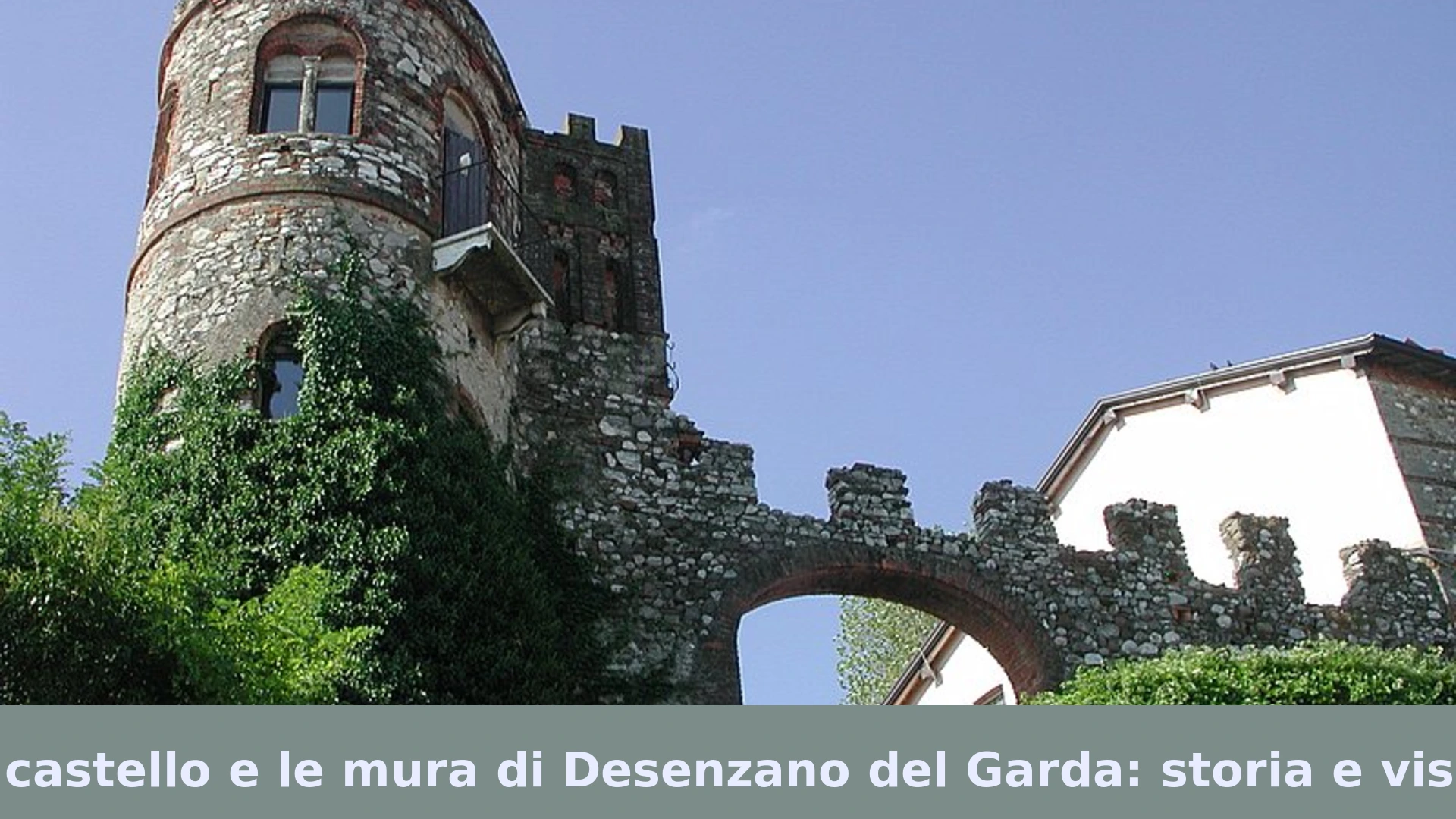
The castello di Desenzano del Garda, one of the most representative fortifications on the Brescia side of Lake Garda, boasts a history rooted in Roman times. Its first defensive structures were built on a pre-existing Roman castrum, as attested by recent archaeological studies.
Historical documents mention its existence as early as the 11th century, highlighting its crucial role in controlling the territory.
This fortified complex, which has undergone several transformations over the centuries, today offers a tangible testament to the region’s medieval military architecture, inviting visitors on a journey through its walls and interior spaces.
The History of Desenzano Castle: From Origins to Military Decline
The genesis of Desenzano Castle dates back to a period of great instability for northern Italy, between the 10th and 11th centuries, when barbarian incursions and defensive needs prompted the construction of fortified shelters.
Its strategic position, on a small hill dominating the village and the lake, made it a fundamental observation and defense point. The first fortifications, probably made of wood and earth, were soon replaced by stone structures, better able to withstand assaults and offer protection to the local population.
During the 14th century, the castle underwent a period of significant expansion and strengthening, particularly under the rule of the Della Scala family of Verona and subsequently the Visconti of Milan. During these lordships, the structure was enlarged with new curtain walls and towers, taking on much of the appearance we see today.
It was conceived not only as a military stronghold but also as a refuge for the inhabitants of the village in case of danger, encompassing a true village within its walls.
For further historical details, you can consult the entry dedicated to the Castello di Desenzano on Wikipedia.
With the advent of the Republic of Venice in the 15th century and the evolution of warfare techniques, which saw the increasingly massive use of artillery, the castle gradually lost its primary military function.
Its walls, though imposing, were no longer able to resist the new armaments. Thus, in subsequent centuries, the fortress was converted into barracks, then partially decommissioned, and finally abandoned, undergoing a slow degradation that compromised some parts, although the main structure has remained largely intact.
Architecture and Structure of the Castle: The Walls and Towers
The Castello di Desenzano del Garda presents itself as an irregular quadrilateral structure, with a perimeter wall extending for approximately 300 meters. Its walls, built with local stone, are characterized by considerable height and thickness, attesting to the defensive importance of the complex. The curtain wall is interspersed with four corner towers, three of which are still well-preserved and one, the southeastern one, partially collapsed over time.
These square-plan towers were key elements for surveillance and perimeter defense of the castle, offering privileged observation points over the lake and the hinterland.
The main access to the castle is through an imposing portal located on the north side.
Originally, this entrance was protected by a drawbridge, of which the housings can still be observed today.
A keep, or donjon, stood at the center of the fortress, serving as the last defensive bastion and residence for the castellan. Within the walls, the area was once densely populated, with dwellings, workshops, and a church, forming a true fortified village that developed around a central square. Although much of these internal constructions no longer exist today, the empty space allows one to imagine the life that took place within these walls.
The construction techniques employed reflect medieval military engineering, with the use of squared stones and robust mortar. The Ghibelline swallowtail battlements that crown the walls and towers are a distinctive element of Scaliger and Visconti architecture, indicating the periods of greater splendor and redevelopment of the castle.
A sentry path runs along much of the curtain wall, offering visitors the opportunity to admire the fortifications from an elevated perspective and enjoy panoramic views of the surrounding landscape.
What to see and do inside the Castello di Desenzano
Once past the ancient portal, visitors find themselves immersed in a large internal courtyard that encloses the remains of the ancient dwellings and structures that made up the fortified village.
The visitor’s route allows for the exploration of various points of interest. One can ascend along the ramparts, an experience that offers a unique perspective on the walls and towers.
From here, the view opens up to Lake Garda, the historic center of Desenzano, and the surrounding morainic hills, making the climb particularly rewarding.
Inside the keep, the tallest and central tower, temporary exhibitions or displays are often set up, narrating the history of the castle and the surrounding territory.
These cultural initiatives enrich the experience, providing context and insights into archaeological finds or historical periods that shaped the fortress. Throughout the year, the castle also hosts cultural events, concerts, theatrical performances, and historical reenactments, transforming into a lively hub for the community and tourists.
Although the internal structures are no longer as intact as they once were, the atmosphere among the ancient stones invites contemplation and reflection on the long history of the place.
Visitors can wander freely in the courtyard, imagining daily life as it unfolded here centuries ago, or pause to admire the architectural details of the surviving walls and towers.
The castle is an ideal place for those seeking a blend of history, culture, and landscape, offering opportunities for photographs and moments of relaxation in an evocative setting.
How to visit the Castello di Desenzano: opening hours and practical tips
The Castello di Desenzano del Garda is open to the public and is an easily accessible destination for those visiting the area.
If you arrive by car, paid parking is available near Desenzano’s historic center, from which the castle is reachable with a short uphill walk. The climb, while not particularly strenuous, requires comfortable shoes. For detailed information on opening hours and ticket prices, it is advisable to consult the official website of the Municipality of Desenzano del Garda or the local tourist office, such as the Visit Desenzano portal.
Opening hours may vary depending on the season, with extended hours during summer months and reduced hours during off-peak periods.
It is always prudent to check updated opening hours before your visit. Admission to the castle is paid, with differentiated rates for adults, children, and groups. Reductions are often available for certain categories of visitors.
A complete visit, including the ascent to the ramparts and exploring the courtyard, generally takes from 45 minutes to an hour and a half, depending on individual interest.
Here are some practical tips for your visit:
- When to go: Spring and autumn offer mild temperatures and fewer crowds, making the visit more pleasant.
Summer is also a good time, but it’s preferable to go early in the morning or late in the afternoon to avoid the hottest hours.
- Accessibility: Access to the ramparts and some internal areas might present difficulties for people with reduced mobility or for strollers, due to stairs and uneven paths.
The internal courtyard is more easily accessible.
- Services: In the immediate vicinity of the castle and in the center of Desenzano, numerous services are available, including eateries, shops, and public restrooms.
For optimal planning, it is suggested to consider the following indicative table for your visit:
| Period | Indicative Opening Hours | Ticket Price (adults) |
|---|---|---|
| April – September | 10:00 – 18:00 | € 5.00 – € 7.00 |
| October – March | 10:00 – 16:00 (closed Mondays) | € 3.00 – € 5.00 |
Please note that the data in the table is indicative and should be verified on official channels before your visit.
The Castle of Desenzano today: events and redevelopment
After decades of abandonment, the Castle of Desenzano del Garda has undergone significant restoration and redevelopment interventions in recent years.
These works have allowed for the consolidation of structures, made visiting routes safe, and enhanced the historical-architectural heritage of the complex.
The objective was to transform the ancient fortress from a mere ruin into an active cultural center, capable of attracting visitors and hosting various types of events.
Today, the castle is not only a historical monument to admire but also a vibrant place that hosts cultural, artistic, and recreational events.
Classical and modern music concerts, open-air theater festivals, contemporary art exhibitions, and artisan markets are just some of the activities that enliven its walls, especially during the warmer months. These initiatives help keep interest in the castle alive and fully integrate it into Desenzano’s cultural life.
The redevelopment also included the creation of permanent exhibition spaces inside the main tower, where informative panels and artifacts illustrate the site’s history, from the Roman period to the present day.
The commitment of local administrations and cultural associations has allowed for the return of a valuable asset to the community and tourists, transforming a symbol of the past into a driver of cultural and tourist development for the city and the entire Garda area.
Frequently Asked Questions about the Castle of Desenzano
Is it possible to access the Castle with strollers or wheelchairs?
Access to the castle’s inner courtyard is generally possible for strollers and wheelchairs.
However, the ascent to the patrol walkway and some exhibition areas inside the towers involves stairs and paths that are not fully accessible, therefore complete access to all areas may be limited for people with reduced mobility.
How much time is recommended for visiting the Castle?
For a complete visit to the Castle of Desenzano, including ascending to the patrol walkway and a thorough observation of the spaces, it is recommended to dedicate a period of time between 45 minutes and an hour and a half.
This allows you to enjoy the panorama and delve into the history of the place without rushing.
Does the Castle host special events during the year?
Yes, the Castle of Desenzano del Garda is an active venue that regularly hosts cultural events, concerts, art exhibitions, and historical reenactments, especially during the spring and summer months.
It is advisable to consult the events calendar on the website of the Municipality of Desenzano or the tourist office to find out about planned events during your visit.
If you wish to further explore the beauties and history of Desenzano del Garda, beyond its imposing castle, we invite you to consult the complete village profile.
You will find additional information on other attractions, itineraries, and tips for making the most of your experience in this Lake Garda location, by visiting Desenzano del Garda.