


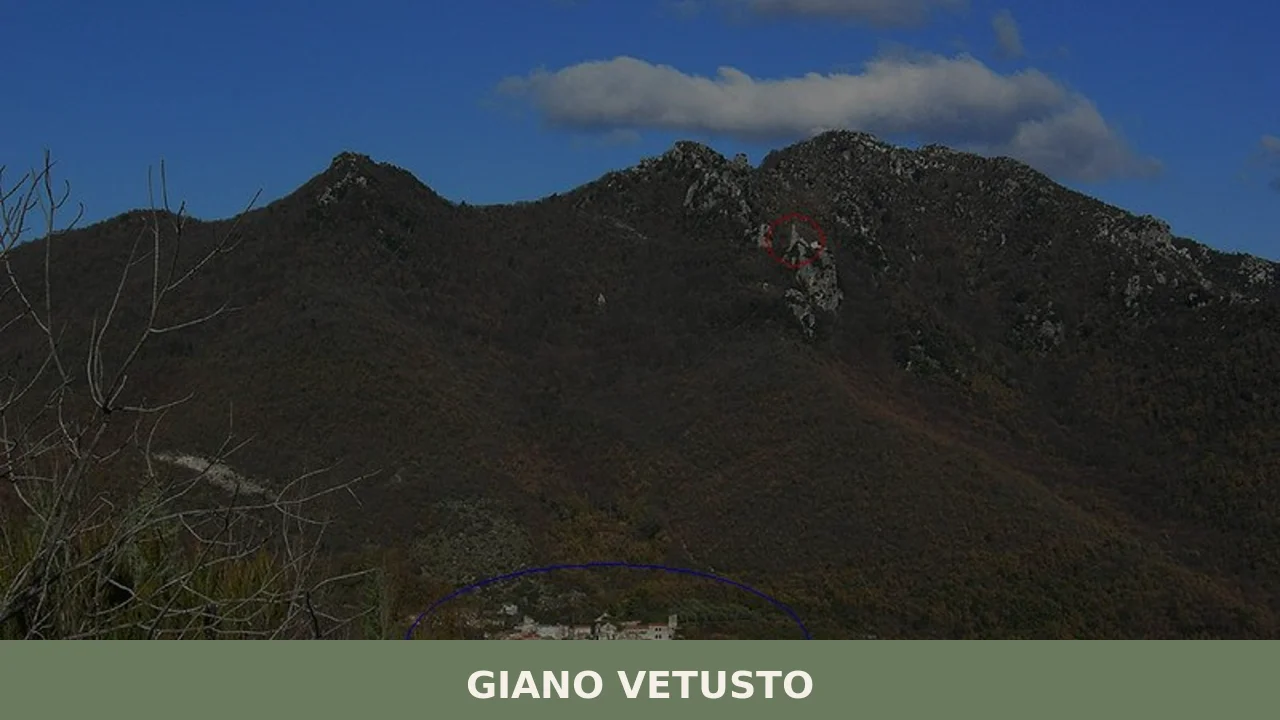
Giano Vetusto
What to see in Giano Vetusto: Church of Sant’Antonio, historic centre, agricultural landscape, local cuisine and how to reach this hillside village near Caserta.
Discover Giano Vetusto
Six hundred and thirty-eight registered inhabitants, a handful of houses arranged along a limestone ridge at 225 metres above sea level, and a place name that carries the weight of antiquity in its very syllables: this is how Giano Vetusto presents itself, without pretence, to anyone driving up the provincial road from Pignataro Maggiore towards Monte Maggiore. The first building you encounter is the parish church, its façade facing south-west over the Volturno plain. From there, a single sweeping glance takes in the Lattari mountains, Vesuvius, and the foothills of the Matese. Understanding what to see in Giano Vetusto means accepting a different scale: here every detail matters, because the village hides nothing behind its small dimensions but compresses centuries of layered history into a few blocks.
History and origins of Giano Vetusto
The place name has been debated across at least three centuries of local historiography. The most widespread theory traces it back to the Roman god Janus, the two-faced deity associated with passages and doorways: the position of the settlement, located on a natural pass between the Campanian plain and the inland valleys of the Caserta area, makes the existence of a small shrine or rest stop dedicated to this deity along a pre-Roman route entirely plausible. The adjective “Vetusto” (meaning ancient) appears in later documents, probably to distinguish the original nucleus from any settlements sharing the same name or from newly expanded areas. The Royal Decree of 1863, which required Italian municipalities to differentiate duplicate names, formalised the current denomination, but the attribute was already in use in Bourbon-era land registers of the eighteenth century, confirming a long-standing local awareness of the site’s antiquity.
During the medieval period, the territory of Giano fell within the orbit of the County of Calvi, a suffragan diocese of the Archdiocese of Capua. The Lombard presence in the area is documented by a network of watchtowers and fortified hamlets that dotted the hills between the Volturno and Monte Maggiore from the ninth to the eleventh century. Giano appeared as a dependent hamlet, a small rural settlement tied to the Norman-Swabian feudal system that reorganised northern Campania after the conquest by Robert Guiscard. In 1269, with the arrival of the Angevins, the fiefs in the area passed through various noble families — including the Marzano and later the Carafa — who administered its agricultural revenues until the abolition of feudalism decreed by Joseph Bonaparte in 1806. The territory’s cereal and wine-growing vocation remained constant through all these changes of ownership, with wheat and wine as the twin pillars of the local economy.
The modern era brought Giano Vetusto a gradual demographic decline, a fate shared by many hilltop centres in the Caserta area. The 1742 onciario land register already recorded a small population devoted almost entirely to agriculture. During the nineteenth century, the village was caught up in the political upheavals of southern Italy: post-unification brigandage reached these hills too, with episodes documented in the provincial archives of Caserta. The twentieth century brought two waves of emigration — the first towards the Americas in the opening decades, the second towards the industrial triangle of the North in the 1950s and 1960s — which drastically reduced the resident population. Today, the 638 inhabitants sustain a community structure that revolves around the parish, the town hall, and the seasonal agricultural cycle, with an economy in which olive growing and small-scale fruit farming coexist with commuting to Capua and Caserta.
What to see in Giano Vetusto: 5 key attractions
1. Church of Sant’Antonio da Padova
Dedicated to the patron saint of the village, Saint Anthony of Padua, this parish church is the focal point of religious and civic life in Giano Vetusto. The building, in its current form, dates from eighteenth-century interventions on an earlier structure. The single-nave interior houses a polychrome marble high altar and several wooden processional statues used during the patron saint’s feast on the penultimate Sunday of August. The simple, plastered façade overlooks a churchyard that also serves as a natural viewing terrace over the plain below. The church is generally open during mass times and on feast days; for visits at other times, enquiries can be made at the parish office.
2. Historic centre and medieval urban fabric
The old nucleus of Giano Vetusto preserves a street layout that reflects the settlement logic of medieval Campanian hamlets: a main axis following the ridge, with short, steep side lanes descending towards the agricultural terraces. The oldest houses, built from local grey tuff and limestone, feature depressed-arch doorways and piperno stone frames, materials that suggest a dating between the seventeenth and eighteenth centuries. A number of minor noble townhouses, recognisable by their larger dimensions and wrought-iron balconies, punctuate the main street. A complete walk through the centre takes about twenty minutes, but the density of architectural detail rewards close attention.
3. Viewpoint over Monte Maggiore and the Volturno plain
From the upper part of the village, at a small open area before the road continues towards the countryside, a panoramic vantage point opens up that, on clear days, allows you to make out the profile of Vesuvius to the south-east and the peaks of the Trebulani Mountains to the north. Monte Maggiore, at 1,037 metres, dominates the northern horizon and also serves as a reference point for hiking along trails that depart from neighbouring municipalities. The viewpoint has no tourist infrastructure, but it is precisely this absence of intervention that preserves its visual quality. It is reachable on foot from the centre in a few minutes and is particularly effective in the early afternoon hours, when the raking light defines the contours of the landscape with precision.
4. Rural chapels and votive shrines
Scattered across the municipal territory, several rural chapels mark the boundaries of old landed estates and rest stops along agricultural paths. These structures, often reduced to a single room with a small altar and a votive fresco, document the popular religiosity that has pervaded the area from the seventeenth century onwards. Votive shrines — masonry niches containing sacred images in ceramic or tempera — are still visible at crossroads along the farm tracks. No precise inventory has been published, but a walk along the roads connecting Giano Vetusto to its rural hamlets will turn up at least half a dozen, some recently restored with municipal funds.
5. Hillside agricultural landscape
The territory of Giano Vetusto offers a well-preserved example of the hillside agricultural landscape of northern Caserta. Olive groves, some with trees over a hundred years old of the Caiazzana and Ortice varieties, alternate with small vineyards and orchards. The dry-stone terraces, still functional, shape the south-facing slopes and bear witness to an organisation of agricultural space that predates mechanisation. Walking the farm tracks that branch out from the built-up centre is like reading a manual of agrarian history at 1:1 scale. In spring, the blossoming of fruit trees — cherry, peach, almond — transforms the hillsides into a palette of whites and pinks that lasts only a few days and rewards those who choose the right moment.
Local cuisine and regional products
The cooking of Giano Vetusto belongs to the hillside Caserta tradition, built on a peasant larder where pulses, cereals, and olive oil take first place. The most representative dish of the winter repertoire is minestra maritata, a stew that combines various cuts of pork — rind, spare ribs, sausages — with a mix of leafy greens such as escarole, chicory, savoy cabbage, and borage. The preparation demands several hours of slow cooking, and the result is a dense dish in which the rich broth binds very different flavours together. Equally widespread are lagane e fagioli, broad durum-wheat pasta cooked together with cannellini beans in a base of garlic, olive oil, and dried chilli — a format found throughout the upper Caserta area with minimal variations from one village to the next.
Among the territory’s products, the extra-virgin olive oil obtained from native cultivars stands out, particularly the Ortice variety, listed in the regional register of Campania’s genetic resources. Conciato Romano, a hard cheese aged in terracotta amphorae with aromatic herbs and vinegar, is a Slow Food Presidium whose historical production area includes the zone around Castel di Sasso and neighbouring municipalities in the Caserta area, a territory with which Giano Vetusto shares similar dairy-making traditions. Also common is the processing of table olives using the local method of prolonged soaking in water and salt, and the production of San Marzano tomato preserves, grown in the lower irrigated plots of the municipal territory. Wood-fired soft-wheat bread baked in family ovens remains an everyday staple even today.
The patron saint’s feast of Saint Anthony of Padua, celebrated on the penultimate Sunday of August, is also the main gastronomic occasion of the year: food stalls and temporary kitchens serve fried peppers and aubergines, grilled sausages, and desserts based on ricotta and cooked wheat such as the Caserta version of pastiera, more rustic and less heavily spiced than its Neapolitan counterpart. The production of nocillo — a liqueur made by macerating walnuts traditionally gathered on 24 June, the feast of Saint John — is a domestic practice common to nearly every household in the village, with recipes that vary in proportions and infusion times from one family to the next.
When to visit Giano Vetusto: the best time of year
The penultimate Sunday of August, on the occasion of the feast of Saint Anthony of Padua, is the moment when the village reaches its highest social density: procession, illuminations, fireworks, and food stalls draw back emigrants and residents of neighbouring municipalities. Those looking for a quieter experience can aim for spring, between April and May, when hillside temperatures range from 15 to 22 degrees and the countryside is at the peak of its growing cycle. Autumn — October and November — coincides with the olive harvest and the late grape picking, and offers the chance to observe agricultural work in action. During these months the light is particularly favourable for landscape photography, with misty dawns dissolving into clear mornings.
Winter is the quietest season: temperatures drop to 3–4 degrees on January nights, but snowfall is rare at this altitude. It is the time of the heartiest cooking — soups, pulses, pork — and of the domestic activities tied to preserving and processing produce. For those who want to visit Giano Vetusto with the certainty of finding active services and an animated village, the advice is to focus on the period from May to September. For those who prefer silence and the industrious solitude of the countryside, any month of the year works, provided you bear in mind that there are no accommodation facilities in the municipality and that the nearest logistical support is found in Pignataro Maggiore or the towns on the plain.
How to reach Giano Vetusto
Giano Vetusto is reached by car via the A1 Milan–Naples motorway, exiting at the Capua toll station, from where you continue towards Pignataro Maggiore along the SP 330 and then turn towards the hills following the municipal signs: the drive from the motorway exit to the village takes about 20 minutes over a distance of 15 kilometres. Those coming from Naples can also use the Santa Maria Capua Vetere exit, with a route of similar length. The nearest railway station is Pignataro Maggiore–Calvi Risorta, on the Rome–Cassino–Naples line, served by regional trains: from there you need your own transport or a taxi to cover the final 6 uphill kilometres.
The reference airport is Naples Capodichino, approximately 55 kilometres away and reachable in 50–60 minutes by car via the A1 heading south. From Rome Fiumicino the distance is around 200 kilometres, with a travel time of two and a half hours under normal traffic conditions. Bus connections are limited and run at reduced frequency — the service is operated by CTP and local operators — so a car remains the most practical option. Parking in the village presents no difficulty: the main square and adjacent areas offer enough free spaces even on feast days.
Other villages to discover in Campania
Visitors to Giano Vetusto find themselves in a strategic position for exploring a network of small Campanian centres that share the same hillside and agro-pastoral character. To the north, heading up towards the Matese along the Volturno valley, you reach Capriati a Volturno, a village that commands a stretch of the river where the waters slow into a series of deep bends: here the landscape shifts from cultivated hill to wooded mountain in just a few kilometres, and the cooking reflects this transition with dishes that combine lowland and highland ingredients. The distance from Giano Vetusto is around 45 kilometres, covered in under an hour, and the two localities can be combined in a day devoted to the inland Caserta area.
In the opposite direction, towards the plain, Caianello is worth a stop — known above all as a motorway junction but possessing a historic centre that few people pause to explore. Caianello retains traces of a Samnite settlement and offers a starting point for excursions towards the southern slopes of the Trebulani Mountains. A two- or three-day itinerary linking Giano Vetusto, Caianello, and Capriati a Volturno allows you to traverse three distinct altitude bands — plain, hill, and mountain — and to observe how the same Campanian cultural matrix expresses itself in distinct variants depending on elevation and aspect. It is a route that requires a car, a good map, and no hurry at all.
In Campania More villages to discover
Castel Campagnano
Standing at fifty-eight metres above sea level along the left bank of the Volturno, Castel Campagnano has a current population of 1,458, spread between the historic centre and the hamlets scattered across the alluvial plain. The municipality, in the province of Caserta, retains an urban layout that still follows the plan of the fortified medieval […]
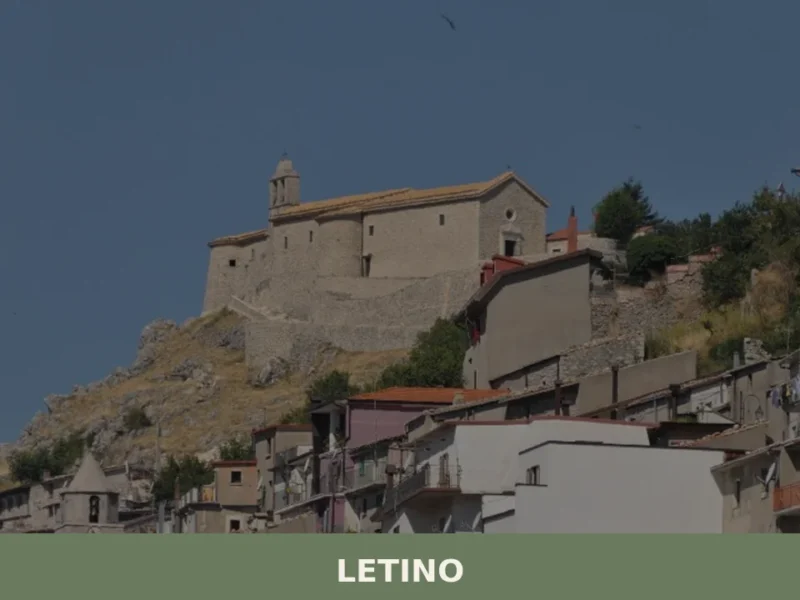
Letino
Explore Letino, a hidden gem village in Campania, Italy. Discover its rich history, stunning mountain scenery, local traditions, and authentic Italian charm.
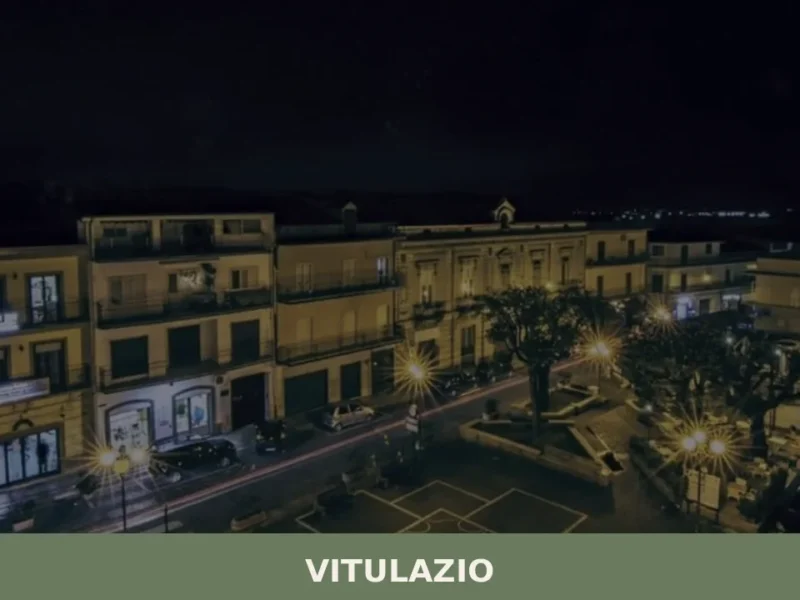
Vitulazio
What to see in Vitulazio: 7,646 residents, 57m above sea level in Caserta province. Visit the Agnena Sanctuary, historic centre and taste PAT products like 'Ndunderi. Plan your trip.



📝 Incorrect information or updates?
Help us keep the Giano Vetusto page accurate and up to date.