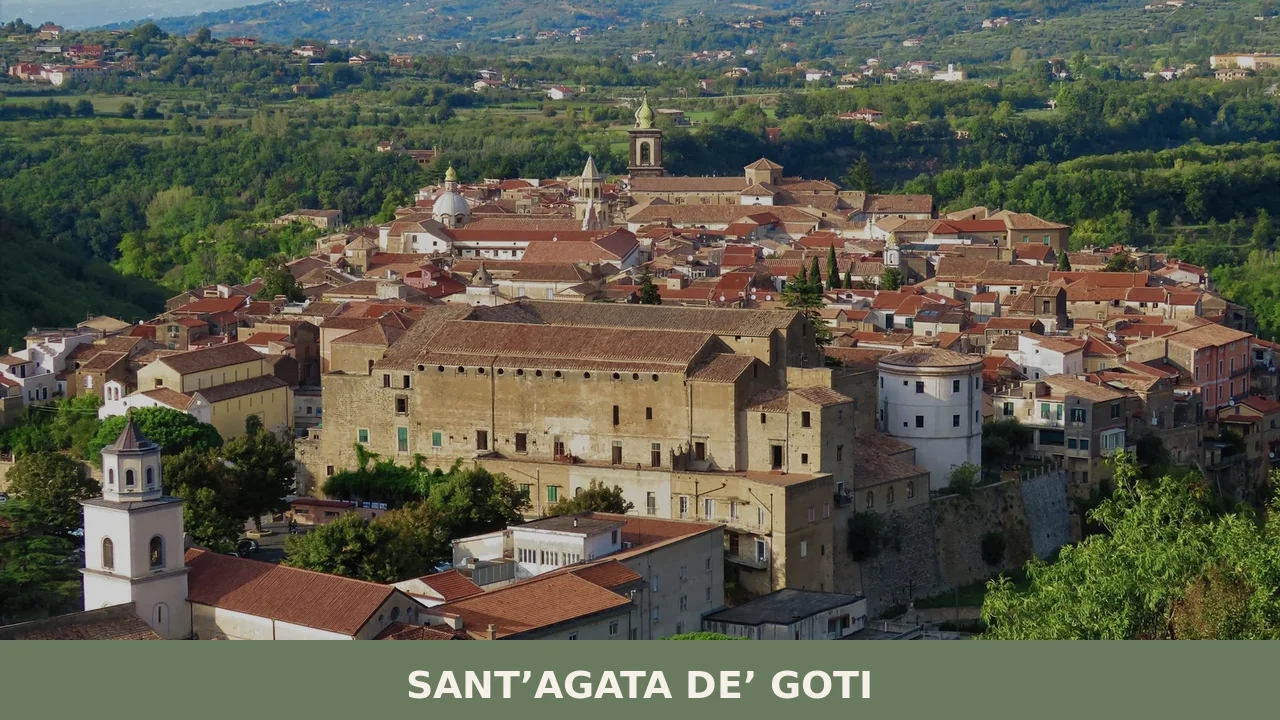

Stone walls rise above the Caudine plain, their ochre surfaces catching afternoon light as you approach from the western slopes of Monte Taburno. The old town occupies a natural ridge, its geometry dictated not by Renaissance planning but by the bedrock itself—a defensive choice made centuries ago. From certain points in the surrounding countryside, the mass of the settlement appears almost monolithic, a fortress of daily life rather than a military installation.
Sant’Agata de’ Goti village stands in the province of Benevento, Campania, at 159 metres above sea level, with a population of approximately 10,096 inhabitants. The community draws its identity from devotion to Sant’Agata, the patron saint honoured each year on 5 February, and from centuries of engagement with the agricultural rhythms of the interior—orchards, vineyards, grain and livestock that still define the local economy and food culture.
Origins and Territory
The settlement’s name carries the saint’s identity at its core, yet the origins of human habitation on this ridge predate the medieval period. The location itself—elevated, defensible, with natural water sources—attracted occupation long before any documented urban form took shape.
The village belongs administratively to Benevento Province and sits within the broader agricultural zone of inland Campania. This interior region, far from the coastal kingdoms and duchies that dominated southern Italian medieval politics, developed its own patterns of settlement and governance. Sant’Agata de’ Goti’s relationship to this hinterland has been one of agricultural production and religious observance rather than dynastic power or military prominence.
The devotion to Sant’Agata, celebrated on the feast day that marks the deep winter of the Christian calendar, anchors the village’s ritual calendar and provides a recurring moment of collective identity that has persisted across centuries of demographic and economic change.
The Fabric of the Medieval and Modern Village
Walking through Sant’Agata de’ Goti village reveals a compact urban structure typical of southern Italian hill settlements. Narrow streets follow the contours of the terrain, creating a network of passages and small squares rather than any geometric plan. Stone buildings, many with arched ground-floor openings that once served as workshops or storage spaces, line these ways. The upper storeys, reached by steep interior stairs, housed families whose occupations tied them to the land, local trade or craft work.
The parish church, dedicated to the patron saint, stands as the focal point of religious and social life. Its position, typically elevated and accessible from the main piazza, reinforced the centrality of faith in village organization. The church architecture reflects periods of renovation and embellishment across centuries—a gradual accumulation of baroque details, votive offerings and furnishings that mark the community’s piety and economic capacity at different moments.
The settlement’s compactness sheltered its inhabitants through centuries of brigandage, feudal instability and economic hardship. The vertical organization of space—stacked dwellings, shared walls, internal courtyards—served practical needs of defence and thermal efficiency in a climate marked by hot summers and cool winters. This architecture persists today, though many buildings have been restored or modified to accommodate modern living while retaining their exterior character.
Places Within the Village
The Church of Sant’Agata
The parish church occupies the highest point of the old town, a position that emphasizes its role as spiritual and social centre. The building has been enlarged and redecorated across successive periods, with baroque elements added to older structural foundations. Inside, the devotional focus remains the saint herself, invoked on her feast day and throughout the year by the faithful. The church serves both as a place of daily prayer and as the stage for the annual celebration that brings the scattered diaspora of the village’s children and grandchildren back to their native community.
The Piazza and Public Life
The main square functions as the village’s meeting place and market ground, where residents encounter one another and where seasonal fairs and celebrations take place. The space is bounded by buildings of mixed ages, some with noble facades dating to the 18th or 19th centuries, others more modest. Here the rhythm of agricultural life—the seasonal arrival of produce, the gathering of families—manifests visibly. The piazza remains the point from which visitors and residents orient themselves within the settlement’s steep geography.
Medieval Street Network and Gates
The narrow lanes that connect the piazza to the outer edges of the settlement preserve the logic of medieval town planning. Several of the original gates that controlled entry to the village remain visible, though stripped of their defensive function centuries ago. The streets rise and fall sharply, following natural contours, and often narrow to passages barely wide enough for two people to pass. These routes once defined the rhythm of daily economic life—connecting homes to the fields, the mill, the market and the church.
Agricultural Heritage and Local Flavours
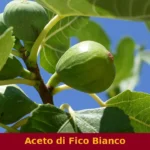
Sant’Agata de’ Goti village lies in a region renowned for distinctive agricultural production. The province of Benevento benefits from particular soil and climate conditions that have yielded recognized quality products for centuries. Among the protected products of the surrounding region are Caciocavallo di Castelfranco, a stretched-curd cheese with protected traditional status, and Ricotta di Bufala Campana, derived from buffalo herds that graze across the inland plains. The village itself remains engaged with grain cultivation, fruit orchards producing apricots and figs, and the care of dairy animals whose milk becomes cheese and other staple foods.
The local diet reflects these resources: vegetables preserved by tradition, breads made from heritage grain varieties, and dishes built around cheese, meat and seasonal produce. While Sant’Agata de’ Goti is not known as a culinary destination in its own right, the flavours of daily meals there remain anchored in the agricultural cycle and in family recipes transmitted across generations. Visitors seeking to understand rural Campania find in the local food culture an expression of economy and custom inseparable from the village’s territory.
Planning Your Visit
The settlement has no railway station; the nearest rail connections lie at Benevento itself, approximately 30 kilometres away. From Benevento, travelling south and then east on regional roads brings you into the interior landscape where the village becomes visible from considerable distance. The journey allows time to appreciate the terrain—the rolling plateau, the isolated ridges where other villages sit, the agricultural character of the province.
The best seasons for visiting are spring (April–May) and autumn (September–October), when temperatures are moderate and the landscape is at its most productive. Summer heat can be intense on the exposed ridge, and winter rainfall makes the narrow streets slippery. The village has basic services for visitors—small restaurants, a pharmacy, a post office—but expect limited opening hours outside peak tourism periods. Most visitors come from neighbouring Benevento, combining Sant’Agata de’ Goti with exploration of other inland settlements or with visits to the agricultural markets and food producers scattered across the province.
| Departure Point | Distance | Estimated Travel Time |
|---|---|---|
| Benevento | ~30 km | 40–50 minutes by car |
| Naples (Napoli Centrale) | ~80 km | 1 hour 30 minutes–2 hours by car |
| Caserta | ~45 km | 55 minutes–1 hour by car |
Visitors planning to stay overnight should book accommodation in advance, as the village has limited hotel capacity. The feast of Sant’Agata on 5 February draws larger crowds from the diaspora, making that date a less suitable time for those seeking a quiet experience. Autumn harvest season and spring growth bring the agricultural landscape to life in ways that deepen understanding of the village’s relationship to the territory. A half-day visit allows time to walk the main streets and sit in the piazza; an overnight stay permits deeper acquaintance with the rhythm of local life and evening encounters with residents.