Grumo Appula: uncovering the hidden gem of Il Territorio del Parco Nazionale dell’Alta Murgia
Forty kilometres west of Bari’s Adriatic waterfront, the road climbs almost imperceptibly onto the limestone plateau of the Murgia, and the compact silhouette of Grumo Appula comes into view against a sky that in late afternoon turns the colour of fired terracotta. With roughly 12,200 residents and an elevation of 181 metres above sea level, this comune in the Metropolitan City of Bari sits squarely within il territorio del parco nazionale dell’Alta Murgia — one of southern Italy’s most ecologically significant protected landscapes — yet it rarely appears on itineraries crowded with better-publicised Puglian destinations.
The Alta Murgia National Park: what il territorio del parco actually means on the ground
The Parco Nazionale dell’Alta Murgia was formally established by Presidential Decree on 10 September 2004, covering approximately 68,077 hectares across thirteen comuni in the provinces of Bari and Barletta-Andria-Trani. Grumo Appula is one of those comuni, and understanding what membership of il territorio del parco means in practical terms requires some precision: not every square metre of the municipality falls within the protected perimeter. The park boundary cuts across the western portion of the municipal territory, which extends for roughly 81 square kilometres in total, meaning that the town itself sits at the edge of the protected zone while its agricultural and natural hinterland deepens into the core landscape of the plateau.
The Alta Murgia is not a mountain park in the conventional sense. It is a karst plateau — the surface of a vast limestone formation — where the absence of significant rivers and the porosity of the rock have produced a landscape of extraordinary minimalism: low dry-stone walls dividing cereal fields, grazing land for the Altamurana sheep breed, stretches of Mediterranean steppe supporting orchids of the genus Ophrys, and isolated masserie, the fortified farmhouses that once functioned as the economic units of this territory. Within il territorio del parco, Grumo Appula contributes both agricultural land and one specific natural feature that the park’s own documentation highlights: the Lagopetto municipal pine forest, discussed in detail in the next section.
For the visitor arriving from Bari, the shift into il territorio del parco is gradual rather than dramatic. The suburban sprawl of the metropolitan area gives way to open fields within a few kilometres of leaving the ring road, and by the time one reaches the outskirts of Grumo Appula the plateau’s characteristic flatness — broken occasionally by shallow ravines called gravine — is clearly legible in the landscape. The park administration, headquartered in Gravina in Puglia, manages visitor services, trail marking and environmental monitoring across all thirteen comuni; Grumo Appula’s municipal council interfaces with the park authority on land-use decisions affecting the protected portion of its territory.
The Lagopetto pine forest: a municipal woodland inside the national park
Among the natural assets documented within il territorio del parco that fall under Grumo Appula’s direct administration, the Lagopetto municipal pine forest — pineta comunale del Lagopetto — is the most visited. The name itself is telling: lagopetto is a diminutive of lago, lake, and refers to a shallow seasonal basin that once collected rainwater in this portion of the plateau. The Murgia’s karst geology means that most surface water disappears quickly through fissures in the limestone, making even a modest natural depression capable of holding water for weeks after rain an ecologically significant feature.
The pine forest was planted during the mid-twentieth century reforestation programmes that characterised much of southern Italian public land management — a period when the Italian Forestry Corps undertook large-scale afforestation of degraded agricultural land across the Mezzogiorno. The species used, predominantly Pinus halepensis (Aleppo pine), is well-adapted to the calcareous, drought-prone soils of the Murgia. Today the pineta functions as a recreational and educational space: families from Grumo Appula and surrounding comuni use it on weekends for picnics, and school groups visit as part of environmental education programmes coordinated with the park authority.
The park’s official documentation cites the Lagopetto pineta as one of the recognisable attractions within il territorio del parco administered by Grumo Appula. This designation matters because it places the woodland within a formal management framework that includes monitoring of fire risk — a real concern in Puglian summers, when temperatures regularly exceed 38°C and the resinous Aleppo pine is particularly combustible — as well as protocols for maintaining the forest floor and managing the seasonal pond habitat.
How to reach the Lagopetto from the town centre
The pineta lies a short distance from the built-up area of Grumo Appula, accessible on foot via rural tracks or by car along local roads that are clearly signed from the main approach routes to the town. There is no admission charge, no ticket office, no café — just a parking area, picnic tables under the pines, and the particular silence of a planted forest on the plateau. The best months to visit are April through June, when the undergrowth produces a range of wild flowers and the temperature remains manageable; July and August are unwise for extended outdoor walking in this part of Puglia.
Mellitto: the frazione that most visitors never reach
Grumo Appula is not an administrative monolith. Like many Puglian comuni, it includes a frazione — a satellite settlement — in this case the small locality of Mellitto, documented in photographs showing its main road and a small roadside chapel. The name Mellitto has a sound that suggests either a Latinisation of a toponym related to honey (mel, mellis) or possibly a corruption of an earlier Messapian or Byzantine place name; local historians have not arrived at a consensus.
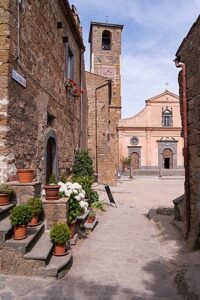
Mellitto’s physical character, as visible in archived photographs from the Wikimedia documentation of the area, is that of a linear rural settlement: buildings strung along a single road, the scale intimate, the architecture functional. The small church visible in photographs is a common typology in the Murgia — a modest structure with a façade oriented toward the road, serving a congregation that was once primarily agricultural workers and their families. As the rural economy of the Alta Murgia has contracted over the past fifty years, many such frazioni across il territorio del parco have seen populations decline; Mellitto is no exception, and the dynamic between the head comune and its satellite locality reflects wider patterns of demographic concentration in Puglian small-town life.
For the visitor willing to drive beyond the town centre, Mellitto offers a contrast that is genuinely informative: it is the agricultural periphery of the comune made visible, a reminder that the administrative unit of Grumo Appula encompasses not just a historic centre with churches and piazzas but also the working landscape that has sustained it for centuries.
The Festival dei Tammurr and the folk music calendar
Among the cultural events documented as taking place in Grumo Appula, the Festival dei Tammurr stands out as the most photographically recorded and the most specifically rooted in the musical traditions of the Murgia Barese. The tammorra — a large frame drum with a single membrane and metal jingles — is the defining instrument of an entire family of southern Italian folk music genres, most famously associated with the Campanian tradition of the tammurriata, but present with local variants across Puglia as well.
Wikimedia documentation of the festival shows groups in folk costume performing in what appears to be an outdoor or semi-outdoor setting in the town. The event brings together groups from Grumo Appula and from other comuni, functioning as both a competitive showcase and a social occasion. The rhythmic complexity of tammorra-based music — built on polyrhythmic patterns in which multiple drummers interlock their phrases — requires months of rehearsal, and the local groups that participate represent a form of associative life that runs parallel to the more institutionalised cultural calendar of the municipality.
The Festival dei Tammurr is not a recently invented event designed for tourist consumption. It belongs to a tradition of summer festivals in the Murgia Barese that has roots in the agricultural calendar — specifically in the festivals associated with harvest, livestock and the major saints’ days of late July and August. In recent decades, as the agricultural basis of these celebrations has weakened, the festivals have been reframed as cultural heritage events, but the musical practice itself retains genuine community participation rather than being reduced to spectacle.
Other moments in the annual calendar
Beyond the Festival dei Tammurr, the religious calendar of Grumo Appula follows the pattern common across the Metropolitan City of Bari: the feast of the patron saint anchors the summer programme, with a procession through the historic centre, fireworks, and the temporary transformation of the main piazza into the social centre of town life. The specific date of the patronal feast and the name of the patron would need to be confirmed with the municipal office (the comune’s website at comune.grumoappula.ba.it maintains an updated events calendar), but the structural form of the celebration is consistent with Puglian practice across il territorio del parco and its surrounding area.
Monteverde Church and the religious topography of the comune

The religious architecture of Grumo Appula extends beyond the Chiesa Madre — the parish church at the centre of the historic nucleus — to include at least one further significant building: the Monteverde Church, documented in the Wikimedia archive under the specific caption “Monteverde Church in Grumo Appula.” The name Monteverde, meaning green mountain or green hill, is a toponym used for churches and sanctuaries across southern Italy, often associated with Marian devotion and frequently located at a slight remove from the town centre, on elevated ground or at the edge of the agricultural territory.
In Grumo Appula’s case, the Monteverde Church likely served — and may still serve — as a destination for local pilgrimage, particularly on the feast day associated with the Marian title to which it is dedicated. These extra-urban sanctuaries, common throughout the Murgia, represent a form of religious geography that predates modern town planning: they mark points in the landscape that were considered sacred or significant before the current settlement pattern was fixed, and they often incorporate elements of earlier religious structures, sometimes Byzantine, sometimes pre-Christian.
The Chiesa Madre itself, documented under the caption “Chiesa matrice di Grumo Appula,” is the architectural and institutional centre of the parish. The term matrice (mother church) in Puglian ecclesiastical usage designates the principal parish church of a comune, the one from which all other churches in the territory derive their institutional status. Without a detailed architectural survey, it is not possible to assign a precise construction date to the current building, but churches of this type in the Murgia Barese typically reached their present form between the sixteenth and eighteenth centuries, incorporating Romanesque or Gothic structural elements under Baroque or Neoclassical surface treatments applied during later campaigns of renovation.
Olive groves, vineyards and the agricultural identity of the Murgia Barese
The natural conditions of il territorio del parco — a climate classified as semi-arid Mediterranean, with summer temperatures regularly exceeding 35°C, annual rainfall concentrated between October and April, and shallow limestone soils with excellent drainage — are precisely those that have made the Murgia one of Italy’s major olive-producing zones. The municipal territory of Grumo Appula, with its 81 square kilometres straddling the edge of the plateau, contains both the rock-outcrop terrain characteristic of the park’s core and the deeper soils of the plateau margins where intensive olive cultivation is viable.
The olive variety most commonly associated with this part of the Bari province is the Coratina, named for the city of Corato roughly 25 kilometres to the northwest. Coratina olives produce an oil of notably high polyphenol content — often exceeding 500 mg/kg in monovarietal oils — which gives it a pronounced peppery finish and makes it among the most oxidation-resistant Italian extra virgin olive oils. Farmers in the Grumo Appula area who cultivate Coratina trees are working within a productive tradition that is at least six centuries old, and the low stone walls that divide olive groves from cereal fields across il territorio del parco are themselves a form of agricultural engineering accumulated over generations.
Viticulture, while less dominant than olive cultivation in this specific micro-area, is present in the municipal territory. The province of Bari is home to several DOC and IGT designations — including the Gravina DOC (produced slightly further west, in the territory of Gravina in Puglia) and the broader Puglia IGT — and the climatic conditions of the Alta Murgia plateau, with its significant day-night temperature differentials during the ripening period, are considered favourable for producing wines of aromatic complexity. Small-scale wine production for local consumption has existed in Grumo Appula as in all Murgia comuni; whether any producer currently markets wine commercially under a recognised designation would require verification with the local agricultural office.
Arriving by train: the FAL railway and how it connects the plateau
One of the practical advantages of Grumo Appula as a base for exploring il territorio del parco is its railway connectivity. The comune is served by two stations documented in the Wikimedia archive: the Stazione di Grumo Appula and the Stazione FAL Grumo Appula. The acronym FAL stands for Ferrovie Appulo Lucane, the regional railway operator that runs a network of lines connecting Bari to the inland towns of the Murgia and Basilicata — a system that was engineered in the early twentieth century specifically to serve communities on the plateau that the mainline Adriatic railway bypassed.
The FAL line from Bari Centrale to Altamura, which passes through Grumo Appula, runs approximately every 30 to 60 minutes during peak hours and takes around 20 to 25 minutes from Bari. This makes Grumo Appula genuinely accessible as a day trip from the regional capital, or as a point of departure for further exploration westward toward Altamura (famous for its DOP bread, the Pane di Altamura) and Matera in Basilicata. The existence of two distinct stations — one on the FAL network and one on what appears to be a separate line — reflects the somewhat complex railway geography of the Murgia, where different operators and different historical moments of railway construction have left overlapping infrastructure.
Driving from Bari, the most direct route follows the SS96 westward through Modugno and Bitetto, then turns south at the junction for Grumo Appula; the total distance is approximately 25 kilometres and the journey takes under 30 minutes outside of rush hour. Parking in the town centre is generally available along the peripheral roads, as Grumo Appula — unlike Bari itself — has not yet implemented residential parking zones.
Practical orientation: sport, daily life and what a real visit looks like
One of the more revealing details in the photographic documentation of Grumo Appula is the presence of the Palazzetto dello Sport — the indoor sports hall that hosts volleyball matches for the local team. This is not a detail that appears in tourist brochures, but it speaks directly to the texture of life in a Murgia comune of around 12,000 people: volleyball is one of the dominant recreational sports in Puglia, with a network of municipal clubs that compete in regional amateur leagues and that function as important centres of social aggregation for teenagers and young adults.
The Palazzetto’s existence implies a level of municipal investment in recreational infrastructure that is worth noting. Grumo Appula, like most comuni of its size in the Metropolitan City of Bari, must balance the maintenance of its historic centre — the churches, the public spaces, the road network — with the provision of contemporary facilities for a population that includes a significant proportion of commuters working in Bari who return home in the evenings. This dual character, historic core plus functional modernity, defines the experience of visiting the town.
A realistic visit to Grumo Appula lasts between half a day and a full day, depending on whether one extends into il territorio del parco for a walk in the Lagopetto pineta or drives out to Mellitto. The historic centre can be covered on foot in two to three hours; add the pineta and lunch at a local trattoria and the day fills naturally. The most recent municipal elections, held on 24 and 25 May 2026, suggest an active civic life — local elections in comuni of this size mobilise high proportions of the electorate and generate significant community discussion — which is itself a marker of a settlement with a functioning social fabric.
Where to eat without consulting a list
Grumo Appula’s restaurant offer is modest in number but not in quality. The principle that applies across the Murgia Barese applies here: look for establishments that describe their menu verbally rather than presenting a laminated booklet with photographs, and prioritise places where the proprietor can tell you which pasta is made in-house that morning. Orecchiette with cime di rapa (turnip tops), tiella (a baked dish of rice, potatoes and mussels that travels inland from the coast), and grilled lamb from the plateau are the preparations most directly connected to this territory. The olive oil used in any serious kitchen in this area will be local — the Coratina-dominant oils of the Bari province are among the most immediately recognisable in Italy, and their flavour profile is unmistakable.
FAQ: real questions about visiting Grumo Appula
Is Grumo Appula inside the Alta Murgia National Park?
Partly. The municipal territory of Grumo Appula extends for approximately 81 square kilometres, and a portion of this falls within the perimeter of the Parco Nazionale dell’Alta Murgia, which was established by Presidential Decree in September 2004. Il territorio del parco within the comune includes the Lagopetto pine forest, which is cited in official park documentation as one of the attractions of the protected area. The town itself sits at the edge of the park boundary rather than at its centre.
How do I get to Grumo Appula from Bari without a car?
The most convenient option is the FAL (Ferrovie Appulo Lucane) train from Bari Centrale, which stops at Grumo Appula in approximately 20 to 25 minutes. Trains run regularly throughout the day. There is also a conventional railway station (Stazione di Grumo Appula) documented on the network. Bus services operated by regional carriers connect Grumo Appula to Bari and to other comuni in the Metropolitan City, though frequencies are lower than on the rail line.
What is the Festival dei Tammurr?
The Festival dei Tammurr is a folk music event held in Grumo Appula that showcases the tammorra, a large frame drum central to the musical traditions of southern Italy. Groups in folk costume perform polyrhythmic drum-based music rooted in the agricultural festival traditions of the Murgia Barese. It is documented in the Wikimedia archive with photographs of ensemble performances in the town. The exact annual date varies; the municipality’s official website (comune.grumoappula.ba.it) publishes the current events calendar.
What is there to see in il territorio del parco near Grumo Appula?
Beyond the Lagopetto municipal pine forest, il territorio del parco in the wider Alta Murgia area includes the masserie (fortified farmhouses), karst features of the limestone plateau, steppe grassland habitat supporting rare orchid species, and the dry-stone wall agricultural landscape. The park authority manages a network of marked trails across the thirteen comuni that make up the protected area; the nearest trail hubs to Grumo Appula can be identified through the park’s official cartography, available at the visitor centre in Gravina in Puglia.
Is Mellitto worth visiting?
Mellitto, the frazione of Grumo Appula, is a small linear settlement accessible by car a short distance from the town centre. It has a roadside chapel documented in the Wikimedia archive but no dedicated tourist infrastructure. For visitors interested in rural settlement patterns of the Murgia Barese and the relationship between head comuni and their satellite localities within il territorio del parco, it offers a straightforward illustration of how agricultural communities organised themselves across the plateau. It requires perhaps 30 minutes, and combines naturally with a visit to the Lagopetto pineta.
When is the best time of year to visit?
April, May and early June are the most favourable months for visiting Grumo Appula and the surrounding Alta Murgia landscape. The plateau is green from the winter rains, wildflowers are at peak bloom in the park territory, temperatures are comfortable (15–24°C), and tourist pressure is minimal. September and October offer a second viable window, with harvest activity in the olive groves and cooler temperatures after the summer heat. July and August are the months when the Murgia most resembles a furnace — daytime temperatures in the mid-to-upper 30s Celsius, combined with the reflective glare of the limestone, make extended outdoor walking uncomfortable. They are also, however, the months when the folk music festivals, including the Festival dei Tammurr, are most likely to take place, so the choice involves a trade-off.
Are there accommodation options in Grumo Appula?
The accommodation offer in Grumo Appula itself is limited, as is typical for comuni of this size on the Alta Murgia plateau. Visitors who prefer to sleep in the area can consider Altamura (approximately 15 kilometres to the west, well-served by FAL trains and with a larger hotel and B&B offer) or Bari itself, from which Grumo Appula is easily reached as a day trip. Within il territorio del parco more broadly, agriturismo accommodation — stays on working farms — is available in several of the thirteen park comuni, offering direct contact with the agricultural landscape; advance booking is advisable during the spring and summer peak.
What language is spoken locally, and is English useful?
The everyday spoken language of Grumo Appula is a mixture of standard Italian and Barese dialect (the local name for the town, Gréume, gives a sense of how substantially the dialect diverges from standard pronunciation). English proficiency varies significantly: younger residents with university education and exposure to tourism will generally have functional English; older residents, shop owners and farmers may have none at all. In practical terms, a few phrases of Italian will smooth any interaction considerably, particularly outside Bari city itself. The linguistic situation in il territorio del parco area is consistent with rural Puglia generally: Italian is always understood, dialect is always present.