


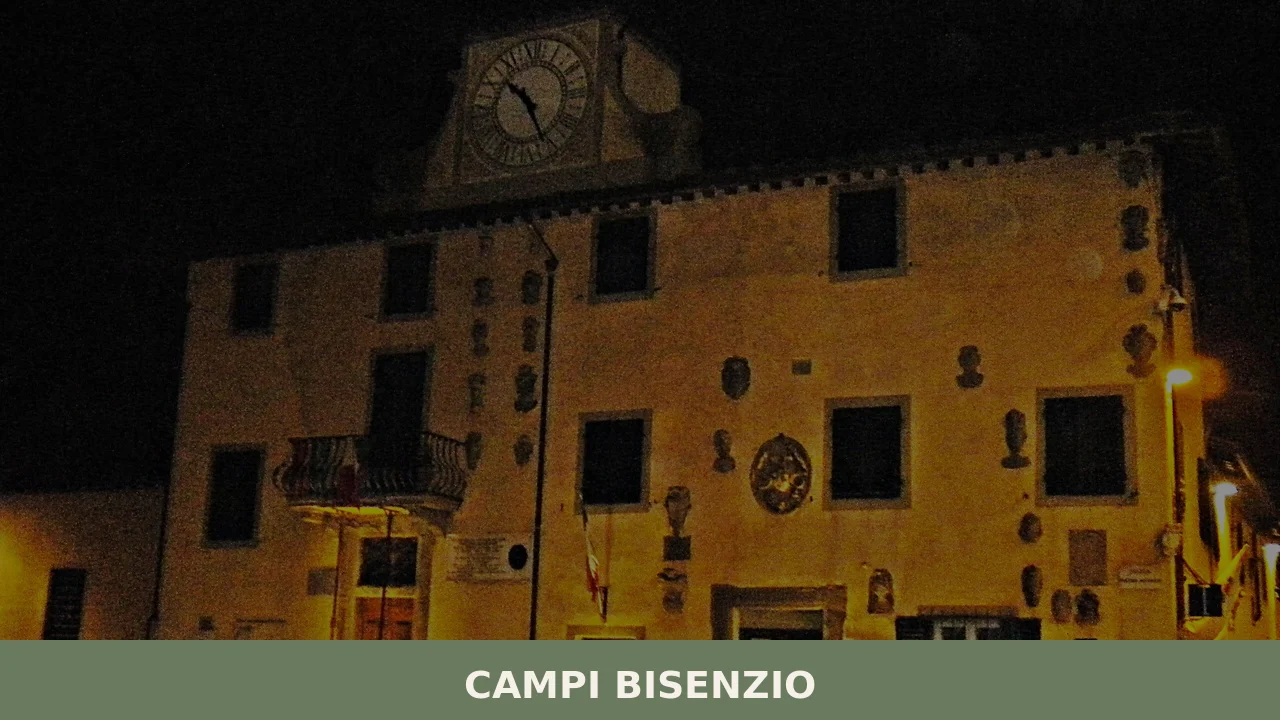
Campi Bisenzio
 Plains
What to see in Campi Bisenzio, Italy: 43,580 inhabitants, 10 km from Florence. Discover the birthplace of the internal combustion engine, Renaissance art and more.
Discover Campi Bisenzio
The Bisenzio river gives the town its modern name, adopted officially in 1862 when the municipality formalised the addition to distinguish it from the surrounding plain settlements.
At 38 metres (125 feet) above sea level, the town spreads across the flat agricultural lands northwest of Florence, where fields — the very campi that form the first half of the name — stretch toward the foothills.
With 43,580 inhabitants, it is one of the more populous municipalities in the Metropolitan City of Florence, and its fabric mixes post-war residential construction with older ecclesiastical cores that have survived largely intact.
Deciding what to see in Campi Bisenzio means following two distinct threads: the scientific and the sacred.
Located about 10 kilometres (6 miles) northwest of Florence, the town claims a verified place in the history of mechanical engineering, and its churches preserve Renaissance artworks that rarely appear in standard Tuscan itineraries.
Visitors to Campi Bisenzio find a flat, walkable centro with concentrated heritage, the church of Santa Maria standing as the most accessible starting point, and the museum adjacent to Sant’Andrea a San Donnino offering a focused collection of panel paintings and devotional objects.
History of Campi Bisenzio
The etymology of the name is direct and practical. Campi simply means fields in Italian, and the word reflects the agricultural character of the territory that surrounded the early settlement — broad, flat cultivated land on the plain west of Florence. For centuries the town was known simply as Campi, a designation shared by other localities across the Italian peninsula.
It was only in 1862, following the administrative reorganisation that accompanied Italian unification, that the municipality formally added Bisenzio to the name, anchoring the town’s identity to the river that flows through it.
The most consequential event in the town’s documented history belongs to the nineteenth century and to two men: Felice Matteucci, an engineer, and Father Eugenio Barsanti, a Barnabite priest and physicist.
Together they built the first internal combustion engine in Campi Bisenzio, a development that places this Tuscan plain town in the foundational chapter of industrial history.
The collaboration between a man of science and a man of the church was unusual by the standards of the period, but the results were concrete.
Their work preceded the better-publicised German developments by a documented margin, and the town has since claimed this achievement as a central part of its civic identity. The nearby city of Pistoia, roughly 20 kilometres (12 miles) to the northwest, shares the same broader Tuscan plain geography and experienced comparable industrial expansion during the same decades of the nineteenth century.
The ecclesiastical heritage of Campi Bisenzio runs deeper than the industrial one in terms of time.
The church of Santa Maria a Campi Bisenzio retains original artworks that survived the upheavals of the Napoleonic suppressions and the damage of the Second World War. The church of Sant’Andrea a San Donnino, a fraction of the municipality, was sufficiently rich in Renaissance material that its contents warranted the creation of a dedicated museum on the adjacent premises.
This decision to house displaced artworks in a purpose-built or adapted museum space, rather than redistributing them, preserved the coherence of the collection and made it accessible to researchers and visitors alike.
What to see in Campi Bisenzio, Toscana: top attractions
Church of Santa Maria a Campi Bisenzio
The interior of Santa Maria holds a set of original artworks that were never removed to larger Florentine collections, a circumstance that makes the church one of the more intact ecclesiastical interiors in the metropolitan area.
The building stands within the older residential core of the town, and its facade reads as a compressed record of successive interventions over several centuries. Visitors standing inside find devotional paintings, sculpted elements, and liturgical furnishings that document local patronage from the medieval period onward.
The church is accessible during morning hours on most days, and the low interior light in the side chapels makes a torch or a phone torch useful for reading inscriptions at close range.
Church of Sant’Andrea a San Donnino and Adjacent Museum
Sant’Andrea a San Donnino is a church within the broader municipal territory of Campi Bisenzio, and its significance for visitors lies primarily in what it generated: a museum housing the Renaissance artworks that once adorned its walls and altars.
The transfer of these works to the adjacent museum space preserved their physical condition and made them available for close study without the visual interruption of active liturgical use.
The collection documents the artistic connections between this rural parish and the Florentine workshops that supplied it, reflecting the economic reach of Renaissance patronage into the suburban countryside. Plan a visit of at least forty-five minutes to move through the museum at a pace that allows the iconographic detail of each panel to register properly.
The Birthplace of the Internal Combustion Engine
The historical claim that Campi Bisenzio witnessed the construction of the first internal combustion engine by Felice Matteucci and Father Eugenio Barsanti is documented and recognised.
This fact gives the town a specific position in the history of technology that distinguishes it from other plain municipalities of similar size and altitude.
For visitors with an interest in industrial or scientific history, the connection between this flat Tuscan territory and one of the central mechanical innovations of the modern era is worth considering before arriving.
The story of Barsanti and Matteucci — a priest and an engineer working in collaboration — is woven into local civic memory, and references to their work appear in the town’s public spaces and institutional communications.
The Bisenzio River Corridor
The Bisenzio river, which lent its name to the municipality in 1862, runs through the town at an altitude of 38 metres (125 feet) above sea level, and the corridor along its banks offers the most direct contact with the natural geography of the plain.
The river descends from the Apennine hills to the north, passing through the territory of the municipality before joining the Arno system further south.
Walking along the river provides a clear reading of how the agricultural plain relates to the water infrastructure that historically sustained it. The banks are most accessible in spring and early autumn, when water levels are moderate and the vegetation along the margins is at its most varied.
The Historic Town Core and Civic Streets
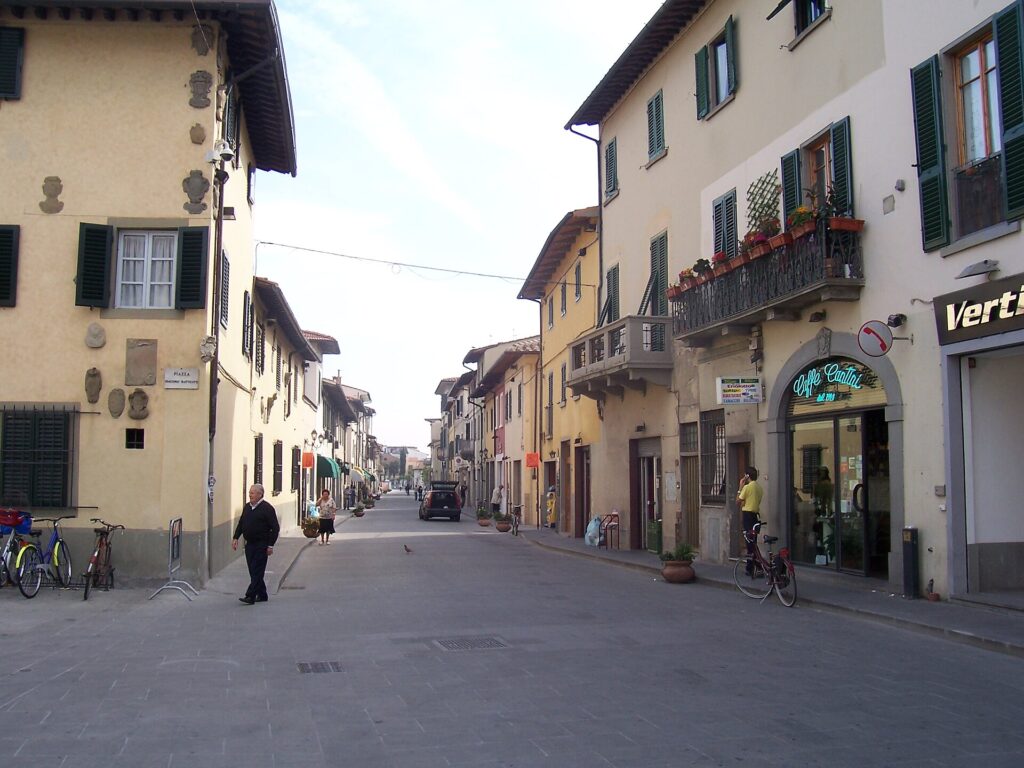
The older residential fabric of Campi Bisenzio concentrates around a series of streets that predate the twentieth-century expansion of the municipality.
At 38 metres (125 feet) above sea level on a flat plain, the town presents no elevated vantage points, but the scale of the older streets — narrow, continuous building facades, modest piazze (squares) — creates a spatial density distinct from the surrounding residential periphery.
The patron saint of the town, Beata Teresa Maria della Croce, also known as Teresa Manetti, is commemorated in local dedications, and the civic buildings in the centre provide a readable record of municipal investment from the late nineteenth century to the Fascist period.
Allow ninety minutes to cover the core on foot without rushing past the architectural details on upper-floor cornices and doorways.
Local food and typical products of Campi Bisenzio
Campi Bisenzio sits on the flat agricultural plain between Florence and the Apennine foothills, a zone where the culinary tradition is rooted in the cucina contadina — the farmhouse cooking of the Tuscan plain.
This is not the hill-town food of Siena or the coastal preparations of the Livorno area; it is food shaped by proximity to Florence and by the produce of irrigated fields and river-fed pastures.
The town’s position within the Metropolitan City of Florence means that Florentine culinary references dominate, but the suburban and rural character of Campi Bisenzio has maintained a set of preparations less visible in city restaurant menus.
Bread in this part of Tuscany follows the regional standard: pane sciocco toscano, unsalted bread baked in a round or oval loaf with a thick, crackling crust and a dense crumb.
The absence of salt is not an oversight but a deliberate regional convention, and it functions as a neutral carrier for the strongly seasoned preparations it accompanies — cured meats, bean soups, and braised vegetables. Ribollita, the twice-cooked bread and vegetable soup built on cavolo nero (Tuscan black kale), cannellini beans, stale bread, and a base of soffritto in olive oil, is the most representative dish of the plain.
It is served thick enough to hold a spoon upright, and in the colder months it appears on almost every local table in some form.
Peposo, a slow-braised beef preparation cooked with black pepper and red wine, reflects the Florentine hinterland tradition of using inexpensive cuts over long cooking times to produce deeply flavoured results.
The area around Campi Bisenzio does not have its own distinct certified designation separate from the broader Florentine and Tuscan production zones.
Olive oil produced in the Florentine hills, including the territories north and west of the city, falls under the Chianti Classico and broader Tuscan DOP frameworks, and locally pressed oils with a high polyphenol content — characterised by a green-gold colour, a grassy nose, and a peppery finish — are available from producers in the surrounding countryside.
Visitors who arrive during the olive harvest season, typically from mid-October to late November, can find freshly pressed oil at farm gates and at the periodic markets held in the town centre.
The Thursday and Saturday morning market in Campi Bisenzio functions as the principal point of contact between local producers and residents.
Seasonal vegetables from the plain — courgettes, tomatoes, artichokes, and the flat fagioli di Sarconi-style beans that appear in late summer — dominate the food stalls in the warmer months. In autumn, funghi porcini from the Apennine foothills north of the town arrive at the market, sold fresh and dried.
Buying directly at the market rather than at supermarkets gives a more accurate picture of what the agricultural plain around Campi Bisenzio actually produces in any given season.
Festivals, events and traditions of Campi Bisenzio
The town’s patron saint is Beata Teresa Maria della Croce, the religious name of Teresa Manetti, born in San Ignazio di Campi Bisenzio in 1846 and beatified by Pope John Paul II in 1986.
Her feast day falls on 23 April, and the annual celebration in Campi Bisenzio marks both the religious commemoration and the town’s direct biographical connection to a figure recognised by the Catholic Church at the highest level.
The celebrations on and around 23 April typically include a solemn mass in the principal church, a procession through the older streets of the town centre, and civic events organised by the municipal administration.
Teresa Manetti founded the Carmelite Sisters of Saint Teresa in 1872, and her connection to the town gives the feast day a local specificity that extends beyond the liturgical calendar.
Beyond the patron saint feast, Campi Bisenzio participates in the broader cycle of Tuscan seasonal events. The agricultural calendar of the plain — olive harvest in October and November, the grape harvest in September — generates informal local activity that visitors can observe or participate in by contacting farm producers directly.
The town’s flat geography and its position on the edge of the metropolitan area mean that it also hosts periodic civic markets and cultural events organised through the Municipality of Campi Bisenzio, details of which are published on the official website in advance of each season.
When to visit Campi Bisenzio, Italy and how to get there
The best time to visit Campi Bisenzio and the surrounding Tuscan plain is during spring (April to June) and early autumn (September to October).
In April, the feast of the patron saint falls on the 23rd, which gives a specific cultural reason to time a visit around that date.
Summer temperatures on the plain can reach 35°C (95°F) and above, making outdoor exploration less comfortable between July and August. Autumn brings moderate temperatures, the grape harvest in the surrounding countryside, and the beginning of the olive-pressing season in October — a period when the agricultural character of the area becomes most visible. For those whose interest is the ecclesiastical collections and the museum at Sant’Andrea a San Donnino, there is no strong seasonal constraint, and the cooler months from November to March offer the advantage of smaller visitor numbers in the broader Florence metropolitan area.
Campi Bisenzio is directly accessible from Florence by public transport and by car.
The town sits 10 kilometres (6 miles) northwest of the Florentine city centre, making it a straightforward half-day or full-day excursion from the city. By car, take the A11 motorway (Firenze–Mare) and exit at Campi Bisenzio; the distance from the Florence ring road to the town centre is under 10 kilometres (6 miles).
Regular bus services operated by Autolinee Toscane connect Campi Bisenzio to Florence’s main transport nodes, and the journey time by bus from central Florence is approximately 30 to 40 minutes depending on traffic.
The nearest major airport is Florence’s Amerigo Vespucci Airport (Peretola), approximately 7 kilometres (4.3 miles) from Campi Bisenzio, making this one of the few Tuscan towns genuinely within reach of an international arrival point without a rail or motorway transfer. For those arriving by train into Florence Santa Maria Novella, a connecting bus service covers the route to Campi Bisenzio. International visitors should note that English is not widely spoken in smaller shops and at the local market; carrying euro cash is practical, as card payment is not universally accepted at market stalls and smaller food producers.
Campi Bisenzio also works as a base for reaching other destinations in the province.
The city of Pisa lies roughly 80 kilometres (50 miles) to the west along the A11 motorway, and the journey by car takes under an hour in normal traffic conditions. Heading south, the medieval city of Siena is approximately 80 kilometres (50 miles) away via the Firenze–Siena superstrada, and it offers a markedly different landscape — hill country, cypress-lined roads, and a well-documented medieval urban core — that contrasts directly with the flat agricultural geography of Campi Bisenzio.
Frequently asked questions about Campi Bisenzio
What is the best time to visit Campi Bisenzio?
Spring (April–May) and early autumn (September–October) are the most comfortable seasons, with mild temperatures ideal for walking the flat town centre and the Bisenzio river corridor. April is particularly relevant: the feast of the patron saint Beata Teresa Maria della Croce (Teresa Manetti) falls on 23 April, bringing local celebrations to the civic centre. Summer is warm and busy given the town's proximity to Florence, while winter is quiet but suitable for visiting indoor attractions such as the museum at Sant'Andrea a San Donnino.
What are the historical origins of Campi Bisenzio?
The name Campi — meaning fields — reflects the agricultural plain west of Florence that defined the early settlement. For centuries the town was simply called Campi. In 1862, following Italian unification and administrative reorganisation, the municipality officially added Bisenzio, the name of the river running through it. The town's most celebrated historical event belongs to the nineteenth century: engineers Felice Matteucci and Father Eugenio Barsanti built the first documented internal combustion engine here, placing Campi Bisenzio in the foundational history of mechanical engineering, ahead of later German developments.
What to see in Campi Bisenzio? Main monuments and landmarks
The Church of Santa Maria a Campi Bisenzio is the primary starting point, housing original medieval and Renaissance artworks never transferred to Florentine collections — accessible most mornings, bring a torch for side-chapel inscriptions. The Church of Sant'Andrea a San Donnino and its adjacent museum preserve a focused collection of Renaissance panel paintings from the former parish, requiring at least 45 minutes to visit properly. The historic town core rewards a 90-minute walking circuit. For technology history enthusiasts, the documented birthplace of the internal combustion engine is a unique civic landmark referenced throughout the town's public spaces.
What are the main natural or scenic attractions of Campi Bisenzio?
The Bisenzio river corridor is the town's main natural feature, offering accessible riverside walks along banks that read clearly against the flat agricultural plain. The river descends from the Apennine hills before joining the Arno system to the south. Spring and early autumn are the best seasons: water levels are moderate and riverside vegetation is most varied. The surrounding plain itself, with its irrigated fields stretching toward the foothills, gives a readable sense of the agricultural landscape that originally gave the town its name — campi, meaning fields.
Are there museums, churches or historic buildings to visit in Campi Bisenzio?
Yes. The museum adjacent to the Church of Sant'Andrea a San Donnino houses Renaissance artworks removed from the church for preservation, documenting connections between the rural parish and Florentine workshops — allow at least 45 minutes. The Church of Santa Maria a Campi Bisenzio contains an intact set of devotional paintings, sculpture, and liturgical furnishings spanning the medieval period to later centuries, accessible on most mornings. The civic buildings in the historic centre provide a readable architectural record from the late nineteenth century through the Fascist period. Verify current opening hours locally before visiting.
Who is Campi Bisenzio suitable for? Families, couples, hikers, solo travelers?
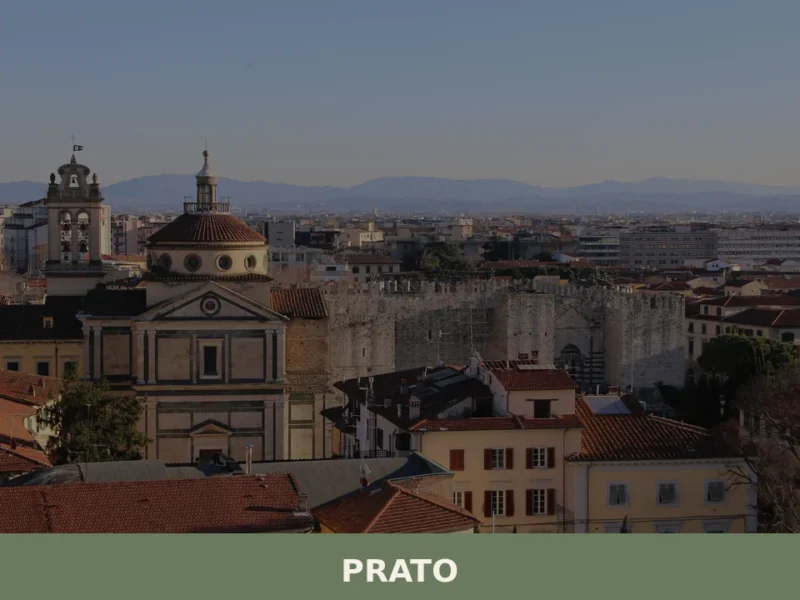
Campi Bisenzio suits culturally curious travellers seeking off-the-beaten-path Tuscan heritage without the crowds of Florence, just 10 kilometres away. The flat terrain makes it accessible for families, older visitors, and anyone with mobility considerations. History and technology enthusiasts will find the internal combustion engine heritage genuinely distinctive. Art lovers with an interest in Renaissance provincial patronage will value the Sant'Andrea museum. It is an effective day-trip destination from Florence rather than a multi-night base, and pairs naturally with nearby Prato or Pistoia for a broader Tuscan plain itinerary.
What to eat in Campi Bisenzio? Local products and specialties
Campi Bisenzio sits firmly in the cucina contadina tradition of the Florentine plain. Ribollita — a thick twice-cooked soup of cavolo nero, cannellini beans, stale bread, and olive oil — is the most representative dish and appears on local tables throughout the colder months. Peposo, a slow-braised beef preparation with black pepper and red wine, reflects the Florentine hinterland tradition of long-cooked inexpensive cuts. Bread follows the regional standard: pane sciocco toscano, unsalted with a thick crust. Local olive oils fall under broader Tuscan DOP frameworks, with high-polyphenol Florentine-area oils available at local producers.
📷 Photo Gallery — Campi Bisenzio
Nearby Villages near Campi Bisenzio
 Mountain
In Tuscany More villages to discover
Forte dei Marmi
 Sea
Sea
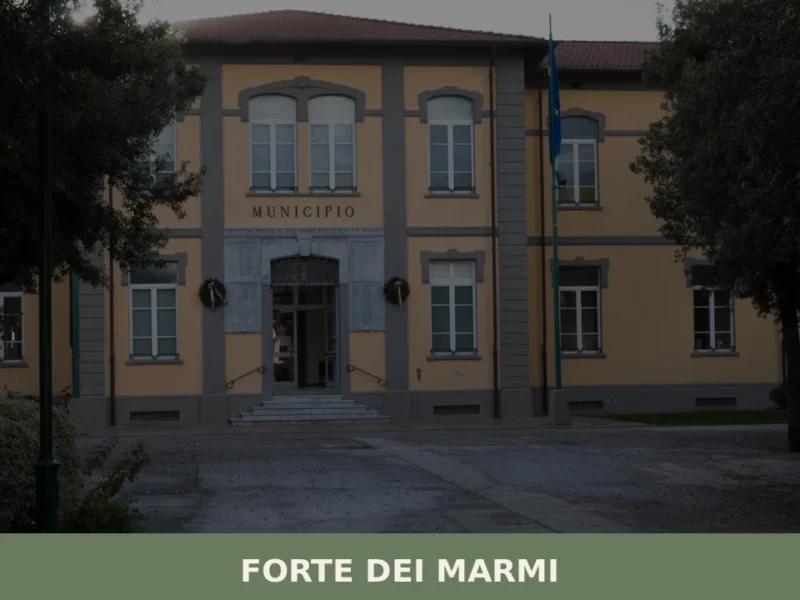
What to see in Forte dei Marmi, Italy: the 1788 fortress, sandy beaches, satirical art museum and weekly market. Population 7,619. Explore the full guide.
Barga
 Hills
Hills
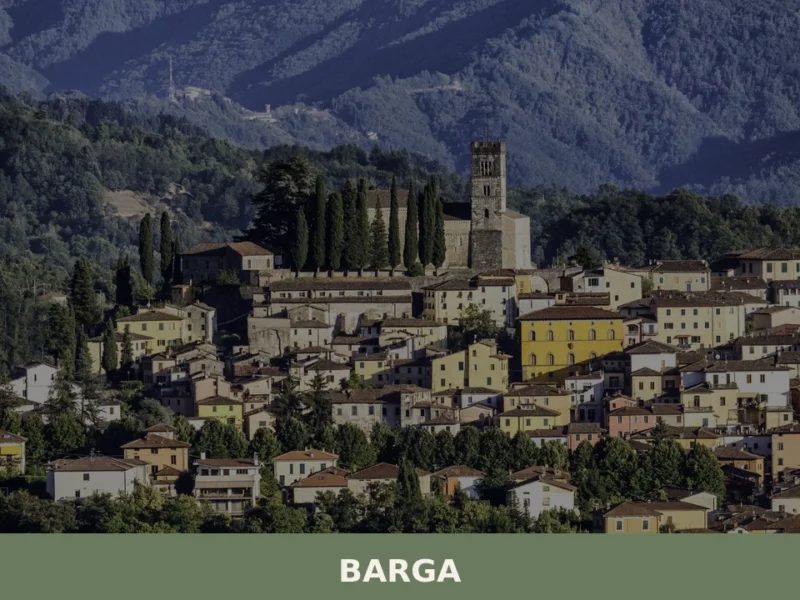
what to see a Barga, village toscano a 410 m s.l.m.: Duomo di San Cristoforo, Teatro dei Differenti, cuisine della Garfagnana. guide pratica con consigli su quando andare e how to get there.
Filattiera
Hills
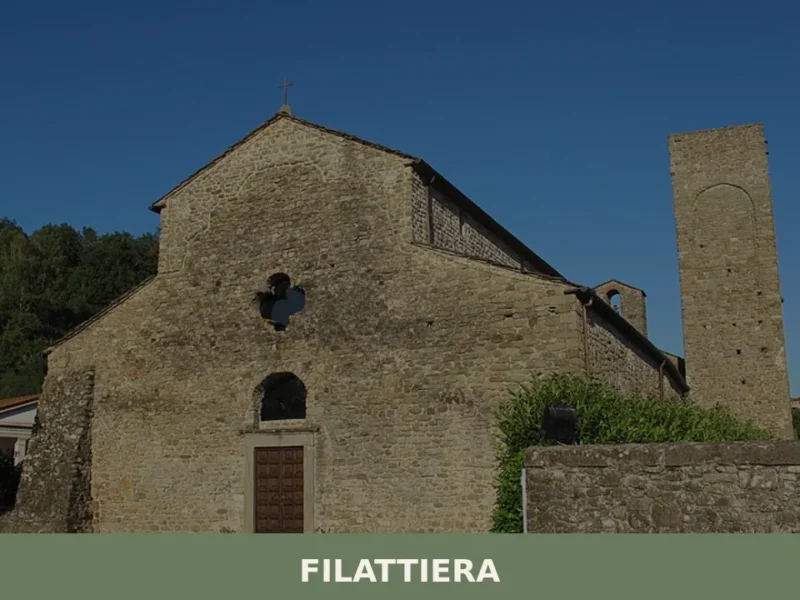
Filattiera first appears in written records in 884, when the name Filacteriae identified a garrison along the Via Francigena in Lunigiana. Sitting at 213 metres above sea level in the province of Massa and Carrara, this village of 2,393 inhabitants preserves prehistoric stelae, Romanesque parish churches, and a defensive layout that reflects centuries of control […]
Villafranca in Lunigiana
Plains
What to see in Villafranca in Lunigiana: explore the Via Francigena, medieval churches and local cuisine in Toscana, Italy. Population 4,803. Discover it now.
Capraia e Limite
Plains
The Arno moves slowly past the low embankment at Limite sull’Arno, its surface carrying the same grey-green light it has carried for centuries. The riverbank here is not decorative: from the 18th century onward, this stretch of the river functioned as a working yard where timber hulls took shape for the Grand Duchy of Tuscany. […]
Barberino Val d’Elsa
Hills
The 14th-century walls still enclose the historic centre of Barberino Val d’Elsa within an almost intact perimeter, with two town gates that filter access to the village just as they did six centuries ago. In this article History and origins of Barberino Val d’Elsa What to see in Barberino Val d’Elsa: main attractions Traditional Cuisine […]
Barberino di Mugello
Hills
What to see in Barberino di Mugello, Italy: explore the Villa Medici of Cafaggiolo, local food traditions, and a town of 10,751 inhabitants. Discover the full guide.
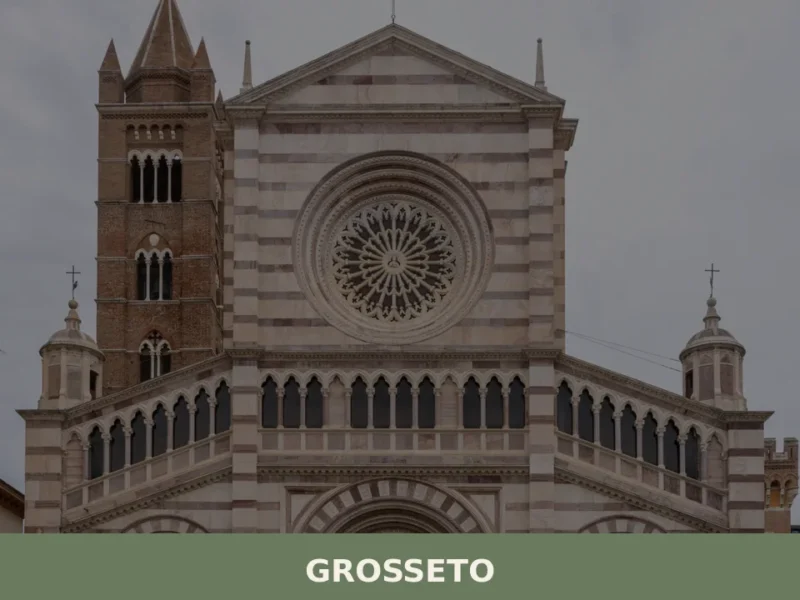
Grosseto
Sea
What to see in Grosseto: Medici walls, San Lorenzo Cathedral and the Maremma Natural Park in a city of 79,216 inhabitants. Plan your visit with our complete guide.
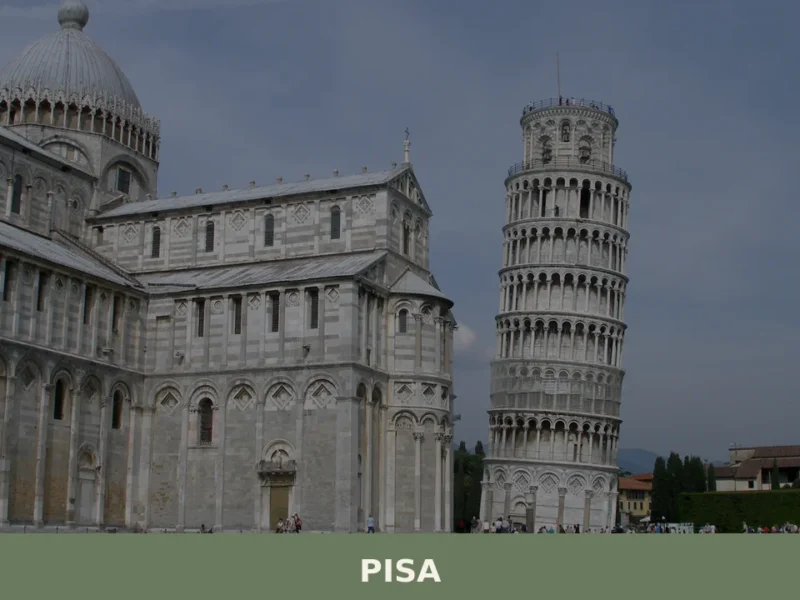
Pisa
Sea
What to see in Pisa: Leaning Tower, UNESCO Piazza dei Miracoli, Regata di San Ranieri on 17 June — city of 86,263. Plan your visit with our complete guide.
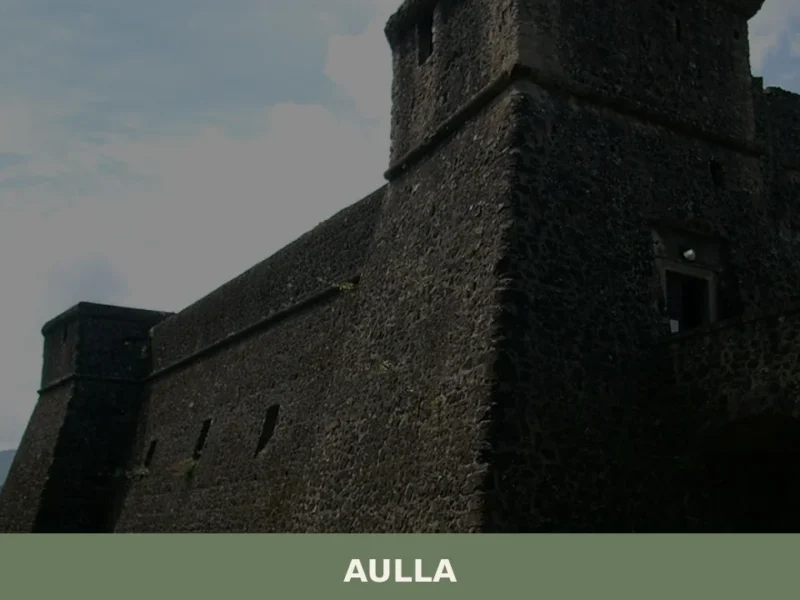
Aulla
Plains
In 884 AD, Marquis Adalbert of Tuscany founded an abbey dedicated to Saint Caprasius at the confluence of the Magra and Aulella rivers, transforming a modest valley-floor settlement into an obligatory stopping point on the Via Francigena. Today, anyone wondering what to see in Aulla will find a lowland town at 64 metres above sea […]
🏡 Know Campi Bisenzio better than we do?
If you’re a local or have been there, your knowledge matters: add what’s missing or fix a detail on this page.