


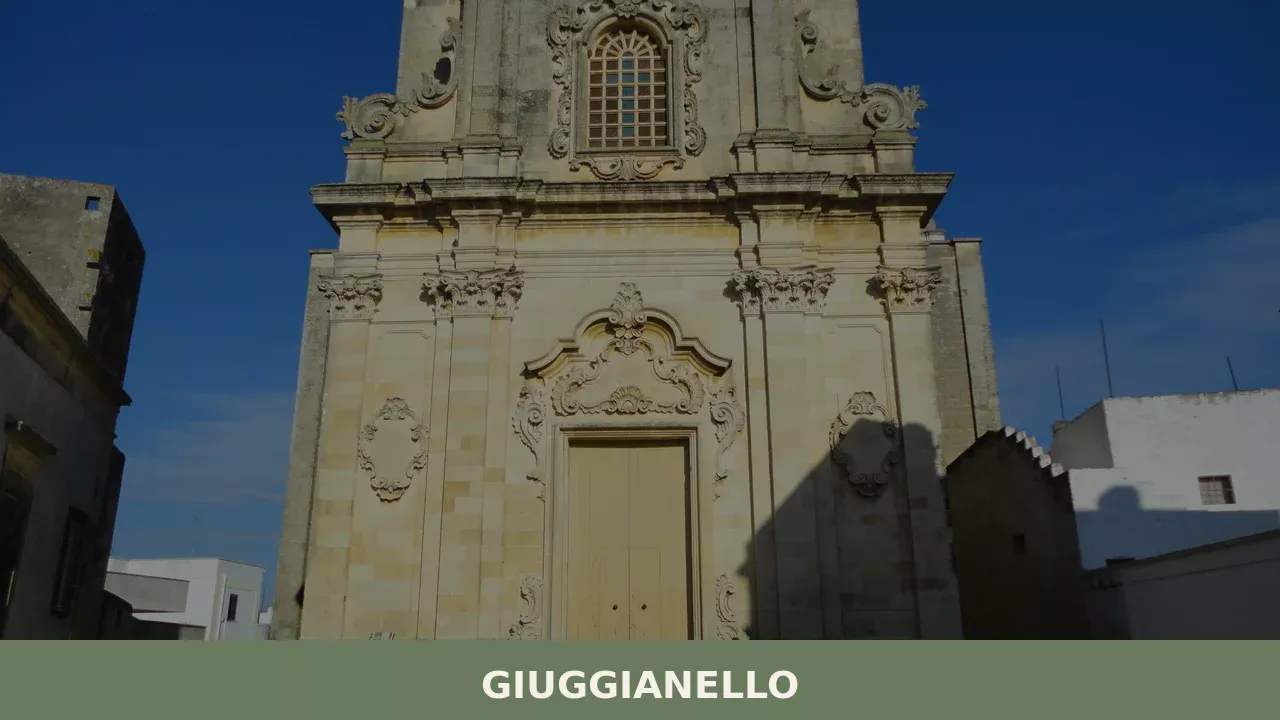
Giuggianello
 Plains
what to see a Giuggianello: 5 attractions, cuisine PAT, festa di san Cristoforo il 25 luglio. guide pratica per visitare questo 1.239 abitanti in the province of Lecce.
Discover Giuggianello
Seventy-nine metres above sea level, a plain that offers no elevation but returns vast distances: from Giuggianello the gaze flows freely to the blurred outlines of the Salento scrubland, unobstructed.
The houses in Lecce stone cluster around the mother church with the compactness typical of agricultural centres in the lower Salento, where every building tells centuries of peasant economy and every doorway bears carved noble crests now faded by limestone.
One thousand two hundred and thirty-nine inhabitants, a bell tower that has measured time with the same rhythm for generations.
What to see in Giuggianello is the right question for anyone travelling through the province of Lecce in search of authentic villages far from the crowded tourist circuits.
At 79 m above sea level in the heart of the eastern Salento, the village offers an eighteenth-century mother church, traces of rock-cut architecture in the surrounding area, a gastronomic heritage certified by PAT, and the patron saint’s feast of San Cristoforo on 25 July.
Those who come here find a small community with a historic urban structure that is still clearly legible, where every alleyway converges towards the civic and religious centre of the town.
History and origins of Giuggianello
The origins of Giuggianello fit within the settlement framework of medieval Salento, characterised by the layering of Messapian, Roman, Byzantine and Norman presences.
The territory surrounding the current built-up area has yielded traces of ancient occupation, confirming that the plain between Otranto and Maglie was already inhabited before the formation of the present village.
The place name most likely derives from a Latin or medieval personal name, following a pattern widespread throughout the Terra d’Otranto, where many minor centres took their name from the original owner of the agricultural estate on which they arose.
During the Middle Ages, Giuggianello was part of the feudal system that characterised the entire province of Lecce.
Like the great majority of Salento hamlets, the village underwent its urban consolidation between the thirteenth and fifteenth centuries, a period in which the settlement network of the Terra d’Otranto stabilised around small-scale centres, each with its own church and a compact residential core.
The Salento plain favoured this horizontal development: without natural elevations to lean against, the village built its identity around religious buildings and the masserie that structured the surrounding agricultural land.
Within this shared geographical context, Conversano also fits, a Puglian centre that experienced similar feudal dynamics during the Norman-Swabian period, though it developed on a Murgia plateau at considerably higher elevations.
In the modern age, Giuggianello followed the fortunes of the Kingdom of Naples and later the Kingdom of the Two Sicilies, maintaining an economy based on cereal farming, olive growing and viticulture, the three historic crops of the Salento.
The eighteenth and nineteenth centuries saw the construction or renovation of several religious buildings in the town centre, in keeping with the Lecce Baroque style that dominated ecclesiastical architecture throughout the province during that period.
After the Unification of Italy, the town became part of the province of Lecce, preserving the agricultural structure of a small centre that still defines its main characteristics today.
What to See in Giuggianello: Main Attractions
Mother Church of San Cristoforo
The Lecce stone façade of the mother church displays the characteristics of mature Salento Baroque, with pilasters, moulded cornices and a sculpted portal that concentrates the typical ornamental repertoire of local craft production between the 17th and 18th centuries.
The building is dedicated to Saint Christopher, patron of the village, and constitutes the architectural and devotional focal point of the entire town centre. Inside, the main nave preserves lateral altars in stucco and canvases of sacred subjects attributable to the pictorial culture of post-Tridentine Salento.
The church faces the main square of the village, which serves as a space for civic as well as religious gathering.
Every year on 25 July, during the patron saint’s feast, the building becomes the starting point of the procession that winds through the streets of the historic centre.
For public opening hours, the most up-to-date information can be found on the official website of the Municipality of Giuggianello.
Historic Centre and Lecce Stone Architecture
The streets of Giuggianello’s historic centre clearly reveal the urban fabric of a Salento hamlet of the modern age: one- or two-storey dwellings with Lecce stone portals, internal courtyards accessible through narrow entrance halls, and façades calibrated on the proportion between openings and solid masonry.
Lecce stone, a bioclastic limestone of pale yellow colour historically quarried in the caves of Salento, lends the entire centre a chromatic uniformity that shifts with the light throughout the day, moving from warm tones in the morning to almost white hues during the central hours.
Some noble palaces retain heraldic coats of arms carved above their portals, witnesses to the layered history of ownership of the village between the 16th and 18th centuries.
Walking through the road network of the centre, which follows a substantially orthogonal layout suited to the flat terrain, allows one to read directly the settlement logic of these agricultural villages of southern Salento.
Agricultural Territory and the Landscape of the Salento Plain
The landscape around Giuggianello is that of the eastern Salento plain: olive groves with centuries-old trees featuring gnarled trunks and wide canopies, dry-stone walls in limestone delimiting the plots, and fig trees and vines cultivated according to traditional systems documented for centuries.
At 79 metres above sea level, the territory presents no significant changes in elevation, yet the visual continuity of the plain offers wide views towards neighbouring municipalities and, on clear days, towards the Adriatic coast to the east.
The farm tracks connecting the centre to the historic farmsteads of the surrounding area cross this agricultural landscape at a slow pace, well suited to those exploring the area by bicycle or on foot.
The dry-stone walls that structure the territory are part of a traditional building system recognised for its landscape and historical value throughout the entire Mediterranean area.
Those who explore the territory in the early morning hours or late afternoon will experience the quality of the Salento light in the most direct way.
Historic Farmsteads of the Surrounding Area
The territory of Giuggianello is dotted with historic farmsteads that over the centuries have shaped the local agricultural economy.
These rural complexes, built between the 16th and 19th centuries in local stone, integrated the landowner’s residence, workers’ quarters, stables, hypogeal olive presses and cisterns for collecting rainwater, resolving within a single settlement all the needs of a large pre-industrial agricultural estate.
Some hypogeal olive presses carved into the limestone bedrock, widespread throughout the eastern Salento strip, are accessible within the farmsteads of the territory and allow visitors to observe the olive-grinding mechanisms with stone millstones and decanting basins.
The presence of this rural heritage places Giuggianello within a broader territorial system that also includes coastal villages such as Polignano a Mare, where rural architecture engages with a radically different maritime landscape yet shares an equally deep Puglian olive-growing tradition.
The Network of Villages in Eastern Salento
Giuggianello is located in the eastern quadrant of the province of Lecce, a short distance from centres such as Poggiardo, Uggiano la Chiesa and Palmariggi, which together form a constellation of smaller villages with similar historic structures.
The geographical position of the village, less than 20 km from the Adriatic coast and approximately 15 km from Otranto, makes it a useful vantage point for understanding how the inner Salento plain connects to the coastal strip through a continuous agricultural territory.
Exploring this network of small centres starting from Giuggianello means building a coherent itinerary for those who wish to discover Salento away from the summer tourist concentrations
Those heading north through the region can also include Rutigliano in their itinerary, a town in the province of Bari with a well-documented ceramic tradition and a well-preserved medieval historic centre.
Typical cuisine and products of Giuggianello
The cuisine of Giuggianello belongs to the gastronomic tradition of agricultural Salento, built over the centuries on locally produced ingredients: extra virgin olive oil, legumes, wild vegetables, cereals, lamb and kid goat.
The relative isolation of the inland villages from the coast has encouraged the preservation of food preparation and conservation techniques that have been lost elsewhere, from oil-preserved foods to preparations based on durum wheat flour.
Salentine peasant cuisine does not draw a sharp distinction between first and second courses, but builds meals around single-dish plates where stale bread, legumes or field vegetables absorb the main seasoning.
Among the dishes that best express this local tradition is ciceri e tria, fried and boiled pasta with chickpeas, which in Salento has a documented history of several centuries and represents the meeting point between the cereal and legume traditions of the plain.
Oven-baked lamb with potatoes, prepared with local aromatic herbs and olive oil, expresses the meat component of a diet that in past centuries involved consuming meat mainly during festivities.
Pittule, leavened dough fritters cooked in oil, appear on tables in the weeks before Christmas and during patron saint festivals.
The village’s peasant cuisine has managed to transform simple ingredients into preparations with a precise gustatory structure, where the acidity of tomato, the bitterness of new-pressed oil and the earthy flavour of legumes balance each other without overlapping.
The territory of Giuggianello falls within the production area of several products included in the national list of Traditional Agri-food Products.
Acquasale (PAT) is a preparation based on soaked stale bread, tomatoes, oil and salt, which during the summer months served as the main meal for agricultural workers in the fields.
Africani (PAT) are fried pastries made from leavened dough, typical of the Salentine confectionery tradition.
Oven-baked lamb with potatoes in the Lecce style, also known as Auniceddhru allu furnu (PAT), involves slow oven cooking with sliced potatoes, onion, rosemary and local oil.
Wild asparagus (PAT) are gathered in uncultivated fields and along the edges of olive groves from February to April and feature in various traditional preparations, from frittatas to pasta dishes.
Asparagus preserved in oil (PAT) is the version conserved in extra virgin olive oil, prepared to keep the product available beyond the harvesting season.
The most suitable period for getting close to local production is autumn, when the olive harvest and milling at local oil presses make new-pressed oil available.
Some agriturismos in the surrounding area organise tastings tied to the agricultural calendar, with the possibility of following the stages of olive processing.
For up-to-date information on local food and wine events and festivals, a useful reference is the , where the calendars of seasonal events are published.
Festivals, events and traditions of Giuggianello
On 25 July, Giuggianello celebrates the patron saint festival of Saint Christopher, one of the most deeply felt occasions in the village’s civil and religious calendar.
The date falls in the height of the Salentine summer, when the high temperatures and long daylight hours favour outdoor celebrations.
Tradition calls for a procession of the statue of the saint through the streets of the historic centre, accompanied by the brass band and the participation of the village’s faithful and those from nearby towns.
The evening of 25 July generally concludes with fireworks, in keeping with the widespread rite throughout southern Puglia that links religious celebrations to firework displays.
The patron saint festival is also the occasion when the historic centre comes alive with market stalls and refreshment points offering local gastronomic products, transforming the religious occasion into a moment of collective gathering for the entire community.
Alongside the festival of Saint Christopher, the calendar of Giuggianello follows the rhythm of occasions tied to the agricultural cycle and Catholic festivities, according to a structure common to the villages of inland Salento.
The celebrations of the Christmas and Easter periods involve religious services in the mother church and moments of community gathering that maintain their traditional form.
The production of ritual sweets associated with the festivities, such as pittule during the Advent period, constitutes a gastronomic practice passed down within families that is intertwined with the local liturgical calendar.
When to Visit Giuggianello and How to Get There
The best time to visit Giuggianello is spring, between April and June, when temperatures range from 18 to 26 degrees Celsius, the olive groves and Mediterranean scrub are at their peak growth cycle, and the countryside offers its finest landscape legibility.
In spring, wild asparagus is still in season, local markets showcase current vegetable production, and the village has not yet experienced the summer tourist flows that affect the Adriatic coast.
Autumn, from September to November, is the other recommended period: the olive harvest, the pressing of new oil, and mild temperatures make it ideal for both visiting the historic centre and exploring the agricultural landscape.
Those who choose July for the patron saint’s feast day on the 25th must bear in mind the intense heat of the summer Salento, which during the central hours of the day can exceed 35 degrees Celsius.
Giuggianello is easily reached by car via the Strada Statale 16 Adriatica as far as the Maglie or Otranto area, then taking the inland provincial roads.
The nearest motorway junction is Lecce on the A14-E55, from which the village is approximately 45 km to the south-east in the direction of Maglie-Poggiardo. The nearest railway station is Maglie, served by the FSE (Ferrovie del Sud Est) line connecting Lecce to Otranto and Gagliano del Capo; from Maglie the village is about a 10-minute drive.
Brindisi Airport, approximately 80 km away, is the most convenient airport for those arriving from outside the region; from there, take the expressway to Lecce and then continue towards Maglie.
For up-to-date train timetables, check directly on Trenitalia or the FSE portal.
Those exploring what to see in Giuggianello can extend their itinerary towards Mattinata, a Gargano town that shares with the Salento the tradition of extra virgin olive oil as an identity product of the Apulian territory.
| Departure Point | Distance | Estimated Time |
|---|---|---|
| Lecce (A14 junction) | approximately 45 km | 45–50 minutes |
| Brindisi Airport | approximately 80 km | 1 hour and 10 minutes |
| Maglie Station (FSE) | approximately 8 km | 10–12 minutes by car |
| Otranto | approximately 18 km | 20–25 minutes |
Frequently asked questions about Giuggianello
What is the best time to visit Giuggianello?
The ideal period to visit Giuggianello runs from late April to June and from September to October, when the Salento climate is mild, the light is particularly clear and the countryside is at its most expressive. July and August bring summer heat and heavier tourist traffic along the coast, though the village itself remains quiet. A specific date worth planning around is 25 July, the feast of patron saint San Cristoforo, when the historic centre hosts a traditional procession departing from the mother church and the community gathers for local festivities.
What to see in Giuggianello? Main monuments and landmarks
The main monument is the mother church dedicated to San Cristoforo, a Lecce stone Baroque building facing the main square, with a sculpted portal, pilasters, moulded cornices and a nave preserving lateral stucco altars and sacred canvases. The historic centre rewards a slow walk through its orthogonal streets lined with pale limestone dwellings, noble portals bearing faded heraldic crests, and internal courtyards. The surrounding agricultural territory adds historic farmsteads with hypogeal olive presses carved into the bedrock. For current church opening hours, consult the Municipality of Giuggianello's official website.
What are the main natural or scenic attractions of Giuggianello?
The landscape around Giuggianello is the open eastern Salento plain at 79 metres above sea level: centuries-old olive groves with gnarled trunks, dry-stone limestone walls partitioning the land, fig trees and traditional vineyards. The absence of elevation changes allows uninterrupted views towards neighbouring municipalities and, on clear days, towards the Adriatic coast roughly 20 km to the east. Farm tracks connecting the village to historic farmsteads are well suited to exploration on foot or by bicycle, offering direct contact with a traditional agricultural landscape of recognised historical and environmental value.
Where to take the best photos in Giuggianello?
The most photogenic spots in Giuggianello are concentrated in the historic centre and the surrounding countryside. The façade of the mother church of San Cristoforo in Lecce stone is especially striking in early morning and late afternoon light, when the limestone shifts from warm gold to near-white tones. The narrow lanes of the centre, with their carved portals and uniform stone frontages, offer strong architectural compositions. Outside the village, the rows of centuries-old olive trees and dry-stone walls crossing the Salento plain provide wide, open landscape shots, particularly effective at sunrise.
Are there museums, churches or historic buildings to visit in Giuggianello?
The main religious and architectural landmark is the mother church of San Cristoforo, an eighteenth-century Lecce Baroque building that anchors the village's main square. Its interior preserves lateral altars in stucco and canvases of sacred subjects from the post-Tridentine pictorial tradition of Salento. The historic centre also contains noble palaces with heraldic coats of arms above their portals, dating from the sixteenth to eighteenth centuries. The territory outside the village holds historic farmsteads with hypogeal olive presses carved into the limestone bedrock, offering insight into pre-industrial agricultural production methods.
What can you do in Giuggianello? Activities and experiences
Giuggianello lends itself to slow, low-impact forms of tourism. The farm tracks of the eastern Salento plain are ideal for cycling and walking itineraries connecting the village to historic farmsteads and neighbouring centres such as Poggiardo, Uggiano la Chiesa and Palmariggi. The village is a practical base for reaching Otranto, approximately 15 km away, and the Adriatic coast within 20 km. Food and wine experiences are built around the local peasant cuisine — ciceri e tria, oven-baked lamb, pittule — and locally produced extra virgin olive oil from the centuries-old groves surrounding the village.
Who is Giuggianello suitable for? Families, couples, hikers, solo travelers?
Giuggianello suits travellers seeking an authentic, unhurried Salento experience away from coastal tourist circuits. Couples and solo travellers drawn to village architecture, Baroque churches and Lecce stone streetscapes will find the compact historic centre immediately rewarding. Cycling enthusiasts and walkers benefit from the flat agricultural plain with its network of farm tracks and dry-stone wall landscapes. Those interested in rural heritage and traditional food culture will appreciate the farmsteads and local peasant cuisine. The village is less suited to travellers requiring organised tourist infrastructure or a wide range of on-site accommodation and dining options.
What to eat in Giuggianello? Local products and specialties
Giuggianello's table reflects the peasant cuisine of agricultural Salento. Ciceri e tria — pasta with chickpeas, part boiled and part fried — is among the most representative dishes of the area, with a documented culinary history of several centuries. Oven-baked lamb with potatoes, seasoned with local herbs and extra virgin olive oil, is a traditional festive preparation. Pittule, leavened dough fritters fried in oil, appear during the Christmas period and patron saint celebrations. The territory's olive groves, some with centuries-old trees, produce an extra virgin olive oil that is the base ingredient of virtually the entire local cuisine.
Nearby Villages near Giuggianello
In Apulia More villages to discover
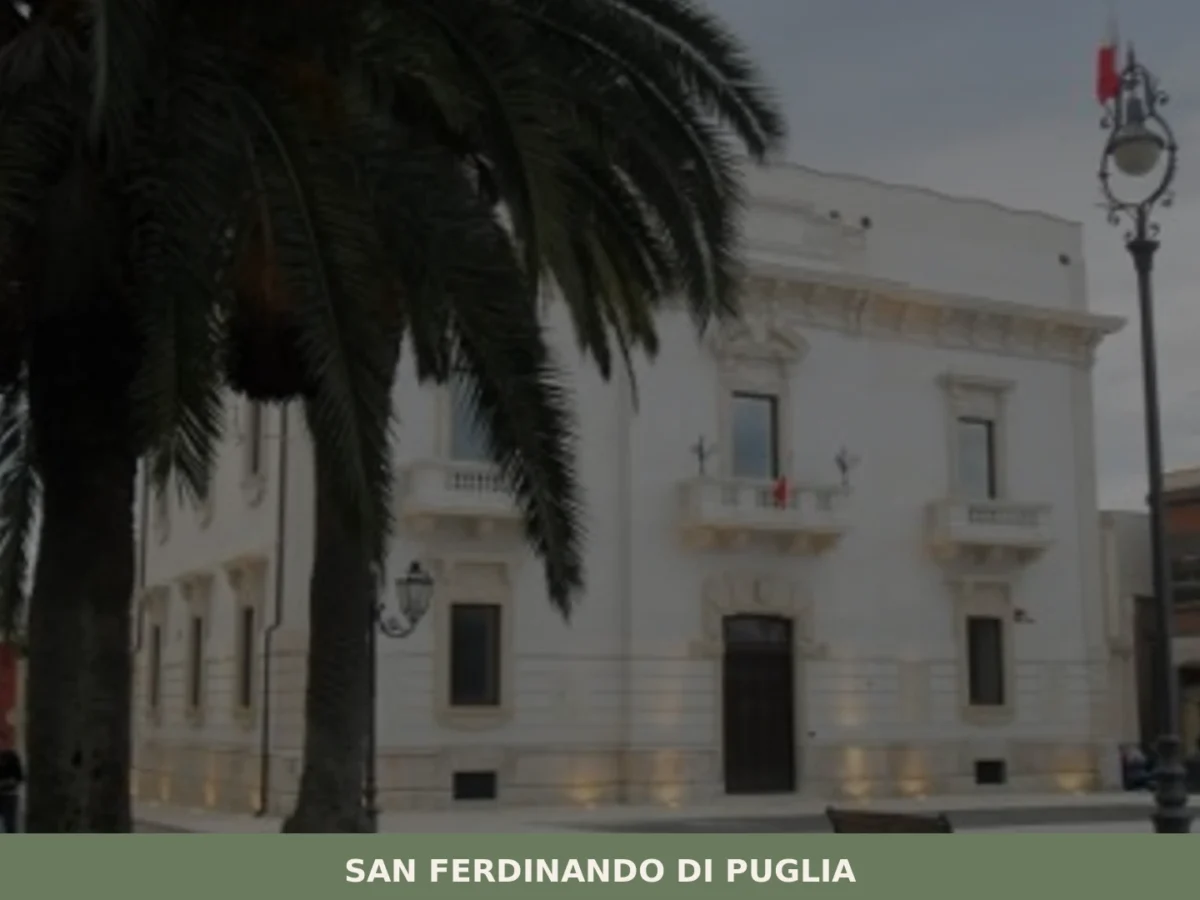
San Ferdinando di Puglia
Plains
What to see in San Ferdinando di Puglia: 5 must-visit attractions, from the historic centre to the churches. Discover the complete guide and plan your visit.
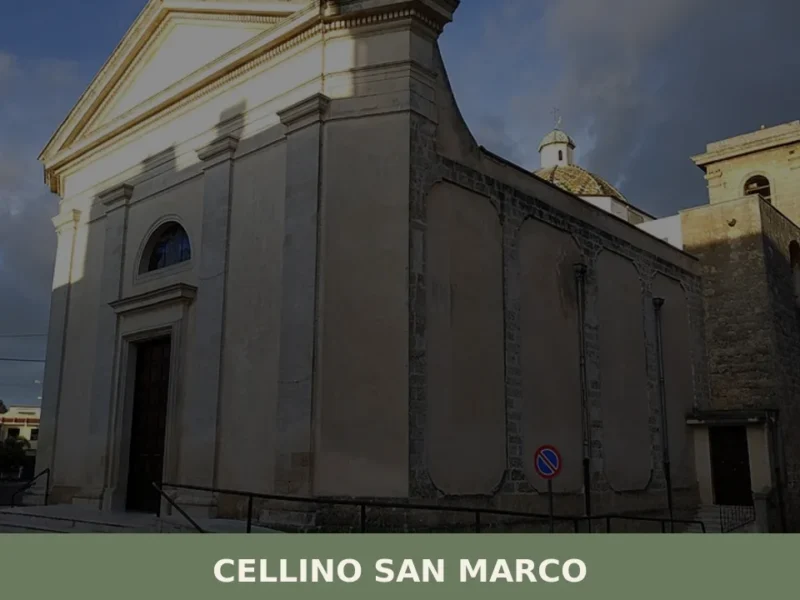
Cellino San Marco
Plains
Scopri Cosa vedere a Cellino San Marco: un borgo agricolo ricco di storia e tradizioni in Puglia. Pianifica la tua visita e assapora l'autenticità del Salento.
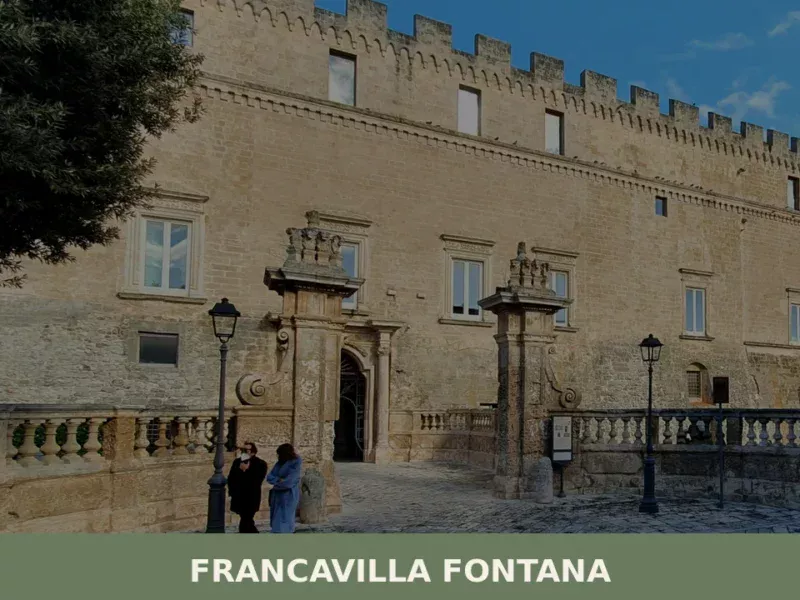
Francavilla Fontana
Plains
Discover what to see in Francavilla Fontana, Puglia: Baroque palaces, the medieval basilica, local food, travel tips and how to get there.
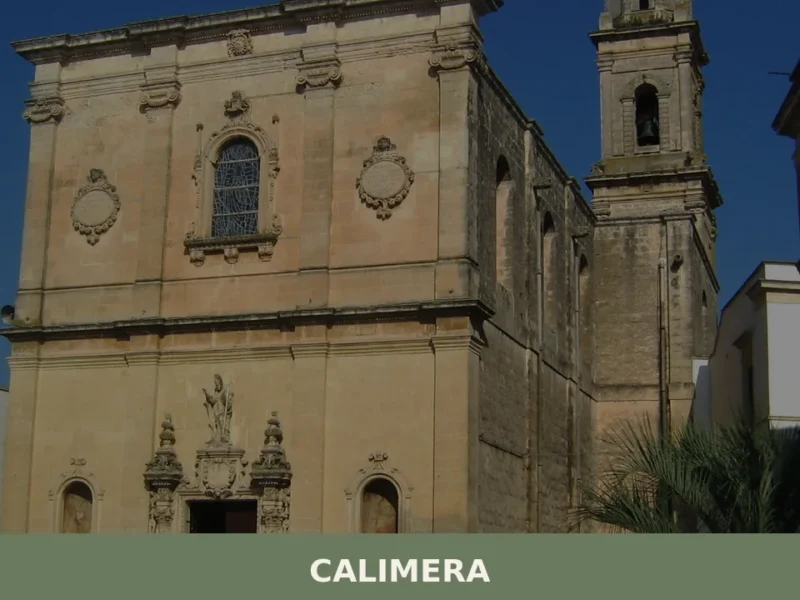
Calimera
Plains
Discover what to see in Calimera, the Puglia village at the heart of the Grecu00eca Salentina u2014 Griko culture, historic architecture, olive oil and local festivals.
Carapelle
Plains
what to see a Carapelle: 5 attractions, prodotti PAT e festivals patronali a 62 m s.l.m. in the province of Foggia. Scopri history, cuisine e how to get there.
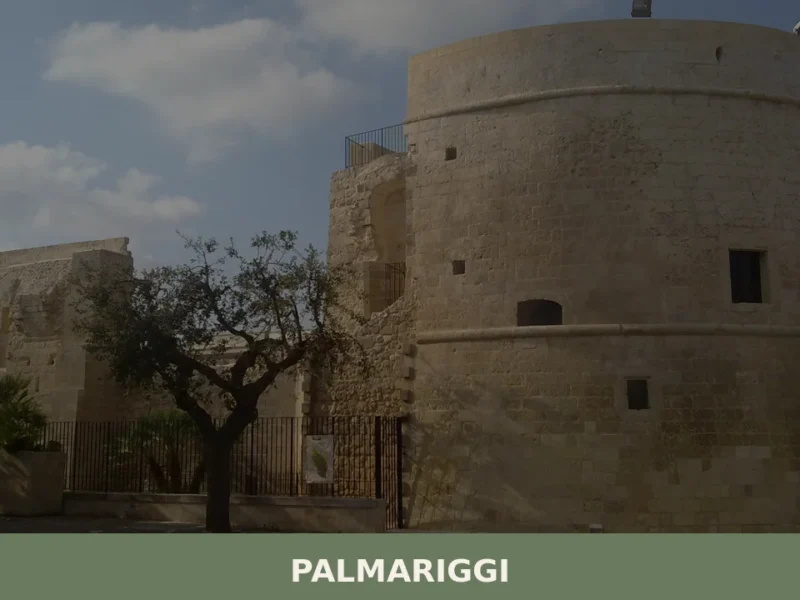
Palmariggi
Plains
What to see in Palmariggi, Puglia, Italy: discover the Aragonese Castle, a prehistoric menhir, and the Sanctuary of Madonna di Montevergine. Population 1,542. Explore now.
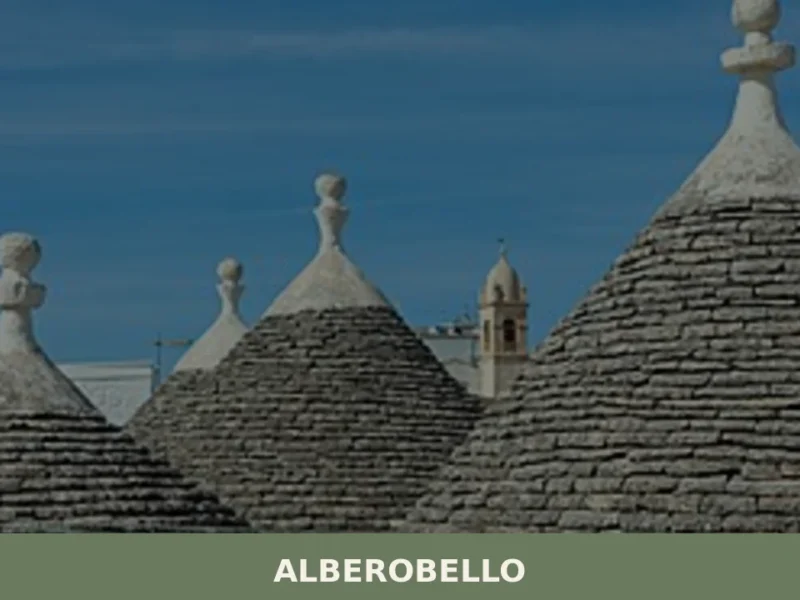
Alberobello
 Hills
Hills
Alberobello, Puglia: Discover UNESCO trulli, Monti & Aia Piccola districts. Explore unique history & traditions. Plan your visit!
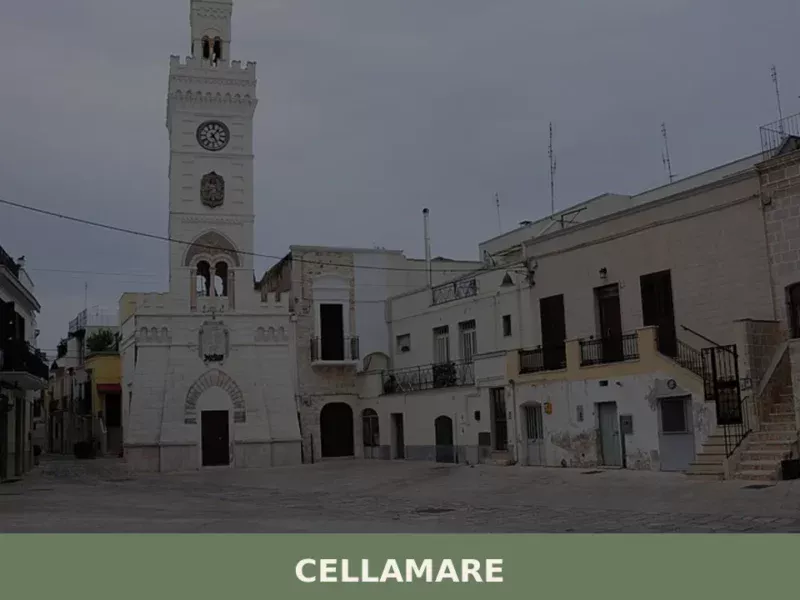
Cellamare
Plains
What to see in Cellamare, Italy: Explore this historic village, founded in 1171, located 110 m (361 ft) above sea level. Discover its grape industry and ancient origins.
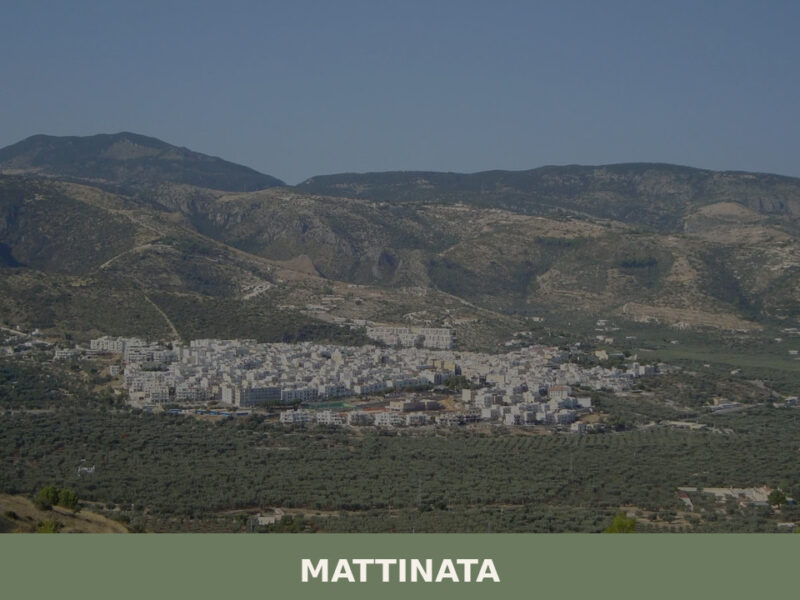
Mattinata
 Sea
Sea
Perched on the sun-drenched slopes of the Gargano promontory, Mattinata is a dazzling white jewel overlooking the Adriatic Sea. With just 5,976 inhabitants and sitting at 75 metres above sea level in the province of Foggia, this coastal village captivates visitors with its pristine bays, ancient olive groves, and a way of life shaped by […]
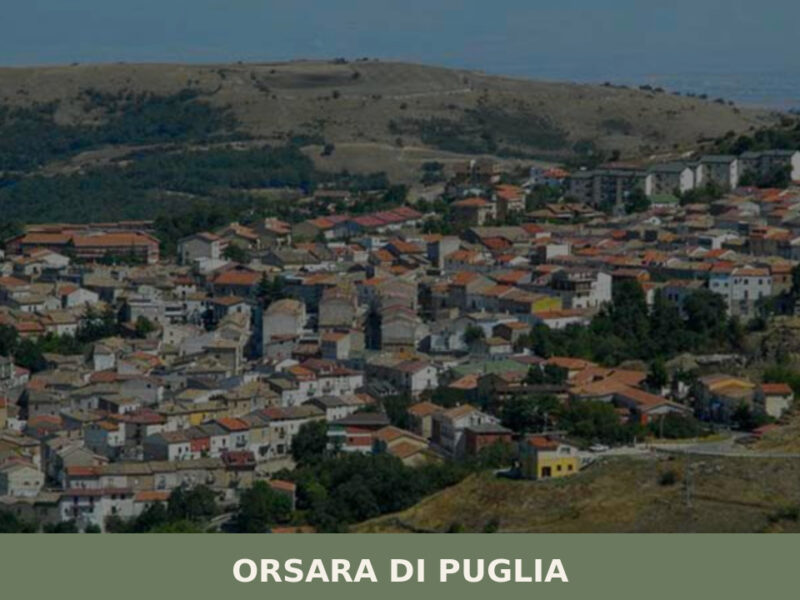
Orsara di Puglia
 Mountain
A mountain village of 2,507 people in the Foggia province, Orsara di Puglia holds sacred grottoes, medieval stonework, and one of southern Italy's most distinctive culinary traditions.
🧀 Italian traditional products


🏡 Know Giuggianello better than we do?
If you’re a local or have been there, your knowledge matters: add what’s missing or fix a detail on this page.