Standing quietly in the flat agricultural terrain of the Po Valley, the oratory of San Rocco in Cadelbosco di Sopra is one of those small religious buildings that accumulates meaning slowly — through plague years, harvest festivals, and the particular devotion of a community that has worked the same fields for centuries. This article examines the oratory in its full context: its architectural presence, the cult of San Rocco that explains its existence, and the broader setting of a commune in the province of Reggio Emilia that is rarely discussed in English-language sources.
San Rocco and the Plague: Why Oratories Were Built
To understand why a modest rural commune like Cadelbosco di Sopra would commission and maintain an oratory dedicated to San Rocco, it is necessary to understand the saint himself and the very specific terror that drove his cult across northern Italy. San Rocco — Saint Roch in English — was a French pilgrim born in Montpellier around 1350. According to his hagiography, he contracted plague while caring for the sick in central Italy, retreated to the forest to die alone, and was miraculously cured, allegedly fed by a dog who brought him bread. He returned to Montpellier, was imprisoned as a spy, and died in captivity around 1376–1379. His cult spread rapidly precisely because plague spread rapidly. By the fifteenth century, he was among the most widely invoked protectors against epidemic disease across the whole of Catholic Europe.
In the Po Valley, the pattern was consistent: a community suffered a serious outbreak of plague or another epidemic, made a vow to San Rocco, and upon survival built or dedicated a small oratory in his honour. These buildings were rarely large. They were not meant to serve the daily liturgy of an entire parish; they were votive structures, expressions of communal gratitude and ongoing propitiation. The oratory of San Rocco in Cadelbosco di Sopra belongs precisely to this tradition. It is a building born from crisis, from the kind of collective fear that made agricultural communities in the Bassa reggiana turn to intercession when medical knowledge offered very little.
The cult of San Rocco also had a practical organisational dimension. Confraternities — lay religious brotherhoods — frequently took on the maintenance of oratories dedicated to him. These confraternities collected alms, organised processions on 16 August (the feast day of San Rocco in the Roman Catholic calendar), and ensured that the building was kept in decent repair between one generation and the next. Whether a specific confraternity formally administered the oratory of San Rocco in Cadelbosco di Sopra is a question that local archival research in the diocesan records of Reggio Emilia could potentially answer; what is clear is that the oratory survived into the present, which speaks to some continuity of local care.
It is worth noting that the dedication to San Rocco is not unique to Cadelbosco di Sopra — oratories under this dedication exist in Cailungo (in San Marino), in Siena, in Spezzano, and in dozens of other Italian localities. What makes each one specific is the community around it, the date and circumstances of its founding, and the degree to which local devotional life still engages with it. In the case of Cadelbosco di Sopra, the oratory sits within a historic centre that retains its compact, grid-like logic, making it readable as part of an intentional urban fabric rather than an isolated monument.
The Oratory of San Rocco in Its Urban Setting
Cadelbosco di Sopra occupies the right bank of the Crostolo torrent, approximately 8 kilometres from Reggio Emilia. At 33 metres above sea level, the land is essentially flat in every direction. The commune covers 44 square kilometres and includes the frazioni of Cadelbosco di Sotto, Villa Argine, Villa Seta and Zurco, but the historic centre — the capoluogo — is where the oratory of San Rocco stands alongside the other principal buildings of the village.
The centre of Cadelbosco di Sopra developed according to a logic common to many settlements in the Bassa emiliana: streets meet at approximate right angles, the main public spaces are defined by the church tower and the civic buildings, and smaller religious structures punctuate the residential fabric without dominating it. The oratory of San Rocco is part of this second category. It does not compete with the parish church of San Celestino for spatial prominence; it occupies its own corner of the historic centre, visible but not imposing, functioning as an accent within the urban composition rather than its centrepiece.
This positioning is itself historically informative. Oratories of this type were typically placed near the edges of a settlement’s core, sometimes adjacent to roads that pilgrims or travellers might use, because San Rocco was also the patron of travellers and wayfarers. A location near a route connecting Cadelbosco di Sopra to the surrounding provincial road network — specifically the SP 63R of the Valico del Cerreto and the SP 358R di Castelnovo that bracket the capoluogo — would have made practical devotional sense: those leaving or entering the village might pause, as they passed, to invoke the saint’s protection.
For anyone visiting Cadelbosco di Sopra from Reggio Emilia, the approach is straightforward. The flat terrain means the village announces itself through its bell tower long before the first buildings appear. The oratory of San Rocco is best understood not as a destination reached by a long search, but as a building encountered naturally in the course of walking the historic centre — which takes no more than thirty or forty minutes to cover on foot at a leisurely pace.
Architectural Character and Interior Details
Small Italian oratories of the type represented by the oratory of San Rocco in Cadelbosco di Sopra tend to share certain architectural features that reflect both their function and their funding constraints. They are typically single-nave structures, sometimes without a separate apse, with a façade that may carry a modest decorative programme — a lunette above the door, a dedicatory inscription, occasionally a niche with a statue of the saint — and an interior whose quality depends entirely on the generosity of local donors over time.
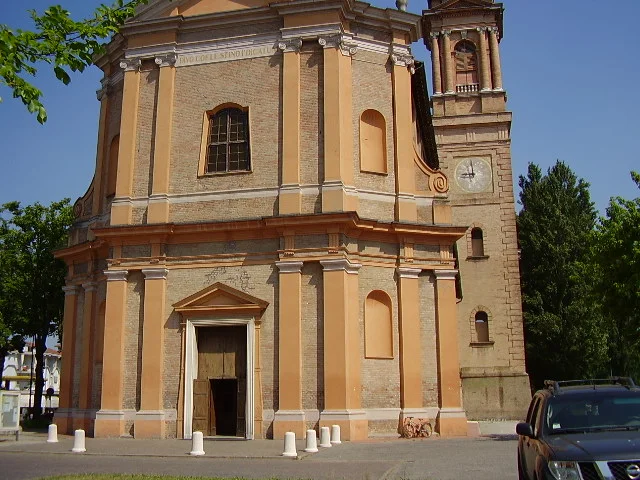
The oratory of San Rocco, as it stands in the historic centre of Cadelbosco di Sopra, represents this category of vernacular sacred architecture that is extremely common in Emilia-Romagna yet rarely documented in systematic English-language publications. The building’s exterior reflects the restrained aesthetic of the Reggiana plain: brick construction, as is standard throughout the province, with proportions that avoid both the monumentality of major church architecture and the improvised quality of purely utilitarian structures. It is a deliberate building, commissioned and executed with care, even if without the resources of a cathedral chapter.
The interior of a San Rocco oratory, by convention, would typically include a painted or sculpted image of the saint — most commonly depicted as a pilgrim lifting his robe to display the plague bubo on his thigh, accompanied by the dog and sometimes by an angel. Whether the specific interior of the Cadelbosco di Sopra oratory retains original devotional imagery, or whether successive restorations have altered the decorative programme, is a matter for direct inspection and local archival consultation. What can be stated with confidence is that the building has been maintained within the fabric of the historic centre, which itself preserves the spatial logic of a bonifica settlement that took shape progressively from the medieval period onwards.
Emilia-Romagna’s Romanesque and early Renaissance religious buildings frequently exhibit the integration of local brick craftsmanship with imported decorative elements — terracotta friezes, Istrian stone details, painted plaster interiors. In smaller oratories, the decorative register is usually more modest, relying on local painters and craftsmen rather than artists of regional reputation. This is not a deficiency; it is precisely what makes buildings like the oratory of San Rocco historically legible as expressions of local devotional culture rather than of external patronage.
One relevant comparison within Emilia-Romagna is offered by other oratories dedicated to San Rocco in the region, such as the Oratorio di San Rocco in Spezzano, which similarly combines a vernacular exterior with an interior that accumulated votive offerings and paintings over several centuries. Each of these buildings, taken individually, might seem marginal; taken together, they form a network of plague-era devotional architecture that maps the spread of epidemic disease and communal response across the Po Valley.
The Parish Church of San Celestino: A Comparison in Scale
To properly situate the oratory of San Rocco within the religious landscape of Cadelbosco di Sopra, it is useful to consider it in relation to the commune’s principal sacred building: the parish church of San Celestino Papa. San Celestino I was a fifth-century pope, best known in theological history for his condemnation of the Pelagian heresy and for sending Saint Patrick to Ireland, though the latter attribution is disputed by modern historians. A parish dedicated to this relatively uncommon papal saint suggests that the church’s dedication may reflect specific historical circumstances — perhaps the patronage of a particular ecclesiastical institution or a local devotion with its own distinct genealogy.
The church of San Celestino is the dominant religious structure of Cadelbosco di Sopra. Photographic documentation (including images catalogued on Wikimedia Commons) shows a building with a formal façade and a bell tower that rises above the roofline of the surrounding historic centre. This is a fully parochial church, serving the liturgical needs of the entire commune, with all the spatial and decorative requirements that this implies: a nave of sufficient size for congregational use, a presbytery, a sacristy, and the accumulated furnishings of centuries of parish life.
The oratory of San Rocco operates on an entirely different scale and with a different institutional logic. It is not a parochial building; it was never intended to serve the regular liturgical cycle of the community as a whole. Its function was specific — the veneration of San Rocco, the organisation of his feast day, the reception of votive offerings from those who had survived illness or danger — and its architecture reflects this specificity. Where the church of San Celestino conveys institutional permanence, the oratory of San Rocco communicates communal vulnerability and its resolution through devotion.
This distinction matters for visitors. Those who arrive in Cadelbosco di Sopra expecting to find a monument on the scale of the urban oratories of Bologna or Modena will find instead something more characteristic of the Bassa reggiana: a building that earns its significance through context and continuity rather than through architectural ambition.
Cadelbosco di Sopra: Land, Water and the Making of a Commune
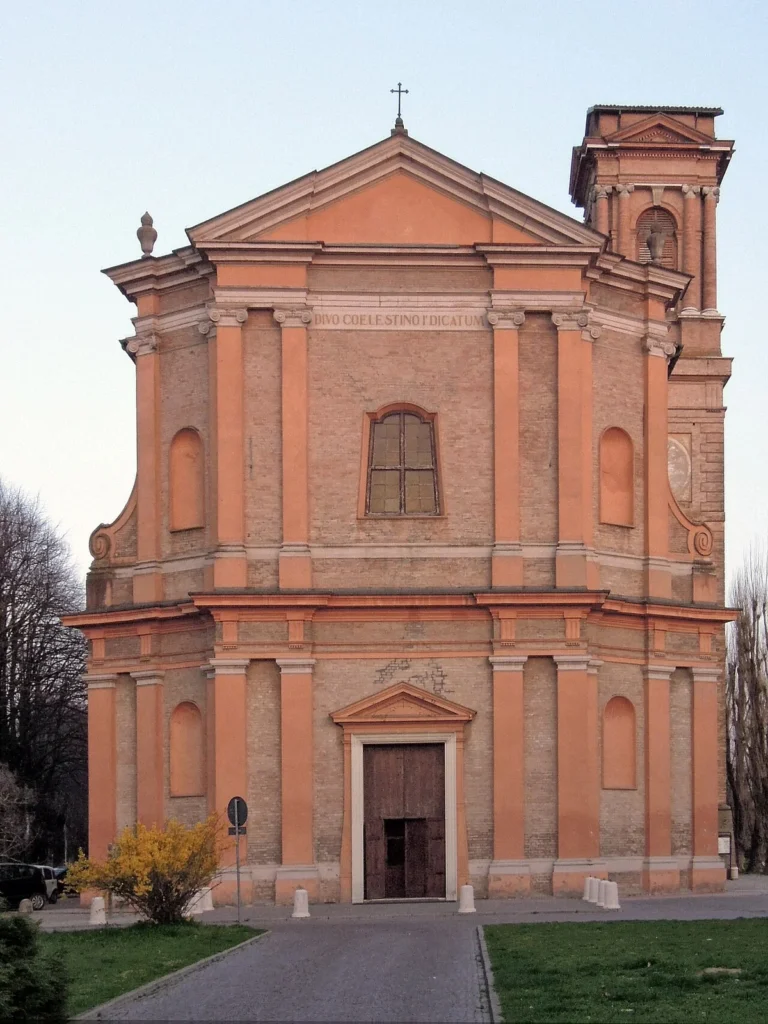
The physical setting of Cadelbosco di Sopra is inseparable from the history of the buildings within it, including the oratory of San Rocco. The commune sits on the right bank of the Crostolo torrent in the Pianura Padana, in a landscape that was not always as agricultural and ordered as it appears today. The name itself — derived from the Latin medieval Castrum de Bosco, meaning “castle of the wood” — recalls a time when the area was covered by forest and wetland, before centuries of drainage and clearance transformed it into the flat, intensively farmed plain visible today.
The earliest documentary reference to the settlement appears in a deed of donation dated 6 April 1032, drawn up by a notary named Guidone in the castle of Vicozoaro — a name derived from the Latin Vicus Zearius, meaning a village where zea (a form of spelt) was cultivated. By 1215, a certain Gherardo Del Bosco held the castle and the surrounding corte, subsequently ceding it to the monastery of San Prospero di Reggio. These medieval transfers of ownership shaped the agricultural and ecclesiastical organisation of the territory for centuries.
The Benedictines played a formative role. The colony of Roarolo (now called Traghettino) was first settled by Benedictine monks from the abbey of Canossa before the year 1000. From 1219 onwards, through a series of land exchanges, ownership passed to the Benedictines of the convent of San Giovanni in Parma, who held it without interruption until the French Revolutionary period, when ecclesiastical properties across northern Italy were systematically confiscated and redistributed.
This long history of monastic land management explains much about the physical organisation of the territory. The drainage canals, the straight field boundaries, the geometry of roads — all of these reflect centuries of institutional agriculture, first under monastic supervision and later under the governance of the Este Duchy of Reggio and its successors. The climate added its own demands: a humid subtropical classification (Köppen Cfa) means hot, humid summers with temperatures occasionally exceeding 35°C, cold winters with frost and moderate snowfall, and violent summer thunderstorms that can produce severe hail damage to crops. It was precisely this agricultural vulnerability — to weather, to disease, to flood — that made devotional buildings like the oratory of San Rocco so structurally necessary to a community’s psychological and social life.
The commune today has a population of approximately 10,510 inhabitants, spread across the capoluogo and the frazioni of Cadelbosco di Sotto, Villa Argine, Villa Seta and Zurco. Population density stands at around 242 inhabitants per square kilometre, which is consistent with a productive agricultural commune in the Reggiana plain rather than a hill town or an urbanised centre. The commune borders Guastalla to the north, Novellara and Bagnolo in Piano to the east, Reggio Emilia to the south, and Campegine, Castelnovo di Sotto and Gualtieri to the west — a geography that places it firmly within the network of mid-sized communes that constitute the agricultural backbone of the province.
Religious Life and Devotional Practices in the Bassa Reggiana
The oratory of San Rocco in Cadelbosco di Sopra does not exist in isolation. It is part of a broader pattern of small religious buildings — oratories, chapels, roadside shrines — that punctuate the landscape of the Bassa reggiana with a density that reflects the intensity of Catholic devotional practice in the region across the medieval and early modern periods. Understanding this pattern is essential for interpreting what the oratory represents.
In Emilia-Romagna, the Reformation made very limited inroads. The region remained firmly within the orbit of the Este duchy and, later, the Papal Legations, both of which maintained strong institutional ties to Rome. The Council of Trent (1545–1563) actively encouraged the veneration of saints and the maintenance of sacred images and buildings as a counter to Protestant iconoclasm, and this had measurable consequences on the built environment: oratories were constructed or renovated, confraternities were reorganised under episcopal oversight, and saints like San Rocco received renewed institutional endorsement precisely because their cults were legible expressions of orthodox Catholic practice.
The feast of San Rocco on 16 August falls within the period of the summer agricultural cycle that is also, historically, the season of greatest epidemic risk — summer heat accelerated the spread of waterborne and vector-borne diseases in the pre-modern period. A feast celebrated in mid-August was therefore not only a religious observance but also a form of collective ritual management of risk, a moment in the agricultural year when the community gathered to reaffirm its relationship with the saint who was believed to stand between them and the worst that the season could bring.
In Cadelbosco di Sopra, as in comparable communes across the Bassa reggiana, local feste have historically combined religious and secular elements: a morning Mass in the oratory or the parish church, a procession through the streets of the historic centre, and an afternoon of community gathering that might include markets, music, and collective meals. The specific form that the celebration of San Rocco’s feast has taken in Cadelbosco di Sopra over the centuries — and whether it continues in any recognisable form today — is a question that would require consultation with local cultural associations and the parish records of the church of San Celestino.
What can be observed more generally is that the religious geography of the Bassa reggiana reflects a layered history of devotion. The great Marian sanctuaries of the region, several of which carry pontifical decrees of canonical coronation granted by the Holy See (Italy has counted 629 such crowned Marian images since the first coronation in 1631), coexist with a dense network of smaller, saint-specific buildings like the oratory of San Rocco — buildings that addressed more particular anxieties and more specific communities. Together, these two levels of the sacred landscape constituted the full range of religious provision available to communities like Cadelbosco di Sopra across the centuries.
How to Reach the Oratory and Plan a Visit
Arriving in Cadelbosco di Sopra from Reggio Emilia is a straightforward proposition. The two centres are separated by approximately 8 kilometres — 15 kilometres by the most direct road route — and the drive crosses a landscape of irrigation channels, poplar rows and flat arable fields that is characteristic of the lower Po Valley in any season. There is no mountain pass, no significant topographic variation; the journey is entirely across the pianura.
By car, the most direct route from Reggio Emilia follows the provincial road network westward, passing through the agricultural hinterland of the provincial capital. The commune is served by the SP 63R and the SP 358R, which bracket the capoluogo to the north and south respectively. Parking in the historic centre is generally possible without difficulty — this is not a tourist-saturated destination where parking has become a logistical challenge.
Public transport options from Reggio Emilia exist, though they require attention to local bus timetables, which vary by season and day of the week. Visitors relying on buses should consult the current schedules of the provincial public transport operator before travelling, as service frequency to communes of this size is typically oriented towards commuter patterns rather than tourist convenience.
Regarding the oratory of San Rocco specifically: small oratories of this type in Italian communes are not always open to the public outside of feast days and scheduled religious functions. The building may be kept locked between services, as is standard practice for small sacred buildings in Italy where security and conservation concerns are balanced against the tradition of open access. Visitors wishing to enter the interior of the oratory of San Rocco should contact the parish of San Celestino in Cadelbosco di Sopra directly, or enquire at the municipal offices (whose official website is comune.cadelbosco-di-sopra.re.it) for current information about opening times and access arrangements.
The best moment to encounter the oratory in its most active devotional context is 16 August, the feast of San Rocco. Whether or not the local celebration in Cadelbosco di Sopra involves a formal liturgical event in the oratory itself, this date is when the building’s founding rationale is most directly legible. The summer climate — hot, with the possibility of afternoon thunderstorms typical of the Cfa classification — means that August visits to the Reggiana plain require some preparation: light clothing, water, and awareness that the flat landscape offers very little natural shade.
For visitors who wish to combine a visit to the oratory of San Rocco with a broader engagement with the commune, Cadelbosco di Sopra offers several points of interest in close proximity: the parish church of San Celestino, the compact historic centre with its bonifica-era street plan, and the surrounding agricultural landscape with its drainage canals and poplar avenues. The local gastronomic tradition — rooted in the products of the Reggiana plain, including Parmigiano-Reggiano produced in the nearby countryside and the cured meats characteristic of the province — provides a practical reason to extend the visit beyond a purely architectural itinerary.
FAQ: Common Questions About the Oratory of San Rocco
What is the oratory of San Rocco in Cadelbosco di Sopra?
The oratory of San Rocco is a small religious building in the historic centre of Cadelbosco di Sopra, in the province of Reggio Emilia, Emilia-Romagna. It is dedicated to Saint Roch (San Rocco in Italian), a fourteenth-century French pilgrim venerated across Catholic Europe as a protector against plague and epidemic disease. Like many oratories of this dedication in northern Italy, it was almost certainly built as a votive structure following a communal vow made during a period of epidemic crisis. The oratory forms part of the architectural fabric of the historic centre alongside the parish church of San Celestino Papa.
When was the oratory of San Rocco built?
The precise construction date of the oratory of San Rocco in Cadelbosco di Sopra is not documented in the sources currently available in the public domain. Oratories dedicated to San Rocco across the Po Valley were typically built between the late fourteenth and the seventeenth century, with the greatest concentration of foundations occurring during the major plague outbreaks of the fifteenth and seventeenth centuries. Establishing the specific foundation date for the Cadelbosco di Sopra oratory would require consultation of the diocesan archives of Reggio Emilia or the historical records of the parish of San Celestino.
Is the oratory of San Rocco open to visitors?
Small oratories of this type in Italian communes are frequently kept locked outside of religious functions and feast days. Access is typically possible by arrangement with the local parish. Visitors wishing to enter the interior of the oratory of San Rocco in Cadelbosco di Sopra should contact the parish of San Celestino or the municipal offices of the Comune di Cadelbosco di Sopra. The official municipal website (comune.cadelbosco-di-sopra.re.it) provides current contact information.
What is the feast day of San Rocco, and is it celebrated in Cadelbosco di Sopra?
The feast of San Rocco is celebrated on 16 August in the Roman Catholic calendar. Across the Bassa reggiana and northern Italy more generally, this feast has historically been marked by a Mass, a procession, and community gathering. Whether a specific public celebration continues in Cadelbosco di Sopra on 16 August, and in what form, is best confirmed by contacting the local parish or cultural associations directly. The feast falls in the height of summer, when the Po Valley experiences its hottest and most humid conditions.
How do I get to the oratory of San Rocco in Cadelbosco di Sopra?
The oratory of San Rocco is located in the historic centre of Cadelbosco di Sopra, approximately 8 kilometres from Reggio Emilia by direct line (15 kilometres by road). By car, the commune is reached via the provincial road network west of Reggio Emilia. Public transport from Reggio Emilia exists in the form of local bus services, though timetables should be consulted in advance as frequencies are primarily designed for commuter use. Once in the historic centre, the oratory is reachable on foot as part of a walking tour of the capoluogo.
Are there other monuments to visit alongside the oratory of San Rocco?
Yes. The historic centre of Cadelbosco di Sopra includes the parish church of San Celestino Papa, which is the principal religious building of the commune and substantially larger than the oratory of San Rocco. The street plan of the capoluogo itself reflects the organised settlement logic of the bonifica tradition in the Bassa emiliana. The surrounding countryside, with its drainage canals, poplar avenues and flat agricultural fields, forms the environmental context that shaped the commune over a period of several centuries. For a broader orientation, the village profile at Cadelbosco di Sopra provides a useful starting point.
Why are there so many oratories dedicated to San Rocco in Italy?
The density of San Rocco oratories in Italy — from Cailungo in San Marino to Siena in Tuscany, from Spezzano in Emilia to dozens of towns across the Veneto and Lombardy — reflects the scale and frequency of plague epidemics in the Italian peninsula between the fourteenth and the seventeenth century. The Black Death of 1347–1351 killed between a third and half of Europe’s population. Subsequent outbreaks in 1361, 1400, 1467, 1522–1523, and 1629–1631 (the latter recorded in Manzoni’s I promessi sposi) repeatedly devastated communities with no effective medical response. San Rocco, whose legend was specifically tied to plague survival, offered a devotional framework for communities seeking supernatural protection. Each oratory represents a specific community’s response to specific epidemic events — which is why the oratory of San Rocco in Cadelbosco di Sopra, however modest in scale, carries genuine historical weight.
What does the interior of a typical San Rocco oratory contain?
By convention, an oratory dedicated to San Rocco typically contains a painted or sculpted image of the saint, almost invariably depicted in his standard iconographic guise: a pilgrim’s cloak, a staff, a broad-brimmed hat, and the gesture of lifting the hem of his robe to display the plague bubo on his thigh. This last detail is iconographically specific and immediately identifies the subject. The dog that fed him in the forest is usually present at his feet, and an angel is sometimes depicted above or beside him. Votive offerings — ex-voto plaques — may also be present if the oratory has received them over the years. The specific condition and contents of the interior of the oratory of San Rocco in Cadelbosco di Sopra are best established by a direct visit during an opening period.