


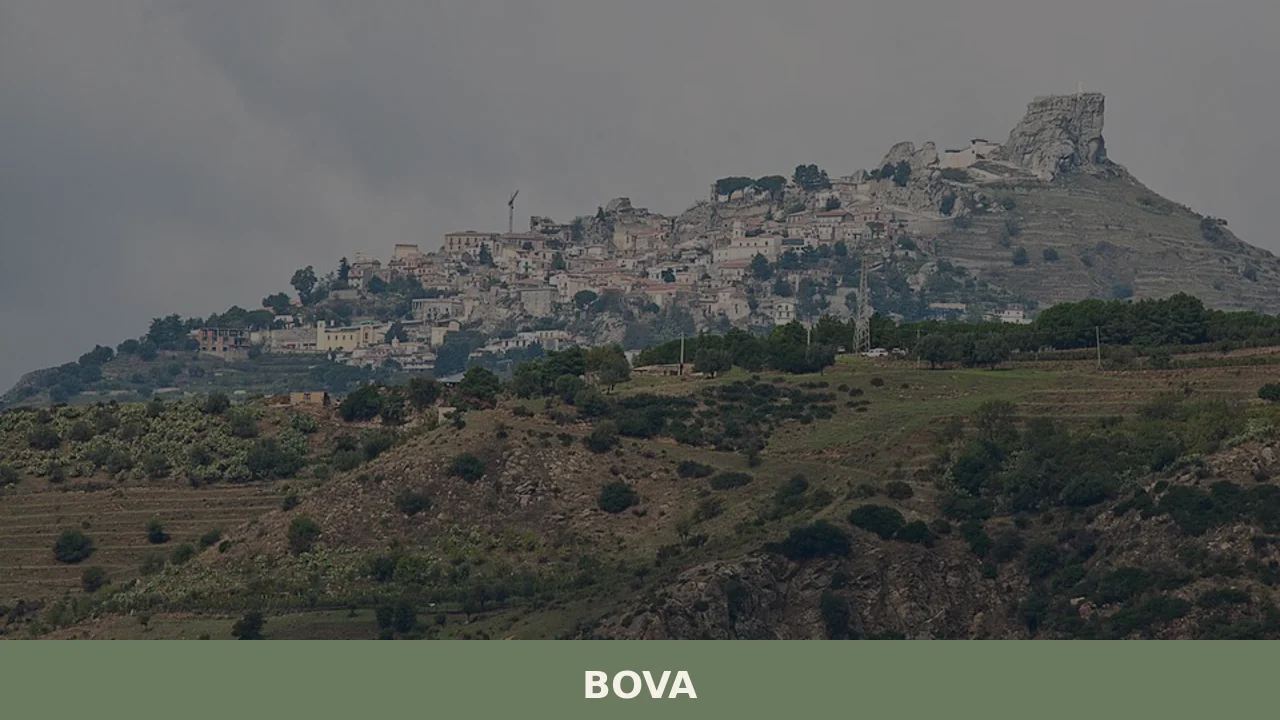
Bova
 Mountain
What to see in Bova, Calabria, Italy: a hilltop comune at 900 m with Greek-Bovesian heritage, Norman history and local cuisine. Discover top attractions and travel tips.
Discover Bova
At 900 metres (2,953 ft) above sea level, the stone streets of Bova carry the outline of a settlement that dates to the Neolithic. The borough of San Pasquale, below in the valley, marks the site of an ancient Greek city known as Delia, later subjected by Syracuse. Above it, on a slope of the Aspromonte, the current town rose after the Vandals sacked the coastal settlement in 440 CE, and the population moved inland. The elevation did not guarantee safety: in 953 the Saracens attacked, deporting many inhabitants as slaves to Africa on the orders of the Sicilian Muslim emir Hassan al-Kalbi.
Knowing what to see in Bova means understanding a place that carries several overlapping identities within a compact area of the Province of Reggio Calabria.
The comune sits about 25 kilometres (16 mi) southeast of Reggio Calabria and about 120 kilometres (75 mi) southwest of Catanzaro, and it holds membership in I Borghi più belli d’Italia, the national association of Italy’s most notable small municipalities. Visitors to Bova find a surviving Griko-speaking community — one of only two in southern Italy — a Norman ecclesiastical history, coastal watchtowers from the 16th century, and a local food tradition shaped by Greek and Arab influence.
History of Bova
Human presence in the territory of Bova is documented from the Neolithic period onwards. Before Roman rule, the Ausones inhabited the area. Greek colonists later established a city called Delia, or Deri, in what is now the borough of San Pasquale. That settlement became entangled in the conflicts between the major Greek centres of the region — Reggio, Locri and Syracuse — and was eventually brought under Syracusan control. After the Roman conquest, it acquired the status of a town with citizenship rights, a legal distinction that gave its inhabitants formal standing within the Roman administrative structure.
The collapse of Roman authority exposed the coastal settlements to new pressures.
In 440 CE, Delia was ravaged by the Vandals, and the unceasing raids from the sea forced most communities in the area to abandon their coastal positions and seek safer ground inland. The inhabitants of Delia founded the current Bova on a slope of the Aspromonte at approximately 900 metres (2,953 ft) in elevation. The move offered some protection, but not immunity: the Saracens attacked repeatedly, and in 953 they sacked the town, deporting many of its people to Africa under the command of the Sicilian Muslim emir Hassan al-Kalbi. The Arabs returned and besieged Bova again in 1075. These repeated incursions explain the defensive logic behind the town’s position and the fortifications that would follow in later centuries.
Under the Normans in the 11th century, Bova became an ecclesiastical fief under the Archbishop of Reggio, an arrangement that remained in place until the abolition of feudalism in 1806. During the 16th century, the territory received numerous coastal watchtowers built to defend against raids by African pirates — several of these structures survive in varying states of preservation. In World War II the town was heavily bombed by the Allied forces in 1943, causing significant structural damage to parts of the urban fabric.
Throughout these periods, the town maintained a Greek-Bovesian speaking population, belonging to the linguistic area known as Bovesia — one of the two surviving Griko-speaking zones of southern Italy, a fact that makes the town’s cultural record particularly significant for researchers and travellers interested in the Greek heritage of Magna Graecia. Those travelling through the broader region of Calabria may also find points of comparison in Altomonte, another Calabrian comune with a well-documented medieval ecclesiastical history.
What to see in Bova, Calabria: top attractions
The Cathedral of Santa Maria Assunta
The Cathedral of Santa Maria Assunta occupies a position near the highest point of the town, and its stone fabric reflects the accumulated interventions of Norman, medieval and later periods. The Norman period established Bova as an ecclesiastical fief under the Archbishop of Reggio in the 11th century, and the cathedral is the direct institutional expression of that designation. Standing at the entrance, the visitor looks down over the Aspromonte slopes and across toward the Ionian coast. Inside, the proportions of the nave and the surviving decorative elements document several centuries of liturgical use. The cathedral remains an active place of worship, so visiting in the morning on non-feast days is generally less disruptive to the local community.
The Norman Castle Ruins
The ruins of the Norman castle stand at the upper margin of the settlement, at close to 900 metres (2,953 ft) in elevation.
The castle’s construction corresponds to the Norman reorganisation of the territory in the 11th century, when Bova was brought under the ecclesiastical and administrative control of the Archbishop of Reggio. The walls that remain give the clearest indication of the defensive logic of the site: the position commands a wide view over the Aspromonte and toward the sea, making approach from below visible at considerable distance. Reaching the ruins requires a short climb on uneven stone ground. The stonework itself — coursed masonry with later repairs — is worth examining for the different build phases it records.
The Greek-Bovesian Linguistic Heritage and Museum
Bova is one of the Calabrian Greek, or Griko-speaking villages of the Bovesia area, one of only two surviving Griko-speaking zones in southern Italy. The language, descended from the Greek spoken by colonists who settled this part of Magna Graecia, is still used by a portion of the population and documented in local cultural institutions. The town maintains spaces dedicated to this linguistic and cultural tradition, where visitors can encounter Calabrian Greek texts, recorded oral material and contextual documentation. For anyone researching the Greek diaspora in Italy or the persistence of minority languages in the Mediterranean, Bova provides a specific, geographically grounded case study rather than an abstract claim about cultural survival.
The 16th-Century Coastal Watchtowers
During the 16th century, Bova’s territory was equipped with a network of coastal watchtowers erected to counter raids by African pirates operating along the Ionian coast.
Several of these towers survive and can be reached from the town by descending toward the coast, a drop from 900 metres (2,953 ft) to sea level that passes through the agricultural and forested bands of the lower Aspromonte. Each tower was positioned to maintain a line of sight with the adjacent tower, so that warning signals could be relayed along the coast with minimal delay. Examining the towers from ground level reveals the construction technique: rough stone bonded with lime mortar, with a tapered cylindrical or square profile designed to minimise the structural impact of cannon fire. The towers are most accessible in spring and early autumn, when the path down from the town is not subject to summer heat or winter rain.
The Borough of San Pasquale and the Site of Ancient Delia
The borough of San Pasquale, located in the lower part of the Bova municipality, marks the site of the ancient Greek city known as Delia or Deri, founded by Greek colonists and later absorbed into the Syracusan sphere of influence. Archaeological findings in the area confirm human activity from the Neolithic period onwards. After the Vandal raid of 440 CE the population abandoned this coastal-facing site and moved up to found the current hilltop town.
Visiting San Pasquale gives a direct sense of the geographic logic behind that migration: the lower site is exposed, relatively flat and visible from the sea, while the upper town is defensible. The distance between the two points — less than a few kilometres as the crow flies but a significant change in elevation — illustrates in physical terms why the community made the choices it did.
Local food and typical products of Bova
The food culture of Bova reflects the layered settlement history of the Bovesia area. Greek colonisation, Roman administration, Arab raids and Norman rule each left their mark on the agricultural and culinary practices of the territory. The Aspromonte provides the vertical range — from coastal citrus groves and olive trees at low elevation to chestnut forests and pasture higher up — that defines what is grown and raised within the municipality’s boundaries. The Ionian coast, reachable within a few kilometres, historically supplied fish that was preserved with salt and incorporated into dishes alongside inland ingredients.
The local table draws on ingredients produced within the Aspromonte slopes.
Pitta ‘mpigliata is a pastry typical of the broader Reggio Calabria area, filled with figs, honey, nuts and spices, then folded and baked until the exterior is firm and the interior dense and sweet. Frittole — small fried pork pieces rendered from the fat trim of the pig — appear in the colder months and reflect the tradition of whole-animal processing that remains common in Calabrian inland communities. Local pecorino, produced from sheep grazed on Aspromonte pasture, is eaten at different stages of ageing: fresh, when it is soft and milky, or matured for several weeks until the paste firms and the rind becomes dry and amber-coloured. Nduja, the soft spreadable cured pork product made with Calabrian chilli, is widely available in the Reggio Calabria province and is used in Bova both as a table product and as a cooking ingredient worked into sauces and bread.
The olive groves on the lower slopes of the Aspromonte produce oil that is used throughout the local kitchen. Calabria holds several DOP designations for olive oil produced in specific zones of the region, though the particular DOP boundaries should be verified against current official registers for the Bova municipality specifically. Travellers interested in buying local products directly should look for small producers operating in the area around Bova and the broader Bovesia zone, where family-scale operations sell oil, preserved vegetables and cured meats through farm gates or local markets rather than through commercial retail channels.
Festivals, events and traditions of Bova
The religious calendar of Bova organises the town’s collective life around the feasts of its patron saints and the broader cycle of Catholic observance.
The Greek-Bovesian cultural tradition adds a distinct layer to these events: local festivals in Bova have historically incorporated elements of the Griko linguistic and musical heritage, including songs and oral recitations in Calabrian Greek. These are not staged performances for visitors but active expressions of a community that has maintained this tradition across generations, and encountering them during a festival period gives a substantially different impression of the town than visiting outside the festival season.
Summer is the primary season for outdoor festivals and cultural events in Bova, as the elevation makes the town significantly cooler than the Ionian coast below during July and August. Events celebrating the Griko heritage, including gatherings focused on Calabrian Greek language, music and oral tradition, are typically held in this period and draw participants from across the Bovesia area and beyond.
Visitors planning to attend should verify current programming with the municipal office, as the specific dates and formats of cultural events can shift between years. The feasts tied to the Catholic liturgical calendar — particularly those of the summer patron saint celebrations — include processions through the town’s stone streets, with the religious image carried through the upper and lower quarters of the settlement.
When to visit Bova, Italy and how to get there
The best time to visit Bova depends on what the traveller is looking for. Spring, from April through early June, offers mild temperatures at 900 metres (2,953 ft) and clear conditions that make the descent to the coastal towers and the views from the castle ruins most rewarding. The summer months of July and August are the peak season for cultural events tied to the Griko heritage, and the elevation provides relief from the intense heat of the Ionian coast. Autumn, from September through October, is suitable for those who prefer fewer visitors and want to see the chestnut and forest zones of the Aspromonte in autumn colour. Winter brings cold and occasional snow at this altitude, and some local services operate on reduced hours.
Bova sits about 25 kilometres (16 mi) southeast of Reggio Calabria, making it a realistic day trip from the city. By car, the most practical approach is via the A2 Autostrada del Mediterraneo, exiting at Bagnara Calabra or Reggio Calabria Sud depending on direction, then following provincial roads into the Aspromonte toward Bova.
The road climbs steeply from the coast and requires attention, particularly on the upper sections. The nearest major rail hub is Reggio Calabria Centrale, served by Trenitalia connections from Naples, Rome and other major Italian cities. From Rome, the high-speed rail journey to Reggio Calabria takes approximately three hours, after which a car or local transport is necessary to reach Bova. The nearest commercial airport is Reggio Calabria Airport (Aeroporto dello Stretto), approximately 30 kilometres (18.6 mi) from Bova. Visitors arriving internationally more commonly use Lamezia Terme Airport, located approximately 130 kilometres (81 mi) north of Reggio Calabria, and then travel south by rail or car. For international visitors, it is worth noting that English is not widely spoken in smaller shops and local establishments in this part of Calabria, and carrying euro cash is advisable as card payment terminals are not universal in the town.
Travellers making the drive from the Reggio Calabria side can reasonably extend their itinerary to include other parts of the Aspromonte and the broader Bovesia zone. Those interested in Calabrian villages with distinct historical profiles may also consider a stop at Aiello Calabro, which sits further north in the region and offers a different geographic and historical context. For travellers who want to understand what to see in Bova within the wider framework of Calabrian village culture, it helps to approach the town as a specific case within a broader pattern of Aspromonte settlement rather than as an isolated destination.
The village of Albidona, in the northern part of Calabria, shares a similar pattern of elevated inland positioning that reflects the same historical logic of coastal exposure and defensive retreat visible in Bova’s own founding. Closer to the Reggio Calabria province, the town of Bianchi offers another point of reference for travellers exploring the Calabrian interior, and what to see in Bova can serve as the anchor for a multi-village itinerary through this part of southern Italy.
Frequently asked questions about Bova
What is the best time to visit Bova?
Spring (April–June) and early autumn (September–October) are the most comfortable seasons to visit Bova. Temperatures at 915 metres are mild, the paths down to the coastal watchtowers are accessible, and the Aspromonte landscape is at its most vivid. Summer brings cooler air than the Ionian coast below, making the village a pleasant refuge from coastal heat. Winter can bring snow and rain, complicating access on mountain roads. The feast of the patron Sant'Leo d'Africo is a local reference point for timing a visit around a traditional religious celebration.
What are the historical origins of Bova?
Human presence in the Bova territory dates to the Neolithic. Greek colonists founded a city called Delia (or Deri) in what is now the borough of San Pasquale, later absorbed into the Syracusan sphere. After the Vandals sacked the coastal settlement in 440 CE, inhabitants moved inland and founded Bova at around 900 metres on the Aspromonte. The Saracens attacked in 953, deporting many residents to Africa under emir Hassan al-Kalbi, and besieged the town again in 1075. Under the Normans in the 11th century, Bova became an ecclesiastical fief of the Archbishop of Reggio Calabria.
What to see in Bova? Main monuments and landmarks
The Cathedral of Santa Maria Assunta, near the town's highest point, reflects Norman origins and centuries of later additions; it remains active so morning visits on non-feast days are least intrusive. The Norman castle ruins at the upper edge of the settlement offer panoramic views over the Aspromonte and toward the Ionian coast. The borough of San Pasquale, lower in the valley, marks the site of ancient Delia. The 16th-century coastal watchtowers, descending toward the Ionian shore, are best reached in spring or early autumn. No admission fees are documented for the castle ruins or towers.
What are the main natural or scenic attractions of Bova?
Bova sits on a slope of the Aspromonte, part of the Parco Nazionale dell'Aspromonte, which surrounds the municipality. The vertical range within the commune is exceptional: from chestnut forests and upland pasture near the town at 915 metres down through olive groves and citrus orchards to the Ionian coastline a few kilometres away. The descent toward the coastal watchtowers passes through this varied landscape and gives a clear sense of why the territory supported both inland and coastal communities across millennia.
Where to take the best photos in Bova?
The Norman castle ruins at the upper margin of the town provide the widest panoramic viewpoint, with sightlines across the Aspromonte slopes and toward the Ionian Sea. The stone streets around the Cathedral of Santa Maria Assunta offer characteristic compositions of medieval architecture against a mountain backdrop. From the paths descending toward the coastal watchtowers, the contrast between the forested hillside and the Ionian coastline below creates strong landscape images, particularly in the clear light of spring and early autumn mornings.
Are there museums, churches or historic buildings to visit in Bova?
The Cathedral of Santa Maria Assunta is the principal ecclesiastical monument, with Norman origins and successive medieval and later interventions. The Norman castle ruins document the 11th-century reorganisation of the territory. Bova also maintains spaces dedicated to its Griko linguistic and cultural heritage, where visitors can encounter Calabrian Greek texts, recorded oral material and contextual documentation — particularly relevant given that Bova is one of only two surviving Griko-speaking zones in southern Italy. Specific opening hours for these cultural spaces are not officially published online; local enquiry on arrival is advisable.
What can you do in Bova? Activities and experiences
Bova is well suited to slow, exploratory visits on foot. Walking the stone streets of the historic centre, examining the Norman castle ruins and visiting the cathedral fills a morning. The descent toward the 16th-century coastal watchtowers on the Ionian shore is a documented route through varied Aspromonte vegetation. The town's Griko cultural heritage offers a specific intellectual itinerary for visitors interested in minority languages and the legacy of Magna Graecia. Local food itineraries built around Aspromonte products — pecorino, pitta 'mpigliata, frittole — can be combined with a visit to the borough of San Pasquale.
Who is Bova suitable for? Families, couples, hikers, solo travelers?
Bova suits travellers who prioritise historical depth and cultural distinctiveness over resort amenities. History enthusiasts and researchers will find the Griko linguistic heritage and the layered Greek-Roman-Norman-Arab history substantive. Hikers benefit from the Aspromonte setting and the route down to the coastal watchtowers. Couples seeking a quiet, atmospheric hilltop village away from mass tourism will find the stone streets and panoramic position appealing. Families with children who walk confidently on uneven ground can manage the town; the castle ruins and watchtowers add exploratory interest. The village's small size and limited commercial infrastructure make it less suited to travellers expecting a wide range of services.
What to eat in Bova? Local products and specialties
Bova's food tradition draws on Aspromonte ingredients and reflects Greek, Arab and Norman influences. Pitta 'mpigliata is a baked pastry filled with figs, honey, nuts and spices, characteristic of the Reggio Calabria area. Frittole — fried pork pieces from fat trimmings — appear in winter and reflect the inland tradition of whole-animal processing. Local pecorino, from sheep grazed on Aspromonte pasture, is eaten fresh or aged. Olive oil and citrus from the lower slopes of the municipality complete the local pantry. The Ionian coast nearby historically contributed salt-preserved fish to inland dishes.
📷 Photo Gallery — Bova
Nearby Villages near Bova
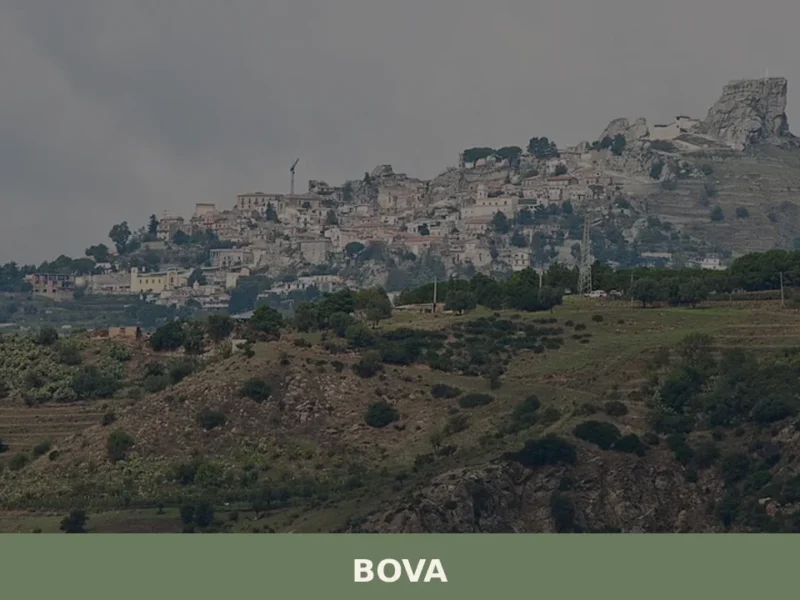
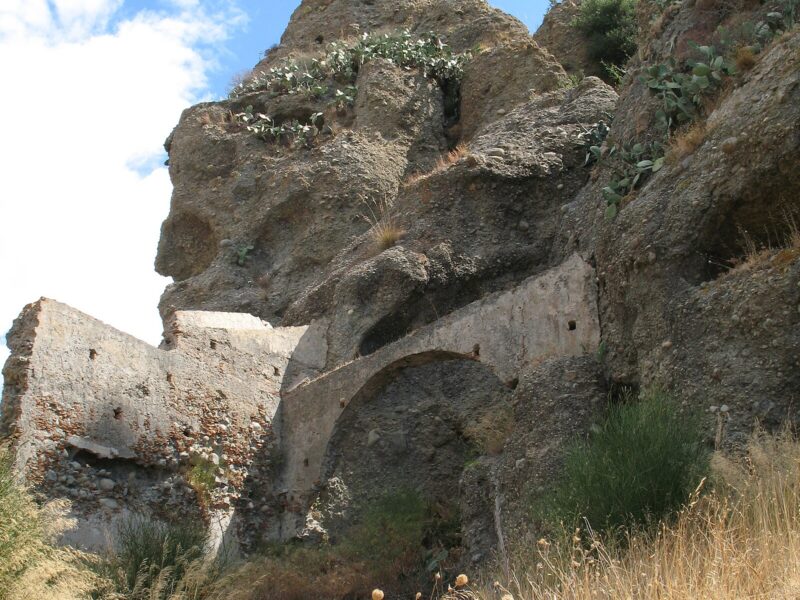
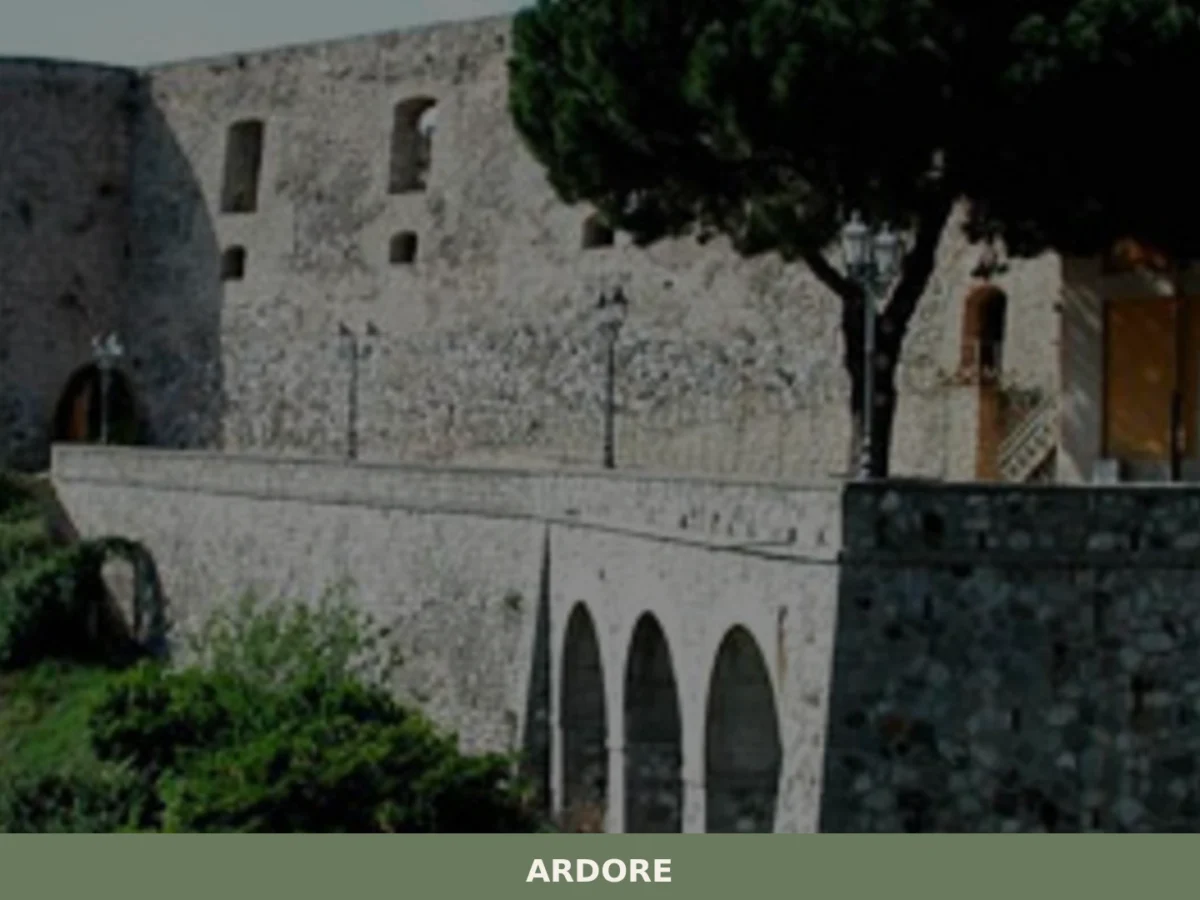
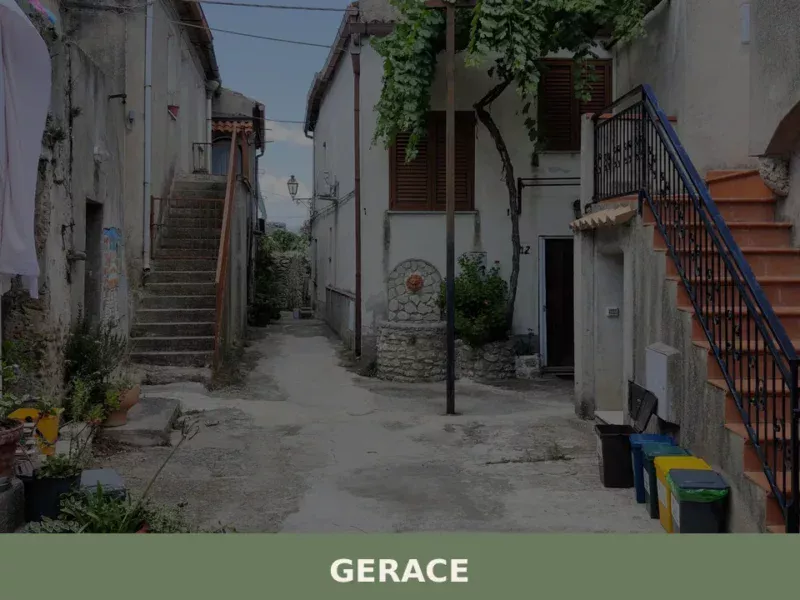
In Calabria More villages to discover
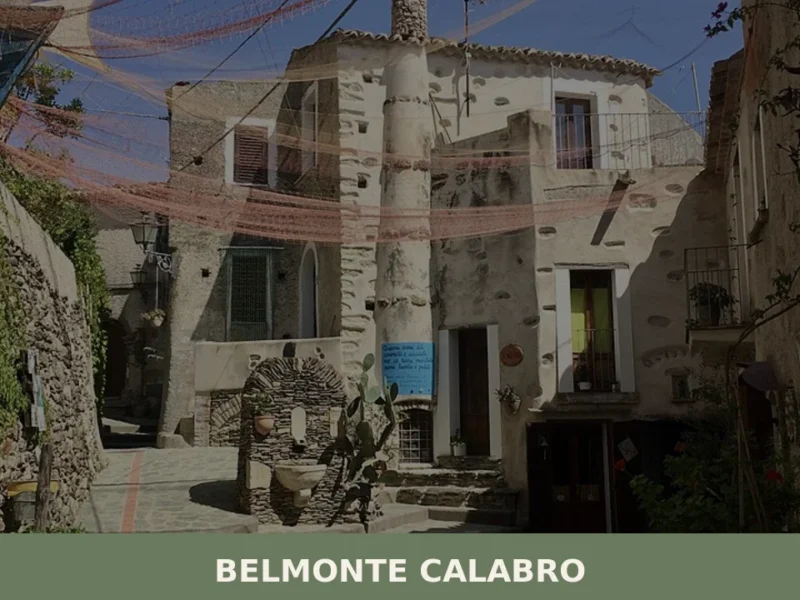
Belmonte Calabro
 Sea
Sea
In 1270, Charles I of Anjou granted Drogone de Beaumont the fief that would give rise to the name Belmonte — from the French Beaumont, meaning beautiful mountain. Sitting at 262 metres above sea level on the Tyrrhenian side of the Cosenza province, the village today has 1,984 inhabitants and preserves a historic centre layered […]
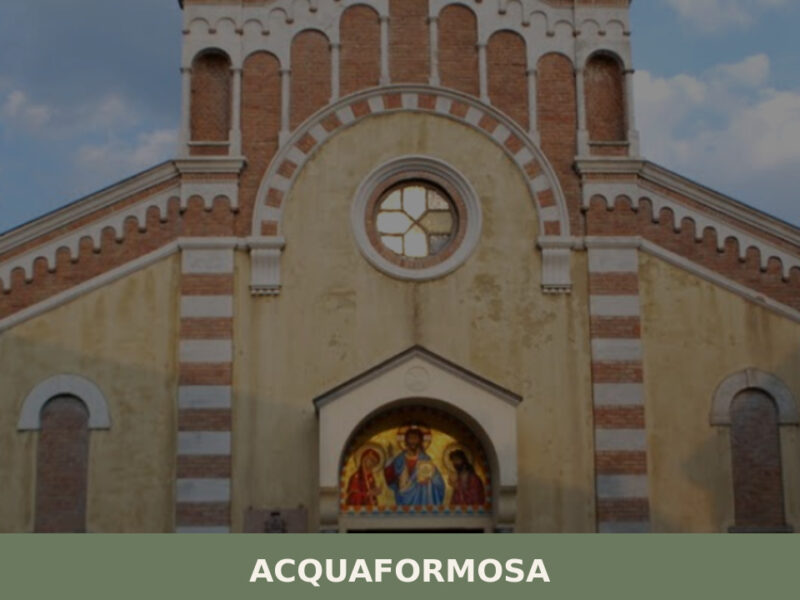
Acquaformosa
Mountain
A mountain village of 988 inhabitants in Cosenza province, Acquaformosa offers ancient springs, Pollino trails, and deep Calabrian food traditions at 756 metres above sea level.
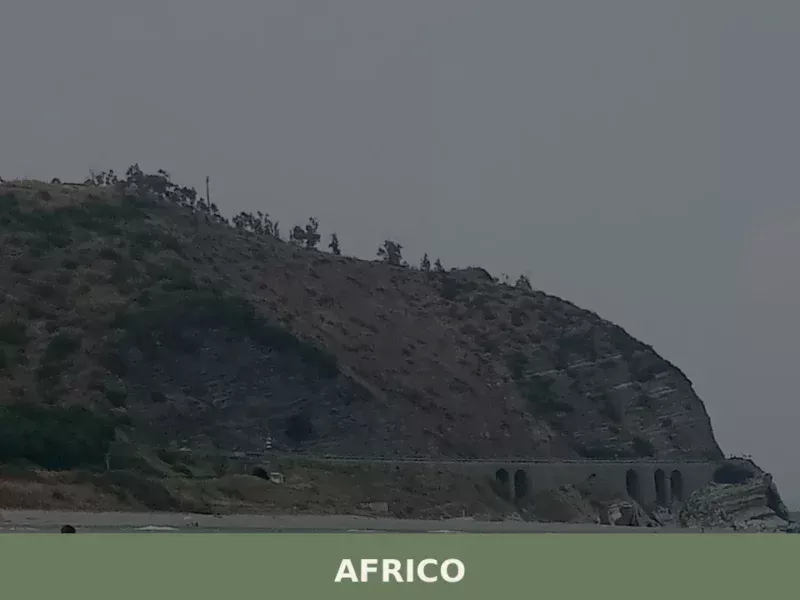
Africo
Sea
Discover what to see in Africo, Calabria: the abandoned mountain village, Ionian coast, Aspromonte landscapes, local food and practical travel tips.
Antonimina
 Hills
Hills
What to see in Antonimina, Italy, at 327 m: Discover stone alleys and patron feast. Explore Calabria's culture.
Amantea
Sea
Explore the picturesque village of Amantea Calabria. Discover its historic center, beautiful beaches, and authentic Italian charm. Plan your perfect trip to this hidden gem on the Tyrrhenian coast.
Morano Calabro
Sea
What to see in Morano Calabro, Italy: a village at 680 m altitude, listed among I Borghi più belli d'Italia. Discover top attractions, local food and how to get there.
Cosenza
Hills
What to see in Cosenza, Italy: explore 5 key attractions from the 1239 Swabian Castle to the medieval Duomo. Discover events, food and how to get there.
Aprigliano
Mountain
Explore Aprigliano Calabria, a picturesque village nestled in the heart of Italy. Uncover its rich history, stunning landscapes, and authentic Calabrian charm. Plan your visit today!
Altomonte
Hills
What to see in Altomonte: a hill village at 455m in Calabria with a 14th-century Gothic church, Civic Museum and medieval castle. Plan your visit today.
Vibo Valentia
Sea
What to see in Vibo Valentia, Italy: Discover the ancient city walls spanning 7 km and the Norman-Hohenstaufen Castle. Explore its rich history and vibrant local culture.


🏡 Know Bova better than we do?
If you’re a local or have been there, your knowledge matters: add what’s missing or fix a detail on this page.