


Pentedattilo
 Hills
Hills
What to see in Pentedattilo, Calabria, Italy: a ghost town founded in 640 BC at 250 m altitude. Discover top attractions, history, and how to get there.
Discover Pentedattilo
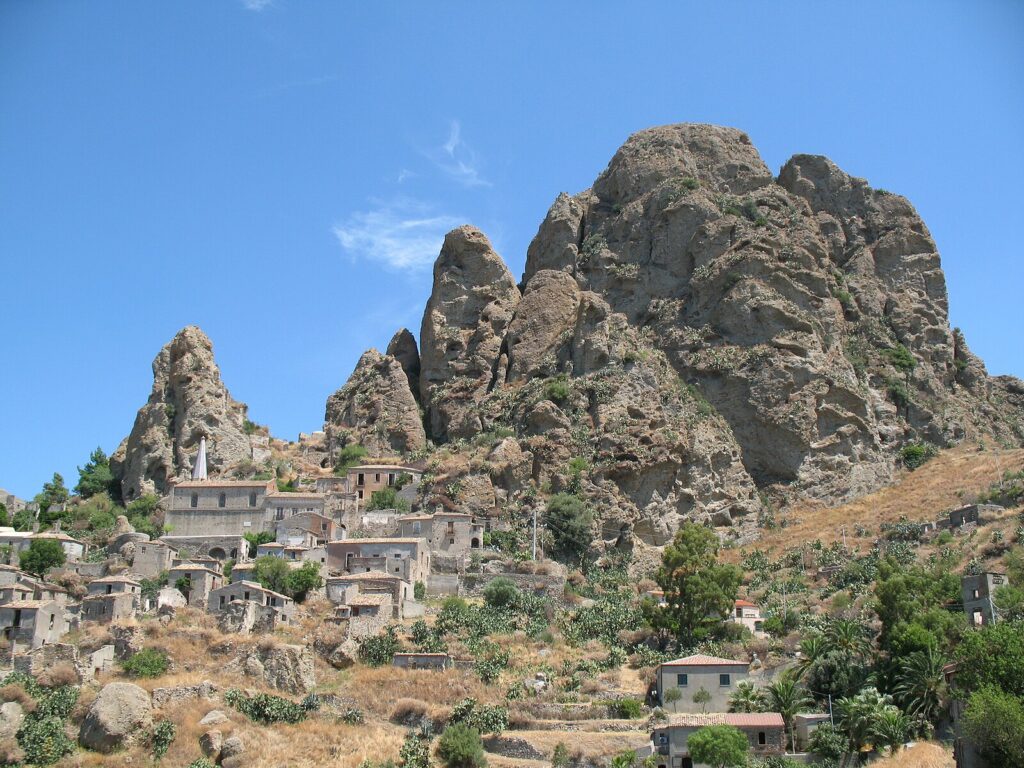
A rock formation shaped like five human fingers rises to 250 m (820 ft) above the Calabrian coast, and the village that clings to it takes its name directly from that shape. The Greek words pente and daktylos — five and fingers — gave Monte Calvario its ancient identity long before the first stone house was built. The mountain’s silhouette, once unmistakable from the sea, oriented Greek sailors approaching the shores of what they called Magna Graecia.
Today the cliff face has eroded, and the five-fingered profile is less sharp than it once was, but the name has outlasted the shape that inspired it.
Deciding what to see in Pentedattilo begins with understanding what the place actually is: a partially abandoned frazione, or administrative sub-division, of Melito di Porto Salvo, sitting at 250 m (820 ft) on Monte Calvario in the Province of Reggio Calabria. Visitors to Pentedattilo find a ghost town with a documented history stretching back to 640 BC, a castle ruin that commands the valley below, a baroque church that survived the 1783 earthquake only in fragments, and a yearly film festival that brings the empty alleys back to life. The Pentedattilo highlights include one of southern Italy’s most unusual post-abandonment restoration stories, carried out by volunteers from across Europe starting in the 1980s.
History of Pentedattilo
The town was founded in 640 BC as a colony of the Greek city of Chalcis, placing it among the earliest documented settlements in what the ancient Greeks called Magna Graecia — Greater Greece — the network of colonies that stretched across southern Italy and Sicily. During the Greek and Roman periods, Pentedattilo functioned as a commercial centre, positioned to take advantage of coastal trade routes visible from its elevated rock. The settlement declined under Byzantine rule, when repeated raids by Saracen forces reduced its population and interrupted its economic activity. That cycle of expansion and contraction left the town’s foundations layered across centuries of occupation.
In the 12th century, Norman forces conquered Pentedattilo and folded it into a baronial structure alongside Capo d’Armi, Condofuri, and Montebello Ionico.
The territory passed between several noble families over the following centuries: first the Abenavoli, then the Francoperta from Reggio Calabria, followed by the Alberti — who held it until 1760 — and subsequently the Clement and the Ramirez families, the last recorded in 1823. The precise boundaries of authority shifted with each succession, but the physical settlement remained anchored to Monte Calvario throughout. The village also retained a distinct linguistic identity: it was one of the Greek-speaking communities of Calabria, part of the Greko linguistic zone, before losing its Greek dialect during the late 19th century.
The earthquake of 1783 was the decisive rupture in Pentedattilo’s demographic history. The tremor caused severe structural damage across the village and accelerated the migration of a large part of the population to the lower-lying town of Melito Porto Salvo on the coast. Depopulation continued in waves over the following century and a half, until the village stood completely empty from the mid-1960s onward. The abandonment lasted until the 1980s, when volunteers from across Europe — drawn by both the site’s history and its architectural condition — began a partial restoration effort. Until 1811, before Italian unification reorganised administrative boundaries, Pentedattilo had been a separate commune; today it is formally a frazione of Melito di Porto Salvo.
What to see in Pentedattilo, Calabria: top attractions
The Ruins of Castello Alberti
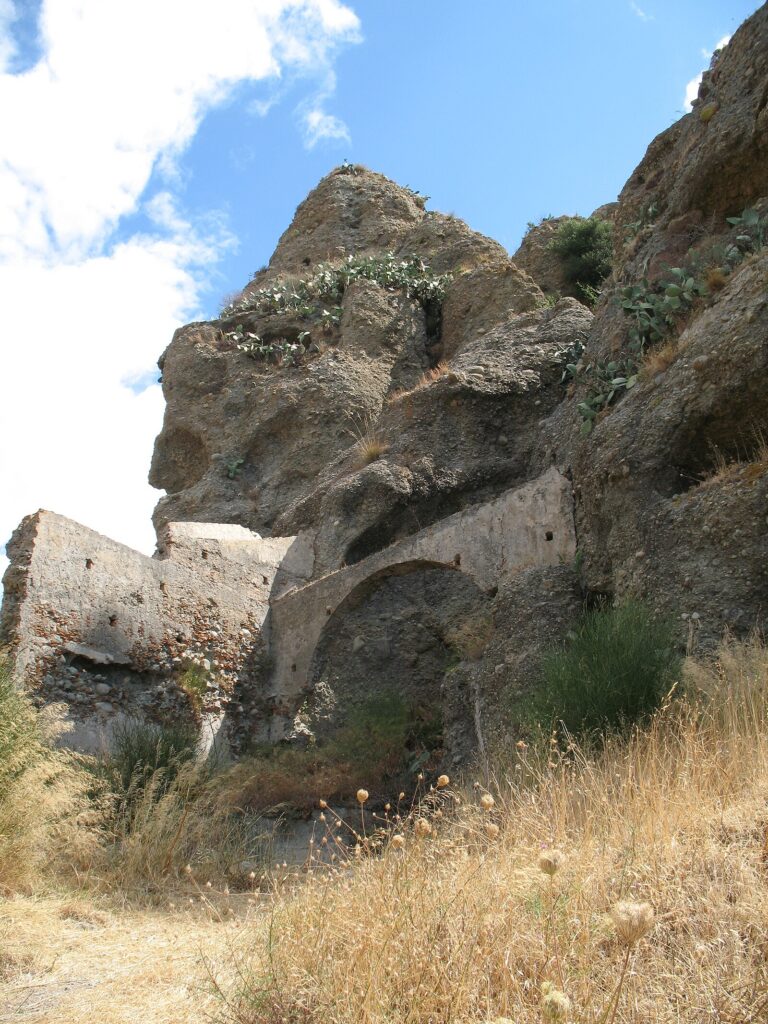
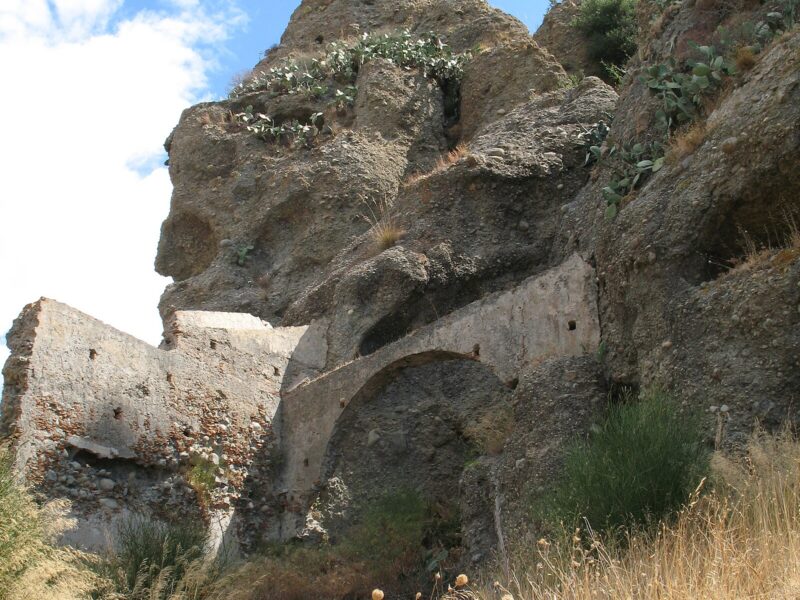
The castle walls stand at the highest accessible point of the rock, their limestone courses broken open where the 1783 earthquake split the structure along its foundations.
The Alberti family, who held the fief until 1760, gave the castle its most documented phase of use, though the fortification itself predates their tenure by several centuries. Standing inside the perimeter, visitors look directly down into the valley and across to the coast of the Ionian Sea. The structure is roofless and partially collapsed, so the interior offers an unobstructed view of the stratigraphy of the walls — courses of different stone types marking successive phases of construction and repair. Access is on foot from the main village square, and the path involves uneven stone surfaces that require appropriate footwear.
The Church of Santi Pietro e Paolo
The church façade faces the central open space of the village, its stone portal surviving as one of the more intact vertical elements in a settlement where most structures have partially collapsed. Santi Pietro e Paolo served as the main place of worship for a community that, at its peak before 1783, numbered far more inhabitants than the site can suggest today. The interior retains fragments of decorative work, though much of the original fittings were removed or destroyed during the abandonment period that began in the mid-1960s. Visiting in daylight hours allows a close examination of the portal carvings and the lateral wall construction, which shows clearly the repair work carried out by restoration volunteers after the 1980s reoccupation effort.
The Village Alleys and Abandoned Residential Quarter
The residential section of Pentedattilo extends back from the church along a series of narrow lanes cut directly into the rock and flanked by stone-built houses whose roofs are largely absent.
Some structures retain their door frames, window openings, and interior wall plaster, giving a precise sense of the room dimensions and construction methods of a small Calabrian hill settlement from the 17th and 18th centuries. The earthquake of 1783 collapsed many of the upper stories, and the resulting rubble has in places been cleared and in places left where it fell, creating an irregular ground level throughout the quarter. Walking the full circuit of the inhabited area covers roughly 500 m (0.3 mi) and takes between 30 and 45 minutes at a thorough pace.
Monte Calvario and the Five-Finger Rock Formation
The rock formation that gives Pentedattilo its name reaches 250 m (820 ft) at its summit and once displayed a clear five-fingered silhouette visible from the sea below. Erosion has softened the profile over the centuries, but the vertical faces of the formation remain pronounced, rising sharply above the surrounding terrain and creating a natural defensive position that explains why Greek colonists chose this site in 640 BC.
The rock itself is composed of compact limestone, and its surface texture — pitted and striated by centuries of weathering — is visible at close range along the paths that approach the village from the access road below. The Aspromonte National Park encompasses the broader mountain territory surrounding Pentedattilo, and the landscape here transitions from coastal scrub at lower elevations to denser Mediterranean vegetation on the slopes above.
The Annual Film Festival
Each year, the empty spaces of Pentedattilo host a film festival that uses the village’s abandoned architecture as both backdrop and venue. Screenings take place in the open-air areas between the ruined buildings, and the event draws audiences from across Calabria and beyond, temporarily reversing the silence that defines the settlement for most of the year. The festival is one of the direct results of the 1980s volunteer restoration movement, which sought to return some form of cultural activity to a site that had been completely uninhabited since the mid-1960s.
Visitors planning to attend should confirm current dates directly with the Melito di Porto Salvo municipality, as the precise scheduling varies from year to year.
Local food and typical products of Pentedattilo
The culinary tradition of the area around Pentedattilo reflects the layered history of the territory itself: Greek colonial settlement, subsequent Roman and Byzantine occupation, and later Norman and Spanish feudal influence each left traces in the foodways of the Reggio Calabria province. The area sits within a coastal-to-mountain gradient that produces both maritime and agricultural ingredients within a relatively compact geographic zone. Fishing communities along the Ionian coast below, and livestock-keeping on the slopes above, supplied the two main protein sources that define the local diet. That combination — preserved fish alongside cured pork — remains the structural logic of the regional table.
Among the most documented preparations of the broader Reggio Calabria area is nduja, a spreadable, heavily spiced pork sausage made with a high proportion of Calabrian chilli, which gives it both its red colour and its persistent heat. The fat content keeps the mixture soft at room temperature, and it is traditionally eaten spread on bread or used to season legume-based dishes. Pitta ‘mpigliata is a pastry typical of the Calabrian Christmas table, filled with figs, honey, nuts, and raisins, then folded into a ring shape and baked.
The dough is made with olive oil rather than butter, a detail that reflects both the local agricultural production and the influence of Greek and Arab food traditions on the region’s baking. Pesce stocco — stockfish, dried and then rehydrated before cooking — appears across the Reggio Calabria coast in preparations that vary by town: stewed with tomatoes and olives, or baked with potatoes and local olive oil.
The Calabria region produces a number of products with protected designations, though the source data available for Pentedattilo specifically does not confirm which designations apply directly to the produce of this individual frazione. The broader Province of Reggio Calabria is associated with Bergamotto di Reggio Calabria (PDO), the bergamot citrus fruit cultivated almost exclusively along a narrow coastal strip of the province and used in perfumery, confectionery, and as a flavouring.
The essential oil extracted from its rind is the primary commercial product, but the fruit also appears in local marmalades and liqueurs sold across the province.
Visitors with an interest in local produce are best served by exploring the weekly markets in Melito di Porto Salvo, the coastal town 5 km (3.1 mi) below Pentedattilo, where producers from the surrounding hills bring seasonal vegetables, cured meats, and preserved citrus products. The summer and early autumn months concentrate the greatest variety of fresh produce, coinciding with the period when Pentedattilo itself receives the most visitors.
Festivals, events and traditions of Pentedattilo
The most documented recurring event in Pentedattilo is its annual film festival, which takes place in the village’s outdoor spaces and uses the ruined architecture as an integral part of the experience. The festival emerged from the restoration movement of the 1980s, when European volunteers began returning to the site and sought to establish a cultural programme that would justify continued maintenance of the partially restored buildings. Screenings and related events run during the summer season, drawing visitors who would not otherwise have a reason to travel to what is, for most of the year, a very sparsely inhabited site.
The exact dates shift annually, so checking with local tourism offices before planning a visit is advisable.
The surrounding area of Melito di Porto Salvo observes the feast of its patron saints with processions and associated religious ceremonies, as is standard across the municipalities of the Reggio Calabria province. Given that Pentedattilo is administratively part of Melito di Porto Salvo since 1811 — when it ceased to be an independent commune — the civic and religious calendar of the parent municipality applies to the broader territory. Local tradition in this part of Calabria also includes the preparation of specific seasonal foods tied to the liturgical calendar, including the Christmas pastries described above, whose production in domestic kitchens represents a continuous practice across the province.
When to visit Pentedattilo, Italy and how to get there
The most practical period to visit Pentedattilo is between late spring and early autumn, specifically from May through September. Summer temperatures on the Ionian coast below can exceed 35°C (95°F), but the elevation of the village at 250 m (820 ft) provides some relief compared to the coast. The film festival, which takes place during summer, gives the site its highest visitor concentration of the year; those who prefer a quieter experience will find the shoulder months of May, June, and September more suitable.
Winter visits are possible but offer fewer services: the village is sparsely inhabited, and the access path can be slippery after rain. For those asking about the best time to visit Calabria more broadly, the spring months offer mild temperatures, green hillsides, and far fewer tourists than July and August.
Reaching Pentedattilo by car is the most straightforward option for international visitors. From Reggio Calabria, the route follows the Ionian coastal road southward for approximately 30 km (18.6 mi) to Melito di Porto Salvo, then continues inland and upward on a narrow road to the village. The journey from Reggio Calabria takes roughly 40 to 50 minutes by car depending on conditions. For those planning a day trip from the nearest major city, Reggio Calabria is the logical base: it is served by direct train connections from Naples and Rome via the main Tyrrhenian line, and by Reggio Calabria Airport, which handles domestic Italian routes.
From Rome, the total travel time to Reggio Calabria by high-speed train is approximately 4.5 to 5 hours; from there, a car rental or local bus connection covers the final 30 km (18.6 mi) to Melito di Porto Salvo. The village of Pentedattilo itself is then 5 km (3.1 mi) further uphill. Visitors travelling by Trenitalia should note that Melito di Porto Salvo has a small station on the Ionian coastal line, though onward connections to the village require either a taxi or a private vehicle. International visitors should carry euros in cash, as card payment infrastructure in smaller shops and cafés in this part of Calabria is inconsistent, and English is not widely spoken outside of dedicated tourist contexts.
The road up to Pentedattilo is narrow and involves a series of switchbacks, so drivers unfamiliar with mountain roads in southern Italy should allow extra time and avoid the route after dark. Parking is available at a small designated area at the base of the final approach to the village, from which the remainder of the ascent is on foot along a stone path. The path covers a modest elevation change but involves uneven surfaces, making sturdy shoes a practical requirement rather than a suggestion.
Travellers extending their time in Calabria may find it worth comparing Pentedattilo’s post-abandonment trajectory with that of other villages in the region that have undergone similar processes of depopulation and partial recovery.
The village of Acri, in the Cosenza province, shares the Calabrian pattern of mountain settlement shaped by successive waves of external domination, from Byzantine administration through Norman feudalism, and offers a different architectural and demographic outcome from the same historical pressures. For visitors interested in how these smaller settlements relate to one another across the region, the contrast between a partially restored ghost town like Pentedattilo and a still-inhabited hill town provides a useful framework for understanding what to see in Pentedattilo within its broader regional context.
Frequently asked questions about Pentedattilo
What is the best time to visit Pentedattilo?
Spring (April–June) and early autumn (September–October) offer the most comfortable conditions for exploring the steep rocky paths and open-air ruins, with mild temperatures and good visibility across the Ionian coast below. Summer brings heat that makes walking the uneven stone alleys more demanding, but it also coincides with the annual film festival, which temporarily revives the abandoned village with screenings and visitors. The feast of patron saints Pietro e Paolo (June 29) may also animate the area. Winter visits are quieter and atmospherically dramatic, though some paths can be slippery after rain.
What are the historical origins of Pentedattilo?
Pentedattilo was founded in 640 BC as a Greek colonial settlement by colonists from Chalcis, making it one of the oldest documented sites in Magna Graecia. Its name derives from the Greek words pente (five) and daktylos (fingers), describing the distinctive rock formation of Monte Calvario on which it sits. After Greek and Roman periods, it passed through Byzantine, Saracen, and Norman rule before entering a succession of feudal lordships — Abenavoli, Francoperta, Alberti, Clement, and Ramirez. The 1783 earthquake triggered its gradual abandonment, completed by the mid-1960s.
What to see in Pentedattilo? Main monuments and landmarks
The key sites are: the Ruins of Castello Alberti, accessible on foot from the main square via uneven stone paths (wear sturdy footwear), offering panoramic views over the Ionian valley; the Church of Santi Pietro e Paolo, whose stone portal and lateral walls survive largely intact and repay close inspection; and the abandoned residential quarter, a 500 m circuit of narrow rock-cut lanes taking 30–45 minutes to walk. All sites are open-air and freely accessible. There are no ticketed entrances. Visit during daylight hours for safe navigation of the terrain.
What are the main natural or scenic attractions of Pentedattilo?
Pentedattilo sits within the territory of Aspromonte National Park, whose broader mountain landscape surrounds the village. Monte Calvario rises to 250 m with sheer limestone faces whose pitted, striated surfaces are visible at close range along the approach paths. The terrain transitions from coastal Mediterranean scrub at lower elevations to denser vegetation on higher slopes. The position of the village provides direct sightlines to the Ionian Sea coast below, making the natural setting as significant as the built ruins. No specific CAI trail numbers are officially documented for the immediate village paths.
Where to take the best photos in Pentedattilo?
The most photographed perspectives are: the approach road below the village, where the full silhouette of Monte Calvario and the clinging stone houses can be framed together; the interior of Castello Alberti, where roofless walls frame the valley and Ionian coast beyond; and the narrow lanes of the abandoned residential quarter, where intact door frames and open rooftops create strong geometric compositions. Early morning light from the east suits the rock face particularly well. The church portal, with its surviving carved stonework, offers strong detail shots in diffused midday light.
Are there museums, churches or historic buildings to visit in Pentedattilo?
The Church of Santi Pietro e Paolo is the principal surviving religious building, with its stone portal and sections of lateral wall remaining structurally intact after the 1783 earthquake and the subsequent abandonment. Interior decorative fragments survive, though original fittings were largely removed or lost during the decades of total desertion after the mid-1960s. Castello Alberti constitutes the main historic secular structure — roofless and partially collapsed, but freely accessible on foot. No formal museum operates within the village itself; the site functions as an open-air heritage area managed in connection with the Melito di Porto Salvo municipality.
What can you do in Pentedattilo? Activities and experiences
Visitors can walk the full circuit of the abandoned village (roughly 500 m, 30–45 minutes), explore the castle ruins with valley views, and examine the surviving church portal and residential architecture. The annual film festival — held in the open-air spaces between the ruins — is the main cultural event, with screenings drawing audiences from across Calabria; confirm exact dates with the Melito di Porto Salvo municipality each year. The surrounding Aspromonte National Park territory offers broader hiking opportunities. The 1980s volunteer restoration story makes the site of specific interest to those engaged with heritage conservation.
Who is Pentedattilo suitable for?
Pentedattilo suits independent travellers, history enthusiasts, and photographers drawn to post-abandonment landscapes and ancient Greek colonial heritage. Architecture and heritage conservation professionals find the partially restored ruins instructive. Couples and solo travellers who appreciate quiet, atmospherically charged sites will find it rewarding. The uneven rocky terrain and absence of facilities make it less suitable for families with very young children or visitors with limited mobility. It is not a beach or resort destination. Those attending the film festival gain a socially animated version of the site that contrasts sharply with its usual silence.
What to eat near Pentedattilo? Local products and specialties
The surrounding Reggio Calabria area produces several well-documented specialties available in nearby towns. Nduja is a spreadable, chilli-rich pork sausage eaten on bread or used to season legume dishes. Pitta 'mpigliata is a traditional Christmas pastry filled with figs, honey, nuts, and raisins, made with olive oil dough reflecting Greek and Arab culinary influence. Pesce stocco (rehydrated stockfish) is a coastal staple prepared with tomatoes and olives or baked with potatoes and local olive oil. Pentedattilo itself has no operating restaurants or food shops; provisions should be sourced in Melito di Porto Salvo before visiting.
📷 Photo Gallery — Pentedattilo
Nearby Villages near Pentedattilo
In Calabria More villages to discover
Acquaro
Hills
Discover what to see in Acquaro, a village of 1,778 inhabitants in Vibo Valentia, Calabria. History, food, travel tips and the Alto Mesima valley landscape.
Africo
 Sea
Sea
Discover what to see in Africo, Calabria: the abandoned mountain village, Ionian coast, Aspromonte landscapes, local food and practical travel tips.
Alessandria del Carretto
 Mountain
At 1,000 metres above sea level, on the eastern slope of the Calabrian Pollino, Alessandria del Carretto has just 357 inhabitants today — making it one of the least populated municipalities in the entire province of Cosenza. Its territory falls within the Pollino National Park, and anyone wondering what to see in Alessandria del Carretto […]
Acquaformosa
Mountain
A mountain village of 988 inhabitants in Cosenza province, Acquaformosa offers ancient springs, Pollino trails, and deep Calabrian food traditions at 756 metres above sea level.

Argusto
Hills
Discover Argusto, a quiet hilltop village of 400 in Calabria's interior. Explore its historic streets, local food, and authentic Catanzaro traditions.
Belvedere Marittimo
Sea
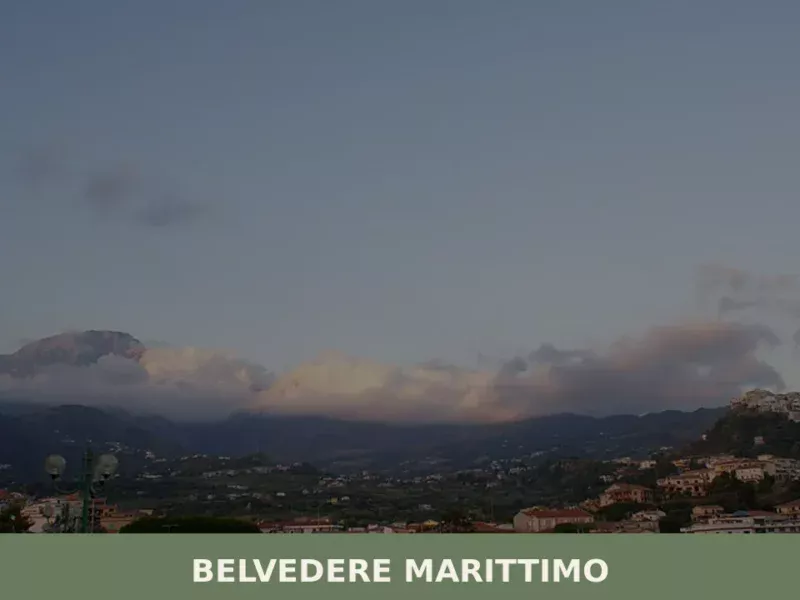
Belvedere Marittimo, a village in the province of Cosenza, stands at 150 meters above sea level and has a population of 9,292 inhabitants. This Calabrian location, classified among the lowland villages, offers a view of the Cosenza Tyrrhenian coast, combining historical elements with its proximity to the coast. Its geographical position has shaped its identity […]
Stilo
Sea
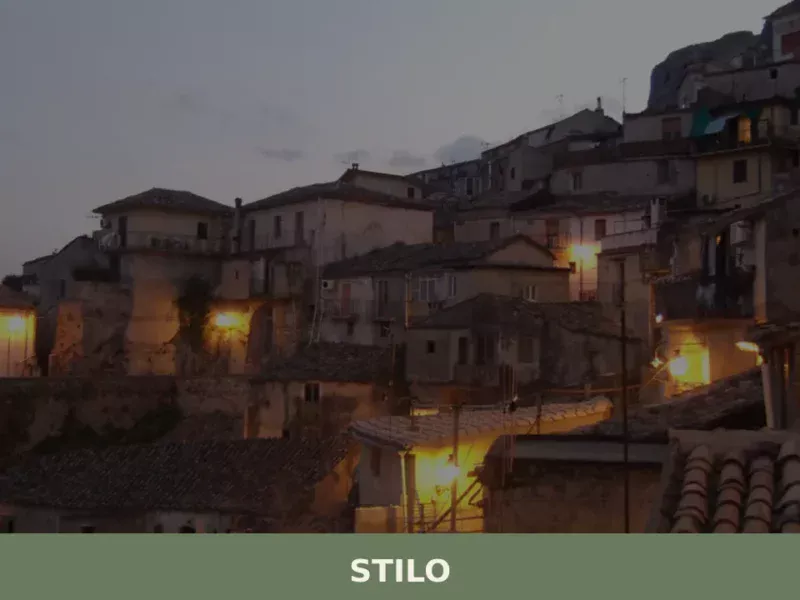
The Cattolica church occupies a spur of rock above the rooftops, its five small domes visible from the valley floor before the rest of the village comes into focus. Below the church, the streets narrow and the stone deepens in colour, shifting from pale grey to near-black where the walls absorb the shadow. Iron and […]

Gizzeria
Sea
5,362 residents, two faces — hilltop village and thermal-wind shore — and a documented Albanian foundation make Gizzeria one of Calabria's most layered communities.
Bonifati
Sea
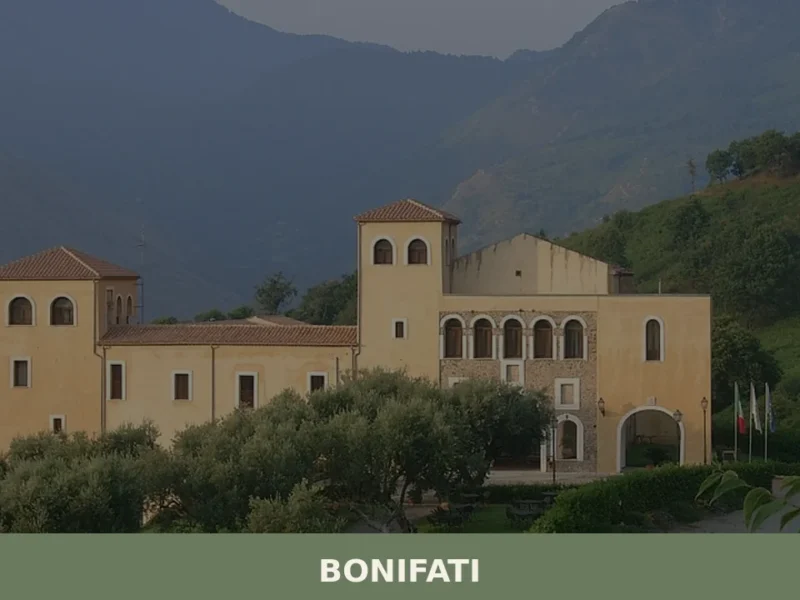
The village of Bonifati, located in the Cosenza hinterland but with a view towards the Tyrrhenian Sea, has historical roots deeply embedded in a past of fortifications and coastal defense. Already in the Middle Ages, this settlement stood out for its strategic position, an element that shaped its urban layout and identity. In this article […]
Anoia
 Plains
What to see in Anoia? Explore the 5 main attractions of this Calabrian village. The complete guide awaits to help plan your visit. Learn more!
🏡 Know Pentedattilo better than we do?
If you’re a local or have been there, your knowledge matters: add what’s missing or fix a detail on this page.