The villaggio ipogeo of Sant’Antioco is one of the most unusual urban formations in the entire Mediterranean basin — a quarter where Phoenician and Punic burial chambers were converted, over many centuries, into actual domestic dwellings. Most visitors to the island walk past its low doorways without registering what they are looking at. This article corrects that oversight with five things that rarely appear in standard guidebooks.
The hypogeum village and its Punic origins: what the tombs actually were
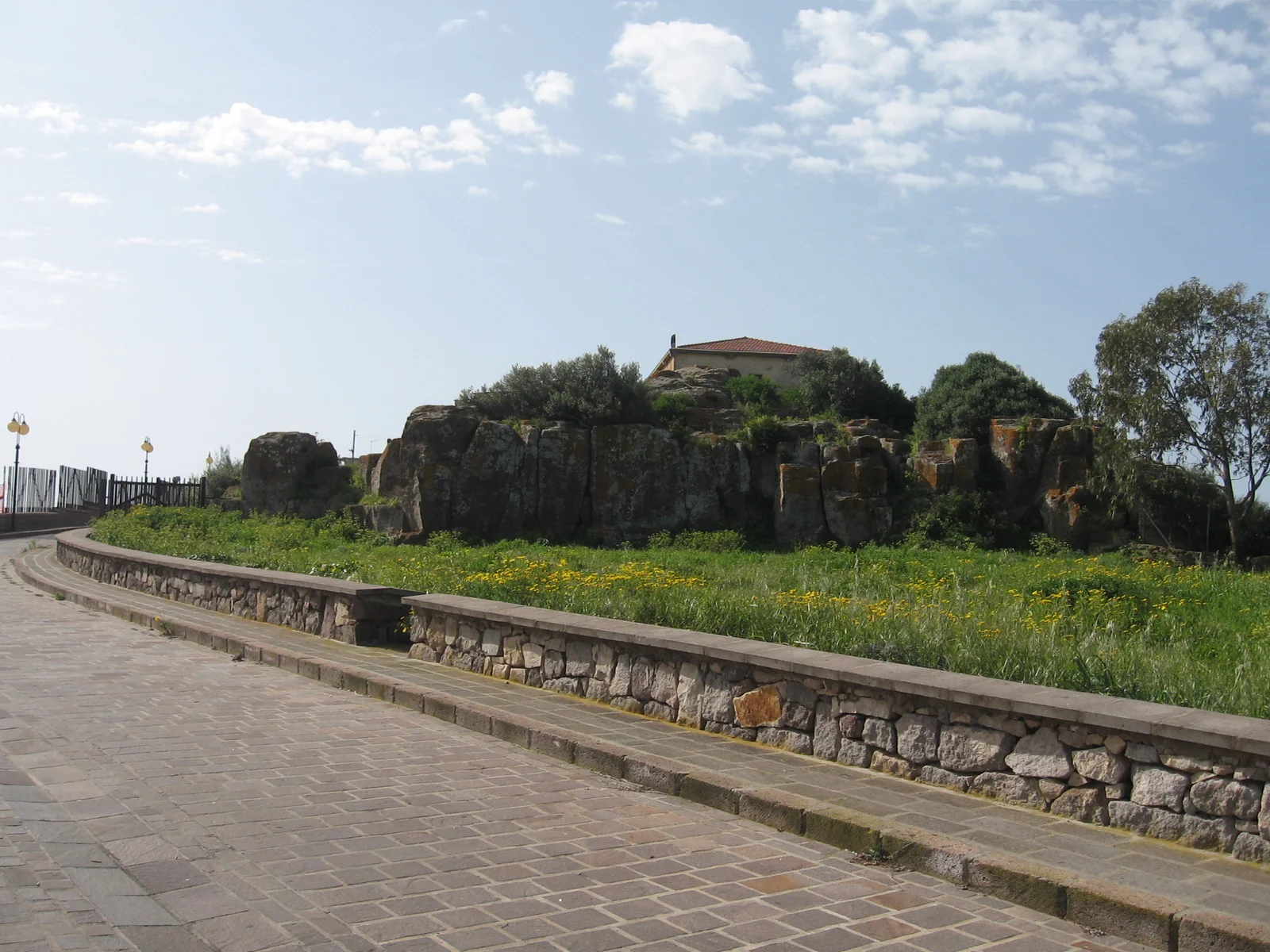
To understand the villaggio ipogeo of Sant’Antioco, you first have to understand the city beneath the city. Ancient Sulci — founded by Phoenician settlers somewhere around 770 BCE, making it one of the oldest urban centres in the western Mediterranean — was built on a low volcanic hill rising just seven metres above sea level on the southwestern tip of the island. From at least the sixth century BCE onwards, its inhabitants cut burial chambers directly into the trachyte rock beneath the inhabited area. This was not an unusual Punic practice: similar hypogea exist at Tharros and Nora, the other great Sardinian Phoenician-Punic sites. What makes Sulci exceptional is the sheer density of the chambers and their later history.
The Punic tombs at Sulci follow a fairly consistent architectural grammar. From a vertical shaft — typically between one and three metres deep — one or more horizontal chambers open outward, each large enough to accommodate several bodies laid on rock-cut benches. The chambers at Sant’Antioco are particularly well-preserved because the volcanic trachyte of the hill is relatively homogeneous and resistant to water infiltration. Archaeological surveys conducted in the twentieth century, most systematically by Ferruccio Barreca and his collaborators beginning in the 1960s, catalogued hundreds of these chambers directly beneath the modern street grid. Barreca’s work for the Soprintendenza Archeologica established that the necropolis extended far beyond the zones already visible, running under streets, under courtyards, and under the foundations of houses that had been standing for centuries.
The grave goods recovered from these chambers — now largely held at the Museo Archeologico Ferruccio Barreca in Sant’Antioco itself, with select pieces transferred to the Museo Archeologico Nazionale in Cagliari — include scarabs, terracotta masks, amulets of Egyptian type, unguentaria, oil lamps, and bronze razors. The typology of the objects dates the majority of the chambers to between the fifth and second centuries BCE, with some extending into the Roman period after 258 BCE, when the Roman consul Gaius Sulpicius Paterculus defeated the Carthaginian fleet in the naval battle off Sulci during the First Punic War. The Roman occupation did not immediately halt Punic funerary customs; the transition was gradual, and several chambers contain stratified deposits showing both Punic and Roman-period materials.
This archaeological substratum is not separate from the villaggio ipogeo above it — it is the villaggio ipogeo. The underground quarter exists precisely because the human geography of Sant’Antioco, across more than two thousand years, never entirely abandoned the hill where Sulci stood. Each time the surface was rebuilt, the chambers below were incorporated, ignored, or reused.
How the underground rooms became homes: a slow transformation across centuries
The conversion of burial chambers into habitable spaces is not a single historical event that can be dated to a specific year. It is a process that unfolded across at least fifteen centuries, driven by poverty, by population pressure, and by the pragmatic logic of a community that had always lived directly above its own dead.
The earliest documented phase of reuse is Christian and dates to the late Roman and early Byzantine periods, roughly the third to sixth centuries CE. The catacombs associated with the Basilica di Sant’Antioco Martire — the paleochristian underground complex beneath the present eighteenth-century church — are technically part of the same hypogeal system as the domestic chambers of the villaggio ipogeo, though they occupy a distinct zone and have a different functional history. The martyr Antiocus, a Christian physician from Mauritania who according to hagiographic tradition was executed on the island during the Hadrianic persecutions of the second century CE, was supposedly buried in one of the pre-existing Punic chambers. The cult that grew up around his tomb drove the early Christian community to expand and adapt the underground spaces for liturgical and funerary use. This created a mental framework in which hypogeal space was associated not with death as contamination but with death as sanctity — a crucial cultural shift that may have made later domestic reuse psychologically more acceptable.
The transformation of tomb chambers into actual dwellings accelerated during the medieval period, particularly after the collapse of Byzantine administrative structures and the disorders of the early medieval centuries. By the time the Aragonese crown consolidated its control over Sardinia in the fourteenth century, there is documentary evidence — though fragmentary — of a settled population occupying the area immediately adjacent to the basilica in conditions that involved underground spaces. The Spanish and later Sabaudo administrative records of the sixteenth through eighteenth centuries are more explicit. Cadastral surveys from the Sabaudo period, following the transfer of Sardinia to the House of Savoy under the Treaty of London in 1718, list properties in the area around the basilica that include underground rooms described as cantinas or magazinos — cellars and storerooms — but which clearly functioned as sleeping and living quarters for the poorest households.
The mechanism was straightforward. A family would occupy the surface level of a property — a room or two of rough masonry — while using the hypogeal chamber beneath as additional space. Over time, as families grew and surface space remained scarce, the underground chamber became the primary living area rather than an ancillary one. The vertical shaft that had originally served as the tomb entrance was widened, lined, and converted into a staircase. The rock-cut benches that had held the Punic dead became sleeping platforms. The chambers were whitewashed, sometimes repeatedly, and in some cases their walls were pierced to connect adjacent chambers belonging to the same family. The result, by the nineteenth and early twentieth centuries, was a villaggio ipogeo — an inhabited underground village — of considerable extent, spread across several parallel streets in the oldest part of Sant’Antioco.
The families who lived there — and those who still do
One of the least-discussed aspects of the villaggio ipogeo is the human continuity it represents. This was not a temporary emergency shelter but a quarter with its own social geography, its own micro-economy, and families who identified specifically with it across multiple generations. Understanding who these people were adds a social dimension that pure archaeological description tends to omit.
The inhabitants of the underground quarter were almost exclusively drawn from the poorest strata of Antiochensi society: fishermen, day labourers, small-scale farmers working plots on the island’s interior, and artisans in trades like rope-making and net-mending that were poorly remunerated. The proximity of the basilica meant that the quarter also housed families involved in minor religious functions — sacristans, bellringers, the people responsible for maintaining the oil lamps in the catacombs. This connection between the underground domestic spaces and the underground sacred spaces created a social unit that was unusually coherent for an Italian southern village quarter.
In the early twentieth century, the hypogeum quarter attracted the attention of Italian social reformers who were documenting conditions of poverty in the Mezzogiorno and the islands. Photographers associated with the rural documentation projects of the 1930s and 1950s recorded the quarter’s low doorways, its children playing on earthen floors below street level, its elderly residents seated on stools in front of entrances that led downward rather than inward. These images circulated in Italian geographical and ethnographic journals and occasionally surfaced in international publications. They created a somewhat sensationalised picture of the villaggio ipogeo as a place of extreme deprivation, which was accurate in material terms but failed to convey the degree to which residents had adapted and organised the space.
The postwar decades brought significant change. The Italian government’s policies for the elimination of substandard housing — consolidated under various national programmes from the 1950s onwards and applied in Sardinia through the Ente per la Rinascita della Sardegna — led to the gradual relocation of many families from the underground chambers to new public housing built on the island’s lower ground. By the 1970s, most of the hypogeal chambers that had been continuously inhabited were emptied of permanent residents. Some were sealed; others were incorporated into the properties of the adjacent basilica complex; a few remained in informal use as storerooms.
However — and this is the detail that most guidebooks miss entirely — not all of the underground chambers were abandoned. A small number of the hypogea in the villaggio ipogeo remain in use today, maintained by families whose connection to the quarter goes back at least four generations. These are not tourist reconstructions or managed heritage sites. They are private properties, and their owners navigate a complex legal and bureaucratic position, since the chambers beneath their homes are technically archaeological assets under Italian heritage law (specifically governed by the Codice dei Beni Culturali e del Paesaggio, Legislative Decree 42/2004) while the surface structures above them are private real estate. Sant’Antioco is therefore home to one of the very few places in Italy where Phoenician-Punic funerary architecture and twenty-first-century domestic life occupy the same cubic metres of space.
What the villaggio ipogeo reveals about Sulcitan building technique
Archaeologists and architectural historians who have studied the villaggio ipogeo closely have noted that it is not simply a collection of tombs that happened to be reused. The underground quarter constitutes an involuntary archive of Punic, Roman, Byzantine, medieval, and modern construction methods, all stratified in a single compact zone. Reading those layers carefully tells you things about Sulcitan urbanism that surface archaeology alone cannot.
The Punic chambers themselves show considerable sophistication. The trachyte bedrock of the Sant’Antioco hill was worked with iron tools — pick marks are visible in many chambers — and the walls were sometimes smoothed to receive a thin plaster coating, traces of which survive in protected corners. The geometry of the chambers is not random: most follow a roughly rectangular plan with a low-arched ceiling, with dimensions that cluster around 1.8 by 2.5 metres for single-niche chambers and 3 by 4 metres for the larger multi-niche variety. This regularity suggests either a shared set of technical norms or, more likely, a specialised class of tomb-cutters operating across multiple family commissions. Some chambers have carved ledges at mid-wall height that served as additional deposition surfaces and that, centuries later, were easily repurposed as shelves.
The Roman modifications to the hypogea are identifiable by changes in tool marks — Roman iron tools left a different surface texture than Punic ones — and by the occasional insertion of brick or opus incertum elements where a chamber wall had partially collapsed. The Byzantine phase introduced the practice of cutting arcosolium niches — arched recesses in the wall large enough for a single body — which are characteristic of early Christian funerary architecture across the Mediterranean and distinguish the zones associated with the catacombs proper from the purely domestic-reuse zones of the villaggio ipogeo.
Medieval and early modern construction above the hypogea created a structural situation unique to Sant’Antioco. Because the chambers were never filled in and never fully stabilised, the masonry walls of the surface buildings had to be founded on the solid rock separating the chambers rather than on continuous footings. This gave the oldest part of the town a characteristic pattern of thick, load-bearing party walls between very narrow plots — walls that, when examined from above in cadastral maps, reveal the irregular geometry imposed by the chamber locations below. Architects studying vernacular construction in the Sulcis region have noted that this forced the development of a local building typology — low, single-storey structures with minimal lateral openings — that persists in the older streets of the quarter to this day.
The villaggio ipogeo also preserves evidence of a specifically Sardinian form of domestic water management. Several of the larger chambers were equipped, probably in the medieval or early modern period, with carved stone basins connected to vertical channels cut through the rock. These collected rainwater seeping down through fissures in the roof — water that in an inhabited chamber was a nuisance but that, managed carefully, provided a supplementary domestic water supply. The channels that served this function are still visible in chambers accessible to visitors, and they illustrate the degree to which the underground inhabitants had developed a working knowledge of their geological environment.
For anyone interested in Sant’Antioco beyond its surface attractions, the structural evidence preserved in the hypogeum village is genuinely irreplaceable. No amount of surface excavation could reconstruct the same information about how Sulci was built, modified, and inhabited across twenty-seven centuries.
Visiting the underground village today: practical and archaeological context
The villaggio ipogeo of Sant’Antioco is not a single, unified tourist attraction with a ticket office and a guided route. It is distributed across several adjacent streets in the oldest part of the town, immediately west and north of the Basilica di Sant’Antioco Martire on Via Necropoli and the surrounding lanes. Understanding its geography before you arrive saves considerable confusion.
The most accessible entry point is the catacombs complex managed by the parish of the Basilica di Sant’Antioco Martire. This is the zone where the sacred function of the hypogea is most clearly on display: the arcosolium niches, the traces of early Christian iconography (most faded to near-invisibility but occasionally surviving as red-ochre outlines), and the tradition associating the deepest chamber with the original tomb of the martyr Antiocus himself. Guided visits to the catacombs operate on a seasonal schedule — in high season from roughly May to September, visits run several times daily; in winter the schedule is reduced and it is advisable to contact the basilica directly before travelling. The entry fee as of the most recent published information was modest, in the range of a few euros, and includes access to a short stretch of the underground galleries.
The domestic hypogea — the true villaggio ipogeo in the sense of inhabited or formerly inhabited underground chambers — are a separate matter. Some of these are visible from street level: you can look down through metal grilles set into the pavement on Via Necropoli and adjacent streets and see the rock-cut chambers below. A small number of chambers have been formally incorporated into the visit route managed by the Museo Archaeologico Ferruccio Barreca, which is located a short walk away at Piazza Ferruccio Barreca. The museum, which holds the most significant artefacts recovered from the Sulci necropolis and from the adjacent Tophet, occasionally organises extended visits into the underground domestic zone — these are worth enquiring about specifically when you book, as they provide a substantially richer experience than the standard catacomb visit alone.
For the chambers that remain private property, there is no formal access, and it would be inappropriate to attempt entry without explicit invitation from the owners. However, the external evidence is considerable even from the street. The low doorways, the stone steps descending below street level, the thick walls of the adjacent surface structures — all of these are legible once you know what you are looking at. Several of the houses in the quarter have upper facades that date from the eighteenth or nineteenth century while their lower entrances give directly onto chambers that predate the Roman conquest of 258 BCE by several hundred years.
A detail worth noting for visitors who arrive from outside Sardinia: the linguistic environment of Sant’Antioco is more complex than it first appears. The town is Sardinian-speaking in its older population cohorts, with the local variety of Sardinian belonging to the Campidanese group. But the island also hosts, in the northern town of Calasetta, a community that speaks Tabarchino — a variety of Ligurian descended from the speech of settlers who came from the island of Tabarka off Tunisia in the eighteenth century. This linguistic layering, though it has no direct connection to the villaggio ipogeo, is part of the same broader pattern of cultural stratification that makes Sant’Antioco unusual: a place where Phoenician foundations, Punic modifications, Roman conquest, Byzantine Christianity, Aragonese governance, and Sabaudo administration have all left legible traces, above and below ground.
The best time to visit the underground quarter is either early morning or late afternoon in summer, when the angle of light illuminates the grilles in the pavement most clearly and when the streets are quiet enough to examine the facades without distraction. In the weeks following Easter — the period around the feast of Sant’Antioco, which falls fifteen days after Easter Sunday according to the liturgical calendar, and which draws significant numbers of devotees to the basilica — the quarter around the church is full of movement and the underground connection between sacred and domestic space is at its most palpable.
FAQ: questions visitors actually ask about the villaggio ipogeo
What exactly is the villaggio ipogeo in Sant’Antioco?
The villaggio ipogeo is a quarter of Sant’Antioco where Phoenician and Punic rock-cut tomb chambers, originally part of the necropolis of ancient Sulci (founded around 770 BCE), were gradually converted into domestic living spaces over the medieval and early modern periods. The process resulted in an inhabited underground village — an abitato ipogeo — where families lived in rooms carved directly into the volcanic trachyte bedrock, originally designed as burial chambers. Some of these hypogeal spaces remain in private ownership today, though most were vacated following postwar housing programmes in the 1950s–1970s.
Is the villaggio ipogeo the same as the catacombs beneath the basilica?
No, though they belong to the same extended hypogeal system and share the same geological substrate. The catacombs of the Basilica di Sant’Antioco Martire are specifically the sacred underground galleries associated with the early Christian cult of the martyr Antiocus, featuring arcosolium niches and liturgical spaces developed from the third century CE onwards. The villaggio ipogeo refers to the broader network of Punic tomb chambers that were converted for domestic use across the quarter surrounding the basilica. They overlap physically — in some cases a chamber that was part of the Christian funerary complex is directly adjacent to one that was used as a kitchen in the nineteenth century — but their functional histories and their current management are distinct.
Can you visit the underground village independently, without a guide?
You can walk the streets of the hypogeum quarter freely and observe the external evidence — pavement grilles, below-street-level doorways, the thick party walls — without any ticket or guide. For access to the catacombs themselves, a guided visit through the basilica is required and covers the most significant underground chambers. For the domestic hypogea incorporated into the Museo Archaeologico Ferruccio Barreca’s visit programme, a museum ticket is needed. The purely private chambers are not accessible to independent visitors. It is worth noting that the Museo Barreca at Piazza Ferruccio Barreca is the best single starting point, as its staff can advise on current access arrangements for the extended underground routes.
How old are the underground chambers in the villaggio ipogeo?
The oldest chambers in the necropolis of Sulci date to the Phoenician period, from approximately the eighth to sixth centuries BCE. The majority of the chambers that became part of the villaggio ipogeo proper — those converted for domestic use — date to the Punic period, between the fifth and second centuries BCE, based on the artefacts recovered from them before or during conversion. Some chambers have Roman-period modifications, identifiable by changes in tool marks and construction materials. The domestic reuse of the chambers as living spaces began in the late Roman or Byzantine period and continued intermittently until the twentieth century.
Are there similar underground villages elsewhere in Sardinia or Italy?
The direct reuse of Punic tomb chambers as domestic dwellings on the scale seen at Sant’Antioco is not closely paralleled elsewhere in Sardinia. Tharros and Nora have extensive Punic necropolises but their sites were not continuously inhabited in the same way. In mainland Italy, the rock-cut dwellings of Matera (the Sassi, a UNESCO World Heritage Site since 1993) offer a superficial visual analogy — rooms carved into or built against volcanic tufa — but the Matera hypogea developed from a different geological and historical context, being primarily natural caves modified for habitation rather than purpose-built funerary chambers secondarily converted. The villaggio ipogeo of Sant’Antioco is therefore distinctive in the specific combination of Phoenician-Punic funerary origin, Christian sacred reuse, and domestic habitation extending into the modern period.
Does the villaggio ipogeo have any connection to the Tophet of Sulci?
The Tophet — the sacred Phoenician-Punic precinct where urns containing cremated remains, primarily of young children and animals, were deposited under votive stelae — is a separate site located at the northwestern edge of the ancient city, at Via Nino Bixio, roughly 500 metres from the main hypogeum quarter. The Tophet is an open-air funerary and votive area, while the villaggio ipogeo involves the underground inhumation tombs typical of the adult Punic necropolis. They represent two distinct Phoenician-Punic funerary practices and two distinct archaeological zones, though both fall within the boundaries of ancient Sulci and are managed within the same municipal heritage framework. The Tophet at Sant’Antioco is one of the best-preserved and most extensively documented in the western Mediterranean, with thousands of urns and stelae catalogued since systematic excavation began in the nineteenth century.
What languages will I hear around the villaggio ipogeo quarter?
Italian is the primary language of public life in Sant’Antioco, as throughout Sardinia. Among older residents of the hypogeum quarter and the town in general, you will hear Sardinian — specifically the Campidanese variety, which differs substantially from the Logudorese forms spoken in the north of the island. The town’s official demonym is antiochensi. In the nearby town of Calasetta, approximately 8 kilometres north, a Ligurian-derived dialect called Tabarchino is still spoken by a community descended from eighteenth-century settlers, adding another layer to the island’s linguistic history. None of these affect practical communication for visitors, but they are part of the same cultural depth that the villaggio ipogeo embodies in its own, architectural register.