


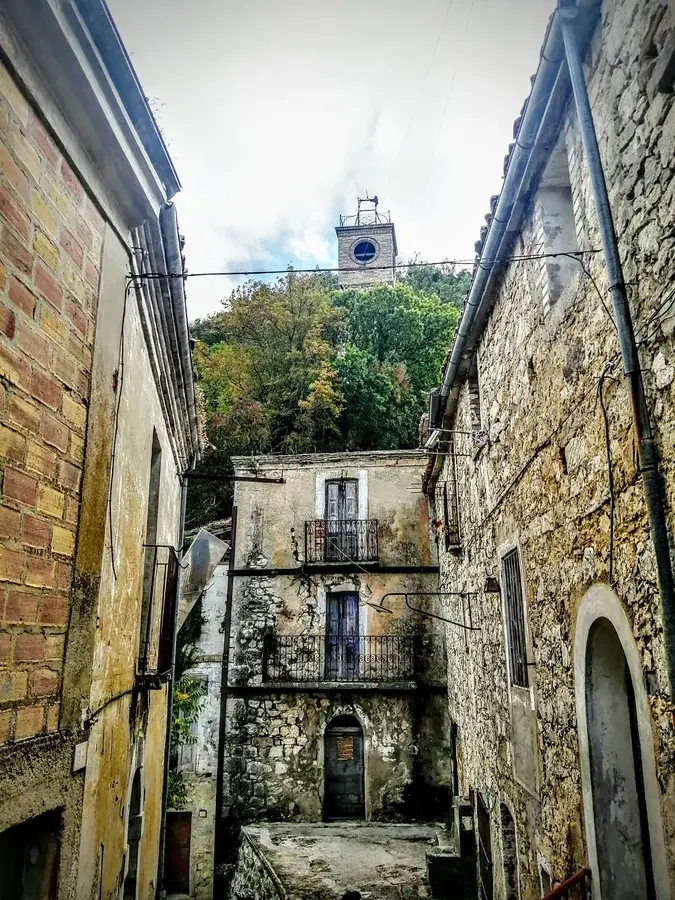
Montebello sul Sangro
what to see in montebello sul sangro? Discover 5 attractions: Church of San Ciriaco and scenic vistas. With 81 inhabitants, explore this mountain village.
Discover Montebello sul Sangro
The village of Montebello sul Sangro, located 810 meters above sea level in the province of Chieti, offers visitors an authentic experience amidst mountain landscapes and centuries-old traditions. Those wondering what to see in Montebello sul Sangro will find an ideal setting to explore the region’s unspoiled nature and discover the simple yet significant architectures that characterize small Abruzzo towns.
Here, it is possible to admire panoramic views over the Sangro river valley and visit the modest parish church dedicated to San Ciriaco, a landmark for the local community.
Life in the village, with its 81 inhabitants, follows slow rhythms and maintains a strong connection with the surrounding territory, inviting a careful and relaxed discovery.
History and origins of Montebello sul Sangro
The history of the territory that today hosts Montebello sul Sangro has its roots in remote eras, with traces testifying to human presence since antiquity, although specific details about the village are less documented.
The Abruzzo area, in fact, was inhabited by Italic populations such as the Samnites, who built fortified settlements on the heights for defensive reasons and territorial control. Subsequently, with the Roman expansion, the region was integrated into the Empire, seeing the construction of communication routes and the development of agricultural and pastoral activities that shaped the local landscape and economy for centuries.
These general elements contextualize the probable origin of many mountain settlements in the province of Chieti.
During the Middle Ages, Abruzzo was the scene of barbarian incursions and subsequent dominations, including those of the Lombards and Normans, which led to the birth and consolidation of numerous castles and fortified villages. These garrisons served to defend populations and control transit routes and agricultural resources.
Montebello sul Sangro, given its elevated position and a name that evokes the beauty of the place and its proximity to the Sangro river, may have played a similar role, developing around a defensive core or a church.
Life in the village, as in many other mountain centers, was closely linked to subsistence agriculture and pastoralism, activities that characterized the economic and cultural identity of the population until the modern age.
During this period, villages like Carapelle Calvisio, situated in a similar mountain context, also experienced dynamics of development and preservation linked to their geographical position.
In subsequent centuries, with its passage under the Kingdom of Naples and then the Kingdom of the Two Sicilies, Montebello sul Sangro maintained its characteristics as a small rural center, influenced by the general political and economic events of the region.
Geographical isolation often contributed to preserving traditions and lifestyles, but it also posed significant challenges in terms of development and connection with larger areas.
The 19th and 20th centuries saw the village face the phenomena of emigration, common to many small towns in Southern Italy, which led to a decrease in population.
Despite these transformations, Montebello sul Sangro continues to represent an example of resilience and preservation of its roots, offering a glimpse into an authentic Abruzzo deeply connected to its history.
What to see in Montebello sul Sangro: main attractions
The Historic Center
The historic center of Montebello sul Sangro represents the heart of the village, a labyrinth of narrow alleys and stone houses that tell the story and daily life of its inhabitants. Walking through the streets, one can observe the traditional Abruzzese architecture, characterized by the use of local materials like Majella stone, masterfully worked to build robust and functional homes.
Every glimpse reveals interesting details, such as stone portals, small windows, and flowered balconies overlooking the smaller squares.
The urban configuration reflects the adaptation to the mountainous terrain, with elevation changes and passages that climb and descend, creating an evocative route. The historic center is a place where time seems to slow down, inviting unhurried discovery, ideal for those seeking tranquility and a genuine connection with the roots of the area.
Visitors to this part of the village can appreciate the care with which the structures are maintained, a testament to a community that values its past.
The Parish Church of San Ciriaco
The parish church of San Ciriaco is a focal point for the community of Montebello sul Sangro, dedicated to the village’s patron saint, whose feast day is celebrated on August 8th. The sacred building, despite its simplicity, expresses the spirituality and devotion of the local population. Its architecture is typical of Abruzzese mountain churches, with a solid structure, often in exposed stone, that integrates well into the surrounding landscape.
Inside, the atmosphere is intimate and invites reflection, with essential but significant furnishings, the result of local faith and craftsmanship.
One can observe paintings and statues depicting San Ciriaco and other saints, elements that enrich the visitor’s experience. The church is not only a place of worship but also a center for social and cultural gathering, where major events are celebrated and traditions are passed down.
It is worth pausing to appreciate the tranquility of the place and its importance to the village inhabitants.
The Panoramas over the Sangro Valley
From its elevated position at 810 meters above sea level, Montebello sul Sangro offers wide and spectacular panoramas over the lush Sangro Valley. This river, one of Abruzzo’s most important, has shaped the landscape, creating a natural setting of great visual impact, with green hills, dense forests, and cultivated fields stretching as far as the eye can see.
Observation points within and around the village allow visitors to enjoy views that change with the seasons, from the intense green of spring and summer to the warm colors of autumn, and even snow-capped peaks in winter.
These panoramas are an invitation to contemplation and photography, offering a privileged glimpse into the vastness and beauty of the Abruzzese territory. The view is particularly striking at dawn and dusk, when the light paints the landscape with unique hues.
Visitors to Montebello sul Sangro can easily find spots from which to admire these breathtaking vistas, which are one of the main reasons to explore the village and its surroundings.
The Surrounding Nature Trails
Montebello sul Sangro’s location, nestled in the mountainous context of the province of Chieti, makes the village an ideal starting point for hiking and nature enthusiasts. The area is crisscrossed by a network of trails and mule tracks that wind through forests of beech, oak, and fir trees, offering routes of varying difficulty suitable for both experienced hikers and families.
Along these paths, it is possible to discover the rich biodiversity of the local flora and fauna, listen to the birdsong, and, with a bit of luck, spot wild animals typical of the Apennines.
The trails lead to even higher panoramic points, water springs, and small clearings, perfect places for a refreshing break. Exploring on foot allows one to fully appreciate the tranquility and purity of the mountain environment, far from the hustle and bustle of cities.
It is advisable to inquire with local authorities or tourist information centers about the most suitable routes and weather conditions before embarking on excursions.
Remains of Fortifications or Defensive Elements
Like many Abruzzese villages of medieval origin, it is plausible to find traces or remains of ancient fortifications in Montebello sul Sangro as well, evidence of a past where territorial defense was a priority. Although there is no specific information about an intact castle, careful observation of the urban fabric can reveal fragments of walls, watchtowers, or foundations of defensive structures incorporated into later dwellings. These vestiges, often made with local stone, tell the story of a village that in the past had to protect itself from incursions and ensure the safety of its inhabitants.
The p
The presence of such elements suggests defensive planning, typical of settlements built on strategic positions. Exploring these ancient structures allows one to imagine life in the village in past eras, when every wall had a practical function and every elevated position was used for controlling the territory.
These remains, though modest, contribute to the historical charm of the place and are another element of what to see in Montebello sul Sangro.
Typical cuisine and products of Montebello sul Sangro
The cuisine of Montebello sul Sangro, like that of much of mountainous Abruzzo, reflects a robust and genuine gastronomic tradition, deeply linked to local produce and pastoral practices. The ingredients are simple but rich in flavour, the result of agriculture and farming that respect natural rhythms and the specific characteristics of the territory. The diet is based on cereals, legumes, sheep and pork, cheeses, and seasonal vegetables, often enriched with wild herbs gathered nearby.
This culinary tradition is the result of centuries of adaptation to available resources and peasant wisdom that has managed to transform humble ingredients into rich and satisfying dishes, perfect for facing daily toil and the rigours of the mountain climate.
Food preparation often follows recipes handed down from generation to generation, keeping the authenticity of flavours alive.
Even in Catignano, another Abruzzese village, similarities can be found in terms of culinary tradition based on local ingredients and homemade preparations.
Among the typical dishes that can be enjoyed in the area, pasta alla chitarra is a timeless classic, often seasoned with a rich mixed meat or lamb ragù. Sagne e fagioli is a hearty first course, where homemade pasta pairs with legumes, creating a blend of rustic and nutritious flavours.
Lamb meat, sourced from local farms, is a protagonist in many preparations, such as agnello al forno with potatoes and aromatic herbs, or agnello cacio e uova, a creamy and flavourful dish.
There are also pork-based preparations, from which cured meats and sausages are obtained, forming an integral part of the food tradition. These dishes, simple in their execution, highlight the quality of the raw ingredients and offer a tasting experience that speaks of the territory and its history.
The Abruzzo territory is renowned for a wide range of certified products that express the excellence and specificity of its agriculture and food craftsmanship.
Among these are Arrosticini (PAT) — municipalities: Pescara, Chieti, Teramo, L’Aquila, which are sheep meat skewers, an icon of Abruzzese gastronomy, grilled and appreciated for their intense flavour. The Aglio rosso di Sulmona (PAT) — municipalities: Sulmona, Pratola Peligna, Raiano, is a prized variety with a characteristic colour and strong flavour, fundamental in many recipes.
The Bocconotti di Castel Frentano (PAT) — municipalities: Castel Frentano, Lanciano, Guardiagrele, are small cakes filled with jam or chocolate, typical of festive seasons.
The Caciocavallo abruzzese (PAT) — municipalities: L’Aquila, Teramo, Chieti, Pescara, is a stretched-curd cheese, with a flavour that varies according to its aging, very versatile in cooking. Finally, the Confetto di Sulmona (PAT) — municipalities: Sulmona, famous worldwide for its quality and elaborate decorations, is a symbol of Abruzzese confectionery.
These products not only enrich the table but are also an expression of a cultural heritage and territorial identity that Montebello sul Sangro helps to keep alive.
Festivities, events, and traditions of Montebello sul Sangro
Life in Montebello sul Sangro is marked by rituals and celebrations that maintain a strong sense of community and connection to its roots. The most important festival in the village is dedicated to Saint Cyriacus of Rome, the patron saint of the town, celebrated annually on August 8th.
On this occasion, the streets of the historic center come alive with a religious procession carrying the statue of the saint on shoulders, accompanied by the musical band and the emotional participation of residents and visitors.
The celebration often includes moments of local folklore, stalls offering typical products, and evenings of music and dancing, creating an atmosphere of joy and sharing that involves everyone.
It is a time when traditions are renewed and social bonds are strengthened, also calling back those who have emigrated to return and participate in this important annual event.
In addition to the patron saint’s festival, Montebello sul Sangro’s calendar may be enriched by other events linked to the cycle of the seasons and agricultural activities, although specific details depend on the municipality’s annual programming.
It is common in Abruzzo’s mountain villages to find food festivals (sagre) dedicated to local produce, such as chestnuts, mushrooms, or cheeses, typically held in autumn, enhancing the seasonal flavors and aromas.
These occasions offer an opportunity for local producers to display and sell their excellent products, and for visitors to savor traditional cuisine in a festive setting. Folk music and traditional dances often accompany these events, offering an authentic glimpse into local culture.
It is always advisable to consult the official website of the municipality for updated information on dates and event programs.
When to visit Montebello sul Sangro and how to get there
The best time to visit Montebello sul Sangro depends on personal preferences and the type of experience one wishes to have. Spring and autumn offer a mild climate, ideal for excursions along nature trails and for admiring the vibrant colors of nature as it awakens or prepares for winter.
These months are perfect for those seeking tranquility and a deep connection with the landscape, away from the crowds.
Summer, particularly the month of August, is the time of the patron saint festival of San Ciriaco, an opportunity to immerse oneself in local traditions and participate in community events, enjoying cooler temperatures compared to the coast.
Winter, with the possibility of snowfall, transforms the village into a picturesque landscape, suitable for those who love quiet and winter atmospheres, although access may be more challenging due to road conditions.
To reach Montebello sul Sangro, various transport solutions can be chosen. Those traveling by car can take the A14 (Adriatica) motorway and exit at Val di Sangro, then continue on provincial roads for about 40-50 km inland. Alternatively, from the A25 (Rome-Pescara) motorway, you can exit at Bussi sul Tirino or Popoli and follow signs for the Sangro Valley, a route that takes about 60-70 km.
The nearest train station is probably Lanciano or Castel di Sangro, from which it is necessary to continue by local bus service or taxi, given the isolated nature of the village.
The reference airport is Abruzzo Airport in Pescara (Abruzzo Airport), approximately 80-90 km away, offering connections to various Italian and European cities.
It is always recommended to check public transport schedules and road conditions, especially in winter, by consulting the official website of the municipality of Montebello sul Sangro (comune.montebellosulsangro.ch.it) for updated information.
| Starting Point | Distance | Estimated Time |
|---|---|---|
| Pescara (Abruzzo Airport) | ~85 km | ~1 hour and 20 min |
| Lanciano (Train Station) | ~45 km | ~50 min |
| A14 Val di Sangro Exit | ~40 km | ~45 min |
Those wishing to extend their exploration of Abruzzo after visiting Montebello sul Sangro can consider an itinerary towards Fano Adriano, another mountain village offering similar natural landscapes and traditions, or move towards the coast, where you’ll find Atri, with its rich historical-artistic heritage that contrasts with the mountain environment but completes the Abruzzese experience.
Photo Gallery of Montebello sul Sangro
Do you have photos of Montebello sul Sangro?
Share your photos of the village: the best ones will be added to the official gallery, with your credit.
Send your photosIn Abruzzo More villages to discover
Lucoli
Lucoli is not a compact town centre but a scattered municipality: 839 inhabitants spread across seventeen hamlets along the southern slopes of the Gran Sasso and the Velino-Sirente mountain group, at 956 metres above sea level in the province of L’Aquila. Understanding what to see in Lucoli means crossing a vast, fragmented territory where each […]
Montazzoli
What to see in Montazzoli at 850m. Discover its 5 historic sites, taste local cheese, visit the annual fair. Explore Montazzoli's treasures.
Corvara
Corvara, a municipality of 210 inhabitants in the province of Pescara, is located 625 meters above sea level in the Pescara valley. Its territory, documented as early as the medieval period, shows traces of settlements dating back to the Neolithic, highlighting a continuous habitation linked to its strategic position. For those wondering what to see […]





📝 Incorrect information or updates?
Help us keep the Montebello sul Sangro page accurate and up to date.