Tropea
What to see in Tropea, Calabria, Italy: explore 5 top attractions, the famous red onion, sandy beaches on the Tyrrhenian Sea. Discover how to get there.
Discover Tropea
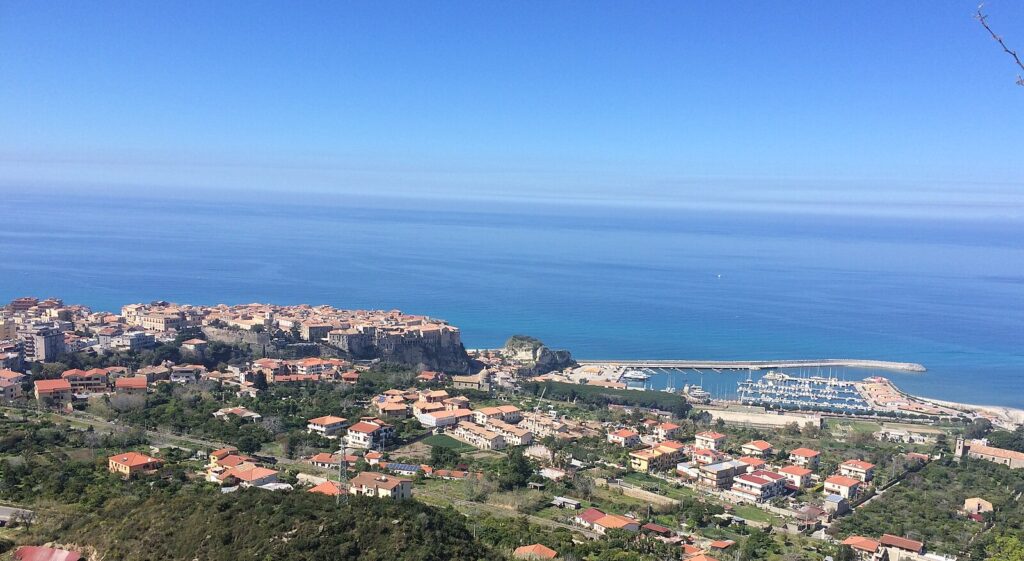
The sandstone cliff drops straight to the sea at the edge of the old town, and the salt air carries the faint sweetness of red onion drying on iron balconies. Below, the Gulf of Saint Euphemia stretches west toward open Tyrrhenian water, its sandy floor visible through clear shallows. The town of Tropea, in the province of Vibo Valentia, holds 5,661 inhabitants and occupies a coastal plateau in the Italian region of Calabria whose edge is literally the sky for anyone standing at its rim.
Deciding what to see in Tropea is the practical challenge for any visitor, because the town concentrates an unusual density of historic, religious, and natural features within a small walkable area.
The population numbers 5,661 and the settlement earned the official title of Most Beautiful Village in Italy for 2021, as well as membership in the association I Borghi più belli d’Italia. Visitors to Tropea find intact medieval street plans, a cliff-face sanctuary, long sandy beaches on the Gulf of Saint Euphemia, and the internationally recognised red onion that defines the local food culture. This guide covers all of it, from arrival logistics to the best season to come.
History of Tropea
The name itself encodes an origin claim. The Latin form Tropaea and the Ancient Greek Trápeia (Τράπεια) both point toward the Greek word for trophy or monument of victory, a reference that early sources link to Hercules, who was said to have erected a victory marker on this coastal promontory during his legendary journeys through the western Mediterranean. Whether that etymology reflects actual Greek colonial activity or a later mythological overlay imposed on an existing place name, the town was already an established settlement by the time Roman administrative geography was formalised.
The Calabrian dialect name Trupìa preserves the older phonology.
Through the medieval period, Tropea passed through Byzantine, Norman, and Aragonese control in succession, each administration leaving physical and institutional traces in the urban fabric. The Norman presence in southern Italy from the eleventh century onward brought the consolidation of ecclesiastical architecture in the region, and Tropea’s cathedral reflects that layered building history. The town’s position on the Tyrrhenian coast made it commercially significant and strategically exposed in equal measure, drawing both investment and repeated military attention from competing powers across the southern Italian mainland and from North African maritime forces.
Two figures born in Tropea mark its contribution to wider Italian intellectual and cultural life. Pasquale Galluppi, the philosopher born in 1770, developed a critical philosophy that engaged directly with Kantian epistemology and became one of the most discussed Italian thinkers of his era. The actor Raf Vallone, born in 1916, built a career that extended from Italian neorealist cinema into international Hollywood productions. On a very different register, Albert Anastasia, the American organised crime figure, was born in Tropea before emigrating to the United States. Since 2013 the town has maintained a formal twin-town relationship with Zvenigorod, Russia.
What to See in Tropea, Calabria: Top Attractions
The Cathedral of Tropea
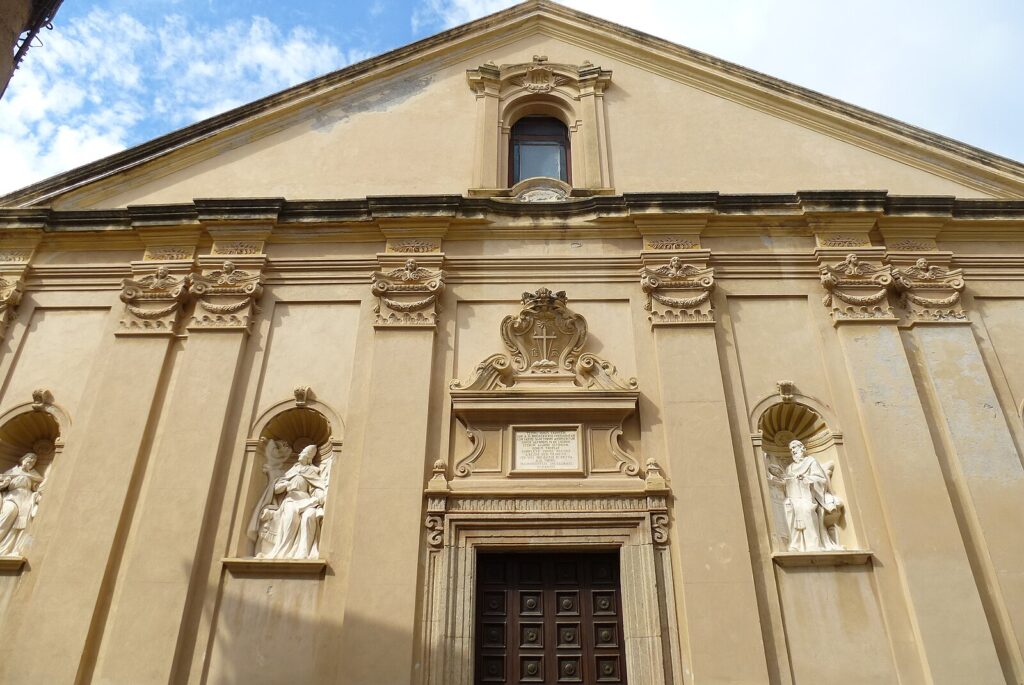
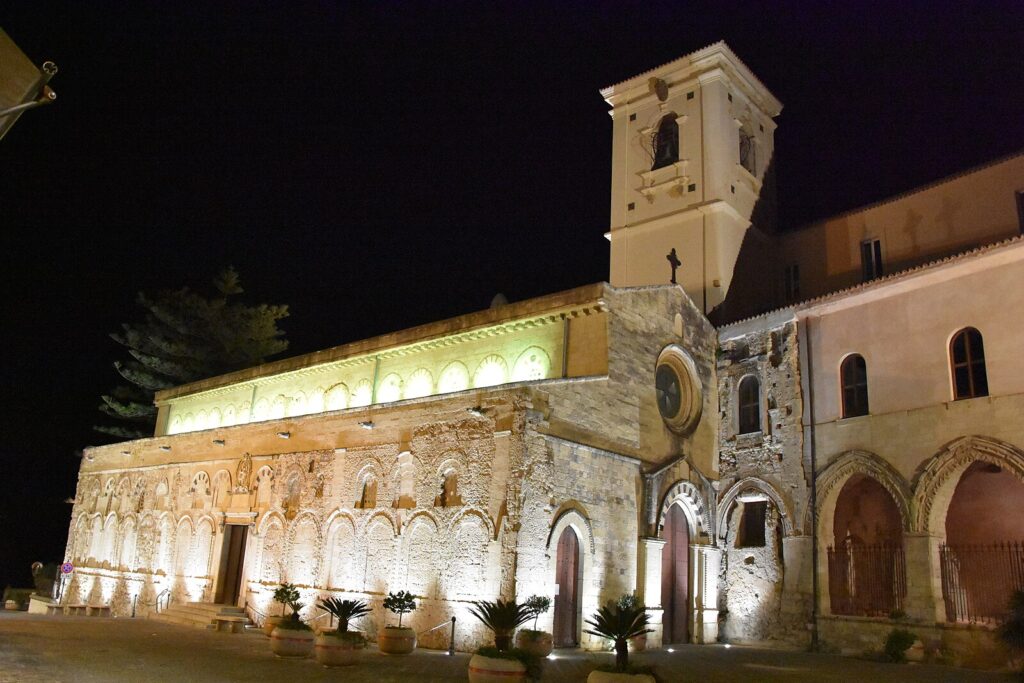
The cathedral’s façade presents a Norman core modified across successive centuries, with visible stonework in warm local sandstone that records each phase of intervention without concealing the earlier layers.
Construction of the original structure dates to the Norman period, placing its foundations firmly in the eleventh or twelfth century, and subsequent Baroque and neoclassical additions accumulate around that nucleus. Inside, the building contains documented artworks including a Byzantine-influenced icon of the Madonna that draws both devotional visitors and art historians. The cathedral stands at the edge of the cliff-top plateau, and the light through its high windows shifts colour as the afternoon sun moves off the Tyrrhenian. For those interested in the interior, the building is generally open during morning and late afternoon hours, with midday closures typical of southern Italian churches.
Santa Maria dell’Isola Sanctuary
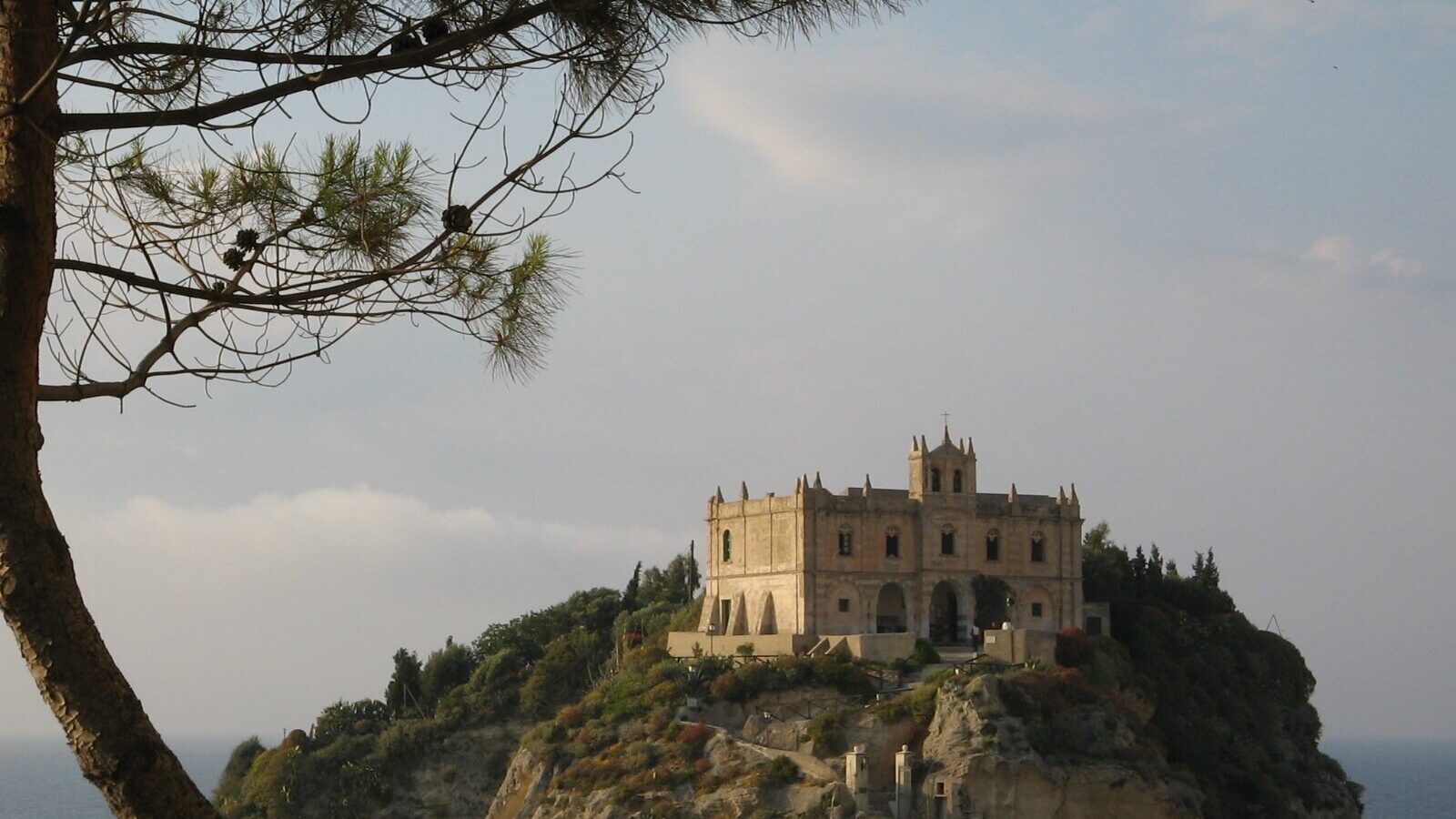
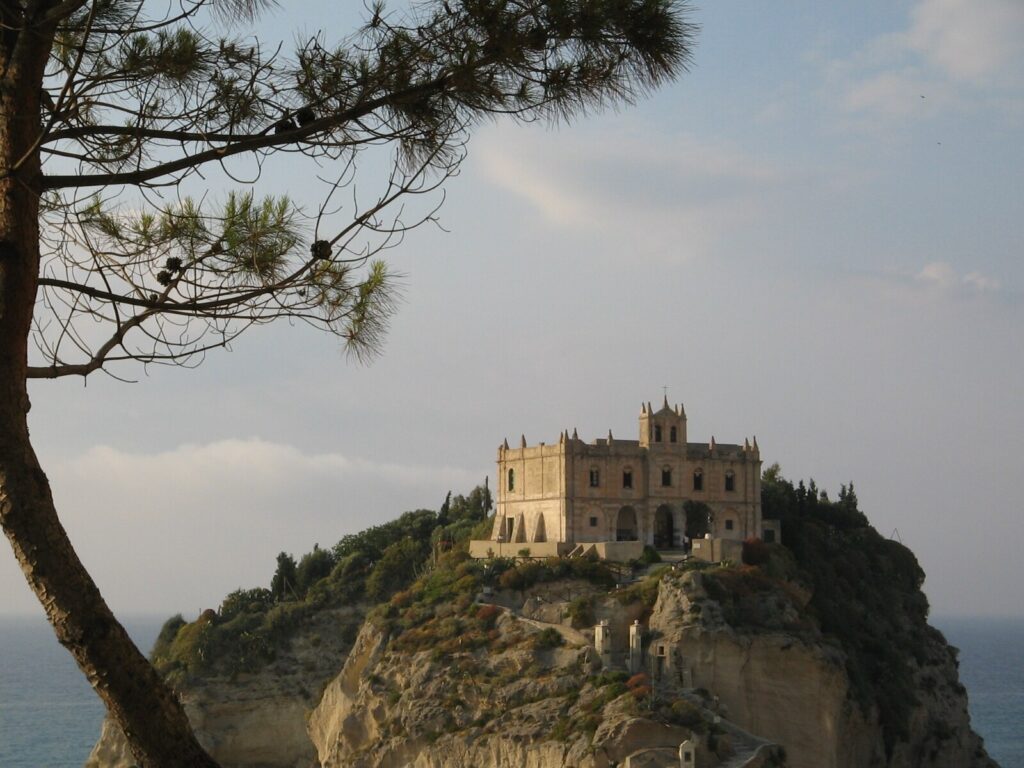
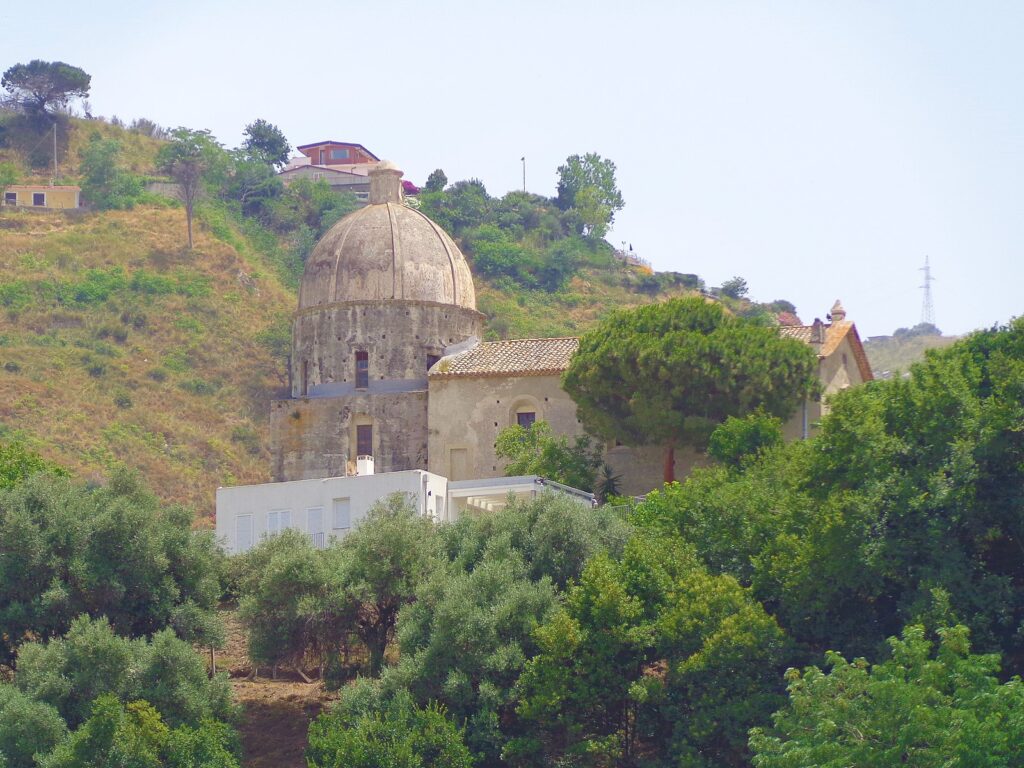
A rectangular rock formation rises from the water just off the main beach, and the white walls of the sanctuary of Santa Maria dell’Isola cap it at a height that makes the structure visible from the town above and from boats several kilometres out to sea. The rock is connected to the shoreline and accessible on foot, with a path that climbs to the sanctuary entrance.
The building’s current form incorporates Norman-era foundations, though the church visible today reflects later rebuilding campaigns. Standing at the top, visitors have a direct sightline back to the sandstone cliff face of the old town, which gives a clear sense of Tropea’s vertical relationship with the sea. The best light for photographs of this view falls in the late afternoon, when the west-facing cliff catches the low sun directly.
The Old Town Cliff Edge and Historic Centre
Tropea’s historic centre occupies a plateau whose southern margin terminates abruptly at a cliff dropping to the beach. The drop is considerable — the cliff face reaches roughly 30 m (98 ft) in sections — and the narrow streets running parallel to the edge follow the contours of the plateau’s original shape. The street grid preserves a medieval pattern of vicoli, narrow alleyways, and small piazze, open squares, that create a compressed urban sequence typical of southern Italian cliff-top settlements.
Several palazzi along the main Corso retain carved stone portals from the seventeenth and eighteenth centuries. The view from the cliff-edge promenade takes in the full arc of the Gulf of Saint Euphemia, with the Aeolian Islands visible on clear days approximately 50 km (31 mi) to the northwest. Walking the circuit of the historic centre, including the main religious buildings and cliff promenade, takes between ninety minutes and two hours at an unhurried pace.
The Beaches of the Gulf of Saint Euphemia
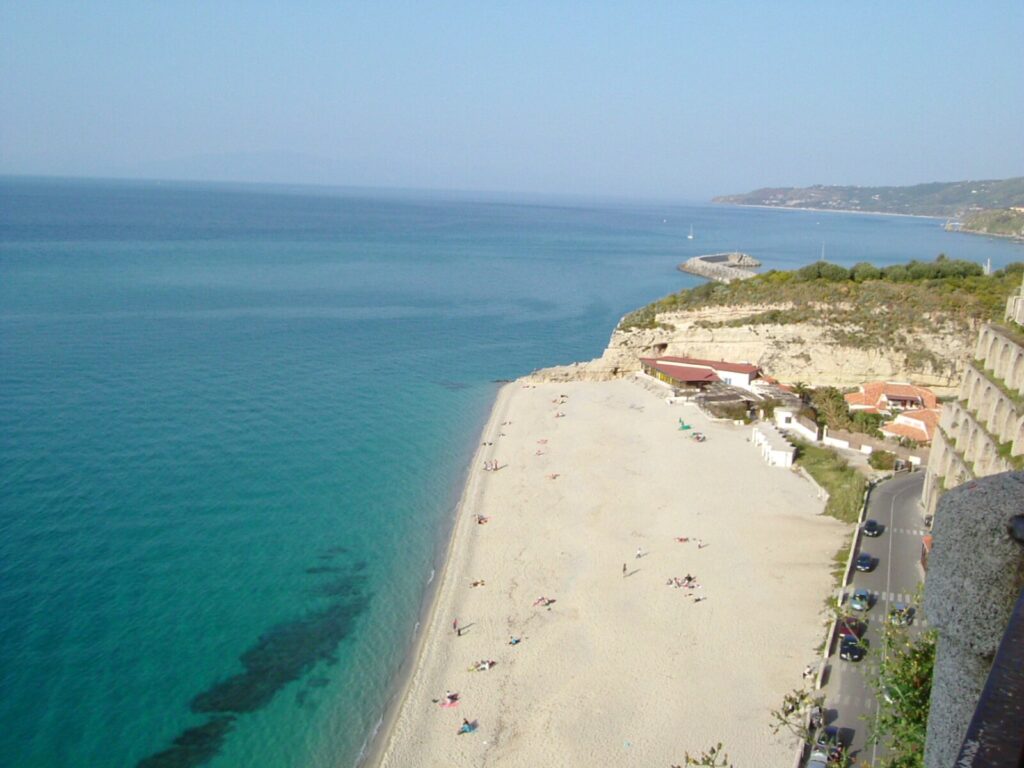
The beaches below the cliff run for several kilometres along the Gulf of Saint Euphemia, which forms part of the Tyrrhenian Sea on Italy’s west coast. The sand is pale and relatively fine, and the sea floor slopes gradually, keeping the water shallow for a significant distance from shore — a physical characteristic that accounts for the clarity of the water over light-coloured sand.
The main beach directly below the old town is accessible from both the north end of town and via steps cut into the cliff in certain sections. A second beach, the Parghelia strand, extends further north. The swimming season runs from June through September with July and August bringing the highest visitor numbers. Water temperature in June averages around 22°C (72°F), rising to approximately 26°C (79°F) in August.
Museo Antichi Mestieri di Calabria
The Museo Antichi Mestieri di Calabria, the Museum of Ancient Crafts of Calabria, documents the manual trades and productive techniques that defined everyday life in the region before industrialisation. The collection includes tools, equipment, and reconstructed workshop environments covering crafts from textile production to agricultural processing.
Located within the town, the museum provides material evidence for the economic and social structures that shaped Tropea and the surrounding Calabrian coast across several centuries. The exhibits include items associated with the processing of the red onion, the town’s most commercially significant agricultural product, alongside broader craft traditions. Opening hours vary seasonally, and checking in advance is advisable, particularly outside the summer peak period from June to September.
Local Food and Typical Products of Tropea
Calabrian food culture reflects the region’s geography: a long coastline with active fishing traditions meeting an interior where smallholder agriculture has produced intensely flavoured vegetables and cured meats across many generations. Tropea sits at the intersection of these two currents. The Tyrrhenian coast has historically supplied swordfish, tuna, and sardines to local tables, while the agricultural land immediately behind the town produces the red onion that has become the most internationally recognised product of the entire province of Vibo Valentia.
The pasta con la ‘nduja is one of the most direct expressions of Calabrian flavour: a spreadable, intensely spiced pork salume called ‘nduja, produced from the softer cuts of the pig blended with Calabrian chilli and cured in a natural casing, is loosened with olive oil in a pan and tossed with short pasta such as rigatoni or paccheri.
The heat is genuine and sustained, not decorative. Pesce stocco alla messinese, stockfish cooked with olives, capers, tomatoes, and potatoes, appears regularly on menus along this stretch of coast, though the “messinese” reference in its name points to the Sicilian influence that crossed the Strait. Cipolla rossa fritta, slices of Tropea’s red onion floured and fried until the sugars caramelise at the edges, appears as a side dish or antipasto and gives a precise taste of what makes this variety of onion different from standard commercial types: lower pungency, higher natural sweetness, and a density of flavour that persists after cooking.
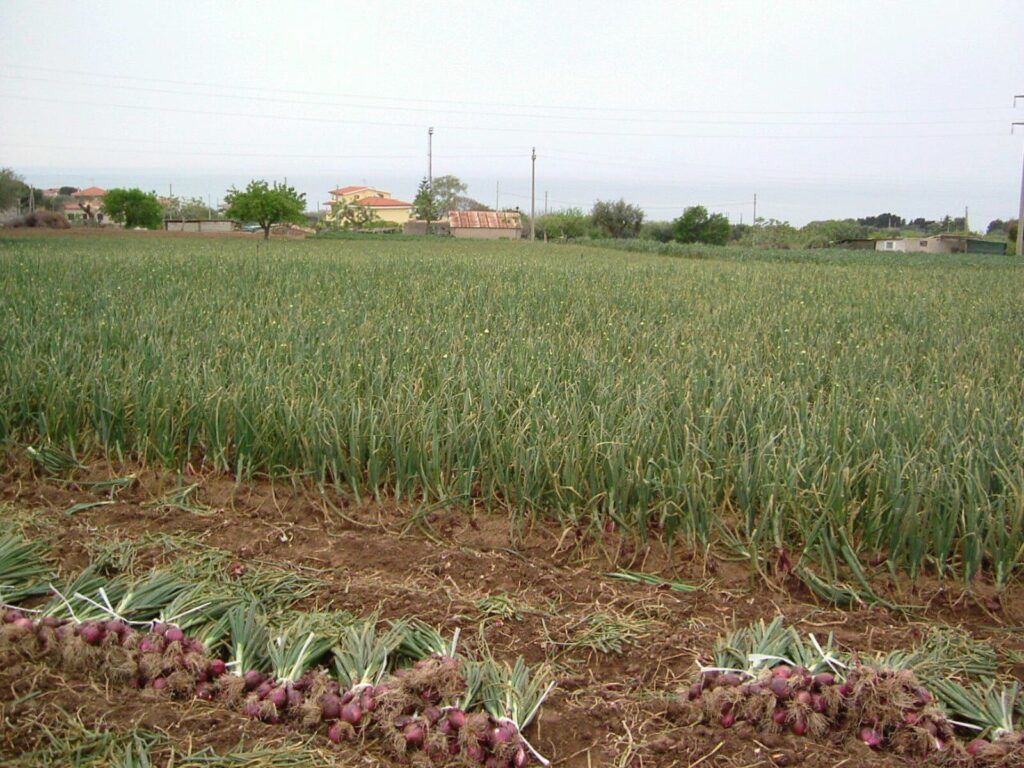
The central certified product of the Tropea area is the Cipolla Rossa di Tropea Calabria (IGP — Indicazione Geografica Protetta), the protected red onion of Tropea, Calabria. This designation covers production in a defined coastal strip of the province of Vibo Valentia. The onion’s particular characteristics — flat-to-round shape, deep red-purple outer skin, mild flavour with low tear-inducing compounds — result from the specific combination of coastal soil, salt air, and local growing techniques. It is sold fresh from late spring and in a dried, rope-hung form (trecce) through the summer and autumn.
Markets along the main street sell the onions directly from producers throughout the season.
The summer months bring a concentration of food-focused events in and around Tropea, with local producers setting up at evening markets along the seafront and in the historic centre. The red onion harvest runs roughly from May through August, and the freshest product is available at source during this window. Visitors arriving between June and September will find the full range of local food shops and producers operating, including those selling the onion in preserved and processed forms such as jams, sauces, and dried preparations.
Festivals, Events and Traditions of Tropea
The religious and civic calendar of Tropea centres on the devotion to the Madonna of Romania, the icon housed in the Cathedral, which has been the focus of local pilgrimage and celebration for several centuries. Processions through the historic centre are a documented feature of the major feast days, with the icon carried through the narrow streets of the old town.
The summer period, from June through August, concentrates the greatest number of public events, as the seasonal population increases substantially with Italian domestic tourists and international visitors drawn to the beaches of the Gulf of Saint Euphemia.
Beyond the religious calendar, the town’s identity as a recognised member of I Borghi più belli d’Italia — the association of Italy’s most beautiful villages — has supported a calendar of cultural initiatives tied to that designation, including events celebrating the 2021 national title. The red onion itself anchors several local food events during the summer harvest period, when producers and restaurateurs collaborate on tastings and market days that run through July and August in the town centre and along the seafront.
When to Visit Tropea, Italy and How to Get There
The best time to visit Calabria’s Tyrrhenian coast, and specifically Tropea, depends on what a visitor prioritises. July and August deliver the warmest sea temperatures and the full programme of summer events, but they also bring the heaviest crowds and the highest accommodation prices. June and September offer a workable middle ground: the sea is warm enough for swimming, the town is less congested, and prices are lower. The shoulder months of May and October are viable for those interested primarily in the historic centre and food culture rather than beach activity, with average daytime temperatures in the range of 18–22°C (64–72°F). For what to see in Tropea without the peak-season crowds, late June or early September represent the most practical windows.
Getting to Tropea by train is the most straightforward option for visitors without a car. The town has its own station on the Trenitalia Lamezia Terme–Reggio Calabria coastal line, which connects to the main high-speed rail network at Lamezia Terme Centrale.
From Lamezia Terme, regional trains cover the approximately 60 km (37 mi) to Tropea in around one hour and fifteen minutes. From Rome, the high-speed train to Lamezia Terme takes approximately three hours and fifteen minutes, making a long day trip from Rome feasible, though an overnight stay allows considerably more time on the ground. The nearest major airport is Lamezia Terme International Airport, located approximately 65 km (40 mi) from Tropea, with transfer by train or hire car taking between one and one and a half hours. By car, the A2 Autostrada del Mediterraneo is the primary motorway route; the exit for Pizzo, approximately 20 km (12.4 mi) from Tropea, is the most direct approach from the north. International visitors should carry some euro cash, as smaller shops and producers along the market streets do not always accept cards, and English is limited outside the main tourist-facing businesses.
Travellers extending their time in Calabria beyond Tropea have several options within a reasonable driving distance. The village of Belmonte Calabro, which sits on a hilltop inland from the Tyrrhenian coast and is also a member of I Borghi più belli d’Italia, offers a different perspective on Calabrian historic architecture, with a well-preserved medieval layout above the coastal plain.
For those travelling northward along the Calabrian interior, Buonvicino is a compact hilltop village in the province of Cosenza that shares the same tradition of small-scale agricultural production and medieval urban form found across this part of southern Italy. Both can be reached within two hours of Tropea by car, and combining them with a base in Tropea extends the range of what to see in Tropea’s wider regional context considerably.
Getting there
📷 Photo Gallery — Tropea
In Calabria More villages to discover
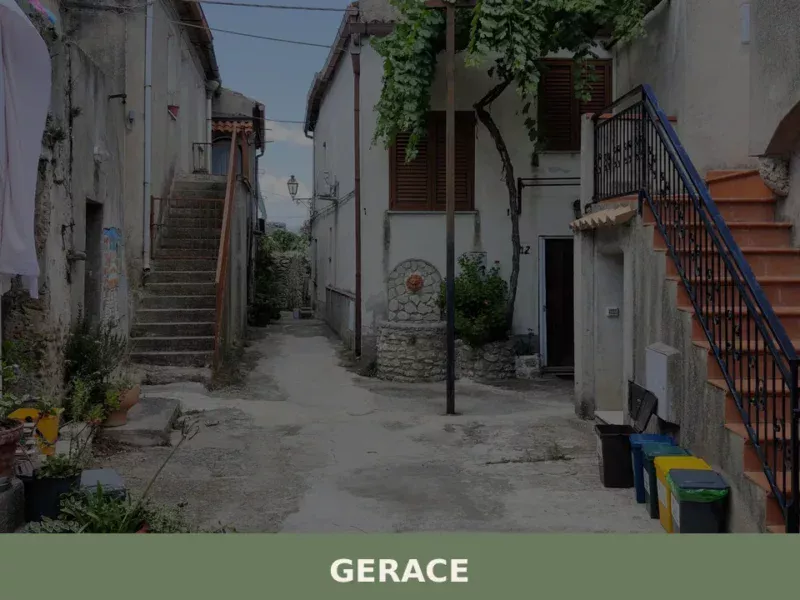
Gerace
A rock formed from sea fossils laid down 60 million years ago rises 500 metres (1,640 ft) above the Ionian plain. From its summit, on a clear day, the coastal town of Locri and the sea beyond it are visible as distinct horizontal bands of terracotta, grey, and blue. The hill is composed of marine […]
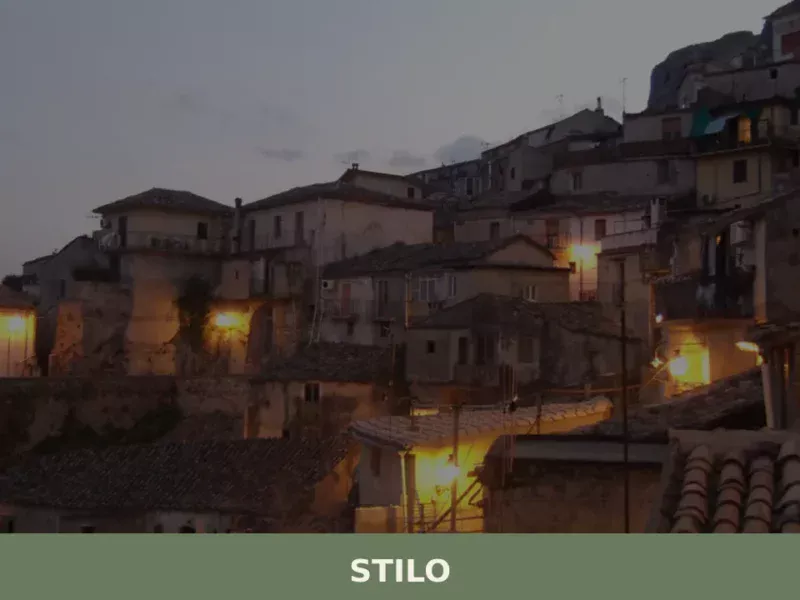
Stilo
The Cattolica church occupies a spur of rock above the rooftops, its five small domes visible from the valley floor before the rest of the village comes into focus. Below the church, the streets narrow and the stone deepens in colour, shifting from pale grey to near-black where the walls absorb the shadow. Iron and […]
Morano Calabro
What to see in Morano Calabro, Italy: a village at 680 m altitude, listed among I Borghi più belli d'Italia. Discover top attractions, local food and how to get there.
📝 Incorrect information or updates?
Help us keep the Tropea page accurate and up to date.