


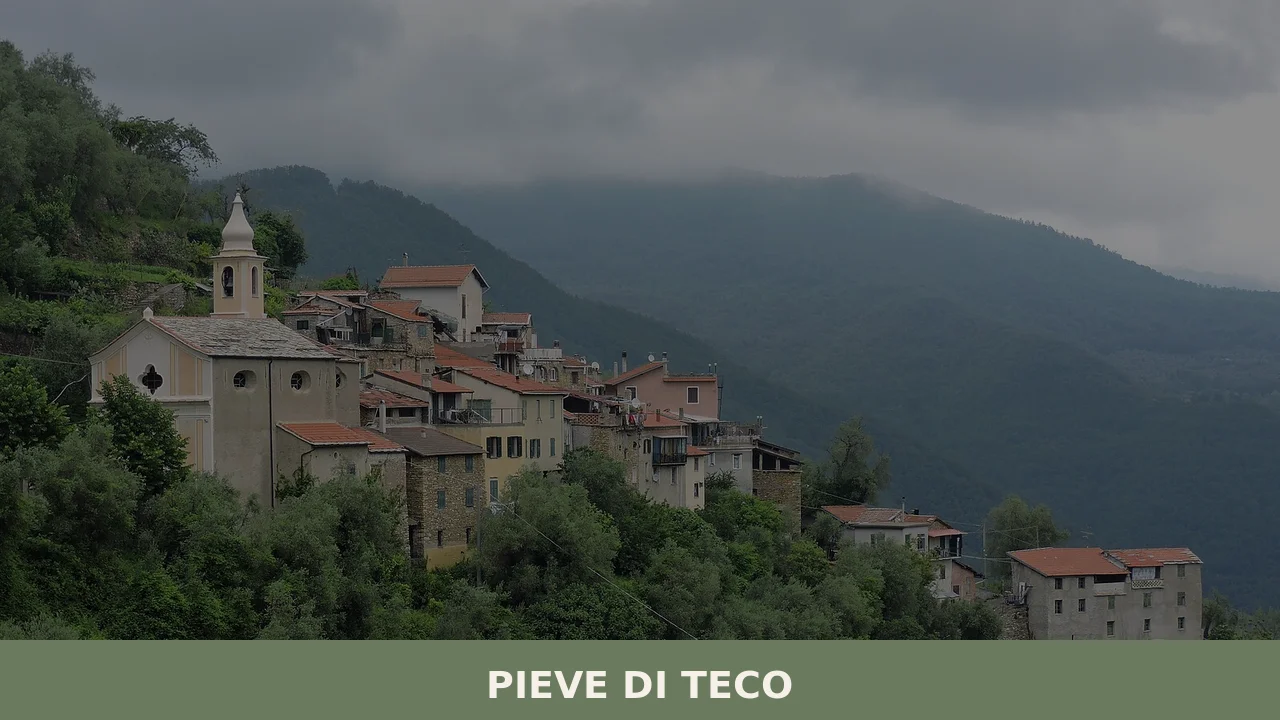
Pieve di Teco
 Mountain
What to see in Pieve di Teco, Liguria, Italy: explore 5 top attractions, local food, and how to get there. Population 1,411. Discover this Ligurian village.
Discover Pieve di Teco
The arcaded main street runs the full length of the village in a single, almost unbroken line, its stone columns carrying low vaults that cast parallel shadows across the paving stones at noon. The Arroscia valley spreads out to the south, a corridor of terraced land that connects the Ligurian pre-Alps to the coastal plain of Imperia, roughly 20 kilometres (12 mi) away.
At 1,411 inhabitants, Pieve di Teco holds its form: compact, structured, legible in an hour on foot.
Deciding what to see in Pieve di Teco is straightforward once you understand the layout.
The municipality sits in the Province of Imperia, about 90 kilometres (56 mi) southwest of Genoa, and its main draw is the medieval porticoed street, one of the most complete examples of continuous arcade architecture in inland Liguria. Visitors to Pieve di Teco find a functioning village with a documented twin-town relationship with Bagnols-en-Forêt in France, a parish church worth examining for its age and positioning, and a surrounding landscape that connects to multiple neighbouring communes for day walks.
History of Pieve di Teco
The name Pieve di Teco breaks into two recognisable parts.
Pieve is the Italian term for a parish church that historically served as the administrative and spiritual centre of a rural district — a function that explains why so many Ligurian settlements carry this prefix. The second element, Teco, is the local toponym, preserved in the Ligurian dialect name Céve. The village developed along the Arroscia valley, a route used for centuries to move goods and livestock between the coastal strip and the inland Ligurian hills, which gave the settlement both its economic purpose and its characteristic linear shape.
The municipality borders ten other communes: Armo, Aurigo, Borghetto d’Arroscia, Borgomaro, Caprauna, Caravonica, Cesio, Pornassio, Rezzo, and Vessalico.
This density of neighbouring settlements reflects the historical fragmentation of territory in the Ligurian pre-Alps, where each valley ridge tended to generate its own administrative unit.
The relationship between these villages was as much competitive as cooperative, with control of valley access roads being a recurring source of local tension across the medieval and early modern period. The arcaded street of Pieve di Teco itself reflects this commercial logic: the porticoes allowed trade to continue regardless of weather, a practical solution in a valley where summer thunderstorms arrive without warning.
The twentieth century left a specific human trace in the village. Mario Magnotta, born here in 1942 and died in 2009, is the most documented individual associated with Pieve di Teco. Since 1990 the commune has maintained a formal twin-town relationship with Bagnols-en-Forêt in the Var department of France, a connection that reflects the broader Franco-Ligurian cultural exchanges along the southern Alpine arc.
That twinning agreement, now more than three decades old, is formalised at the municipal level and periodically renewed through cross-border civic exchanges.
The village of Prelà, situated to the south in the same province, shares a comparable pattern of medieval settlement in the Ligurian hills and makes for a logical extension of any itinerary through this part of Imperia.
What to see in Pieve di Teco, Liguria: top attractions
The Porticoed Main Street
The defining physical feature of Pieve di Teco is its arcaded main street, where stone columns support a near-continuous sequence of vaults running the length of the village centre. This type of construction — essentially a covered walkway integrated into the ground floors of residential and commercial buildings — was documented across Ligurian market towns from the medieval period onward, but few examples survive as intact as this one. Standing at one end, you can measure the perspective down the full length of the arcade, with the columns creating a rhythm that makes the scale of the settlement immediately apparent.
Visit on a market day to see the space used as it was designed: for transactions carried out in shade.
The Parish Church
The parish church of Pieve di Teco anchors the settlement both physically and historically, positioned as the focal point of the pieve district it once administered.
In Liguria, churches of this category typically date to foundations between the tenth and thirteenth centuries, with subsequent rebuilding campaigns that layered Romanesque, Gothic, and Baroque elements onto earlier cores. The church interior holds fittings and decorative work accumulated over multiple building phases, making it a readable archive of local patronage and artistic influence. It is worth arriving in the morning when light enters from the east-facing windows and illuminates the nave without obstruction.
The Arroscia Valley Landscape
The land immediately surrounding Pieve di Teco drops into the Arroscia valley, a corridor roughly oriented north-south that extends from the Ligurian pre-Alps toward the coast. The terraced hillsides visible from the village edge are the product of centuries of agricultural work, with dry-stone walls holding narrow planting beds on slopes that would otherwise be unusable. The valley connects to Borghetto d’Arroscia to the north and opens toward Imperia, 20 kilometres (12 mi) to the southeast.
For those who want to cover the terrain on foot, the network of mule tracks between the bordering communes — including Rezzo and Pornassio — offers routes that stay close to the topography rather than the road network.
The Historic Village Boundary and Communal Territory
Pieve di Teco’s communal territory borders ten distinct municipalities, an unusually high number for a village of 1,411 people.
Walking the perimeter paths that approach these boundaries gives a clear sense of how the Ligurian landscape was parcelled: ridges as dividing lines, valleys as shared resources, and the village itself as the point where multiple local economies converged. The boundary with Caprauna to the north reaches into higher elevation terrain, while the border with Borgomaro to the east follows the lower valley floor.
Carrying a detailed 1:25,000 topographic map of the Imperia province is the most reliable way to navigate these routes independently. The nearby village of Castelbianco, further up the Arroscia watershed, sits within a comparable landscape and is accessible by the same valley road.
The Twin-Town Cultural Connection with Bagnols-en-Forêt
Since 1990, Pieve di Teco has maintained an official twinning agreement with Bagnols-en-Forêt in the Var department of southern France. This relationship, now in its fourth decade, reflects the documented historical exchanges between inland Liguria and Provence — two zones that share not only a border but a pattern of upland agricultural settlement. The practical result for visitors is that Pieve di Teco occasionally hosts Franco-Ligurian cultural events tied to the twinning calendar, which the municipal office can confirm.
The formal twinning monument or plaque, where present in Italian communes of this size, is usually positioned near the municipal building and worth locating as a reference point for the village’s civic geography.
Local food and typical products of Pieve di Teco
The food culture of inland Imperia province is shaped by the altitude and the terrain.
At roughly 20 kilometres (12 mi) from the coast, Pieve di Teco sits in the zone where marine influence on the diet — olive oil, preserved fish, herbs — meets the upland tradition of dried pulses, chestnut flour, and cured meats. The Arroscia valley historically produced enough olives in its lower reaches to supply oil to the village, while the higher slopes contributed chestnuts, wool, and seasonal grazing. This combination of coastal proximity and upland production defines what appears on tables in the area.
Among the dishes documented in the Ligurian inland tradition, testaroli — a flat, disc-shaped pasta cooked on a terracotta plate called a testo and then briefly boiled before serving — appears across the Ligurian pre-Alps.
In the Imperia area, minestrone alla genovese takes its inland variant with the addition of legumes grown at altitude, including borlotti beans, and is thickened without cream.
Coniglio alla ligure, rabbit braised with olives, pine nuts, and white wine, represents the kind of slow-cooked preparation suited to a kitchen that works with foraged and locally raised ingredients rather than market imports. Chestnut-based preparations, including castagnaccio, a flat cake made with chestnut flour, rosemary, and pine nuts, remain present in the autumn food calendar of the valley.
The Ligurian hills around Imperia are associated with extra-virgin olive oil production, particularly from the Taggiasca olive variety, which produces a mild, low-acidity oil with a characteristic pale gold colour. While no certified product database entry specific to Pieve di Teco was available for this guide, the Taggiasca olive and its oil are documented products of the broader Province of Imperia and are available from producers operating in the valley.
When buying directly from a local producer, quantities are typically sold in 0.5-litre (17 fl oz) or 0.75-litre (25 fl oz) glass bottles.
The village of Diano San Pietro, situated closer to the coast in the same province, is specifically associated with Taggiasca olive cultivation and production.
Local markets in the Province of Imperia follow a weekly rotation across the valley communes. For the most direct access to seasonal produce — mushrooms in autumn, herbs in late spring, olives and new oil from October onward — visiting during the harvest months of September through November gives the clearest picture of what the territory actually produces.
International visitors should carry euros in cash, as card payment is not universally accepted at smaller market stalls and rural producers.
Festivals, events and traditions of Pieve di Teco
The village observes the civic and religious calendar common to Ligurian communes of its size, with the patron saint festival marking the central point of the summer season.
Specific dates for Pieve di Teco’s patron saint celebration were not available in the sources consulted for this guide, and the municipal office at the Comune di Pieve di Teco should be contacted directly for the current year’s programme. Events in villages of this type in Liguria typically include a religious procession through the main street, with the arcaded route providing a natural ceremonial corridor, followed by outdoor dining and, in some years, music organised by local associations.
The twinning with Bagnols-en-Forêt, established in 1990, generates periodic exchange events between the two communities, including delegations that travel in both directions for civic occasions.
These events are not fixed to a single annual date and vary with the administrations of both communes. The autumn period — particularly October, when the olive harvest begins across the Imperia province — concentrates informal food-related activity in valley villages, including Pieve di Teco, even where no formally named sagra (a traditional local food festival tied to a specific product) is scheduled.
When to visit Pieve di Teco, Italy and how to get there
The most practical window for visiting Pieve di Teco, Liguria, Italy is from late April through June and again from September through October.
Spring brings mild temperatures in the valley — typically between 14°C (57°F) and 22°C (72°F) at this elevation — without the midday heat that makes walking between communes uncomfortable in July and August. Autumn combines harvesting activity with stable weather and reduced visitor numbers compared to the Ligurian coast.
Winter is workable for those who want to see the village without any competing foot traffic, though some local services reduce their hours between November and March.
Getting to Pieve di Teco by car is the most direct option. From the A10 motorway (the Genoa–Ventimiglia autostrada), exit at Albenga and follow the SP1 inland along the Arroscia valley for approximately 30 kilometres (19 mi). From Imperia, the village is about 20 kilometres (12 mi) to the northwest on the same valley road. The nearest train station with regular intercity connections is Albenga, on the Trenitalia coastal line between Genoa and Ventimiglia.
From Albenga station, Pieve di Teco is reached by regional bus or by car. The nearest international airport is Genoa Cristoforo Colombo Airport, approximately 100 kilometres (62 mi) to the northeast, with a road transfer of roughly 90 minutes depending on traffic. For visitors coming from France, Nice Côte d’Azur Airport sits about 85 kilometres (53 mi) to the west along the coast.
As a day trip from Genoa, Pieve di Teco is feasible — allow around 90 minutes each way by road — though an overnight stay in the valley allows more time to cover the surrounding communes on foot.
English is not widely spoken in the village’s smaller shops and service points, so carrying a translation app and sufficient euros in cash is a practical step for international visitors. The arcaded main street is largely flat and accessible, though the lanes climbing away from it toward the upper village involve gradient and uneven stone paving.
Visitors exploring the wider Province of Imperia can extend their trip inland toward Plodio, a Ligurian comune that shares the same pattern of small-scale upland settlement and sits within a reasonable driving distance of the Arroscia valley corridor.
Frequently asked questions about Pieve di Teco
What is the best time to visit Pieve di Teco?
Late spring (May–June) and early autumn (September–October) offer the most comfortable conditions: mild temperatures at 240 metres, clear visibility across the Arroscia valley, and seasonal produce at local markets. The feast of San Sebastiano on 20 January is the principal civic and religious event, worth timing a winter visit around. Summer brings occasional afternoon thunderstorms typical of the Ligurian pre-Alps, which the porticoed main street was literally built to handle. October marks the start of new olive oil production in the valley.
What are the historical origins of Pieve di Teco?
The name combines pieve — an Italian term for a rural parish church that historically served as the administrative centre of its district — with Teco, the local toponym preserved in the Ligurian dialect form Céve. The village developed along the Arroscia valley as a staging point for the movement of goods and livestock between the Ligurian coast and the inland pre-Alps. Its characteristic linear form, with a continuous arcaded street, reflects a commercial logic: covered porticoes allowed trade to continue year-round in a valley prone to summer storms.
What to see in Pieve di Teco? Main monuments and landmarks
The arcaded main street is the essential sight: stone columns carry an almost unbroken line of vaults along the full length of the village centre, one of the most intact examples of continuous arcade architecture in inland Liguria. Stand at one end to appreciate the full perspective. The parish church, positioned as the historic focal point of the pieve district, contains decorative layers from multiple building campaigns. Near the municipal building, look for the civic plaque marking the twin-town agreement with Bagnols-en-Forêt, France, formalised in 1990.
What are the main natural or scenic attractions of Pieve di Teco?
The Arroscia valley, visible from the village edge, offers terraced hillsides built on dry-stone walls and a network of historic mule tracks connecting the ten bordering communes — including Rezzo, Pornassio, and Caprauna to the north. These routes follow ridgelines and valley floors rather than roads, making them well suited for walking. The terrain rises toward higher elevations at the Caprauna border to the north. A 1:25,000 topographic map of Imperia province is the recommended navigation tool for independent walkers.
Where to take the best photos in Pieve di Teco?
The porticoed main street is most photogenic at midday when the low vaults cast parallel shadows across the paving stones — a geometry that only works when the sun is high. Stand at either end of the arcade for a full-length perspective shot. The valley viewpoint from the southern edge of the village looks out over terraced land descending toward Imperia, 20 kilometres away. Morning light entering east-facing windows in the parish church illuminates the nave cleanly, making it a good interior photography opportunity in the first hours after opening.
What can you do in Pieve di Teco? Activities and experiences
Walking the mule track network between Pieve di Teco and its ten bordering communes is the primary outdoor activity. The valley road connects to Borghetto d'Arroscia to the north and to Imperia to the southeast, making it a natural corridor for cycling. On market days, the porticoed street functions as a covered trading space exactly as it was designed — local seasonal produce, including autumn mushrooms and new olive oil from October onward, is available directly from valley producers. The municipal office can confirm dates for Franco-Ligurian cultural events tied to the Bagnols-en-Forêt twinning calendar.
Who is Pieve di Teco suitable for? Families, couples, hikers, solo travelers?
Pieve di Teco suits walkers and slow travellers who want an intact medieval village without coastal crowds. The compact layout — legible in an hour on foot — makes it accessible for all ages, including families with children. The mule track network connecting to neighbouring communes appeals to experienced hikers with map-reading skills. Couples and solo travellers interested in Ligurian architectural history will find the arcaded street and parish church worth extended attention. It is not a resort destination; the appeal is in the village fabric and the surrounding upland landscape, not organised tourist infrastructure.
What to eat in Pieve di Teco? Local products and specialties
The local table sits at the meeting point of coastal and upland Ligurian traditions. Documented area specialities include testaroli (flat pasta cooked on terracotta and briefly boiled), coniglio alla ligure (rabbit braised with Taggiasca olives, pine nuts, and white wine), and castagnaccio (chestnut flour cake with rosemary and pine nuts), present in autumn. Inland minestrone is made with altitude-grown borlotti beans. The Taggiasca olive, the documented variety of Imperia province, produces a pale gold, low-acidity extra-virgin oil available from valley producers in 0.5-litre and 0.75-litre glass bottles from October onward.
📷 Photo Gallery — Pieve di Teco
Getting there
Corso Mario Ponzoni, 18026 Pieve di Teco (IM)
Nearby Villages near Pieve di Teco
In Liguria More villages to discover
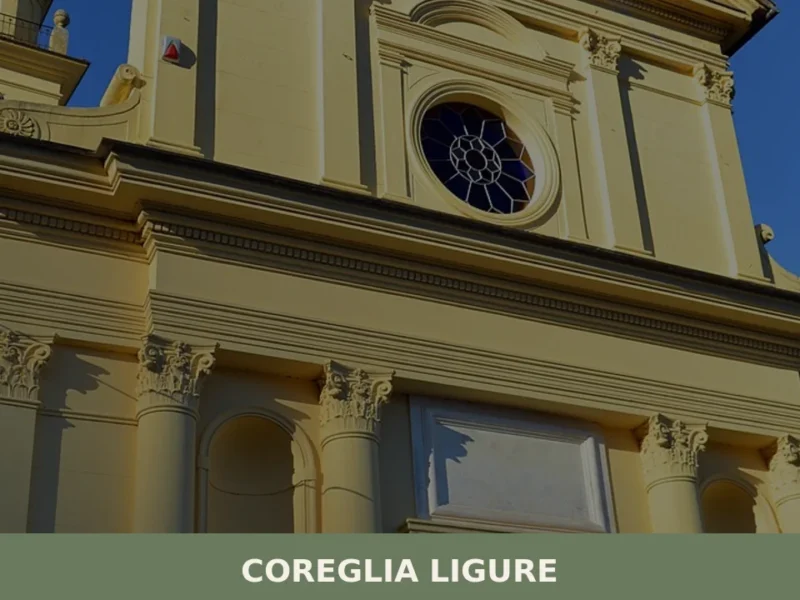
Coreglia Ligure
 Plains
Coreglia Ligure, a comune of just 257 inhabitants in the province of Genova, sits at 65 metres above sea level on the eastern slope of the Fontanabuona valley — one of the most densely settled inland corridors of the Ligurian Apennines. The village’s economy historically revolved around slate extraction and olive cultivation, two activities that […]
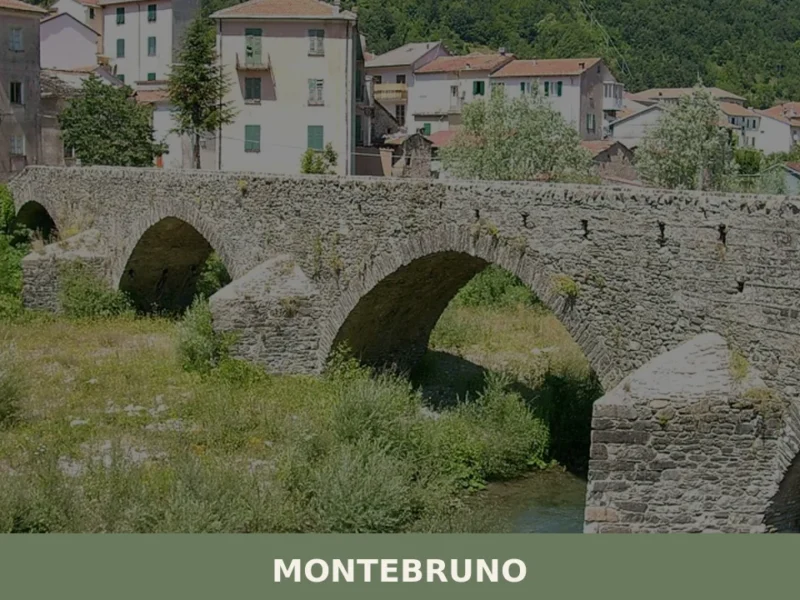
Montebruno
Mountain
What to see in Montebruno, Italy: a mountain village at 655 m (2,149 ft) near Genoa. Discover the Marian sanctuary, Antola park trails and the 8 September feast.
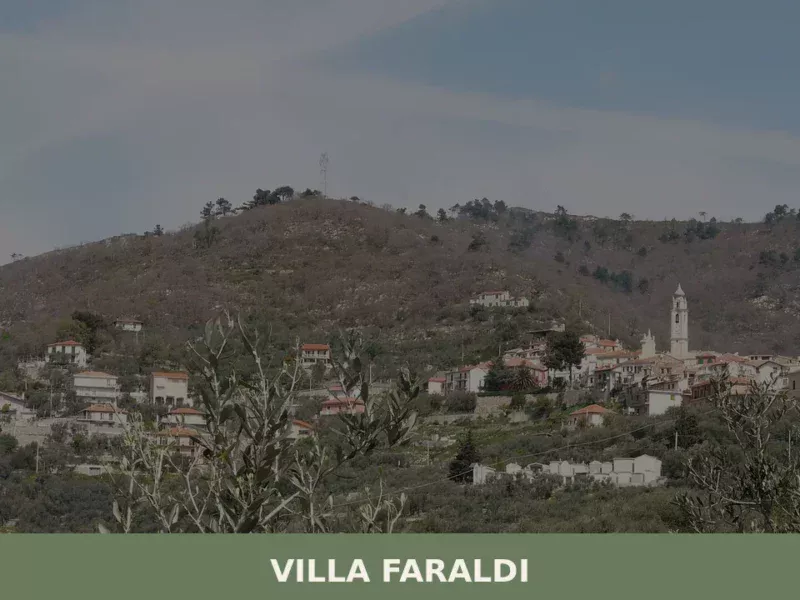
Villa Faraldi
 Hills
Hills
what to see in villa faraldi: Discover this Italian village of 452 inhabitants in Liguria. Explore historic alleys and scenic views. Read our guide to Villa Faraldi, Italy.
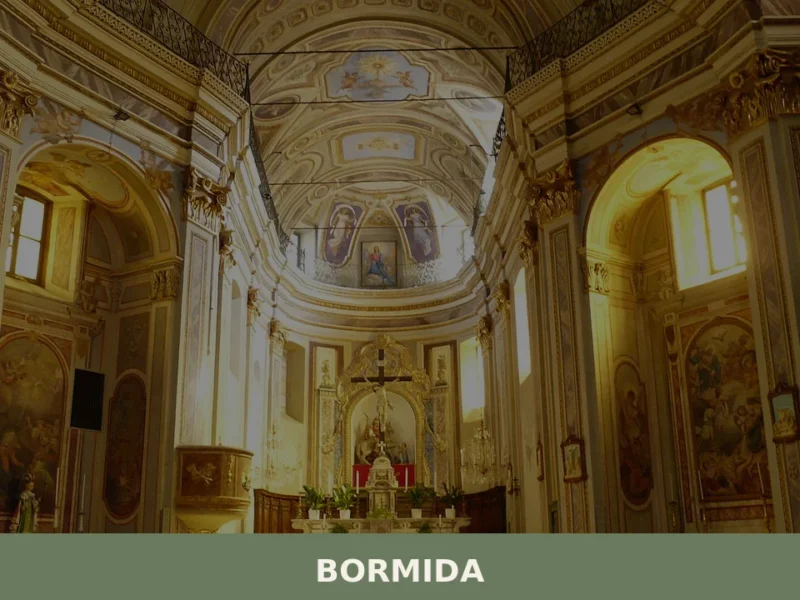
Bormida
Hills
The Bormida di Pallare runs cold through the upper valley, cutting between the flanks of Monte Settepani at 1,386 m (4,547 ft) and Ronco di Maglio at 1,108 m (3,635 ft). Iron was worked here for centuries, and the name of at least one surviving building still carries that industrial memory. The village covers 22.4 […]
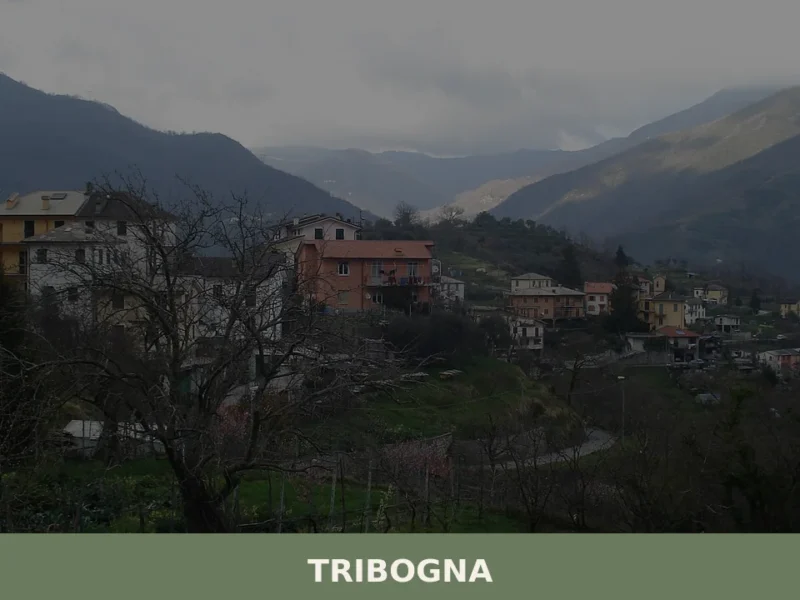
Tribogna
Hills
what to see in tribogna, Italy: Explore this Ligurian comune of 628 inhabitants, 33 km east of Genoa. Read about its administrative role and surrounding valleys.
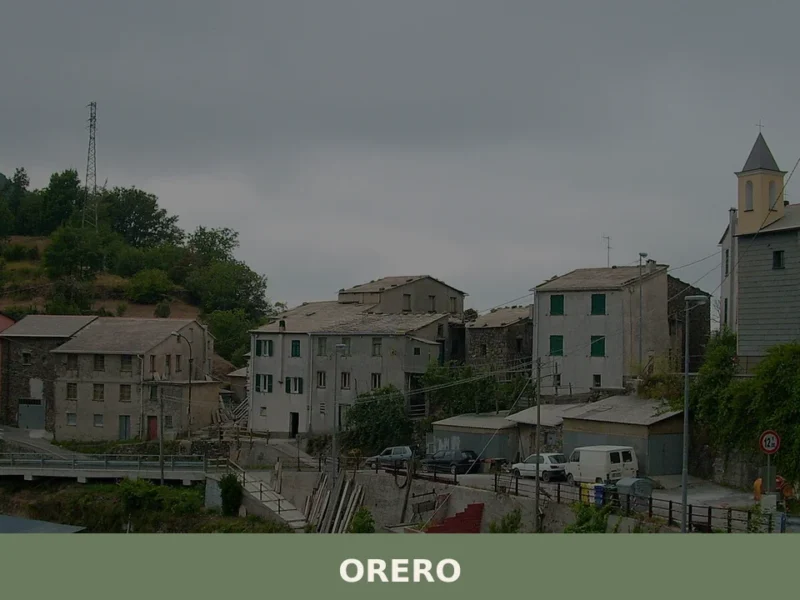
Orero
Mountain
What to see in Orero, Italy: Explore a Ligurian village at 400 m (1,312 ft) altitude. Discover the 17th-century Sant'Ambrogio Church and the autumn Chestnut Festival. Read our guide.
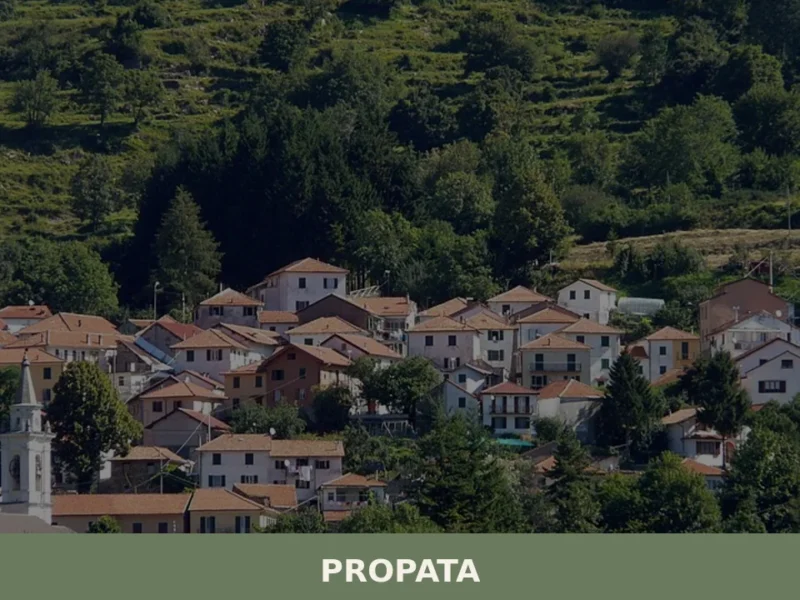
Propata
Mountain
What to see in Propata, Italy: Discover the parish church and its Maragliano statue in this Ligurian village of 156 inhabitants. Explore its history.
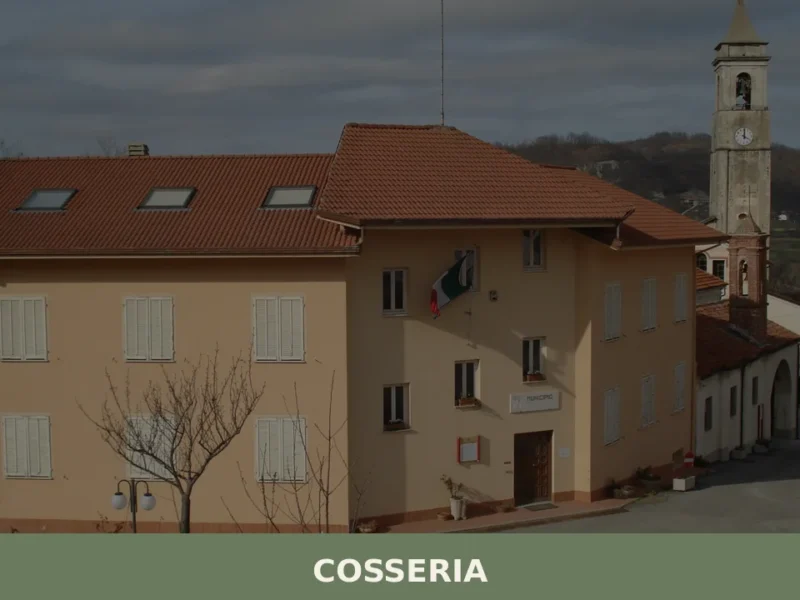
Cosseria
Mountain
What to see in Cosseria, Liguria, Italy: explore a comune of 1,095 inhabitants near Savona. Discover the 5th Infantry Division history, local food and how to get there.
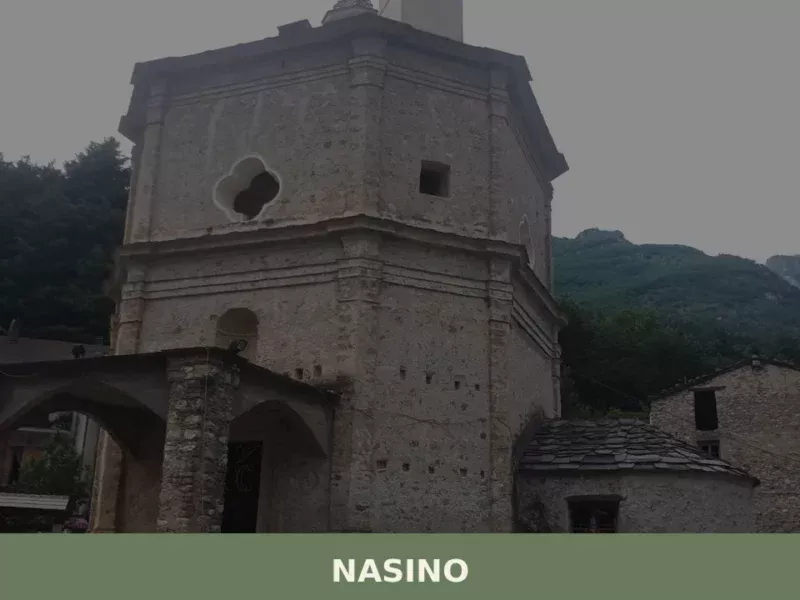
Nasino
Mountain
What to see in Nasino, Italy: a village of 212 inhabitants southwest of Savona. Explore its Ligurian character and scenic surroundings. Discover its unique charm.
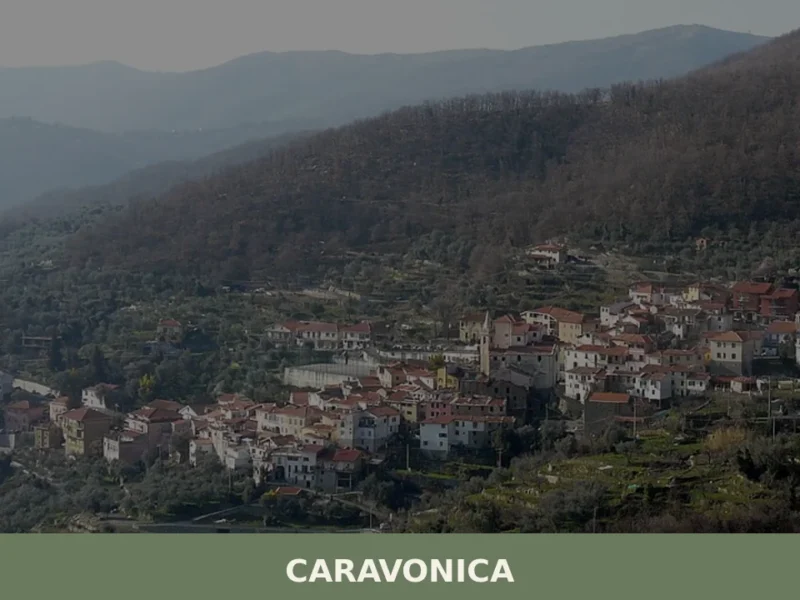
Caravonica
Hills
The scent of wild rosemary drifts on the morning air, carried by a breeze that has travelled from the Ligurian Sea and across the terraced olive groves. Morning light, still soft, begins to illuminate the ochre and terracotta facades of Caravonica “”, a village clinging to a hillside in the Imperia province. At 360 meters […]




🏡 Know Pieve di Teco better than we do?
If you’re a local or have been there, your knowledge matters: add what’s missing or fix a detail on this page.