


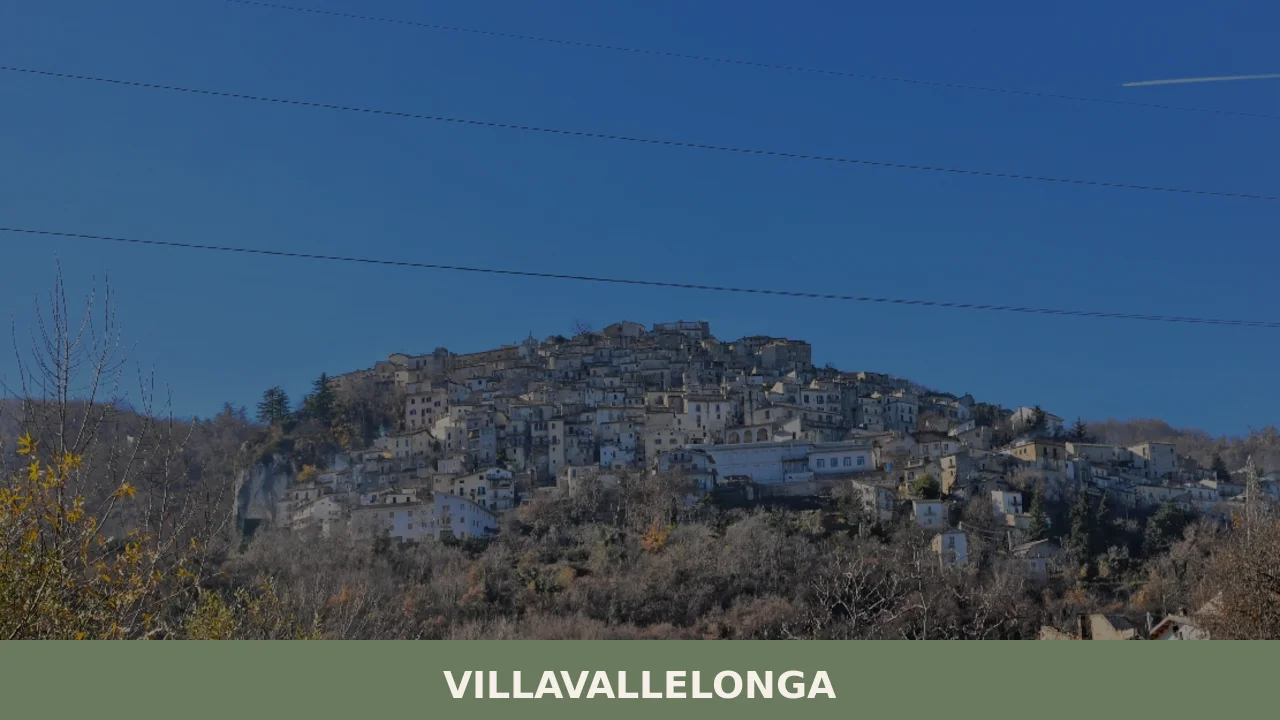
Villavallelonga
 Mountain
What to see in Villavallelonga, Italy: explore the national park, botanical garden and 927-inhabitant village of Abruzzo. Discover top attractions and travel tips.
Discover Villavallelonga
At 927 inhabitants, Villavallelonga occupies a narrow valley in the Marsica area of central Italy, at an elevation that places it well inside one of the oldest protected territories on the peninsula. The surrounding woodland closes in on three sides, and the silences between villages here are measured in kilometres of forest rather than in quiet streets.
Locally, residents call the place La Vìlla — a compressed name that says nothing about the scale of the landscape surrounding it.
Knowing what to see in Villavallelonga means understanding first that the village itself is inseparable from the Abruzzo, Lazio and Molise National Park, the protected area that frames every walk, every viewpoint, and every road in and out of the comune.
With a population just under a thousand and attractions that include the Giardino Botanico Loreto Grande and the national park territory, what to see in Villavallelonga ranges from documented botanical science to old-growth Apennine forest. Visitors to Villavallelonga find a village that functions as both a destination and a starting point for deeper exploration of the Marsica highlands.
History of Villavallelonga
The Marsica, the traditional area that encompasses Villavallelonga, has been continuously inhabited since pre-Roman times.
The territory fell under Roman administration as part of the broader Italic region, and the valleys cutting through this section of the central Apennines served as natural corridors for transhumant herding routes — the seasonal movement of livestock between lowland winter pastures and highland summer grazing grounds. These routes shaped the layout and economy of small settlements across the entire province of L’Aquila for centuries.
The comune of Villavallelonga formed part of the administrative and territorial reorganisation that followed the unification of Italy in the nineteenth century.
Like many villages in the L’Aquila province, its modern boundaries were consolidated during this period, fixing the relationship between the settlement and the surrounding land that had previously been governed by feudal arrangements and ecclesiastical jurisdiction. The name itself — combining villa (a settlement or estate) with vallelonga (long valley) — is a direct topographic description of the elongated valley floor on which the village stands.
The establishment of the in 1923 marked the most significant external event to affect Villavallelonga in the twentieth century.
The park’s creation brought both constraints and protections that altered land use across the Marsica, including within the Villavallelonga commune. The designation has remained in force ever since, making the village one of the longest-established national park communities in Italy. For a comparable experience of Marsica-area village history within a protected landscape, Civitella Roveto, situated in the Liri valley to the west, shares a similar layering of medieval settlement patterns over older Italic foundations.
What to see in Villavallelonga, Abruzzo: top attractions
Giardino Botanico Loreto Grande
The Giardino Botanico Loreto Grande is the principal documented attraction within the village boundaries, a botanical garden that catalogues the flora of the Apennine ecosystem at this altitude.
The garden takes its name from the locality of Loreto Grande and sits within the national park perimeter, giving it direct access to the plant communities of the surrounding woodland and mountain meadow zones.
Visitors can identify species representative of the central Apennine flora, from montane shrubs to forest understory plants, in a structured setting that organises specimens for comparative observation. The garden is most informative during the late spring and summer months, when the majority of flowering species are at their most visible and the access paths through the site are fully clear of seasonal snowmelt.
Abruzzo, Lazio and Molise National Park Territory
The national park, founded in 1923, covers a total area of approximately 50,000 hectares (123,550 acres) across three Italian regions, and Villavallelonga sits within its boundaries in the Abruzzo section. The forest immediately surrounding the village is predominantly beech and mixed broadleaf woodland, the same habitat that supports the park’s documented populations of Marsican brown bear, Apennine wolf, and Apennine chamois.
Walking directly out of the village and into the park territory requires no vehicle: the boundary is effectively the tree line at the edge of the built area.
Autumn is particularly useful for observing the beech woodland, when the canopy changes colour across the higher ridgelines and animal activity increases ahead of winter.
The Village Centre and Local Architecture
The built fabric of Villavallelonga reflects the construction materials and techniques common to L’Aquila province mountain villages: stone walls in local limestone, modest ecclesiastical buildings, and a residential layout that follows the contours of the valley floor rather than imposing a grid. The parish church anchors the central part of the settlement, as is typical in Abruzzo highland villages of this age and size. Walking the main street takes under fifteen minutes, but the relationship between the built edge and the forest boundary on both sides of the valley gives the urban space a distinct spatial quality that wider towns in the region lack.
Early morning, before vehicle traffic picks up on the provincial road, is the clearest time to read the village’s geometry.
Forest and Wildlife Observation Routes
The national park administration maintains a network of marked trails accessible from villages within the park boundary, including Villavallelonga. Elevations in this section of the park range from approximately 900 m (2,953 ft) in the valley floor to over 1,800 m (5,906 ft) on the surrounding ridges. The trail network is documented on park maps available at the park visitor centres, and several routes are graded for difficulty to allow walkers of different fitness levels to enter the forest. The Marsican brown bear — Ursus arctos marsicanus, a subspecies endemic to this part of the Apennines — is most likely to be encountered at dawn and dusk on trails at the forest edge; the park recommends standard wildlife awareness protocols for all walkers.
Marsica Landscape Viewpoints
The valley position of Villavallelonga means that the surrounding ridge crests are visible from multiple points within and immediately above the village, offering unobstructed sightlines across the Marsica upland.
At approximately 1,000 m (3,281 ft) above sea level, the village sits high enough that on clear days the horizon extends across successive parallel ridges of the central Apennine chain. The best elevated viewpoints are reached on foot via the marked trails that climb from the village towards the park interior; the first significant rise begins within 500 m (0.3 mi) of the village edge.
Winter visits, when deciduous trees have lost their leaves, open up views into the valley structure that summer foliage obscures entirely.
Local food and typical products of Villavallelonga
The food culture of the L’Aquila province highlands is built on the resources of a mountain economy: livestock, forest products, pulses, and preserved meats. Villavallelonga sits within the broader Marsica food tradition, where the altitude and climate imposed a diet of long-storing, energy-dense ingredients and preparation methods designed for cold winters. The village’s position inside the national park also means that foraging and hunting have historically contributed to local diet, though both activities are now regulated within the protected area.
The most characteristic preparations of this territory use lamb and pecora (mature sheep) as the primary meat, typically slow-cooked with local herbs, wild fennel, and dried chilli.
Arrosticini, the skewered and grilled mutton or lamb specific to Abruzzo, are prepared from small cubes of fatty meat cooked over narrow charcoal grills and eaten immediately; the texture depends on the balance of lean and fat in each skewer, and the technique is consistent across the region.
Pasta alla mugnaia, a hand-rolled pasta typical of the L’Aquila area, is made by rolling a simple semolina dough into irregular thick strips and dressing it with tomato-based meat sauces or simply with oil and local sheep’s cheese. Legumes — particularly lentils and dried beans — appear in winter soups, often combined with guanciale (cured pork cheek) and coarse black pepper.
Within the broader Abruzzo highland tradition, sheep’s milk cheeses aged in local cellars form a consistent part of the table. The pecorino produced in L’Aquila province villages is typically aged for a minimum of 60 days, developing a firm rind and a paste that ranges from ivory to pale yellow; the flavour sharpens with extended ageing.
No certified PDO or PGI products specific to Villavallelonga have been documented in the available sources, but the village benefits from proximity to the food production traditions of the wider Marsica and L’Aquila areas, and local agriturismi (farm-stay businesses) in the surrounding comuni are the most reliable points of access to these products.
The forested territory around the village also yields seasonal products that have always supplemented the local diet: wild mushrooms, including porcini (boletus) from the beech and mixed woodland, are gathered in late summer and autumn and either sold fresh at local markets or dried for winter use.
Chestnuts from the lower-altitude woodland edges appear in both sweet and savoury preparations from October onward. The most practical way for visitors to access these seasonal products is through the weekly markets of larger nearby centres in the L’Aquila province, which draw produce from the surrounding highland villages.
Festivals, events and traditions of Villavallelonga
Like the majority of villages in the L’Aquila province, Villavallelonga organises its annual calendar around the feast day of its patron saint, a recurring structure in Abruzzo highland communities that combines a religious procession with communal gathering and, typically, outdoor eating.
The sources available do not document the specific date of the patron saint’s feast or the name of the patron for Villavallelonga, so these details are not included here.
What the sources confirm is that the village functions within a regional festive culture in which late summer — particularly August — concentrates the majority of local celebrations, when the resident population is at its highest due to the return of emigrants and seasonal visitors.
The national park context adds a further layer to the local calendar: the park administration and associated organisations regularly organise naturalistic events, guided walks, and educational programmes within the park territory, including in and around Villavallelonga. These events tend to be scheduled for spring (April to June) and autumn (September to October), the two seasons when wildlife activity and plant diversity are highest.
Visitors interested in participating in organised park activities should consult the programme published by the national park directly, as dates and formats vary between years.
When to visit Villavallelonga, Italy and how to get there
The best time to visit Villavallelonga depends on what the visit is primarily for. Late spring — from mid-May through June — offers the most complete combination of conditions: the botanical garden is in full flower, the park trails are clear of snow, wildlife is active, and visitor numbers have not yet reached their August peak. September and early October are equally productive for walkers, with stable weather, the beginning of autumn foliage in the beech woodland, and mushroom season underway.
July and August bring the highest temperatures and the largest number of visitors to the Abruzzo national park in general; the village itself remains relatively uncrowded compared to the park’s more publicised entry points, but accommodation in the surrounding area fills quickly. Winter access is possible but requires preparation for mountain road conditions, and the botanical garden may be inaccessible depending on snowfall.
Villavallelonga, Abruzzo, Italy is reached by road from the A25 motorway (Rome–Pescara), exiting at Pescina, approximately 20 km (12.4 mi) from the village.
From Rome, the drive covers roughly 130 km (80.8 mi) and takes around one hour and forty minutes under normal traffic conditions, making a day trip from Rome entirely practical for those with a vehicle. The nearest railway station with regular connections is Avezzano, approximately 30 km (18.6 mi) from Villavallelonga; Trenitalia operates services to Avezzano from Rome Tiburtina with a journey time of approximately one hour.
From Avezzano station, the village is reachable by local bus or taxi, though bus frequency on this route is limited and checking current timetables in advance is essential. The nearest international airport is Rome Ciampino, approximately 135 km (83.9 mi) away; Rome Fiumicino is at a comparable distance of around 160 km (99.4 mi). If you arrive by car from the north via the A24 motorway, exit at L’Aquila Est and follow the road south through the Marsica to reach the village.
For international visitors, English is spoken reliably only in larger tourist centres; in Villavallelonga and the immediate surrounding villages, carrying cash in euros is advisable, as card payment facilities in smaller shops and local eating places may not be available.
Travellers combining Villavallelonga with other Abruzzo destinations should note that Castel di Sangro, roughly 60 km (37.3 mi) to the southeast along the park’s southern boundary, offers a natural extension to any itinerary focused on the national park territory. Further north, the village of Borrello represents one of the smaller, less-visited settlements in the Abruzzo highland network and can be reached on a longer driving circuit through the province.
Frequently asked questions about Villavallelonga
What is the best time to visit Villavallelonga?
Villavallelonga offers distinct experiences across seasons. Late spring and summer are ideal for visiting the Giardino Botanico Loreto Grande, when Apennine flora is in full bloom. Autumn is perfect for observing the vibrant colours of the beech woodland and increased animal activity within the Abruzzo, Lazio and Molise National Park. Winter provides clear, expansive views of the Marsica landscape once deciduous trees have shed their leaves. The village also celebrates its patron saint, Leucio d'Alessandria, with a traditional festival on September 2nd, offering a glimpse into local culture.
What are the historical origins of Villavallelonga?
Villavallelonga's history dates back to pre-Roman times, with the Marsica area continuously inhabited for millennia. Its valleys served as essential transhumant routes for centuries, shaping early settlements. The modern comune was established after Italy's unification in the 19th century, with its name directly describing its location: 'villa' (settlement) in a 'vallelonga' (long valley). A pivotal event was the creation of the Abruzzo, Lazio and Molise National Park in 1923, which profoundly influenced the village's development and land use, establishing its long-standing connection to a protected natural environment.
What to see in Villavallelonga? Main monuments and landmarks
The primary documented attraction in Villavallelonga is the Giardino Botanico Loreto Grande, which showcases the diverse flora of the Apennine ecosystem within a structured setting, best visited in late spring and summer. The village is also intrinsically linked to the Abruzzo, Lazio and Molise National Park, whose forest boundary is immediately accessible, offering direct immersion in nature. Within the village centre, the modest local architecture, characterised by stone walls and a layout following the valley contours, is anchored by the parish church, typical of Abruzzo highland settlements. Specific opening hours for the botanical garden or church are not detailed but can usually be found locally.
What are the main natural or scenic attractions of Villavallelonga?
Villavallelonga's most significant natural attraction is its direct immersion in the Abruzzo, Lazio and Molise National Park. Visitors can immediately access extensive beech and mixed broadleaf woodlands, home to Marsican brown bears, Apennine wolves, and chamois. A network of marked trails, documented on park maps available at visitor centres, allows for forest and wildlife observation, with elevations ranging from 900m to over 1,800m. Additionally, the surrounding ridge crests offer multiple Marsica Landscape Viewpoints, providing expansive panoramas across the central Apennine chain, particularly striking in winter.
Where to take the best photos in Villavallelonga?
For captivating photographs, the Marsica Landscape Viewpoints accessed via marked trails climbing from Villavallelonga offer stunning panoramic shots of the central Apennine chain and the elongated valley. The first significant elevated spots are just 500 meters from the village edge. Autumn is particularly picturesque for capturing the vibrant colours of the beech woodlands within the national park. Within the village itself, the early morning provides the clearest light to photograph the distinctive local architecture and the relationship between the built environment and the surrounding forest, before vehicle traffic increases on the provincial road.
Are there museums, churches or historic buildings to visit in Villavallelonga?
In Villavallelonga, visitors can explore the Giardino Botanico Loreto Grande, which functions as an open-air catalogue of Apennine flora, offering a scientific and educational experience. While not a traditional museum, it provides structured observation of local plant species. The village features modest ecclesiastical buildings, with the parish church anchoring the central settlement, reflecting typical mountain architecture of the L'Aquila province. Details on specific opening hours for the church or the botanical garden are generally available locally upon arrival. The article does not specify other named historical buildings.
What can you do in Villavallelonga? Activities and experiences
Villavallelonga is ideal for nature-based activities and cultural immersion. Visitors can hike the extensive network of marked trails within the Abruzzo, Lazio and Molise National Park, perfect for wildlife observation (including Marsican brown bears) and enjoying panoramic Marsica Landscape Viewpoints. Exploring the Giardino Botanico Loreto Grande offers insight into local flora. Gastronomically, indulge in the mountain food traditions, tasting arrosticini, pasta alla mugnaia, local pecorino cheese, and seasonal wild mushrooms. Engaging with local agriturismi or visiting nearby weekly markets offers authentic access to these regional specialties.
Who is Villavallelonga suitable for? Families, couples, hikers, solo travelers?
Villavallelonga is particularly suitable for nature enthusiasts, hikers, and those seeking a tranquil escape into the mountains. Its direct access to the Abruzzo, Lazio and Molise National Park makes it a prime destination for wildlife observation, forest walks, and exploring marked trails catering to various fitness levels. Families can enjoy the educational Giardino Botanico Loreto Grande, while couples or solo travelers will appreciate the profound silence and breathtaking Marsica landscape viewpoints. It appeals to visitors who value authentic mountain culture, traditional Abruzzese cuisine, and a deep connection with the natural environment.
What to eat in Villavallelonga? Local products and specialties
The cuisine of Villavallelonga reflects the mountain traditions of the Marsica area. Signature dishes include slow-cooked lamb or pecora (mature sheep) with local herbs and wild fennel, and the iconic Abruzzese arrosticini—skewered, grilled mutton or lamb. Pasta alla mugnaia, a hand-rolled pasta, is a local specialty often served with rich meat sauces or pecorino cheese. Winter menus feature hearty legume soups, particularly with lentils and dried beans, enhanced with guanciale. Sheep's milk cheeses, like the local pecorino aged for at least 60 days, are also prominent. Seasonal wild mushrooms and chestnuts further enrich the local diet, accessible through nearby agriturismi or weekly markets.
📷 Photo Gallery — Villavallelonga
Nearby Villages near Villavallelonga
In Abruzzo More villages to discover
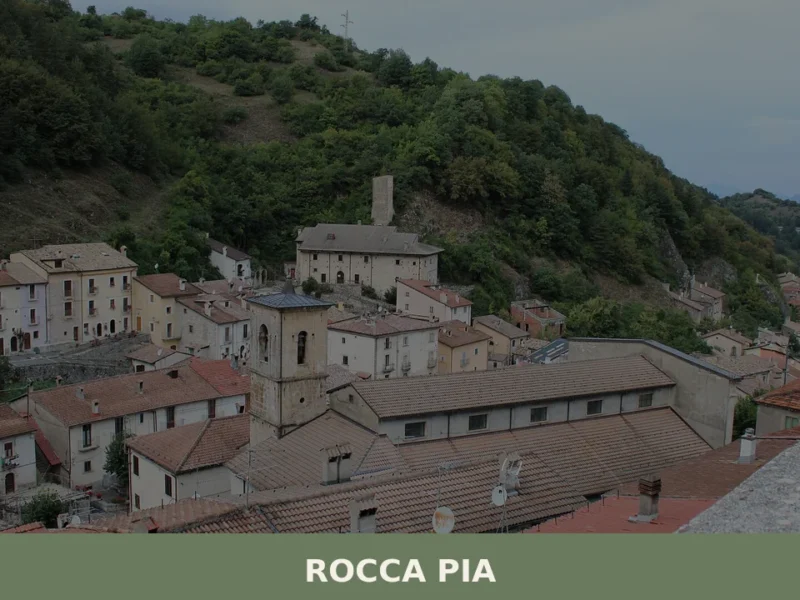
Rocca Pia
Mountain
what to see in rocca pia, Italy: Explore this Abruzzo comune near L'Aquila. Discover its territory extending to the Cinquemiglia Plain. Read our guide.

Casalbordino
 Hills
Hills
 Sea
Sea
What to see in Casalbordino, Italy: a sanctuary dating to 1576, 7.5 km of sand beach, and a nature reserve. Discover top attractions and travel tips.
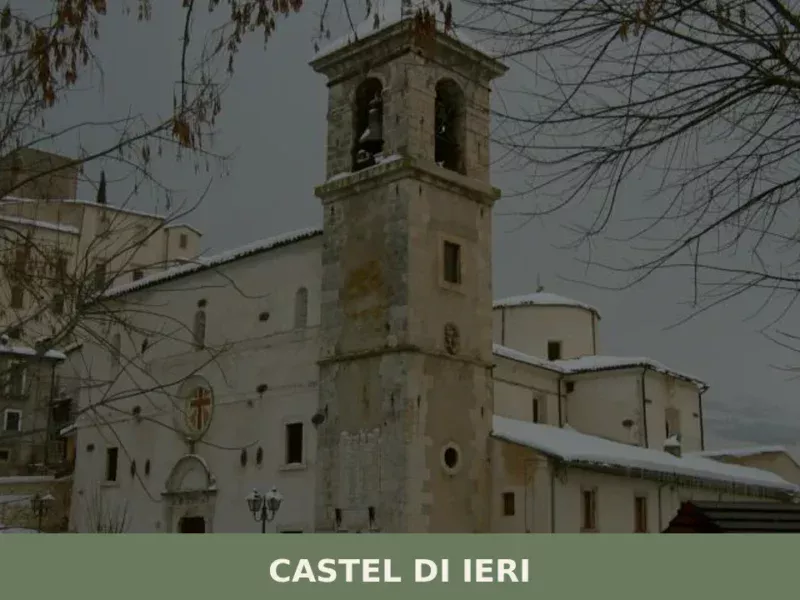
Castel di Ieri
Hills
In Castel di Ieri, a village of 289 registered inhabitants at 519 metres above sea level in the Valle Subequana, the most significant feature lies underground: an Italic temple from the 1st century BC, unearthed during the 1980s, which redrew the archaeological map of inland Abruzzo. Anyone looking into what to see in Castel di […]
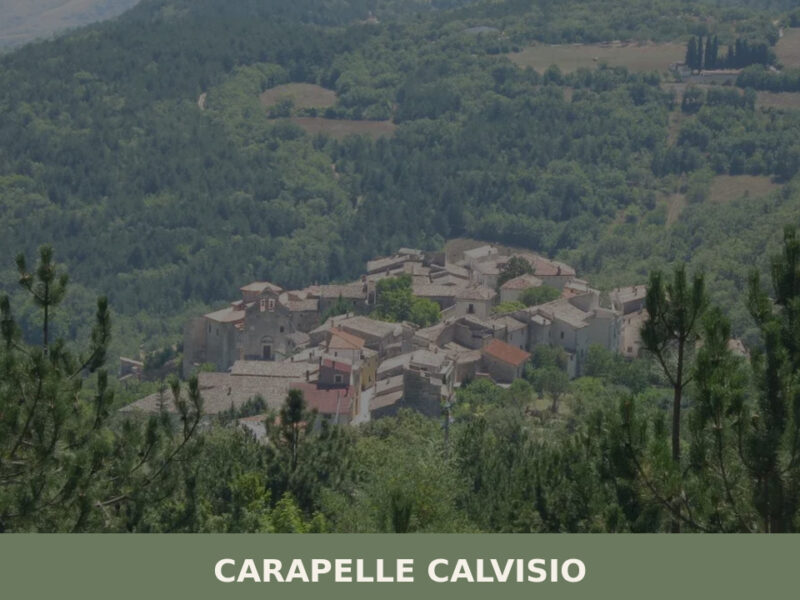
Carapelle Calvisio
Mountain
What to see in Carapelle Calvisio, Italy? Explore this village at 910 m (2,986 ft) altitude, visit Rocca Calascio, and discover its unique population status. Read our guide!
Carunchio
Mountain
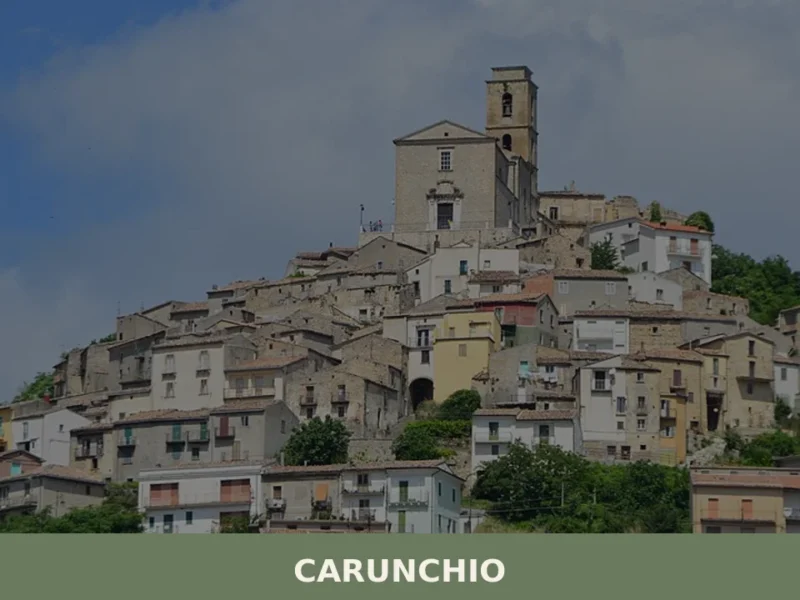
Carunchio is home to 565 inhabitants, spread along a ridge at 714 metres above sea level in the southern part of the province of Chieti, close to the border with Molise. The municipal territory extends between the Treste river and the Elce stream, two watercourses that have shaped the morphology of these clay hills over […]
Corvara
Mountain
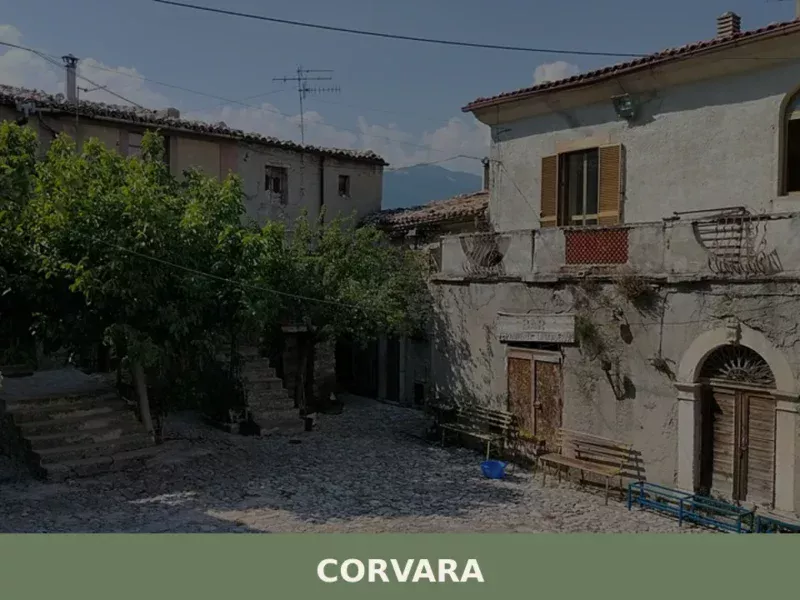
Corvara, a municipality of 210 inhabitants in the province of Pescara, is located 625 meters above sea level in the Pescara valley. Its territory, documented as early as the medieval period, shows traces of settlements dating back to the Neolithic, highlighting a continuous habitation linked to its strategic position. For those wondering what to see […]
Montebello di Bertona
Mountain
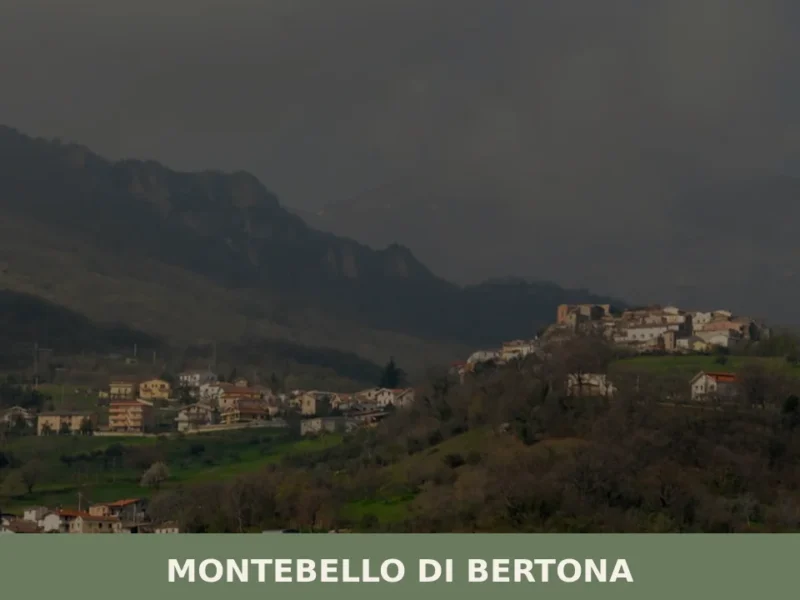
What to see in Montebello di Bertona, Italy: Discover a village of 994 inhabitants in Gran Sasso National Park. Explore historic sites and natural trails. Read our guide.
Lama dei Peligni
Mountain
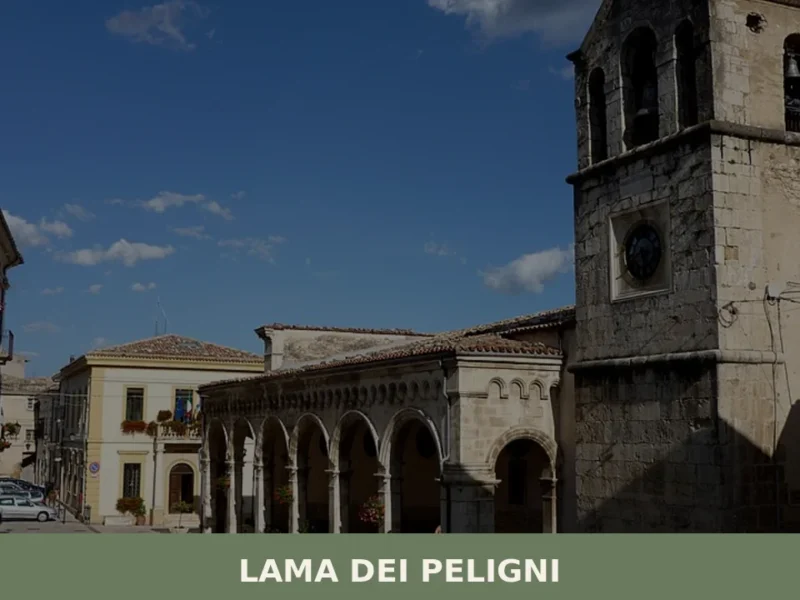
What to see in Lama dei Peligni: village at 669 m, Grotta del Cavallone, Majella National Park trails and arrosticini PAT. Plan your visit with this complete guide.
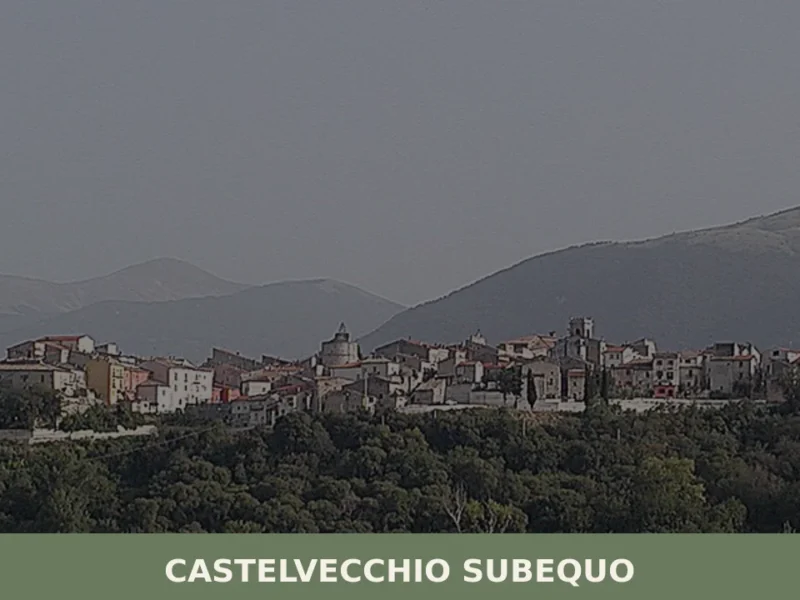
Castelvecchio Subequo
Hills
The convent of San Francesco in Castelvecchio Subequo preserves a cycle of fourteenth-century frescoes attributed to painters of the Giottesque school, among the few surviving examples in the central Apennine area. This fact alone is enough to justify a detour from the nearby A25 motorway towards a town of 832 inhabitants, at 490 metres above […]
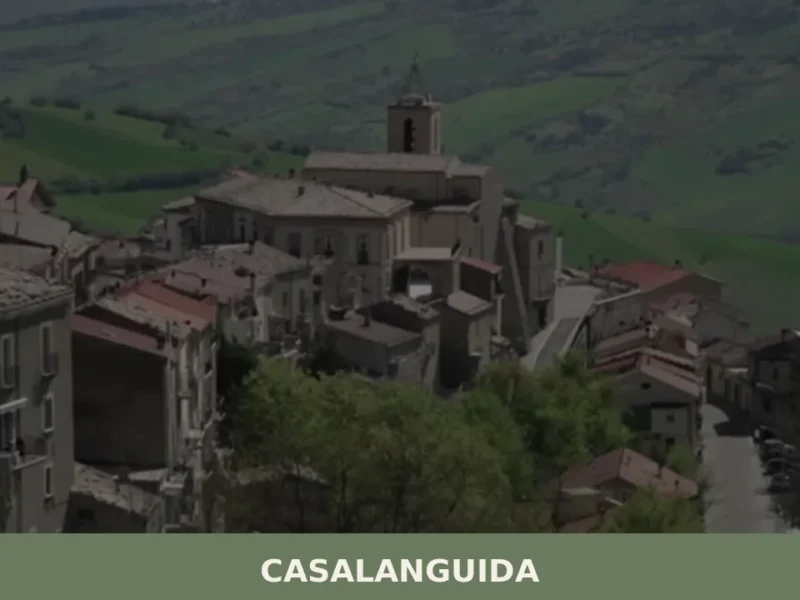
Casalanguida
Hills
With its 818 registered inhabitants and an elevation of 470 metres above sea level, Casalanguida occupies a hilltop ridge in the middle Sinello valley, in the province of Chieti. The municipal territory extends across vineyards and olive groves that mark the landscape with regular geometric patterns, visible from the provincial road that climbs up from […]





🏡 Know Villavallelonga better than we do?
If you’re a local or have been there, your knowledge matters: add what’s missing or fix a detail on this page.