


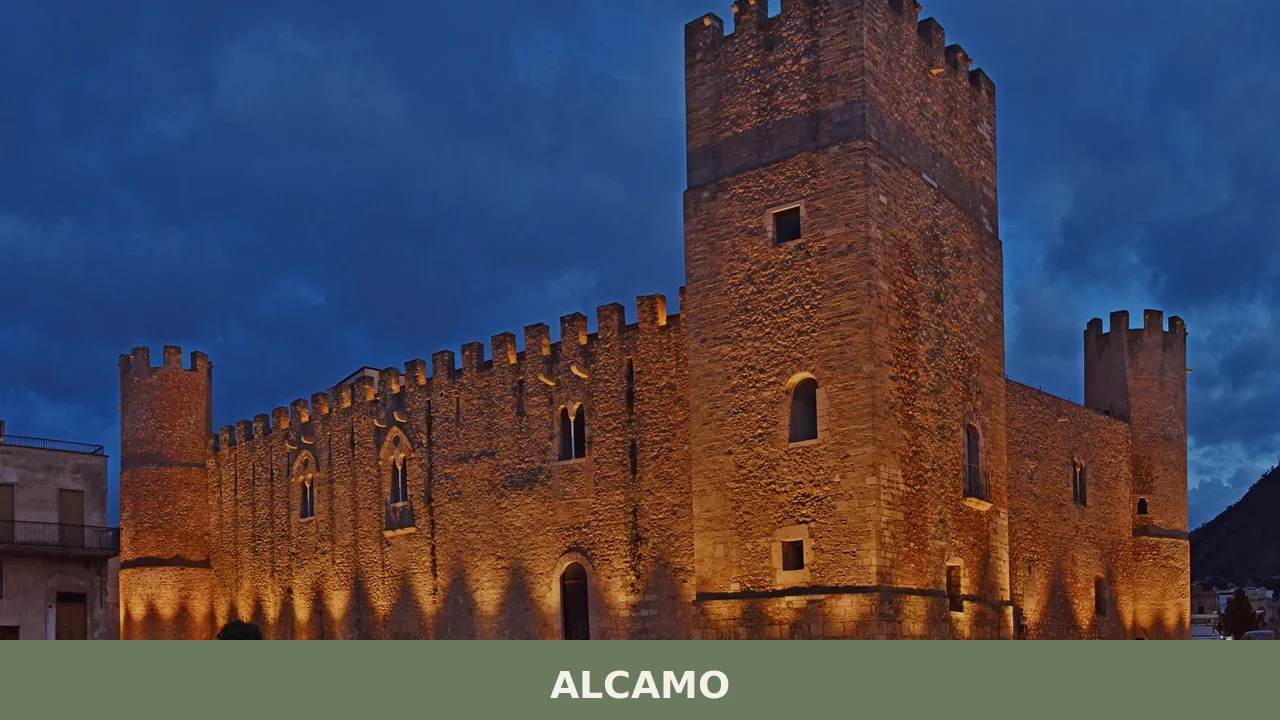
Alcamo
Alcamo sits where Arab merchants once haggled at fiorenti markets and Norman barons held court. Discover how a Mesolithic settlement became Sicily’s most layered trading town.
Alcamo: Medieval Crossroads at the Base of Monte Bonifato
At 258 metres above the Golfo di Castellammare, Alcamo spreads across a shallow slope dominated by the stone mass of Monte Bonifato, a limestone ridge that raggiunge gli 829 metri s. l. m. and shelters the village from northern winds. The light here is Mediterranean and clear, falling on terracotta roofs and pale stone walls that mark centuries of rebuilding—conquest, plague, expulsion and renewal written into the urban fabric.
Alcamo is a municipality of 44,632 inhabitants in the province of Trapani, Sicily, and one of the oldest documented towns in the region. Two draws for visitors shape the character of this place: its role as a medieval market hub where Arab, Norman and Spanish merchants converged, and the sanctuary of the patron saint, focus of local devotion.
Centuries of Dominion and Rebuilding
The territory of Alcamo has been inhabited since the Mesolithic period—artefacts dating to around 9,000–6,000 BCE have been found near contrada Mulinello—but the settlement that became recognizable as a town emerged much later. On the slopes of Monte Bonifato stood Longuro, a settlement mentioned in classical texts as possibly founded by Greeks fleeing Troy. When Roman settlers arrived, they descended to the plain and built Longarico at the foot of the mountain, a name preserved in the third-century itinerary of Antoninus Pius.
The first written record of Alcamo itself dates to 1154, when the Arab geographer Idrisi described it in the Tabula Rogeriana as a casale (small settlement) with fertile lands and a flourishing market, already called Alqamah by its Arab inhabitants. A visitor thirty years later, the pilgrim Ibn Jubayr, confirmed its Arab character: he found a beleda (town) with mosques and a marketplace, its population entirely Muslim. The etymology of the name itself remains disputed. One hypothesis links it to the Arabic al-qamah (meaning muddy or fertile land); another to a Muslim commander called al-Qāmūq said to have founded the town in 828, though some scholars regard this as an invention without documentary proof. A third theory connects it to Camico, a legendary Sicani settlement supposedly on Monte Bonifato, with Alqamah as an Arab adaptation of the casale’s original name.
Medieval Alcamo endured a succession of rulers—Vandals, Ostrogoths, Byzantines, Saracens, Normans and Swabians—each leaving traces. During the 13th century, revolts by the Arab population between 1221 and 1243 prompted the emperor Frederick II to deport the Muslims inland; those who remained were expelled again in 1243, sent to Nocera Inferiore and Lucera. The town that emerged from this upheaval was Christian and feudal. Its growth was uneven: by 1378 it lay in ruins and was rapidly rebuilt by settlers—called habitatores—from across Italy and Spain. By the late 14th century, Alcamo had swelled to several thousand inhabitants, a vital crossroads drawing traders from Pisa, Amalfi, Bologna, Calabria, Liguria and beyond.
In the 15th century, Alcamo was an important city for commerce and craft. Wheat and wine flowed to neighbouring cities; bakers, blacksmiths, leather-tanners and weavers maintained thriving workshops.
The town changed hands between feudal families—the Ventimiglia, the Conti di Modica, the Chiaramonte—until 1407, when Giaimo de Prades took control, followed by the Cabrera family throughout the 15th century. By the early 16th century, under the captain Ferdinando Vega, Alcamo was ringed by defensive walls with four gates to ward off Turkish pirates. During the 16th century under the Enríquez family, Alcamo’s Jewish quarter—home to some 400 families with a synagogue on present-day Via Giacomo Matteotti (known until 1941 as Via della Sinagoga)—was dismantled by royal order. Yet the same century brought a cultural flowering: the poet and scholar Sebastiano Bagolino taught here, and an icon was discovered and came to be venerated as the patronal image of the town. Plague struck hard between 1574 and 1575, and the dead were buried in the cemetery of Sant’Ippolito.
In 1631, Alcamo was elevated from terra (village) to città (city) by the viceroy Francesco Fernández de la Cueva. The 18th century saw recovery and urban renewal—churches rebuilt, frescoes commissioned, the town repopulated—though epidemics and social unrest persisted. By 1798, the population had climbed to roughly 13,000. The transition to modernity was marked: in 1812 and formally in 1816, Alcamo ceased to be a fief and became royal demesne, and prominent citizens sat in the Sicilian parliament.
The Sanctuary and Religious Heart
The spiritual anchor of Alcamo is the Santuario di Maria Santissima dell’Alto, situated on Monte Bonifato within the Bosco di Alcamo nature reserve. This sanctuary honours the patronal image. The feast of the patron saint brings together the community in traditions of prayer and celebration rooted in four centuries of local piety.
Castles and Stones of Power
Monte Bonifato and Its Fortifications
The limestone massif of Monte Bonifato dominates the landscape, its summit visible for kilometres across the Castellammare Gulf. Atop its peak stand the ruins of the Castello di Bonifato, built by the Ventimiglia family during their rule and now fragmentary but still commanding. The castle’s strategic position made it a frontier post against raids and a symbol of feudal authority. At lower elevations, between 514 and 829 metres, the Bosco di Alcamo protects a mixed forest of Mediterranean species and forms a natural boundary between the town and the mountain hinterland.
Castello di Calatubo
Within Alcamo’s municipal territory stands the ruins of Castello di Calatubo, first mentioned by Idrisi in 1154 as a landmark used to locate the nearby settlement. The site remains visible today, a tangible link to the Arab geographer’s 12th-century account and to the strategic network of fortifications that once crossed the region under Norman and subsequent rule.
The Medieval Town Walls and Gates
Four gates controlled entry and exit from the walled town: Porta Palermo (at the entrance to what is now Corso VI Aprile), Porta Trapani or San Francesco (at the street’s far end), Porta Stella (near the Church of Madonna della Stella) and Porta Nuova (towards the sanctuary). These gates governed entry and exit from the walled town and organised traffic into its four main quarters, each associated with a principal church. Though the walls themselves no longer stand complete, traces survive in street names and corner structures. The gates and their stone arches represented the boundary between the ordered Christian town and the surrounding countryside, a medieval notion of controlled space that shaped urban consciousness for centuries.
Flavours of the Territory
The agricultural landscape surrounding Alcamo produces grain and wine, exports that have enriched local merchants since the Middle Ages. In particular, the region’s position in the province of Trapani gives access to products like the Pecorino Siciliano (a protected designation of origin cheese from the wider Sicilian tradition), the Nocellara del Belice olives grown in nearby valleys, and the Sale Marino di Trapani, sea salt harvested from coastal pans. Local kitchens transform these ingredients into dishes rooted in the land, though the precise repertoire of Alcamo’s home cooking remains best discovered by eating in the town itself rather than from written sources.
When to Visit and How to Arrive
Alcamo sits at a crossroads of northwestern Sicily, accessible from both Palermo to the east and Trapani to the west. The climate is Mediterranean: warm and dry in summer (August averages 25.8 °C), mild and rainy in winter (February averages 11.2 °C). Average annual rainfall is 558 millimetres, with July the driest month (4 mm) and December the wettest (83 mm). Spring and autumn are ideal for walking and exploring the town and Monte Bonifato without summer heat. The town is classified in seismic zone 2 (medium-high seismicity) and benefits from low atmospheric diffusion, meaning air quality is generally good.
The nearest major city is Trapani, the provincial capital. The coast at Alcamo Marina—a frazione (hamlet) within the municipality—fills with summer visitors seeking bathing and seaside calm. For those exploring the wider region, nearby villages like Valderice and the medieval hilltop town of Erice lie within day-trip distance. The municipal website www.comune.alcamo.tp.it provides practical information on accommodation and local services.
| Departure | Distance | Time |
|---|---|---|
| Palermo | 80 km | 1 hour 15 minutes |
| Trapani | 48 km | 50 minutes |
| Mondello (Palermo beaches) | 92 km | 1 hour 30 minutes |
| Erice | 38 km | 45 minutes |
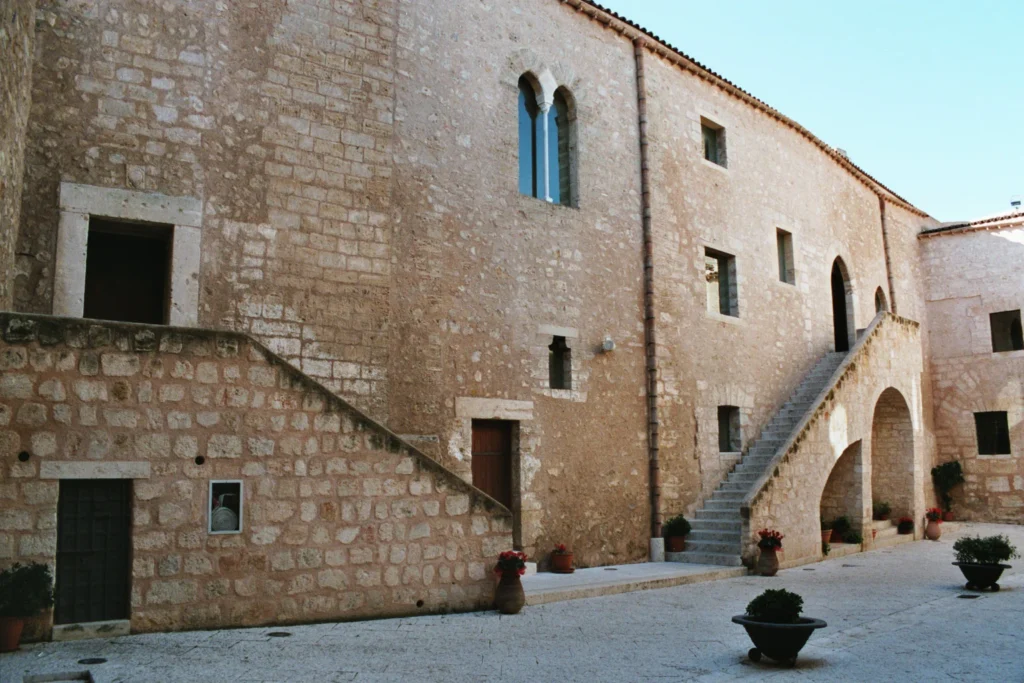
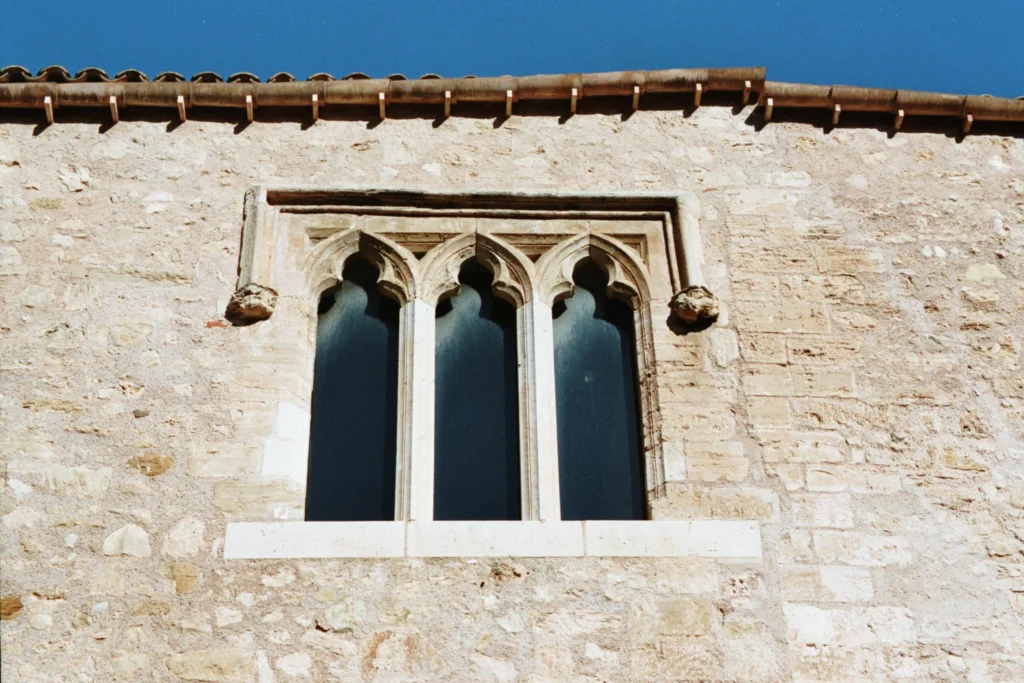
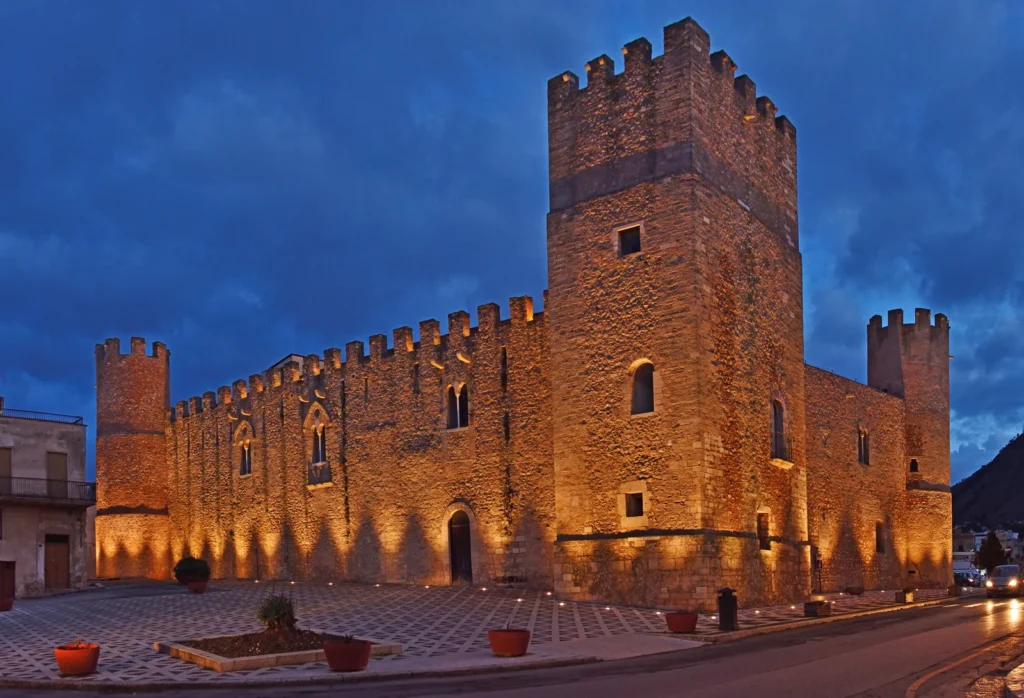
📷 Photo Gallery — Alcamo
In Sicily More villages to discover
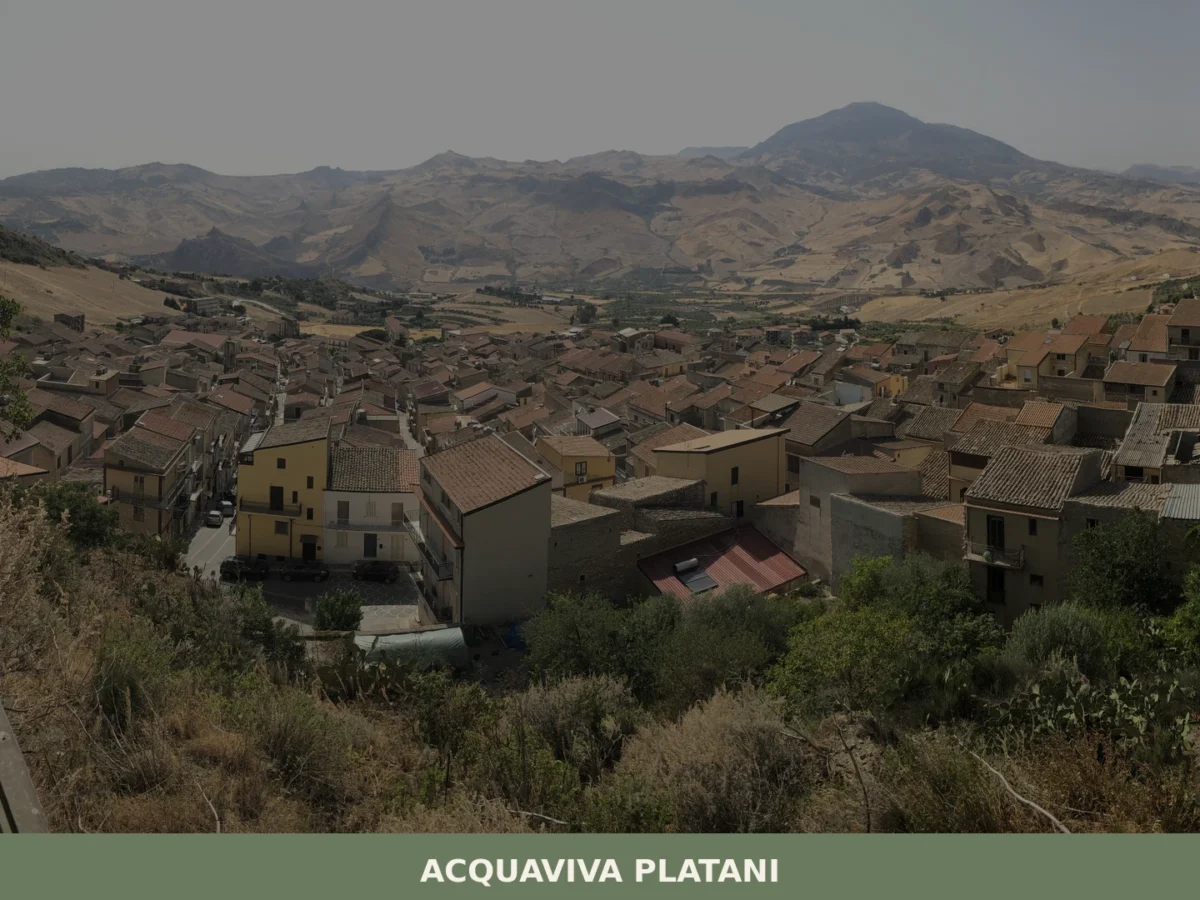
Acquaviva Platani
 Hills
Hills
A clock tower built in 1894 rises above the roofline of a compact hill town in the province of Caltanissetta, its stone face marking hours in a landscape where the Platani river moves through the valley below. The name of the place translates directly from Italian as “Living Water,” a reference to the natural springs […]
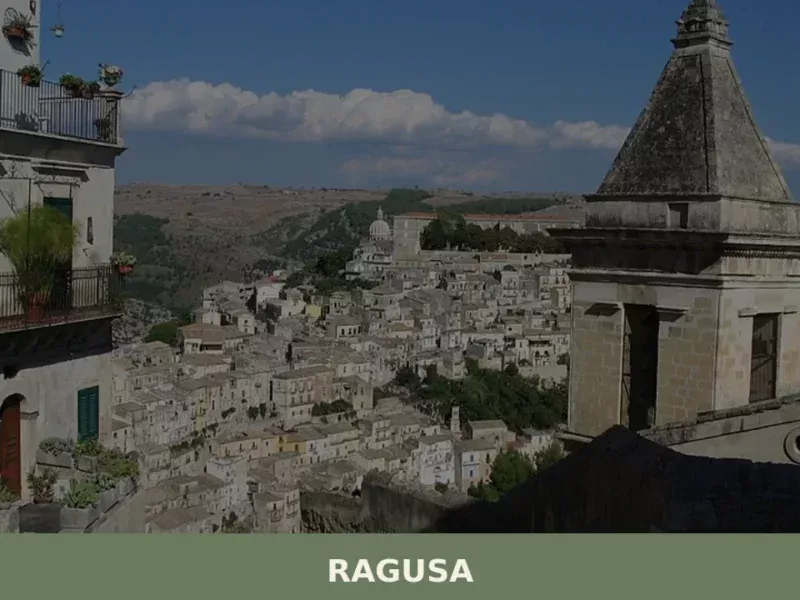
Ragusa
 Sea
Sea
What to see in Ragusa, a UNESCO city at 520m with 70,000 residents: explore Ibla, San Giorgio, Giardino Ibleo and Cotognata PAT. Plan your visit now.
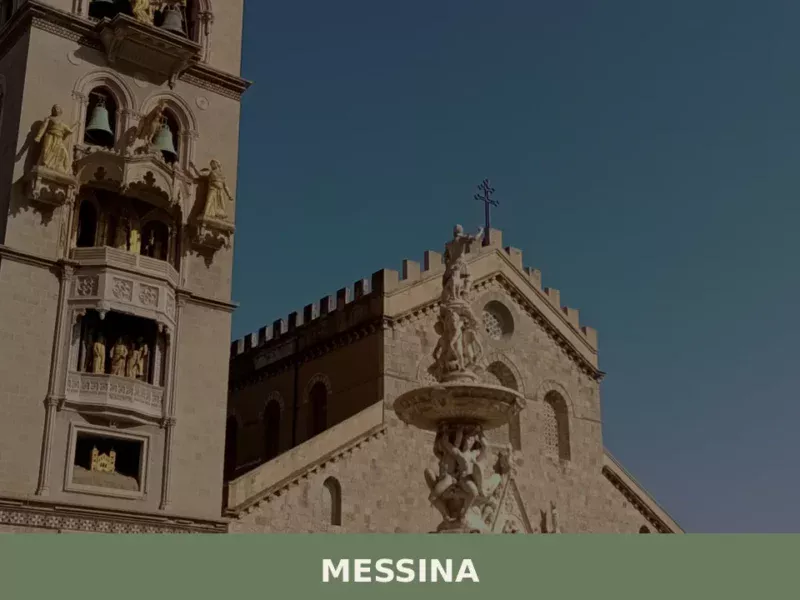
Messina
Sea
What to see in Messina: 242,267 inhabitants, the astronomical clock tower, two Caravaggios and the Norman Cathedral. Plan your visit and discover how to get there.
Caltanissetta
Hills
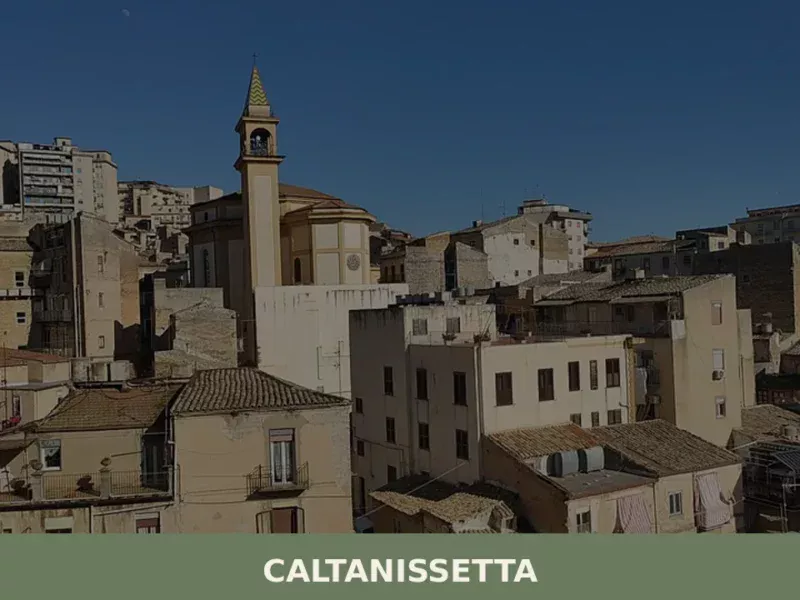
What to see in Caltanissetta: 61,000 residents at 568m, from Castello di Pietrarossa to Baroque churches and Holy Week. Plan your visit with this complete guide.
Aliminusa
Hills
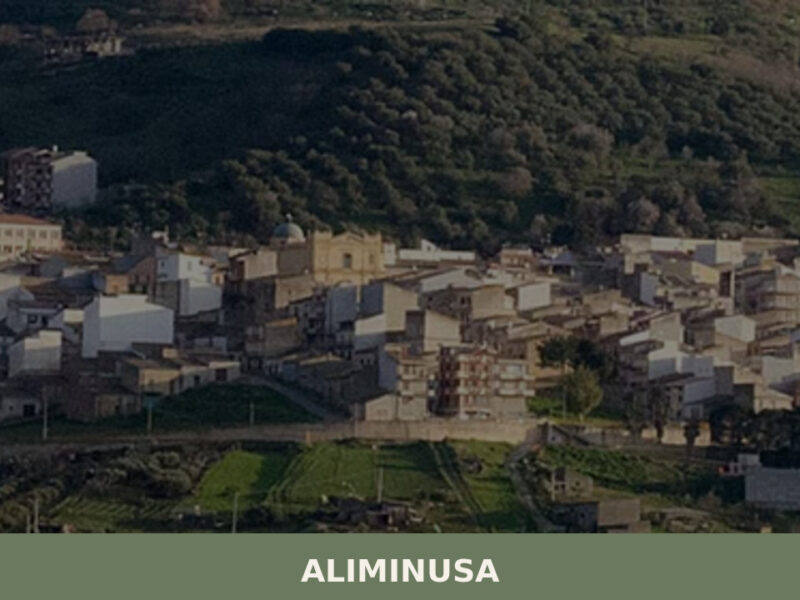
Morning light hits the limestone facades along Corso Umberto at a low angle, turning the walls the colour of raw honey. A few voices carry across the piazza — unhurried, familiar. Aliminusa is a village of just over a thousand people, set at 450 metres above sea level in the hills of the Palermo province, […]
Palermo
Sea
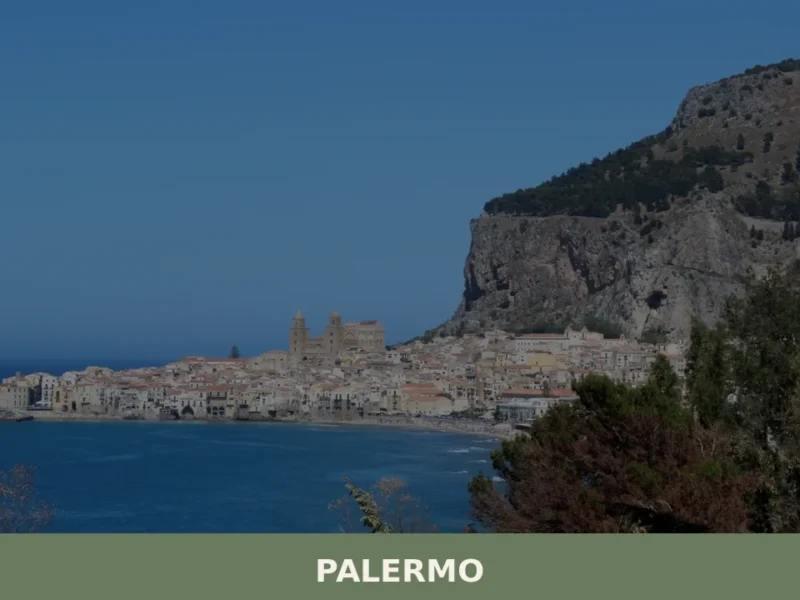
What to see in Palermo: from the Palatine Chapel mosaics to Ballaru00f2 Market. Home to 654,987 people and 2 PAT-certified products. Plan your visit with this complete guide.
Aci Bonaccorsi
Sea
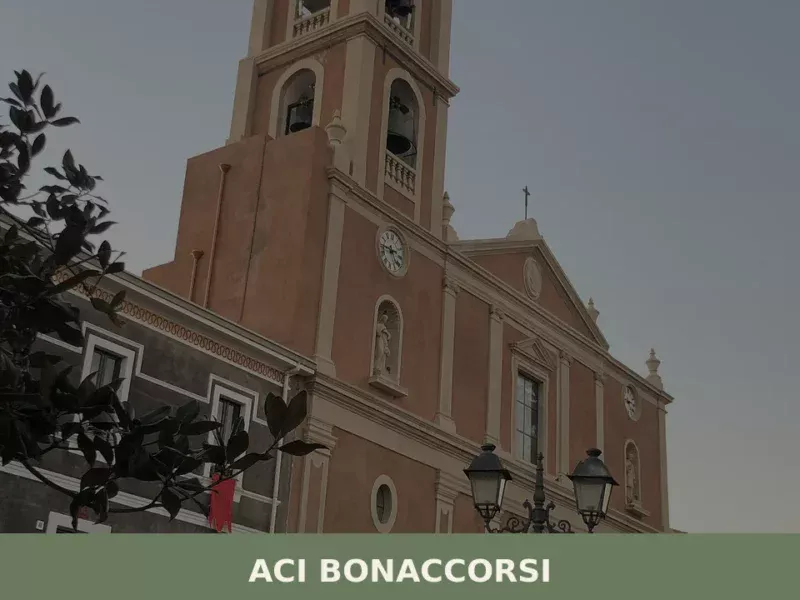
Discover what to see in Aci Bonaccorsi: Etna views, volcanic architecture, IGP citrus groves and Italy's 2022 most virtuous municipality on the Ionian slope.

Belpasso
Hills
A town rebuilt three times from volcanic catastrophe. Belpasso village in Sicily embodies resilience through its geometric urban grid and living festival traditions.

Licata
 Mountain
34,000 residents, Greek foundations and a coastline of alternating cliffs and sandy coves make Licata one of the most layered towns on Sicily's southern shore.

San Michele di Ganzaria
Hills
A village of 2,820 people shaped by a medieval Albanian settlement pact and a baroque parish church with neo-Gothic facade. History runs deep here.

🏡 Know Alcamo better than we do?
If you’re a local or have been there, your knowledge matters: add what’s missing or fix a detail on this page.