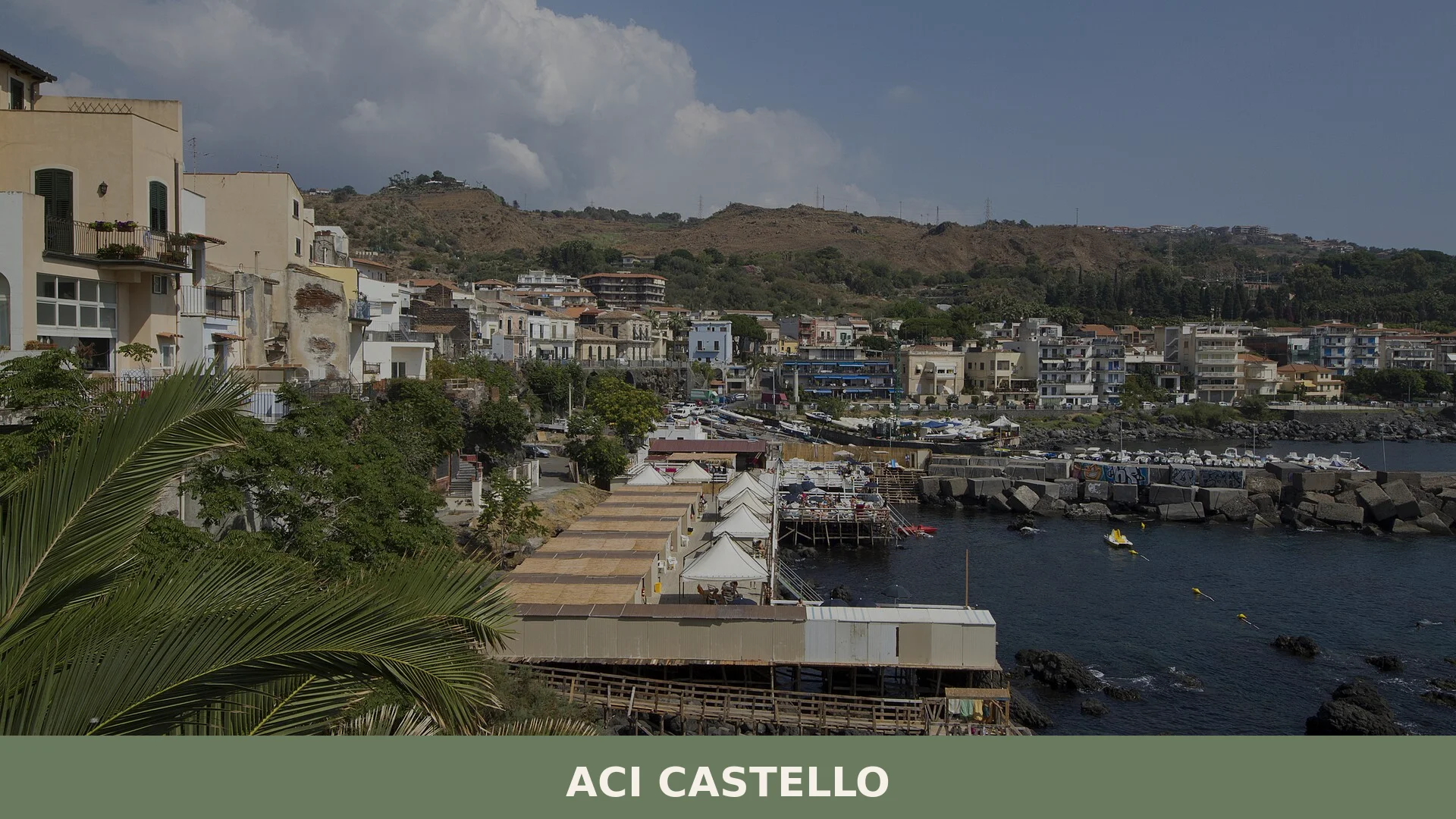
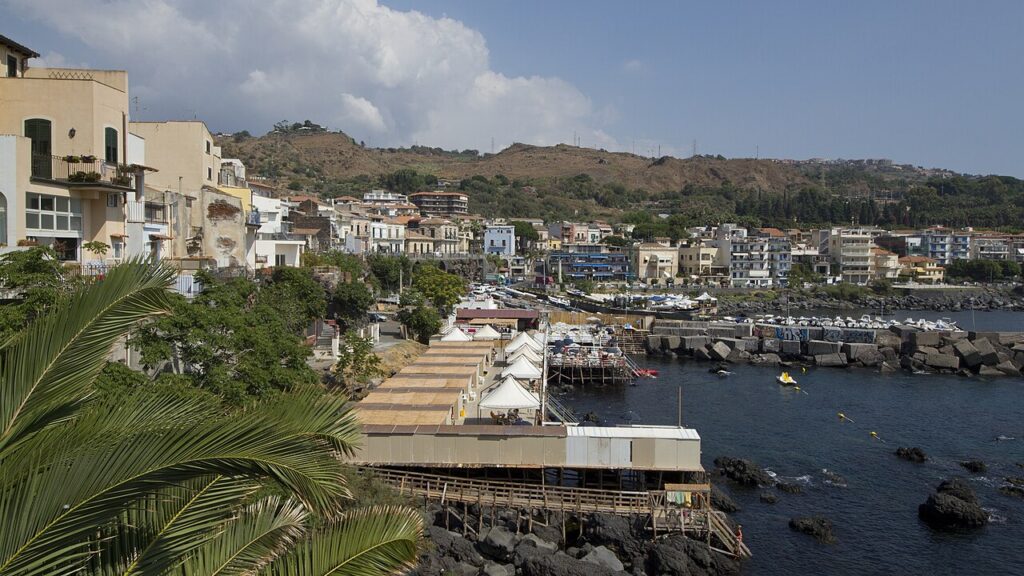
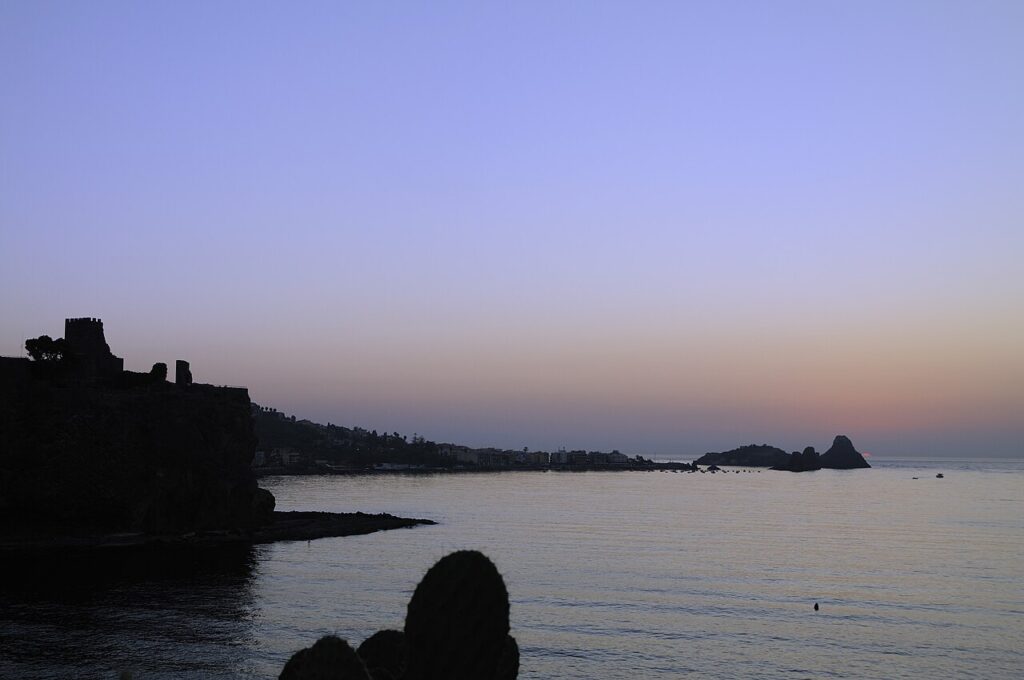
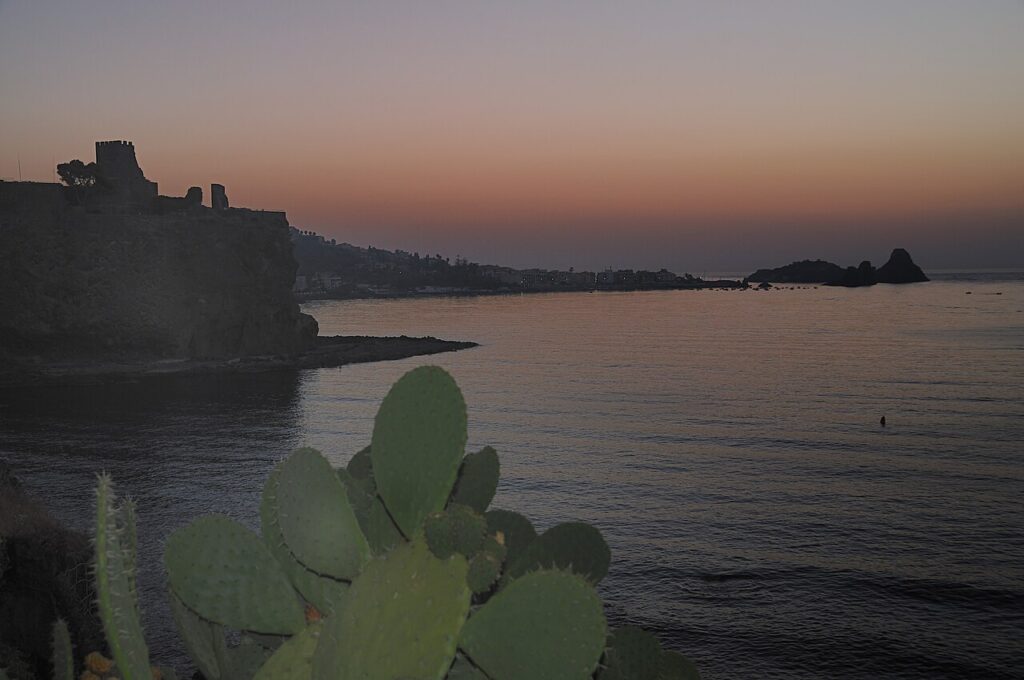
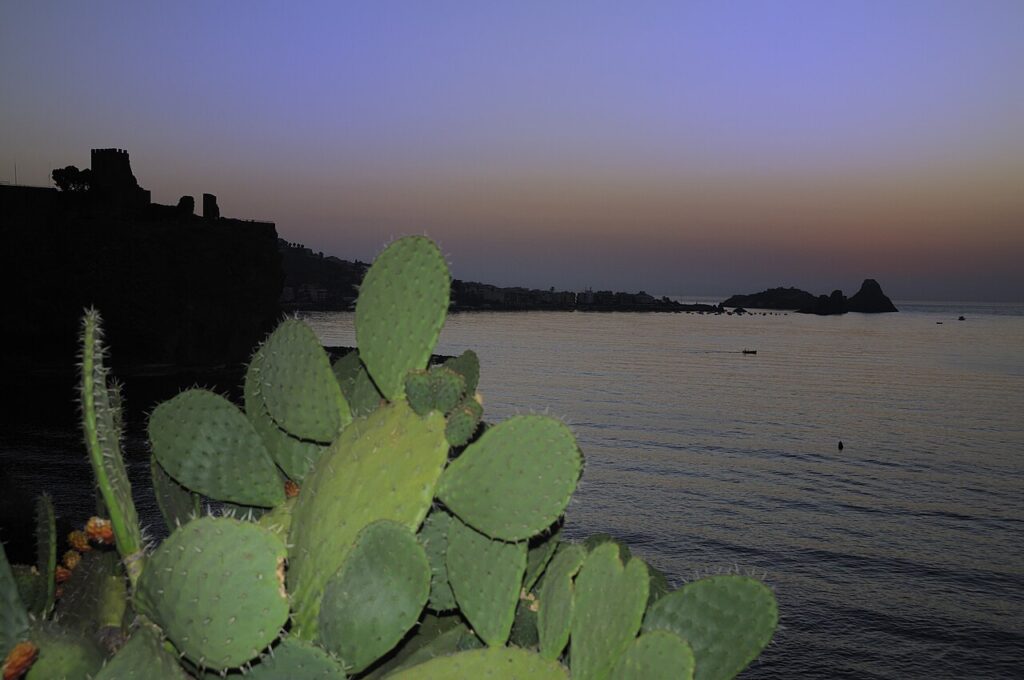
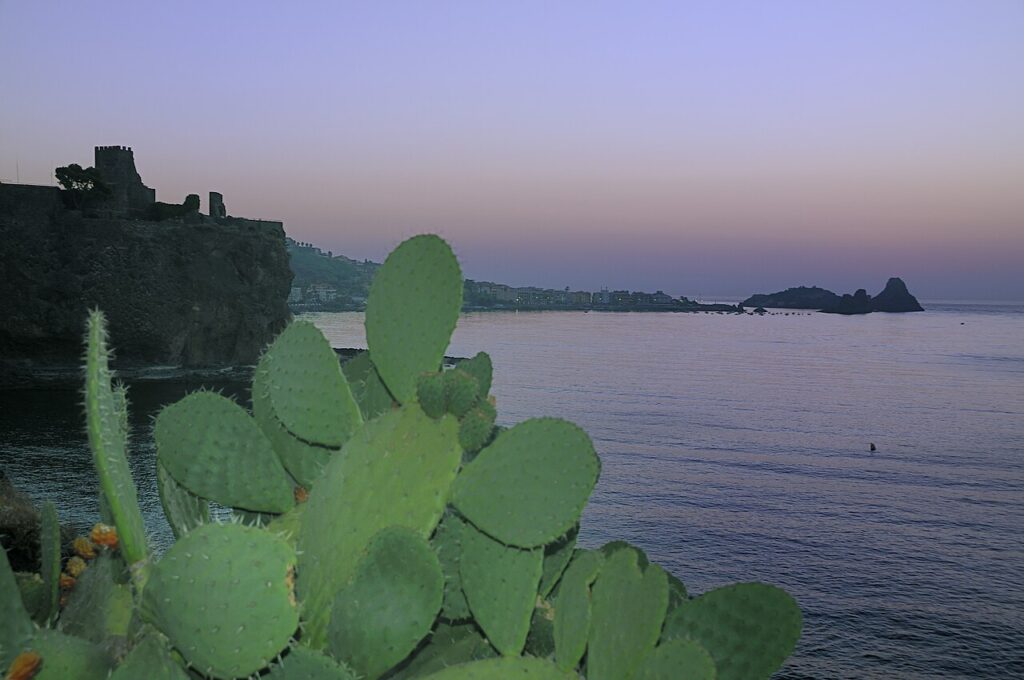
Where the Ionian Sea meets a steep volcanic ridge, Aci Castello rises from a shelf of dark basalt, its Norman fortress commanding the water below. The castle sits not on a gentle slope but on a rupe—a jagged rocky platform—that has watched over fishermen, merchants and travellers for nearly a thousand years. The village spreads inland from this stone anchor, its streets climbing away from the Mediterranean light into a quieter domestic rhythm of apartment buildings, small squares and local commerce.
Aci Castello village in Sicily belongs to the Catania metropolitan area in the eastern coastal plain, one of several settlements that share the prefix Aci—all descended from a mythical pastorello (shepherd) named Aci. The village draws visitors through two distinct registers: the visible present of a working seaside community, and the hidden layers of Greek and Roman occupation that archaeologists have begun to recover from beneath its streets. With a population of 17,713 and an altitude of just 15 metres above sea level, it is neither remote nor monumental, yet it sits at the intersection of classical legend and medieval power.
Origins and the Aci Mythology
The name Aci Castello carries within it a layer of Greek literary mythology. According to tradition, the Aci settlements of this coast—Aci Castello, Aci Catena, Aci Sant’Antonio, Aci Bonaccorsi and the others—trace their collective origin to Xiphonia, a mysterious city of ancient Greece that disappeared, likely within what is now the territory of Aci Catena. The poets Virgilio and Ovidio drew from this geography to craft the story of Aci, a shepherd, and Galatea, a sea nymph, a narrative that linked pastoral romance to the Cyclops Polifemo and the violent waters of the Ionian.
In Roman times, a city called Akis occupied this coast and took part in the Punic Wars, leaving behind no monumental remains but a record of civic participation in the Mediterranean’s largest conflicts. During the Norman medieval period, the settlement was known as Jachium, and the Norman rulers built the fortress that still dominates the village today. This castle, raised in the 12th century, was the first permanent strongpoint of Aci’s later administrative identity.
Until the 17th century, Aci Castello remained administratively bound to the larger territory of Aci, shared with neighbouring casali (hamlets). When the Spanish crown governed Sicily, the dramatic prosperity of Aquilia Nuova—later called Acireale—created tension and rivalry among the subordinate communities seeking independence. The separation of the casali followed: Aci Sant’Antonio (including Aci Valverde, Aci Santa Lucia and Aci Catena) gained autonomy in 1628, Aci Castello in 1647, and Aci Bonaccorsi in 1652. From that point, Aci Castello developed as a distinct comune with its own local governance and identity.
The myth of Aci and Galatea, immortalised by Rome’s greatest poets, transformed a coastal village into part of the classical imagination—a place where love, loss and the sea were bound together in narrative memory long before historians recorded its medieval stones.
Landmarks and Territory
The Castle of Aci
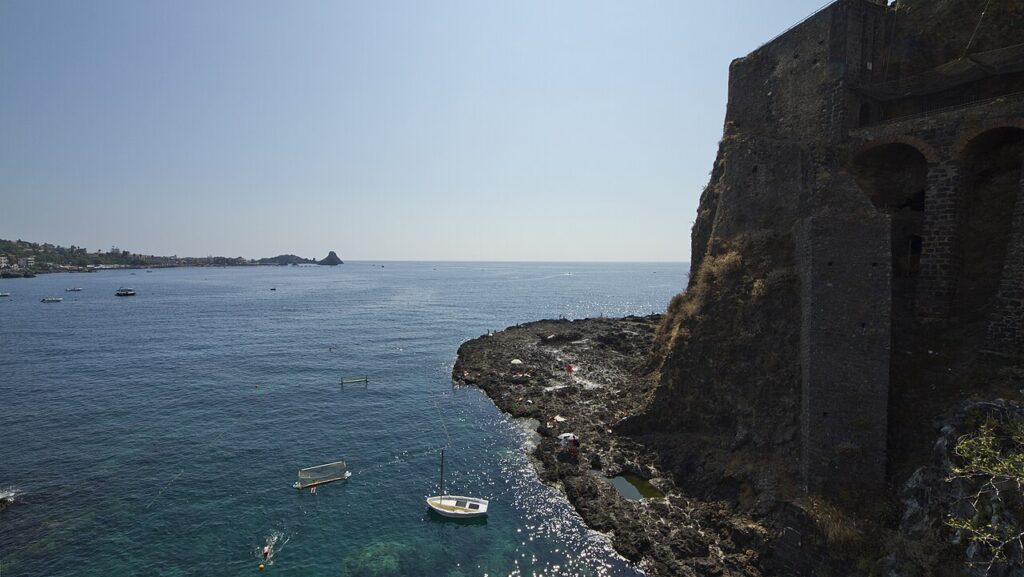
The Castello di Aci stands as the visual anchor of the village, occupying the highest point of a rupe that juts directly above the sea. Built during the Norman 12th century, it is a fortification of medieval military logic: positioned to command the coast, to observe approaching vessels, and to offer refuge to the settled population below. The castle remains the most recognisable monument in Aci Castello’s skyline, its stone silhouette a constant reference point for residents and visitors approaching from the coast road.
Church of San Mauro
The mother church, dedicated to San Mauro (the village’s patron saint), was constructed during the 17th century in the barocco orientale style characteristic of eastern Sicily. Its central dome is the defining feature, a substantial cupola that rises above the surrounding roofline and can be seen from several approaches to the village. The church embodies the baroque religious architecture of the Spanish colonial period, when local communities invested in monumental piety to express civic pride and faith together.
Church of San Giuseppe
Built also in the 17th century, the Church of San Giuseppe stands as a secondary religious monument, reflecting the period when Aci Castello was consolidating its identity as an independent administrative unit. Both churches anchor the spiritual geography of the village and illustrate the intensity of baroque religious patronage during the centuries immediately following local autonomy.
Necropolis and Archaeological Evidence
Between the 1950s and the final decades of the 20th century, construction work in the zone called Vigna Vecchia exposed systematic evidence of a Greco-Hellenistic necropolis. Excavations during the 1950s, again in the 1970s, and once more in the late 1990s revealed burial sites and material remains spread across a minimum of one hectare, indicating a substantial population centre in antiquity. These discoveries anchor Aci Castello within the archaeological story of Greek Sicily, a layer that lies directly beneath the medieval and modern settlement.
Coastal and Maritime Context
The Riserva naturale integrale Isola Lachea e faraglioni dei Ciclopi (the protected reserve of Lachea Island and the Cyclops rock formations) and the Area marina protetta Isole Ciclopi (marine protected area) safeguard the terrestrial and marine zones corresponding to the Cyclops archipelago. These natural reserves form part of the extended territorial identity of Aci Castello, connecting the village to the mythological landscape and the marine biodiversity of the eastern Sicilian coast. The nearby settlement of Aci Trezza, part of the larger Acireale municipality, holds literary significance as the setting for Giovanni Verga‘s novel I Malavoglia, and houses the Casa del Nespolo, a museum dedicated to the work.
Food and Agricultural Tradition
The province of Catania, where Aci Castello lies, is part of the Piana di Catania (Catania Plain), an agricultural region renowned for citrus cultivation and protected-designation products. The Arancia Rossa di Sicilia (red orange, IGP-protected), Limone dell’Etna (Etna lemon, IGP), and Ciliegia dell’Etna (Etna cherry, DOP) are among the regional specialities that define the agricultural rhythm of the area. The volcanic slopes of Mount Etna, visible from many points in the village, influence the terroir and the production of these and other protected products including Pistacchio Verde di Bronte and Pecorino Siciliano.
Coastal villages like Aci Castello have historically drawn sustenance from both the sea and the surrounding agricultural plain. Fresh fish and seafood remain part of local custom, while the citrus harvests and olive oil production connect the village to the broader Sicilian food culture. These products and practices form the background of daily life, though they are better explored through dedicated regional food articles.
How to Reach and Plan Your Visit
Aci Castello is easily accessible from Catania by car, bus and train. The village sits on the Strada Statale 114 Orientale Sicula (the eastern coastal highway) and is served by the Strada Provinciale 52. The railway station at Cannizzaro, on the Messina–Catania–Siracusa line, provides frequent connections to Catania and the surrounding region. Urban and regional bus services connect Aci Castello to Catania, Acireale and other nearby settlements. From 1915 to 1934, a tram line linked the village to Catania, a service now replaced by more flexible bus and rail alternatives.
| Departure Point | Distance | Travel Time |
|---|---|---|
| Catania city centre | 18 km | 25–35 minutes by car |
| Catania Centrale station | 18 km | 20–30 minutes by train to Cannizzaro |
| Acireale | 8 km | 15–20 minutes by car |
| Siracusa | 75 km | 70–85 minutes by car |
The best season to visit is late spring (May–June) or early autumn (September–October), when coastal weather is warm and sea conditions are favourable for swimming and small-boat exploration. Summer months (July–August) bring peak tourism and heat, while winter offers solitude and grey skies over the Ionian. The village is best explored on foot once you arrive; the castle is accessible by a short walk uphill from the main road, and the churches and town centre are within easy walking distance of the waterfront. Parking is available near the seafront and in small lots throughout the residential zones.
A visit of a few hours allows you to see the castle, visit one or both churches, and walk along the coast. A half-day visit enables a slower exploration of the village’s streets and a meal at one of the local establishments. Those interested in archaeology will appreciate the sites of the Greco-Hellenistic necropolis, though these are not formally developed as visitor attractions and require local guidance. The nearby Aci Bonaccorsi and Catania can be combined with a visit to Aci Castello as part of a wider exploration of the metropolitan area and its scattered but connected villages.

 Mountain