


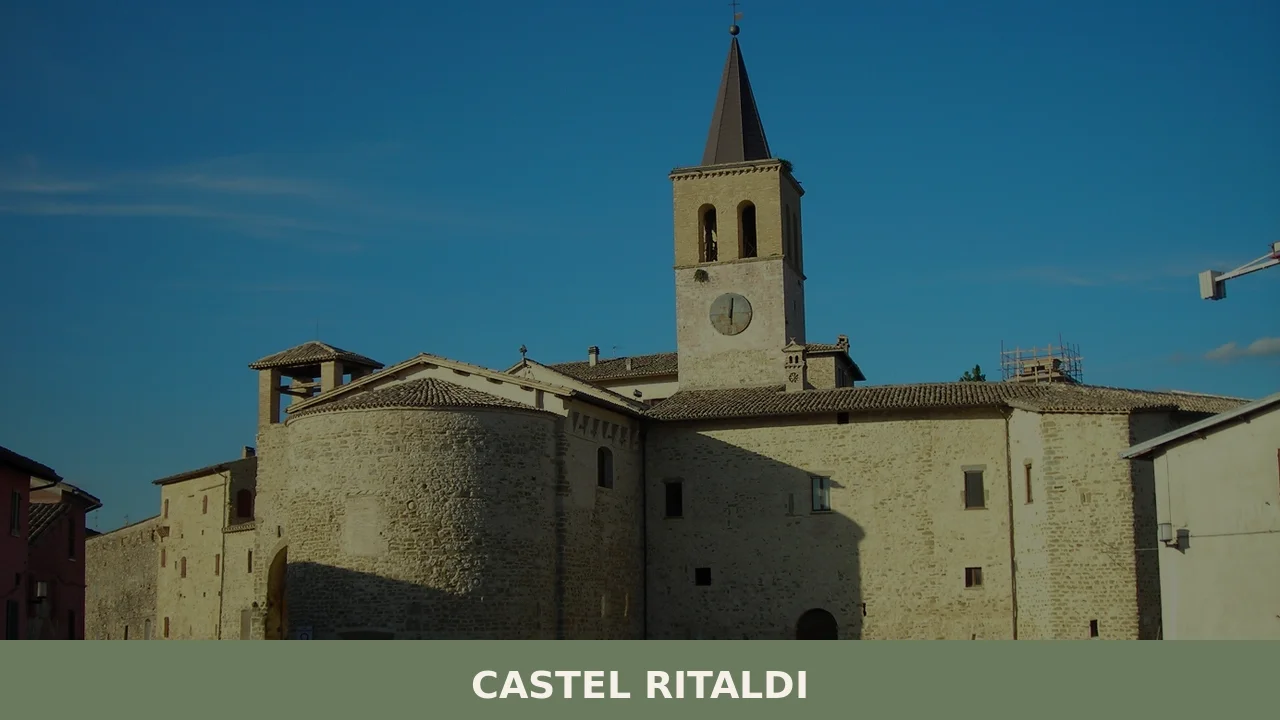
Castel Ritaldi
 Hills
Hills
What to see in Castel Ritaldi, Italy: 5 top attractions, local food, and travel tips for this Umbrian village at 297 m. Discover frescoes, medieval churches & more.
Discover Castel Ritaldi
A carved stone arch above the doorway of San Gregorio in Nido carries the date 1141, pressed into the surface in numerals that have absorbed eight centuries of Umbrian weather. The façade alternates horizontal bands of white and red stone — a pattern rebuilt after the 1997 earthquake but following the original medieval rhythm.
Inside the church’s territory, the road between Castel Ritaldi and the hamlet of Colle del Marchese runs flat and quiet, crossing a landscape where olive groves and grain fields occupy the same ground they did in the mid-nineteenth century.
Knowing what to see in Castel Ritaldi means understanding a municipality of 3,330 inhabitants sitting at 297 m (974 ft) above sea level, about 40 km (25 mi) southeast of Perugia in the Province of Perugia, Umbria, Italy.
Visitors to Castel Ritaldi find a cluster of medieval and Renaissance religious buildings that contain documented frescoes and panel paintings, a hilltop historic core with clear sight lines toward Spoleto and Montefalco, and a local calendar anchored to the feast of its patron saint Marina di Bitinia. The Castel Ritaldi highlights include the pieve of San Gregorio in Nido, the church of Santa Marina with works attributed to Tiberio d’Assisi and Francesco Melanzio, and the Renaissance Sanctuary of Madonna Bruna.
History of Castel Ritaldi
The name itself locates the village within the feudal map of medieval Umbria. Castel Ritaldi derives from the Ritaldi family, recorded in nineteenth-century sources as an ancient feudal lineage of the territory. Until the early thirteenth century the settlement functioned as an imperial fief.
Shortly after 1213 it passed under the authority of the Roman Curia, which governed it through a vicar responsible for justice and taxation, while specific feudal rights remained distributed among the Lambardi, Cattanei, and Litaldesi families — a tripartite arrangement that would gradually dissolve over the following decades as Spoleto extended its regional reach.
By November 1247 the commune had been drawn into the district of Spoleto, and in June 1254 the feudal families formally ceded their remaining rights to the city. Resistance surfaced: in 1298 the castle was forcibly resubmitted by Spoleto following opposition.
Between 1572 and 1585 the municipality compiled its own statutes, giving formal shape to local institutions for the first time. The modern administrative history is equally layered. During the Roman Republic of 1798–1799 the municipality was included in the Department of Clitunno. French rule from 1809 to 1814 reorganized it as a mairie, the French administrative unit equivalent to a municipality.
After the reforms promoted by Cardinal Ercole Consalvi in November 1817, local government was entrusted to a gonfaloniere — the civic magistrate under the restored papal administration — a title that carried both ceremonial and executive functions. Situated between the larger centers of Cerreto di Spoleto and the Valnerina to the east, Castel Ritaldi occupied a strategically secondary but administratively significant position within papal Umbria.
The nineteenth century brought further disruption. The brief return of the Roman Republic in 1849 interrupted papal rule, which was then restored. After the conquest of Umbria by Piedmontese forces, a decree of 17 September 1860 dissolved existing municipal councils. Between 1860 and 1865 the commune was integrated into the administrative system of the Kingdom of Italy. On 10 March 1865, under Law no.
2248, Castel Ritaldi risked suppression due to its small population.
The municipal council opposed annexation to Montefalco on 11 February 1875, and by royal decree of 29 June 1875 the hamlet of Castel San Giovanni was aggregated to the commune, raising the population to 1,658 inhabitants. On 10 March 1927 the municipality was suppressed and reduced to a delegation dependent on Spoleto, but in 1932 it was restored as an autonomous commune — the administrative status it retains today.
What to see in Castel Ritaldi, Umbria: top attractions
Pieve of San Gregorio in Nido
The façade of San Gregorio in Nido presents alternating horizontal bands of white and red stone, a building language common to Romanesque Umbria but here applied to a structure whose earliest documented record dates to 1066. The arch above the entrance portal carries the date 1141, marking a partial reconstruction of the church, likely prompted by structural problems in the original fabric.
Above that arch, a sequence of carved scenes runs in relief, flanked by a multi-centered window set between two niches with Ionic-capital columns, and surrounded by the symbols of the four Evangelists and figures of prophets.
The star motif from the original rose window survives, mounted on the bell gable. The church served as the parish church of Castel Ritaldi until 1828, when that title transferred to a church within the town itself. It stands along the road linking Castel Ritaldi to Colle del Marchese and is accessible by car or on foot from the village center.
Church of Santa Marina
Santa Marina is the church most directly connected to the village’s patron saint and contains the highest concentration of documented artworks in the municipality. The single nave opens into two large niches and two high-ceilinged chapels supported by trussed beams. To the right of the main altar, a fresco by Tiberio d’Assisi shows the Eternal Father on golden clouds with a globe and an iridescent arc, surrounded by seraphim; below appear Saint Catherine of Alexandria, Tobiah with the archangel Raphael, and Pope Saint Sylvester I above a slain dragon.
To the left, an altar dedicated to the Madonna del Soccorso holds a panel painting dated 1509, attributed to Francesco Melanzio, showing the Virgin freeing a possessed child.
The sacristy preserves a fourteenth-century crucifix, and the apse contains a fourteenth-century fresco with numerous saints. The presbytery sits raised by two steps, enclosed by an arch on two columns; beneath the former pavement lies a crypt used by the Confraternity of the Most Holy Sacrament.
Sanctuary of Madonna Bruna
The Sanctuary of Madonna Bruna stands near the Tatarena stream, outside the main built area of the village, and its architecture belongs to the Renaissance Bramantesque tradition. The plan consists of a single nave in the form of a cross enclosed by three equally sized apses — a geometrically balanced arrangement that differs sharply from the longitudinal medieval churches elsewhere in the municipality.
The main altar contains a large fresco of the Madonna della Bruna attributed to Tiberio d’Assisi, while the apsidal frescoes were executed by Pier Matteo Piergili.
A legend associated with the sanctuary records that in June 1706 a group of pilgrims travelling toward Montefalco stopped by the stream and, finding themselves unable to lift their processional banner, had the image painted on the church wall; the following day the work was found miraculously completed. The sanctuary is reachable from the village on foot, following the road toward Bruna, the municipality’s most populous locality with 1,242 residents at the 2021 count.
Former Monastery of Santa Maria di Scigliano
Among the ecclesiastical buildings in Castel Ritaldi, the former monastery of Santa Maria di Scigliano represents the longest institutional continuity. Originally a Benedictine abbey, the structure later served as a summer residence for the Archbishops of Spoleto, a use that speaks to the political geography of this part of Umbria, where Spoleto’s ecclesiastical authority extended well into the surrounding communes.
The building’s conversion from monastic to episcopal use is consistent with broader patterns of post-Tridentine reorganization of religious property in central Italy.
The structure itself does not function as an active monastery today. For those researching Benedictine heritage in the Spoleto valley, this site provides a documented local example of the movement’s territorial reach into the smaller communes of the Province of Perugia.
Parish Church of Santa Massima and the School of Perugino Attribution
The parish church, dedicated to Santa Massima, functions as the active center of Catholic worship in the village and is equipped with a pipe organ. It houses a painting of Our Lady of Perpetual Help, identified in nineteenth-century sources as belonging to the school of Perugino — a broad attribution that nonetheless places the work within the tradition of Umbrian Renaissance painting centered on the workshop of Pietro Vannucci, whose influence shaped religious iconography across the region.
The transfer of the parish title from San Gregorio in Nido to a church within the town occurred in 1828, making Santa Massima the canonical center for the community from that point onward.
Visitors interested in tracking the Perugino school’s regional reach will find this a concrete, if modest, local example, comparable in attribution style to works documented in other small Umbrian communes such as Monteleone di Spoleto to the south.
Local food and typical products of Castel Ritaldi
The agricultural economy of the Castel Ritaldi area has been documented since the mid-nineteenth century, when the majority of the population was engaged in farming within the local territory. Three products formed the core of that economy: grain, which was considered sufficient for local needs; wine, which was produced in abundance; and olive oil, alongside acorns, which served both human and animal nutrition.
This combination — cereals, wine, and oil — reflects the classic triad of central Italian hill-town agriculture and places Castel Ritaldi within the broader productive landscape of the Spoleto valley and the foothills between Montefalco and Trevi.
The proximity to Montefalco, just 8 km (5 mi) to the northwest, situates Castel Ritaldi within one of Umbria’s most recognized wine-producing zones.
While no certified designation of origin is recorded specifically for Castel Ritaldi in the available sources, the historical abundance of wine production in the territory is consistent with a viticultural environment that has supported the region’s reputation for red wines made from Sagrantino and Sangiovese grapes. Local cooking in this part of the Province of Perugia relies on ingredients that the landscape produces directly: durum wheat for pasta al farro and hand-rolled formats, legumes grown in the valley floors, and pork processed into cured meats in the cooler months.
Olive oil from the Spoleto-Trevi corridor — pressed from Moraiolo, Frantoio, and Leccino olives — is the standard fat used in both raw applications and cooking throughout this corridor of Umbria.
For visitors who want to connect food and landscape, the road between Castel Ritaldi and Preci in the Valnerina crosses territory where black truffle — the tartufo nero di Norcia, the prized black truffle of the Norcia area — is a defining product of the broader sub-regional cuisine.
While Castel Ritaldi’s own territory does not produce truffle at documented commercial scale, the dish formats typical of this strip of Umbria — hand-cut pasta dressed simply with local oil and truffle shavings — are the standard offering in the trattorie (informal family-run restaurants) of the Spoleto district, to which the village historically belongs.
The local food calendar follows the agricultural seasons.
Harvest festivals organized around the olive and grape pressing typically take place between October and November in this part of Umbria. Markets in nearby Spoleto, accessible in under 15 minutes by car, offer the broadest selection of certified regional products, including Umbrian extra-virgin olive oil and local wines, for visitors who want to take produce home.
Festivals, events and traditions of Castel Ritaldi
The civic and religious calendar of Castel Ritaldi is anchored to the feast of Santa Marina di Bitinia, the village’s patron saint, celebrated on the Sunday following 15 August. The August date places the festival within the densest period of summer festivity in Umbria, when sagre — traditional local food and harvest festivals — and patron saint celebrations fill the regional calendar.
The Sunday timing, rather than a fixed calendar date, means the precise day shifts from year to year, so visitors planning specifically for the feast should confirm the date with the official municipality of Castel Ritaldi before traveling.
The celebration of Marina di Bitinia in an Umbrian hilltop commune reflects a pattern of early Christian martyr devotion that persists across the small municipalities of the Province of Perugia.
Beyond the patron feast, the summer period — roughly from late July through mid-August — concentrates the largest number of visitors in the area, drawn both by the cooler evening temperatures at altitude and by the density of events in neighboring centers. Spoleto, 13 km (8 mi) away, hosts its internationally known Festival dei Due Mondi in late June and early July, which increases regional circulation and can be combined with a visit to Castel Ritaldi on a single day trip.
For those interested specifically in Castel Ritaldi’s own calendar, the patron saint weekend remains the single most significant public moment in the village’s annual cycle, traditionally accompanied by processions and communal gatherings in the historic center.
When to visit Castel Ritaldi, Italy and how to get there
The best time to visit Umbria in general, and Castel Ritaldi in particular, falls between April and June, and again in September and October.
Spring brings moderate temperatures and the full green of the olive groves and valley fields, with far smaller crowds than the August peak. Autumn offers the olive harvest, the grape pressing season, and clear air with long sight lines across the Spoleto valley. July and August are the hottest months and also the most active for local festivals; the patron saint feast in the week after 15 August is the specific draw for visitors interested in local religious traditions. Winter visits are viable — the village is accessible year-round — but expect limited opening hours for churches and no guarantee that all interior spaces will be accessible without prior arrangement.
Castel Ritaldi sits about 40 km (25 mi) southeast of Perugia and approximately 13 km (8 mi) from Spoleto.
For visitors arriving by car, the most direct route from Rome uses the A1 motorway (Autostrada del Sole) with exit at Orte, then follows the SS3 Flaminia north to Spoleto before taking local roads west toward Castel Ritaldi; total distance from Rome is approximately 150 km (93 mi), with a typical drive time of around 90 minutes depending on traffic. From Perugia, the SS3bis connects to the Spoleto area in under an hour. If you arrive by car, parking is available along the approaches to the historic center. The nearest railway station is Spoleto, served by regional trains on the Rome–Ancona and Rome–Foligno lines via Trenitalia; from Spoleto station, Castel Ritaldi is approximately 13 km (8 mi) by local road, reachable by taxi or hired car.
The nearest international airport is Perugia San Francesco d’Assisi, roughly 55 km (34 mi) to the northwest, with connections to several European cities. Rome Fiumicino (FCO) is approximately 180 km (112 mi) to the south and functions as the main international gateway for visitors traveling to this part of Umbria. For those making a day trip from the nearest major city, Rome offers the most practical base: the journey by car or train to Spoleto and onward to Castel Ritaldi is completable in under two hours each way.
International visitors should note that English is not widely spoken in smaller local shops and bars; carrying cash in euros is advisable, as card payment acceptance varies in the village itself.
Visitors with time to extend their itinerary beyond Castel Ritaldi can consider the mountain village of Scheggia e Pascelupo in the northern reaches of the Province of Perugia, which shares the same administrative context and offers a contrasting landscape of the Apennine foothills along the old Via Flaminia corridor — a logical addition for anyone already traveling the Umbrian road network between Perugia and the Adriatic side.
Frequently asked questions about Castel Ritaldi
What is the best time to visit Castel Ritaldi?
Late spring (May–June) and early autumn (September–October) offer mild temperatures ideal for exploring the hilltop historic center and the surrounding olive groves at 297 m above sea level. Summer visits are rewarding around the feast of patron saint Marina di Bitinia, celebrated on the Sunday following 15 August, when the village hosts its main annual religious and civic festivities. Avoid the hottest midday hours in July and August. Winter is quiet and uncrowded, suitable for those seeking an authentic, off-season Umbrian atmosphere.
What are the historical origins of Castel Ritaldi?
Castel Ritaldi takes its name from the Ritaldi family, an ancient feudal lineage of medieval Umbria. The settlement functioned as an imperial fief until shortly after 1213, when it passed under the Roman Curia. By 1247 it entered the district of Spoleto, which formally absorbed the feudal families' remaining rights in 1254. The municipality compiled its own statutes between 1572 and 1585. After Napoleonic rule and restoration under papal administration, it was fully integrated into the Kingdom of Italy between 1860 and 1865, and restored as an autonomous commune in 1932 after a brief suppression in 1927.
What to see in Castel Ritaldi? Main monuments and landmarks
The top sites are: the Pieve of San Gregorio in Nido (documented from 1066, with a carved 1141 portal and alternating white-and-red stone façade), accessible by car or on foot from the village center; the Church of Santa Marina, containing frescoes by Tiberio d'Assisi and a 1509 panel painting by Francesco Melanzio; the Renaissance Sanctuary of Madonna Bruna near the Tatarena stream, with frescoes attributed to Tiberio d'Assisi and Pier Matteo Piergili; and the former Benedictine Monastery of Santa Maria di Scigliano. The parish church of Santa Massima houses a pipe organ and a painting from the school of Perugino.
Where to take the best photos in Castel Ritaldi?
The hilltop historic center of Castel Ritaldi offers clear sight lines toward Spoleto and Montefalco — two of Umbria's most iconic skylines — making it a rewarding spot for landscape photography, particularly at sunrise or in the golden light of late afternoon. The façade of San Gregorio in Nido, with its alternating red-and-white stone bands, provides a strong architectural subject along the quiet road to Colle del Marchese. The area around the Sanctuary of Madonna Bruna near the Tatarena stream combines Renaissance architecture with the olive grove landscape characteristic of this part of the Spoleto valley.
Are there museums, churches or historic buildings to visit in Castel Ritaldi?
Castel Ritaldi has four documented religious buildings of artistic significance. San Gregorio in Nido (recorded 1066) features a sculpted Romanesque portal dated 1141 with Evangelist symbols and prophet figures in relief. Santa Marina preserves a Tiberio d'Assisi fresco, a Francesco Melanzio panel painting (1509), a fourteenth-century crucifix, and a crypt beneath the presbytery. The Sanctuary of Madonna Bruna follows a Bramantesque Greek-cross plan with three equal apses. The former monastery of Santa Maria di Scigliano, originally Benedictine, later served as an archbishop's residence. Specific opening hours are not officially published; local inquiry is recommended on arrival.
What can you do in Castel Ritaldi? Activities and experiences
Castel Ritaldi suits slow, culturally oriented travel. Visitors can walk between the village center and the Pieve of San Gregorio in Nido along a quiet road through olive groves and grain fields, and follow the road toward the hamlet of Bruna to reach the Sanctuary of Madonna Bruna on foot. The landscape setting at 297 m, with views toward Spoleto and Montefalco, makes the village a natural base for scenic drives through the Spoleto valley. The feast of Marina di Bitinia on the Sunday after 15 August is the main communal event of the year.
Who is Castel Ritaldi suitable for? Families, couples, hikers, solo travelers?
Castel Ritaldi is best suited to culturally curious travelers — couples, solo visitors, and art lovers — drawn to documented Romanesque and Renaissance religious heritage in an uncrowded Umbrian hill setting. The compact, walkable historic center and quiet surrounding roads are accessible for families with older children. Those interested in the Perugino school and Umbrian fresco painting will find concrete, if modest, examples here and easy day-trip connections to Spoleto and Montefalco. It is not oriented toward beach tourism, large-scale hiking infrastructure, or theme-park-style attractions.
What to eat in Castel Ritaldi? Local products and specialties
The documented agricultural economy of the Castel Ritaldi area historically centered on three products: grain, wine, and olive oil — the same triad that defines Umbrian rural food culture more broadly. Olive oil from the Spoleto valley falls within the DOP Umbria designation (Colli Spoleto subzone). Local wine production fits within the broader Montefalco DOC and Spoleto DOC appellations. Traditional Umbrian staples available in the area include hand-rolled pasta, cured meats, and pulses. For the most direct local experience, markets and agriturismi in the surrounding communes of Spoleto and Montefalco offer the full range of these products.
Nearby Villages near Castel Ritaldi
In Umbria More villages to discover
Lisciano Niccone
Hills
A 601-inhabitant village on the Umbria-Tuscany border. Discover what to see in Lisciano Niccone: its medieval core, valley trails, and traditional food.
Sant’Anatolia di Narco
 Plains
In 1213, a document from the Abbey of San Felice recorded for the first time the castrum of Sant’Anatolia, a fortified settlement on the left bank of the River Nera in the southern Valnerina. Today the municipality has 555 inhabitants spread between the main village and a handful of hamlets scattered across the wooded slopes […]
Bettona
Hills
What to see in Bettona, Umbria, Italy: Etruscan walls, Perugino paintings and a Pinacoteca at 353 m altitude. Discover top attractions and how to get there.
Assisi
Hills
What to see in Assisi, Umbria, Italy: explore the UNESCO Basilica of San Francesco, Rocca Maggiore, and 27,721-inhabitant hilltop town. Discover festivals and travel tips.
Cerreto di Spoleto
Hills
A ridge-top village of 975 inhabitants in the Valnerina, Cerreto di Spoleto holds medieval streets, scattered hamlets, and a centuries-old tradition of itinerant herbalists.
Acquasparta
Hills
Discover what to see in Acquasparta, Umbria: Renaissance palaces, the Cesi legacy, mineral springs, Martani Hills trails, and local food. A complete travel guide.
Spello
 Sea
Sea
What to see in Spello, Umbria, Italy: Roman gates, mosaic villa, medieval walls at 314 m. Discover top attractions, local food and how to get there.
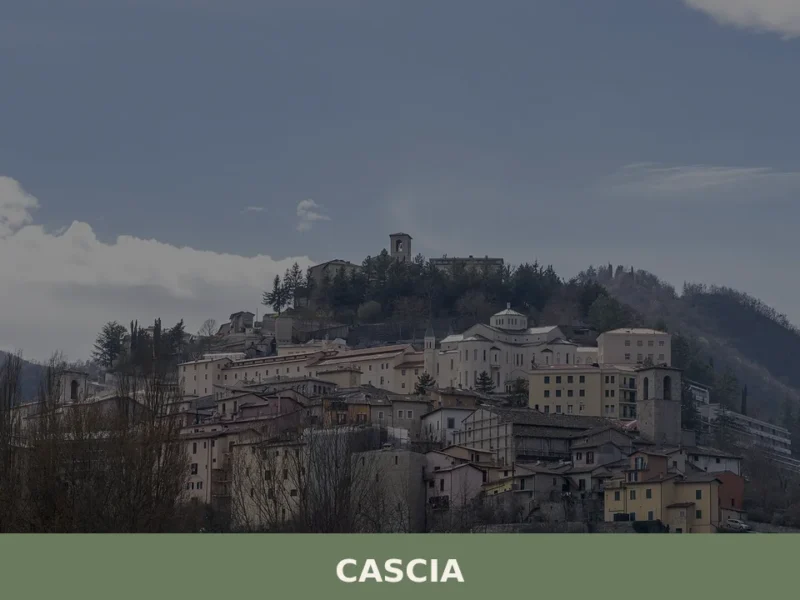
Cascia
 Mountain
What to see in Cascia, Umbria, Italy: explore the Basilica of Santa Rita, medieval churches, and local truffles at 653 m altitude. Discover the full travel guide.
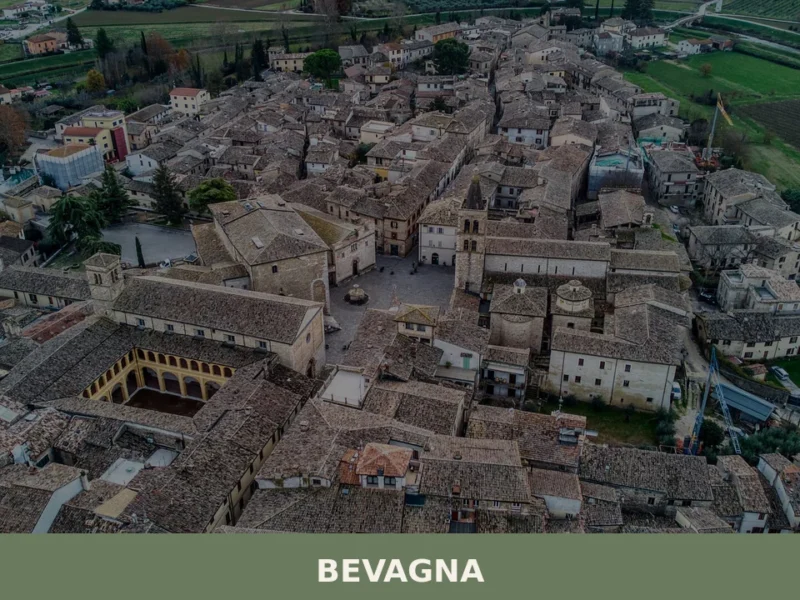
Bevagna
Hills
What to see in Bevagna, Umbria, Italy: explore 5 key attractions, Romanesque churches, Roman ruins, and local food. Population 5,130. Discover the full guide.
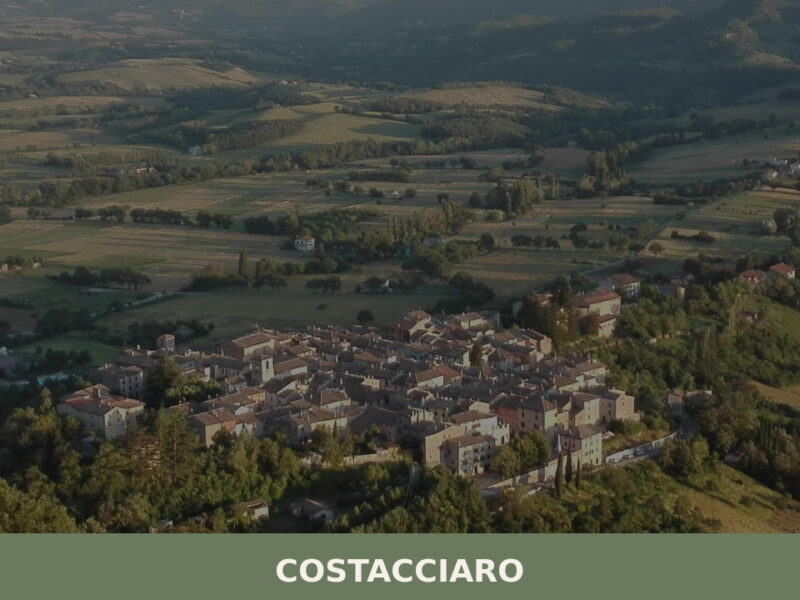
Costacciaro
Hills
Morning light reaches Costacciaro slowly, filtered through the mass of Monte Cucco before it spills across stone facades and narrow lanes still damp from overnight mountain air. At 1,280 inhabitants, this is a village measured not in monuments but in texture — the grain of limestone walls, the sound of water channelled from karst springs, […]


🏡 Know Castel Ritaldi better than we do?
If you’re a local or have been there, your knowledge matters: add what’s missing or fix a detail on this page.