


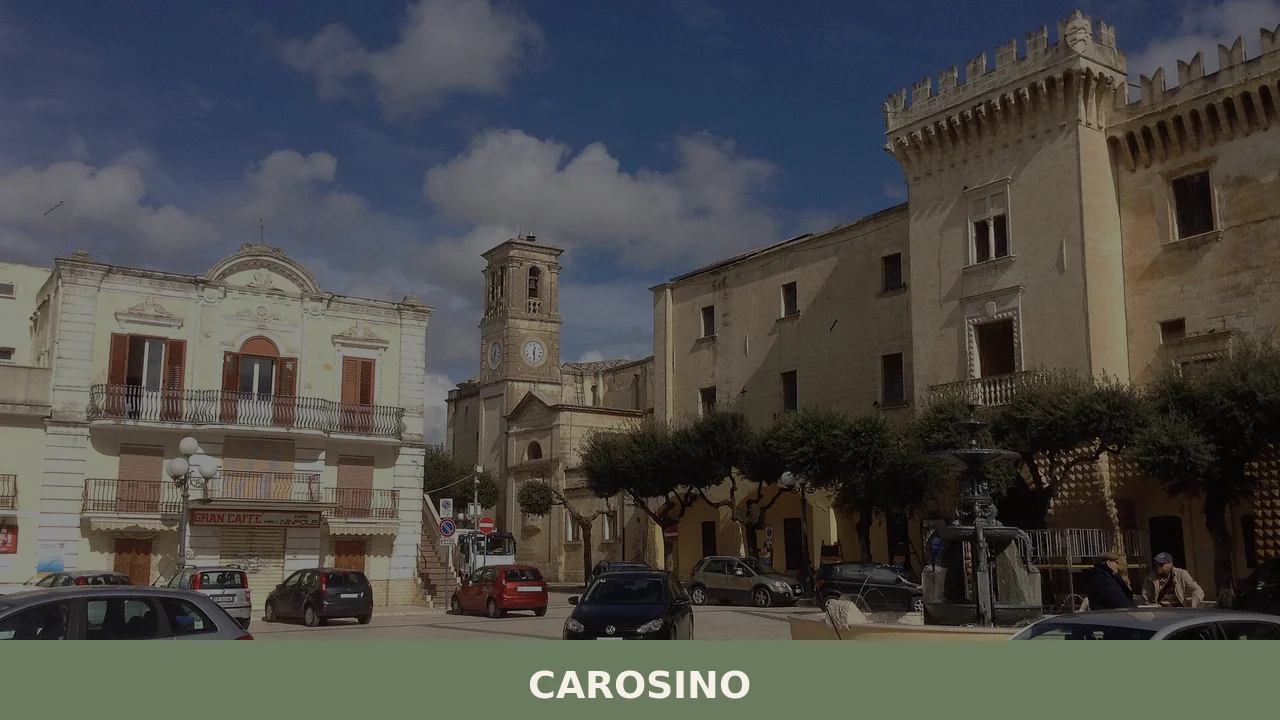
Carosino
 Plains
Carosino is a comune of 6,371 inhabitants in the province of Taranto, positioned in the Ionian arc of Puglia where the landscape flattens into olive groves and vineyards before reaching the coast. Known locally by its Salentine dialect name Carusinu, the town sits within a territorial context defined by centuries of agricultural production and the […]
Discover Carosino
Carosino is a comune of 6,371 inhabitants in the province of Taranto, positioned in the Ionian arc of Puglia where the landscape flattens into olive groves and vineyards before reaching the coast. Known locally by its Salentine dialect name Carusinu, the town sits within a territorial context defined by centuries of agricultural production and the administrative gravity of nearby Taranto. Anyone asking what to see in Carosino will find a place whose identity is built not on monumental tourism infrastructure but on the layered evidence of southern Italian civic and rural life, readable in its streets, churches, and surrounding land.
History of Carosino
The origins of Carosino are bound to the medieval settlement patterns of the Tarantine hinterland, a territory repeatedly reorganised under successive feudal powers following the Norman conquest of southern Italy in the eleventh century. The Normans restructured much of Puglia into a network of smaller fiefdoms, and communities like Carosino emerged or were formalised during this period of administrative consolidation. The dialect name Carusinu preserves a linguistic layer older than standard Italian, rooted in the Salentine variant of Griko-influenced Pugliese speech that once covered a far wider area of this heel of the Italian peninsula.
Through the Aragonese and later Spanish periods of control over the Kingdom of Naples — which encompassed all of Puglia from the late fifteenth century onward — communities in the Taranto province operated within a feudal economy centred on grain, olives, and viticulture. Carosino would have functioned within this agrarian system, its social structure shaped by the relationship between landowners, the Church, and tenant farmers. The physical fabric of the historic centre, with its palazzo-scale residences and religious buildings, reflects the accumulated investment of local landowning families during the seventeenth and eighteenth centuries, when wealth from agricultural surplus was redirected into civic architecture across the Mezzogiorno.
The administrative unification of Italy in 1861 brought Carosino into the new Kingdom of Italy as a recognised comune within the province of Taranto — a provincial designation that has remained stable through subsequent territorial reorganisations. The late nineteenth and early twentieth centuries brought the same demographic pressures to Carosino that affected most of rural southern Puglia: emigration toward the industrial north of Italy and toward the Americas thinned rural populations while Taranto’s naval and industrial development drew workers from its hinterland. Today the commune administers its territory as an independent municipality, maintaining civic institutions while remaining economically integrated with the broader Taranto metropolitan area.
What to see in Carosino: 5 must-visit attractions
The Historic Centre
The old urban core of Carosino follows a compact street plan typical of inland Pugliese towns, with narrow lanes opening onto small civic squares. The building fabric dates predominantly from the seventeenth to nineteenth centuries, constructed in the local calcarenite limestone that weathers to warm ochre tones. Walking the centre offers a readable cross-section of southern Italian small-town architecture across three centuries.
Parish Church of Sant’Anna
The principal parish church of Carosino is dedicated to Sant’Anna, placing it within the widespread Marian and saintly devotional tradition of Tarentine Puglia. Its façade and interior reflect the accumulated artistic and decorative investments of local confraternities and clergy over several centuries, with altarwork and devotional furnishings that document the town’s religious patronage networks from the baroque period onward.
The Rural Landscape and Olive Groves
The agricultural territory surrounding Carosino is part of Puglia’s historic olive belt, where centuries-old ulivi secolari — trees whose gnarled trunks can exceed several metres in circumference — dominate the countryside. This working landscape, still actively producing olive oil under regional quality frameworks, constitutes one of the most visually and culturally significant aspects of what to see in Carosino and its immediate surroundings.
Local Palazzo Architecture
Several palazzo-scale private residences in the historic centre reflect the architectural ambitions of Carosino’s landowning families during the eighteenth and nineteenth centuries. Characterised by rusticated stone doorways, wrought-iron balconies, and internal courtyards, these buildings are the most tangible surviving evidence of the agrarian wealth that once concentrated in the hands of a small local elite during the Bourbon period of rule.
The Town’s Religious Festivals and Civic Squares
Carosino’s piazzas function as the operational centres of civic life, particularly during the town’s religious feast days tied to the liturgical calendar. The main square serves as both a social gathering space and the stage for processions associated with local patron saints — events that have structured community time in this part of the Taranto province for several hundred years.
Local food and typical products
Carosino sits within one of Italy’s most productive olive oil territories, and the extra virgin olive oil produced from the Ionian hinterland of Taranto falls under the broader Pugliese tradition of cultivars including Ogliarola and Coratina, varieties prized for their polyphenol content and low acidity. The local table reflects the cucina povera of the Tarentine countryside: orecchiette alle cime di rapa, broad bean purée with wild chicory, and preparations of dried legumes cooked with locally foraged vegetables are the foundations of daily eating here. Lamb and pork from the provincial interior appear in the heavier dishes of winter, often seasoned with the dried peppers and fennel seeds that recur across Pugliese rural cooking.
The vineyards of the Taranto province contribute to IGP-designated production, and local wine culture leans toward the robust red varieties — Primitivo and Negroamaro — that perform well on the iron-rich soils of this part of Puglia. For those wanting to engage directly with local production, the network of agriturismi in the surrounding countryside occasionally offers meals prepared from estate produce. The Puglia regional administration maintains updated registers of certified producers and rural hospitality businesses operating across the province, which can help visitors source direct-from-farm experiences in the Carosino area.
Best time to visit Carosino
The climate of the Taranto hinterland follows the classic southern Italian Mediterranean pattern: hot and dry from June through August, when temperatures regularly exceed 35°C and the agricultural land bakes under intense sun. The spring months of April and May offer the most practical conditions for exploring both the town and its surrounding countryside — temperatures between 18°C and 26°C, the olive trees and wildflowers in active growth, and the fields still carrying the green of the pre-harvest season. September and October bring the olive harvest, which animates the rural landscape with working activity and gives visitors an opportunity to observe the extraction process at local mills. The Municipality of Carosino publishes the schedule of local civic and religious events on its official site, which is worth consulting before travel to align a visit with any active festivals or markets.
Winter in the Taranto province is mild by northern European standards — January averages hover around 8–10°C — making it viable for travel, though many rural businesses operate on reduced schedules between November and March. The weeks around the feast of Sant’Anna in late July represent a high point of local community activity, with outdoor events making the heat more tolerable in the evening hours. Visitors primarily interested in food and agricultural culture will find the autumn harvest window the most rewarding season overall.
How to get to Carosino
Carosino is located in the province of Taranto in southern Puglia, and most practical access routes pass through or near the city of Taranto itself. The following reference points apply:
- By car: From Taranto, Carosino is reachable in approximately 15–20 minutes via the SS7 (Via Appia) or secondary provincial roads leading southeast from the city. From the A14 motorway (Autostrada Adriatica), exit at Taranto and follow signs toward the Ionian hinterland.
- By train: The nearest main railway station is Taranto Centrale, served by Trenitalia regional and intercity services connecting to Bari (approximately 1 hour 20 minutes), Brindisi, and Lecce. From Taranto station, Carosino is accessible by local bus services or taxi.
- By air: The most practical airports are Brindisi Airport (Aeroporto del Salento), approximately 70 km from Carosino, and Bari Karol Wojtyła Airport, approximately 100 km away. Both airports are connected to Taranto by road via the SS7 or A14 motorway. Car hire at either airport provides the most flexible onward access.
- From Taranto city centre: Carosino is approximately 15 km southeast of Taranto, making the provincial capital the logical base for day visits if accommodation in the village itself is limited.
Where to stay in Carosino
Carosino is a working comune of moderate size rather than a destination built around visitor accommodation, and the range of lodging available within the village boundary reflects that reality. Travellers seeking to stay in or very close to the village will find the most suitable options in the form of small B&Bs and private holiday apartments — a type of accommodation that has expanded across rural Puglia as local owners have registered rooms through national and regional tourism platforms. The official Puglia tourism portal aggregates certified accommodation across the province and provides a reliable starting point for searches in the Carosino area.
For travellers who want a wider choice of hotel infrastructure while still accessing Carosino easily, Taranto city centre — approximately 15 km away — offers a full range of accommodation categories from budget to mid-range hotels, with good road connections into the hinterland. The surrounding countryside also supports a modest number of agriturismi, which offer the dual advantage of rural setting and direct access to local agricultural production. A practical booking approach for this area is to secure accommodation in Taranto or at a countryside agriturismo and treat Carosino as part of a broader itinerary covering the Ionian hinterland.
More villages to discover in Puglia
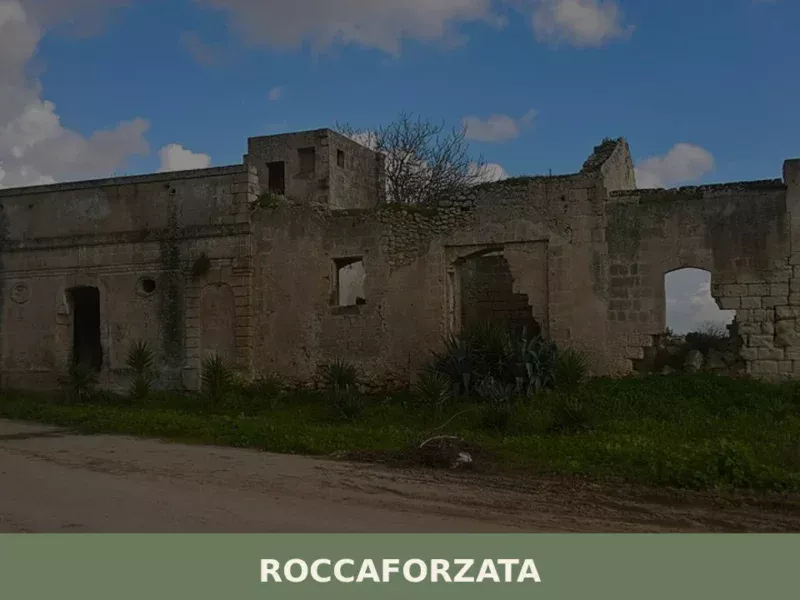
The Taranto province contains several small communes that share the agricultural and historical character of Carosino’s territory. Roccaforzata, a small comune a few kilometres from Carosino in the same provincial cluster, offers a similarly compact historic centre and the kind of quiet civic life that defines inland Tarentine Puglia at a human scale. Those interested in the broader patterns of settlement across this part of the region will also find Panni, a Pugliese village of quite different topographical character in the Apennine foothills, a useful counterpoint — demonstrating how differently the same regional identity expresses itself across the varied geography of Puglia.
Further north in the province of Bari, the agricultural towns of the Murge plateau and its eastern fringe show how Pugliese civic architecture and rural economy evolved in parallel across the region. Palo del Colle and Cellamare both sit within the Barese hinterland and provide useful context for understanding how the smaller comuni of Puglia — each with its own dialect history, patron saint cycle, and agricultural base — have navigated the same broad arc of feudal, Bourbon, and post-unification history that shaped Carosino.
Frequently asked questions about Carosino
What is the best time to visit Carosino?
The most practical times to visit Carosino are spring (April-May) for pleasant temperatures (18-26°C), blooming landscapes, and active wildflowers. Autumn (September-October) is rewarding for experiencing the olive harvest and local food culture, with moderate temperatures. The patronal feast of San Biagio is celebrated on February 3rd and again on the second Sunday of October. The Feast of Sant'Anna in late July is also a significant community event with outdoor activities, despite the summer heat. Winter months (November-March) are mild but see reduced rural business schedules.
What are the historical origins of Carosino?
Carosino's origins are rooted in medieval settlement patterns, with its formalization occurring under Norman rule in the 11th century as part of Puglia's feudal system. The town developed within an agrarian economy focused on grain, olives, and viticulture. Its historic centre's architecture, particularly palazzo-scale residences and religious buildings, reflects the accumulated wealth of landowning families during the 17th and 18th centuries. The dialect name 'Carusinu' preserves ancient linguistic layers, and the town became an independent comune with Italy's unification in 1861.
What to see in Carosino? Main monuments and landmarks
In Carosino, explore the **Historic Centre**, characterized by narrow lanes, small squares, and 17th-19th century calcarenite limestone buildings. Visit the **Parish Church of Sant'Anna**, the principal church showcasing centuries of religious art. Admire the **Local Palazzo Architecture**, with rusticated stone doorways and wrought-iron balconies, reflecting past agrarian wealth. Don't miss the extensive **Rural Landscape and Olive Groves** surrounding the town, featuring ancient 'ulivi secolari.' The town's **Civic Squares** also serve as vibrant hubs for community life and festivals.
What are the main natural or scenic attractions of Carosino?
The primary natural and scenic attractions around Carosino are its expansive **rural landscape and ancient olive groves**. Situated in Puglia's historic olive belt, the countryside is dominated by centuries-old 'ulivi secolari' whose gnarled trunks create an iconic and visually stunning environment. The flat plains (Pianura) are also home to vineyards, contributing to a rich agricultural panorama that offers opportunities for scenic drives or tranquil walks amidst working landscapes, providing a deep connection to the region's agricultural heritage.
Where to take the best photos in Carosino?
For captivating photos in Carosino, focus on the **Historic Centre**, capturing its atmospheric narrow lanes, small civic squares, and the warm ochre tones of the 17th-19th century calcarenite limestone buildings. The intricate details of the **Local Palazzo Architecture**, with their rusticated stone doorways and wrought-iron balconies, also offer excellent subjects. Outside the village, the **Rural Landscape and Olive Groves** provide iconic Puglian vistas, especially the majestic 'ulivi secolari' at dawn or dusk, perfectly embodying the agricultural essence of the region.
Are there museums, churches or historic buildings to visit in Carosino?
Yes, Carosino offers several historical and religious sites. The **Parish Church of Sant'Anna** is the main church, featuring an interior that reflects centuries of local devotional patronage. The entire **Historic Centre** functions as an open-air exhibition of southern Italian civic architecture, with buildings primarily from the 17th to 19th centuries. Additionally, visitors can admire the **Local Palazzo Architecture**, private residences with distinctive rusticated stone doorways and wrought-iron balconies, tangible evidence of the town's historical agrarian wealth. There are no documented museums within the village itself.
What can you do in Carosino? Activities and experiences
In Carosino, you can **explore the Historic Centre** on foot, discovering its ancient street plan and architecture. Immerse yourself in the **rural landscape** by walking or cycling through centuries-old olive groves and vineyards. During autumn (September-October), you can **observe the olive harvest** and visit local mills. Engage with the **local food and wine culture**, tasting traditional 'cucina povera' dishes and IGP-designated red wines like Primitivo and Negroamaro, possibly at local agriturismi. Attending **religious festivals**, such as the Feast of Sant'Anna in late July or the patronal feasts, offers a vibrant insight into community life.
Who is Carosino suitable for? Families, couples, hikers, solo travelers?
Carosino is perfectly suited for **cultural explorers and slow travelers** who seek an authentic experience of southern Italian civic and rural life, away from typical tourist crowds. It appeals strongly to **food and wine enthusiasts** eager to delve into local olive oil production, traditional cuisine, and regional wines. **Couples and solo travelers** will appreciate its peaceful charm and historical atmosphere. While not a hiking destination, it's also suitable for **families** interested in exploring local traditions and the agricultural landscape, offering a genuine taste of everyday Puglian life.
What to eat in Carosino? Local products and specialties
Carosino boasts the authentic flavors of Puglian 'cucina povera.' The area is renowned for its high-quality **extra virgin olive oil**, produced from cultivars like Ogliarola and Coratina. Essential dishes include **orecchiette alle cime di rapa** and **purè di fave con cicoria selvatica** (broad bean purée with wild chicory). Winter menus often feature lamb and pork, seasoned with local dried peppers and fennel seeds. Complement your meal with robust **IGP-designated red wines** such as Primitivo and Negroamaro, sourced from the surrounding Taranto province vineyards.
📷 Photo Gallery — Carosino
Nearby Villages near Carosino
In Apulia More villages to discover
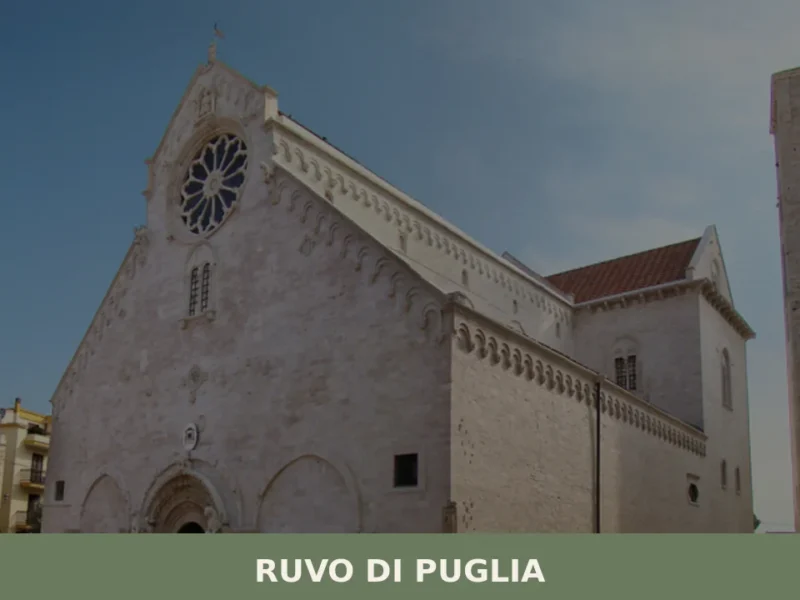
Ruvo di Puglia
 Hills
Hills
Discover 5 unique attractions in Ruvo di Puglia. Explore the Cathedral and Jatta Museum. Plan your visit now!
Manduria
 Sea
Sea
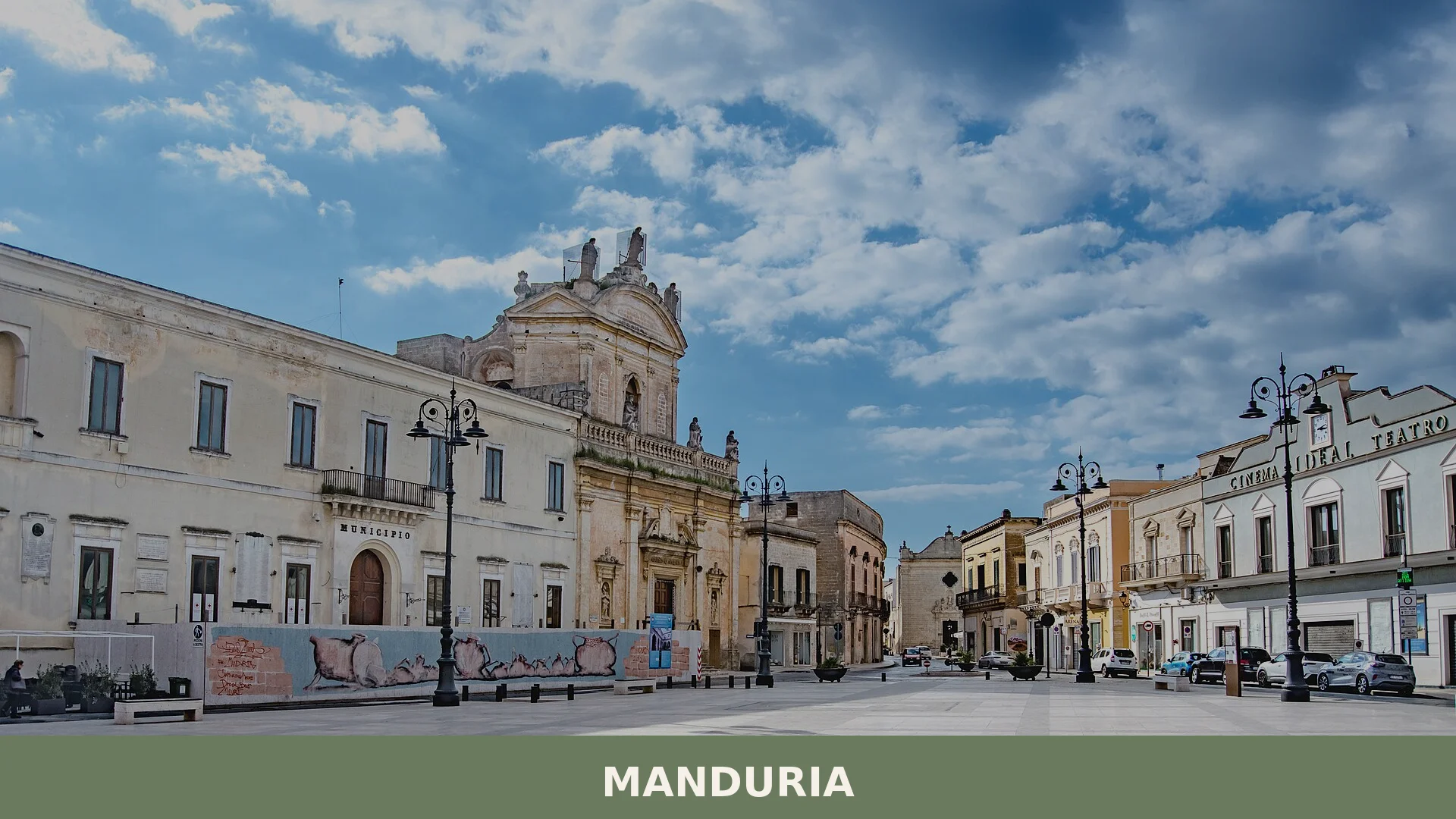
A territory where Messapic walls still stand and Roman roads connect to the coast. Manduria earned its title as a City of Art through centuries of layered stone and faith.
Cavallino
Plains
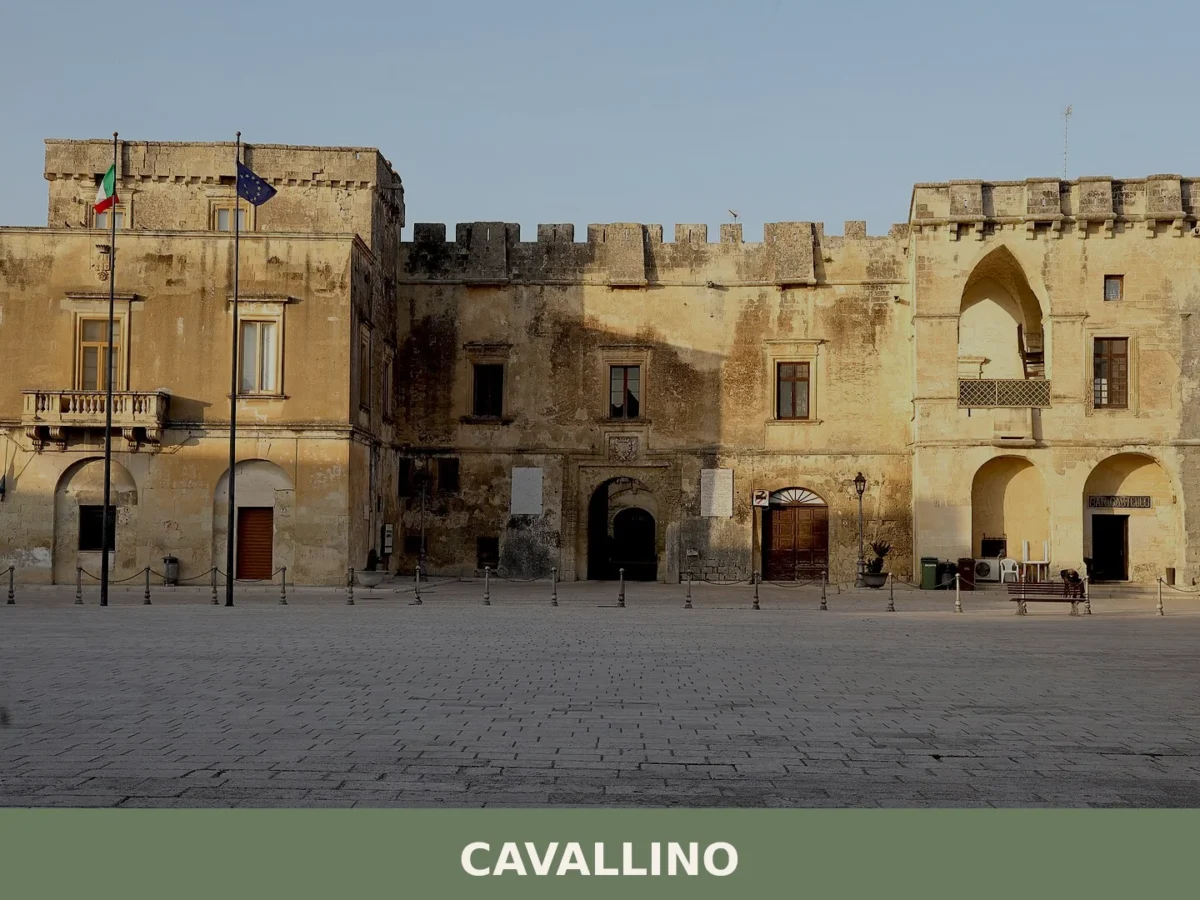
A village of 13,000 inhabitants where Messapic foundations meet Baroque stone. Visit the Dominican church, the feudal castle and a 1633 public well.
Alessano
Sea
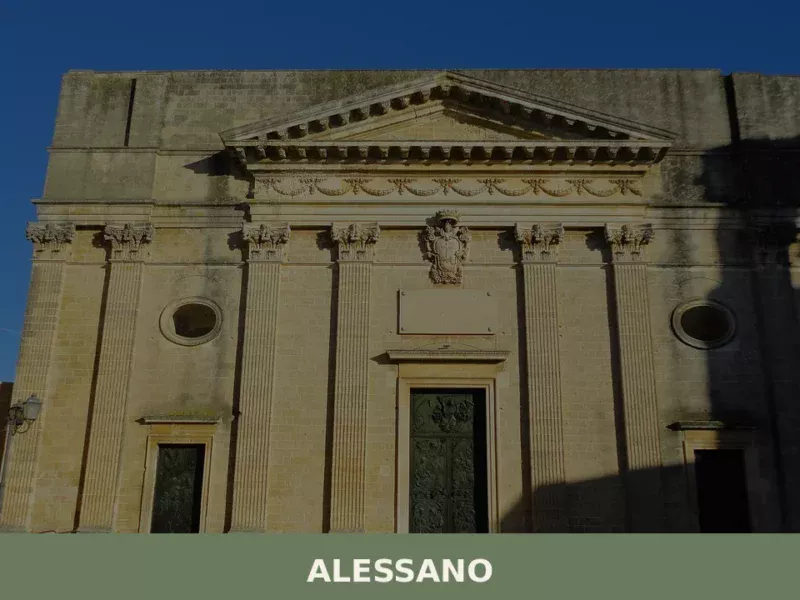
Until 1818, Alessano was the seat of its own diocese — a fact that explains the density of sacred architecture concentrated in a village of fewer than 6,000 inhabitants. Located in the basso Salento, the southernmost stretch of Puglia’s heel, the comune includes the hamlet of Montesardo and the coastal locality of Marina di Novaglie. […]
Alberobello
Hills
Alberobello, Puglia: Discover UNESCO trulli, Monti & Aia Piccola districts. Explore unique history & traditions. Plan your visit!
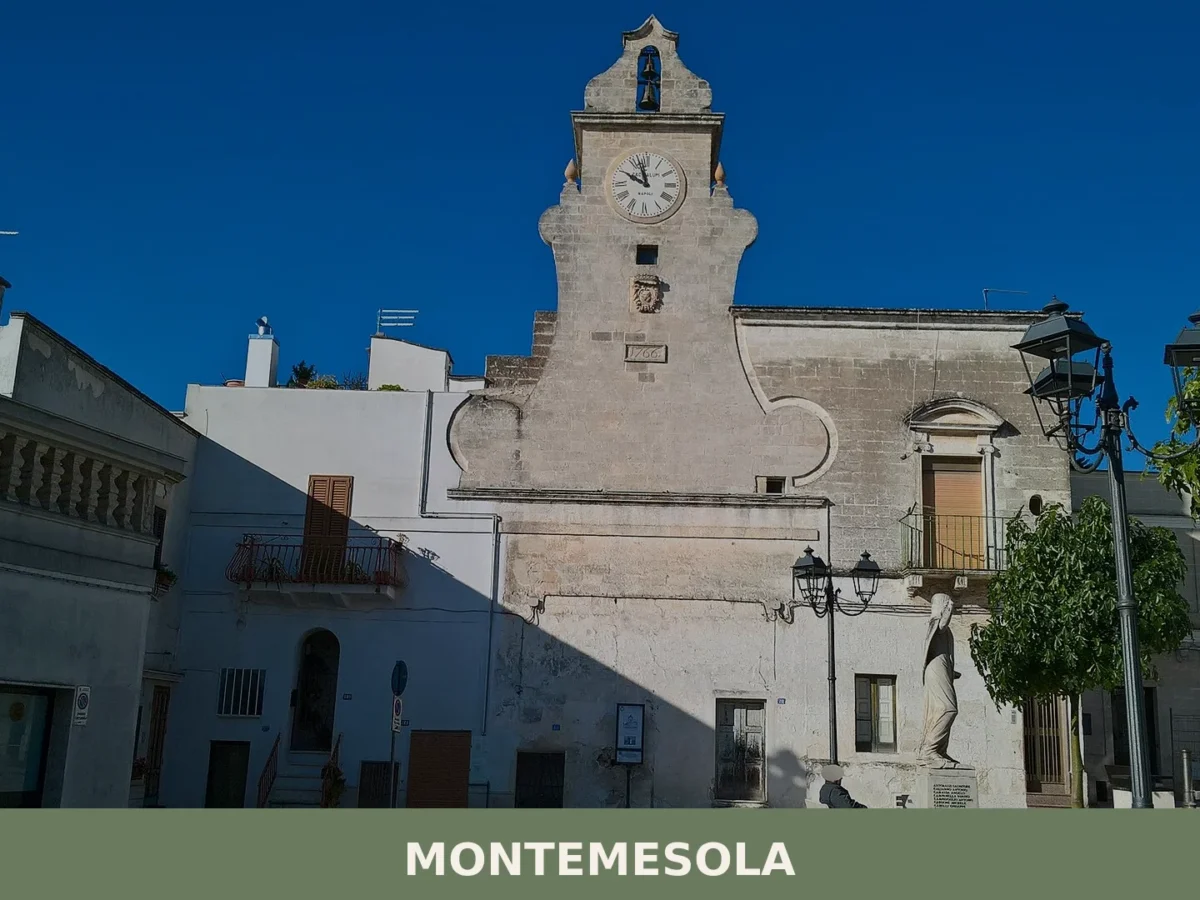
Montemesola
Plains
A hill village of 3,478 inhabitants overlooking the Taranto gulf. Explore its feudal palaces, Byzantine church heritage and agricultural traditions rooted in the Apulian hinterland.
Carapelle
Plains
what to see a Carapelle: 5 attractions, prodotti PAT e festivals patronali a 62 m s.l.m. in the province of Foggia. Scopri history, cuisine e how to get there.
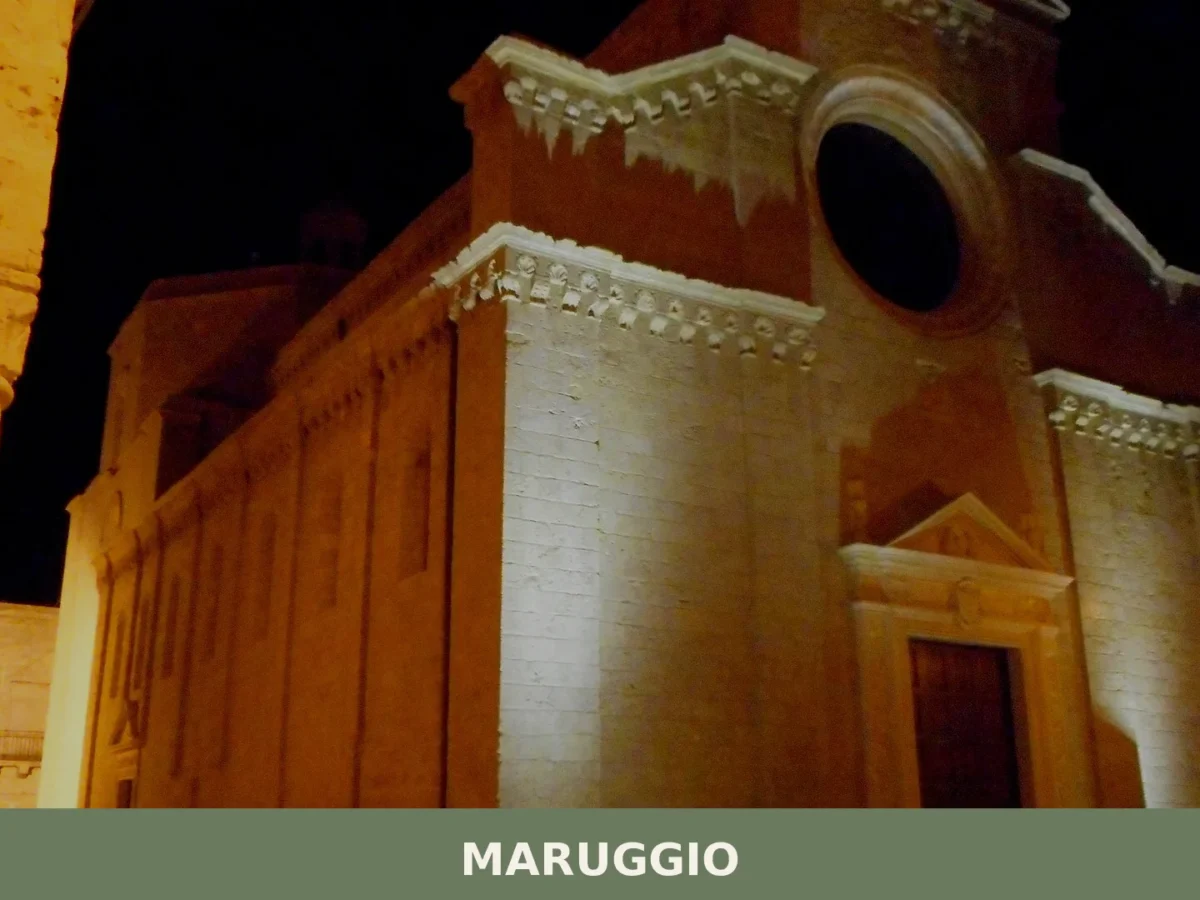
Maruggio
Sea
A 5,100-soul village in Taranto province, hidden in a natural depression and rebuilt by military monks. Medieval stone, salt ponds, Greek shipwrecks offshore.
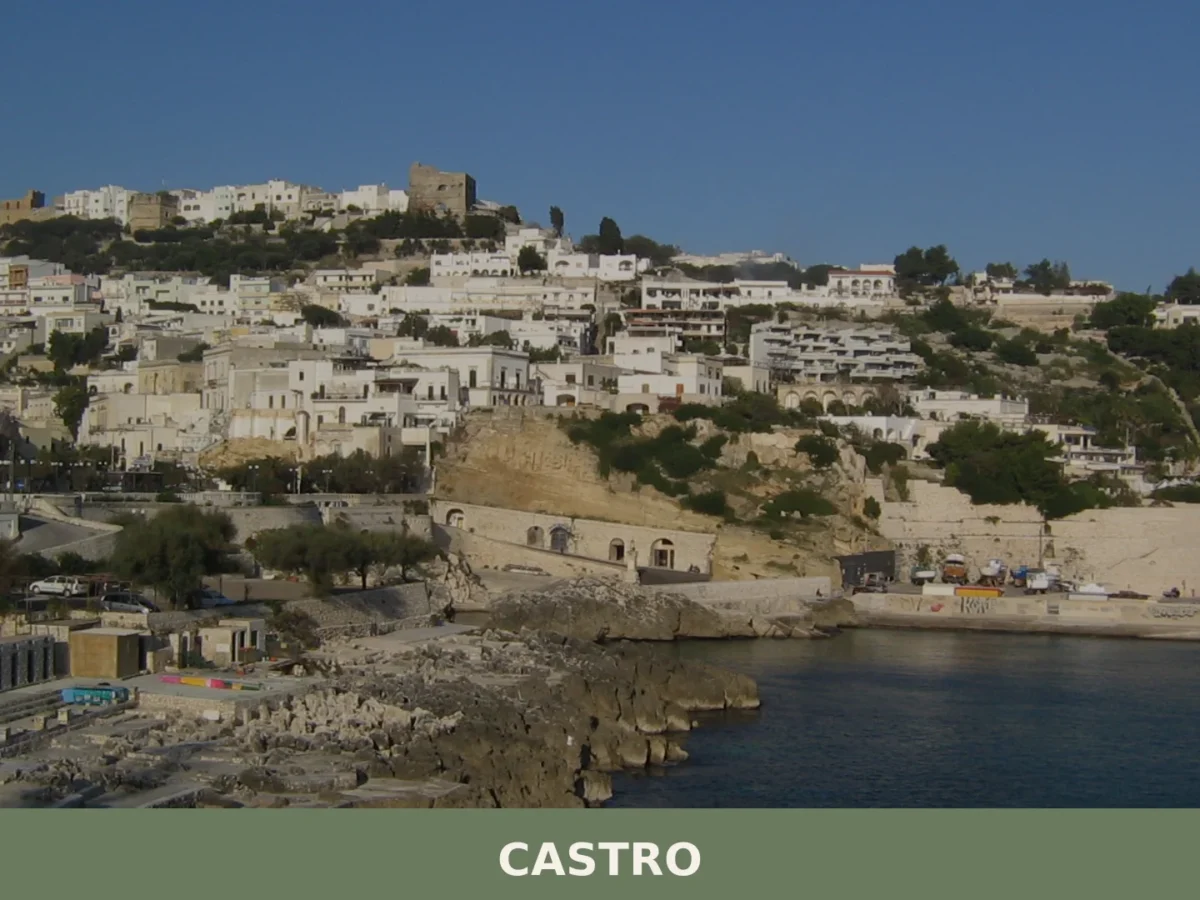
Castro
Sea
Population 2,318 on 4.44 km². Visit for the 12th-century castle, 11th-century church, and Byzantine remains overlooking the Canale d'Otranto.
Martano
Plains
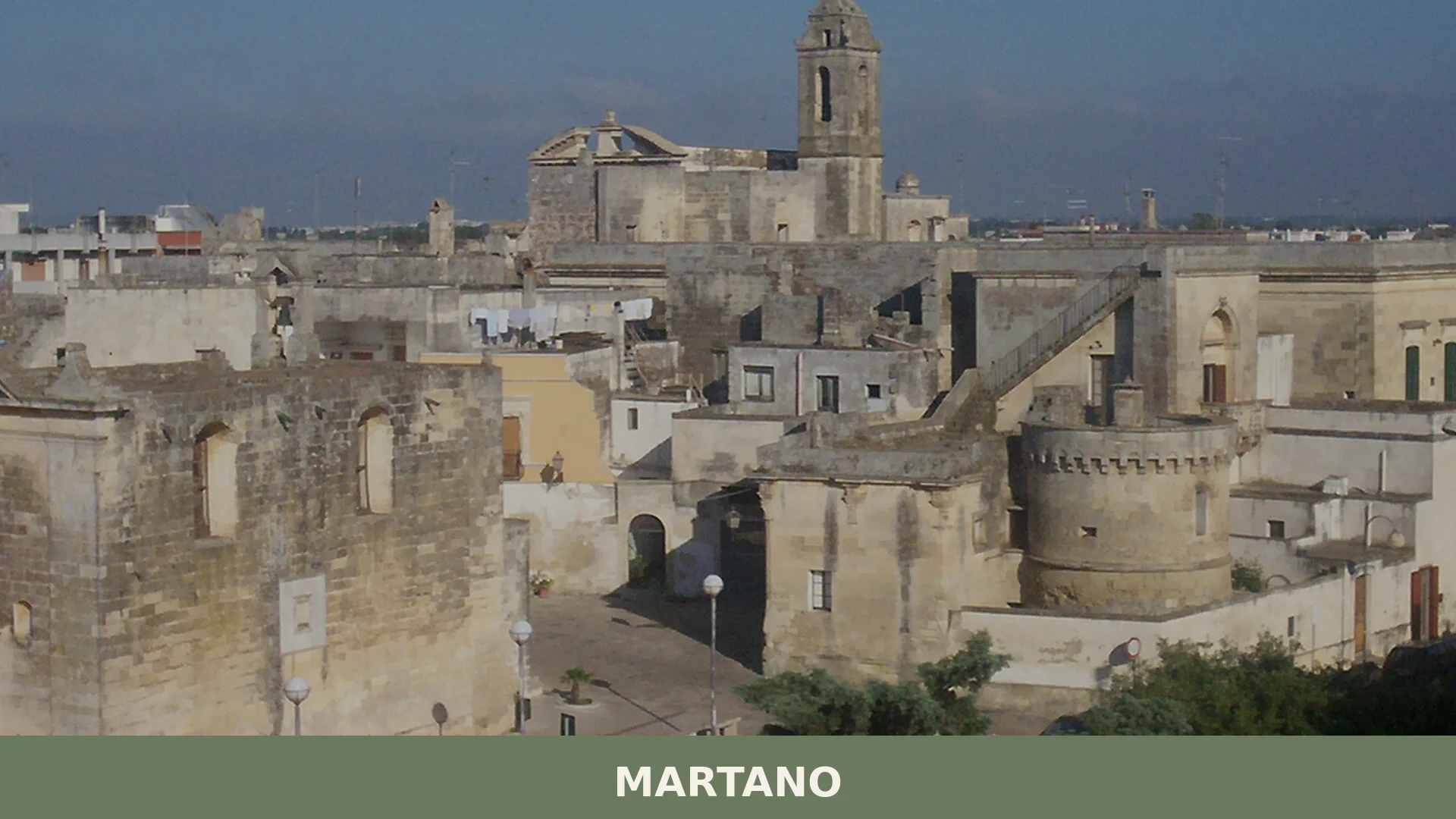
8,478 residents. A Baroque settlement rooted in Greek culture and feudal heritage, home to five centuries of religious art and an emerging aloe industry.

🏡 Know Carosino better than we do?
If you’re a local or have been there, your knowledge matters: add what’s missing or fix a detail on this page.