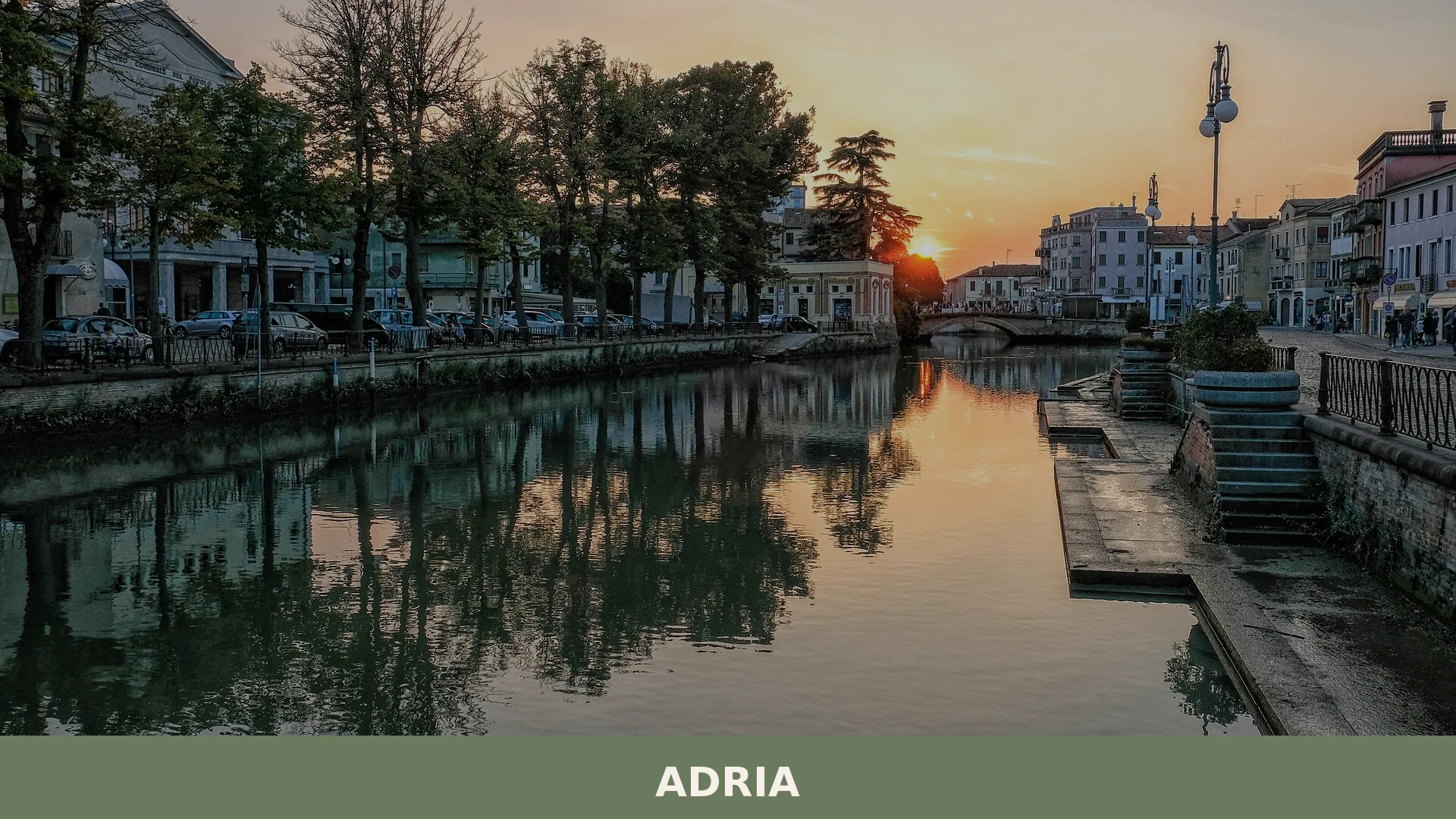
Adria sits four metres above sea level at the southern edge of Veneto, in the province of Rovigo, where the flat delta landscape dissolves into marshland and waterways. This is a town built on absence—the absence of sea, which once arrived here as merchant ships and trade routes, and the absence of solid ground, which palafitte dwellings and medieval embankments struggled to claim. Water has been Adria’s foundation, threat and identity for more than two millennia.
Adria village in Veneto holds a population of 18,787 and carries the weight of two competing histories: a port city that outlived its harbour, and a religious centre whose cathedral still anchors the townscape. Ancient Etruscan traders, Greek colonists and Venetian engineers all left their marks on the same narrow waterfront, each generation closer to the sky than the one before.
From Etruscan Settlement to Greek Colony: The Ancient Foundations
The name Adria likely derives from the Etruscan word atrium, meaning “day, light, east”—a designation for the town’s eastward position relative to the sea and the broader Etruscan heartland. In classical times, Greek geographers adopted the same root to name the upper Adriatic gulf and, eventually, the entire sea that still bears the name today.
Early settlement here took root between the 12th and 9th centuries BC, when Venetian communities built houses on stilts in the waterlogged lowlands, already distant from the sea but still within reach by river. The Rotta di Sermide in the 8th century BC shifted the Po’s course away from Adria. By the 10th century, the Villanovan culture—an Iron Age society centred around the Po valley—flourished across the region until the 6th century BC brought Etruscan dominion. At the start of the 6th century BC, Adria emerged as a proper Etruscan settlement on the Adrias river (known in Latin as the Atriano), which then flowed directly to the sea along what is now the Canal Bianco. The port prospered through the late 6th century, becoming a node in long-distance trade networks that moved amber and tin southward from the Baltic and the North, and silver and luxury goods northward in return.
In 385 BC, Dionisio I, the Sicilian Greek tyrant of Syracuse, refounded Adria as a colonial outpost as part of his aggressive expansion into the Adriatic. That same year saw the establishment of three other strategic Greek settlements: Ancona, Lissa and Alessio. Adria became the terminus of overland caravan routes descending from the Brenner Pass and the Danube, connecting the Mediterranean world to Central Europe and the Black Sea. A system of artificial canals—the Filistina—linked the town to a chain of coastal lagoons stretching north to Grado, creating a sheltered waterway for merchant vessels moving between the Aegean, Egypt and the Alpine interior.
From the 3rd century BC onwards, occupation by Celtic Gauls and the gradual silting of the delta began a slow erosion of Adria’s commercial dominance. By the 1st century AD, vessels required an artificial canal to reach the town at all.
The great river breaches of late antiquity sealed Adria’s fate as a maritime power. The catastrophic Rotta della Cucca in 589 AD reshaped the entire hydrography of the delta, isolating Adria among malaria-ridden marshes. The road network linking the region to Rome deteriorated, though the Via Popilia, later renamed the Romea, survived as a pilgrimage route to Rome.
Medieval Bishopric and Venetian Transformation
From the 5th century onwards, Adria held the status of an ecclesiastical jurisdiction, and by the 7th and 8th centuries it had become an independent episcopal fief. The bishop’s authority gradually ceded to the power of an autonomous commune, which maintained local governance until around 1250, when the Este family placed a representative—first a judge, later a viscount—to administer the territory. This arrangement persisted until the early 16th century, when Venice absorbed Adria into its mainland dominion.
During the War of Ferrara in 1482, Venetian forces attacking along the Po river attacked and sacked the city. Yet Venice’s long commitment to draining and reclaiming the Polesine valley—a project that included the dramatic cut of Porto Viro in the 17th century—gradually restored Adria’s strategic importance as a waypoint in the region’s managed waterway system.
The Napoleonic occupation of 1796 brought Adria into the Padua administrative district, and on 13 May 1797, General Giambattista Rusca, commanding the Polesine territories, seized municipal power by force, establishing a civic guard and a new local administration. The Treaty of Campoformio in the same year placed Adria under Austrian rule; in February 1798, the Habsburgs granted Adria enhanced administrative status within the Austrian territorial system. After the French victory at Marengo in June 1800, the town passed into the Cisalpine Republic, then the Italian Republic (1802–1805), and finally the Kingdom of Italy, administered as a vice-prefecture under Venice.
In 1809, resistance erupted across the Veneto against French occupation. In Adria, the priest Carolo Giocoli, based at Bellombra, led a revolt that culminated on the night of 8–9 July with the storming of the local prison, seizure of weapons and systematic arson and pillage. French repression was swift and severe. Giocoli, captured near Ferrara, received a sentence of hard labour for life. The Napoleonic era, despite its violence, introduced lasting reforms: public elementary schools, secular administration and modern civil law.
Following Austria’s restoration in 1815, Adria became part of the Kingdom of Lombardy–Venetia under the Prefect of Rovigo. Habsburg administrators built new roads, drained urban waterlogged areas, reinforced bridges and opened the theatre (1816), hospital (1844) and retirement home (1852). In January 1819, a Carbonari cell was discovered in nearby Fratta, with members from Adria among its ranks. The revolutionary wave of 1848 brought anti-Austrian uprising and a brief period of local autonomy under a district committee until 26 May. After the First War of Independence ended in defeat, political repression intensified across the region. Three Adria citizens enlisted in Giuseppe Garibaldi’s Thousand and rose to civic prominence after the Veneto’s annexation to Italy in 1866.
In the 1920s, Adria absorbed the communes of Bottrighe and Ca’ Emo, increasing its administrative footprint. During the Fascist period (1940–1943), Adria served as a civilian internment camp, confining 17 foreign Jewish refugees who had arrived from Slovenia; two were granted emigration permits in March 1942. The remainder fled after September 1943, seeking refuge in Switzerland, southern Italy or clandestine existence. One deportee from Adria, arrested in Fiume in November 1943, perished at Auschwitz. In November 1951, a breach of the Po inundated Adria, submerging homes and forcing many families to relocate to the interior Polesine, Lombardy or overseas destinations including Canada and Australia.
The Cathedral and Religious Heritage
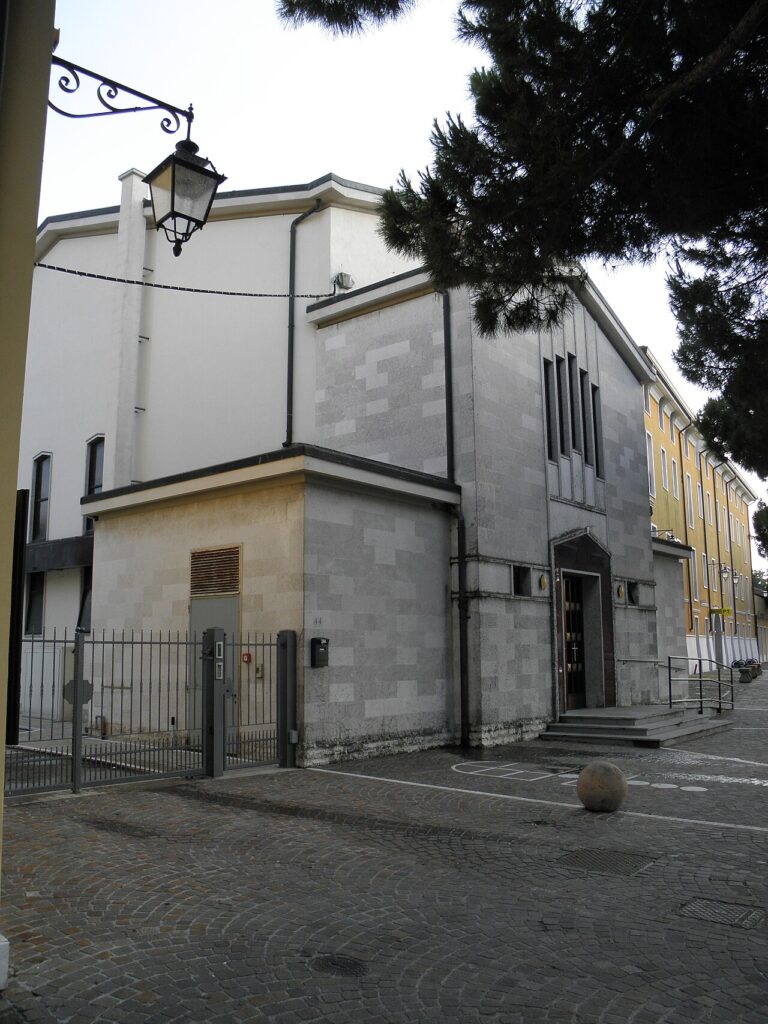
The Cathedral of Saints Peter and Paul stands as the seat of the Diocese of Adria–Rovigo, though the bishop resides in Rovigo at the co-cathedral. Its presence in the town centre reflects Adria’s ecclesiastical importance across medieval and early modern centuries.
The Basilica of Santa Maria Assunta, also known as the Church of Santa Maria Assunta della Tomba, underwent multiple reconstructions and assumed its current form in 1718. Local tradition holds that the former bell tower, demolished in 1928, once stood upon a beacon of the ancient Roman harbour. A third-century marble stone embedded in the tower’s base bore a Latin inscription identifying it as the ruin of the north-west corner of the old Roman Adriatic lighthouse. The basilica houses an octagonal baptismal font from the 7th or 8th century, inscribed with the name of Bono, Adria’s third bishop. Inside are 15th and 16th-century paintings and a terracotta relief of the Virgin’s Dormition. The basilica holds the dignity of a minor basilica.
The Old Cathedral of San Giovanni, dating to approximately the 11th century, stands to the left of the newer cathedral with its apse facing west—reversed from its original orientation due to the newer building constructed against it. A 1930s replica of the Grotto of Lourdes adorns its rear. Inside, a stucco relief by the Bolognese sculptor Gaetano Samoggia depicts the Baptism of Christ flanked by medallions of the four Evangelists. The walls display a chronological succession of Adria’s bishops with their coats of arms. Below lies a semicircular crypt, possibly dating to the 5th or 6th century, decorated with frescoes in Byzantine style representing the Apostles—evidence of early Christian presence beneath the later medieval structure.
The Waterway Landscape and Local Identity
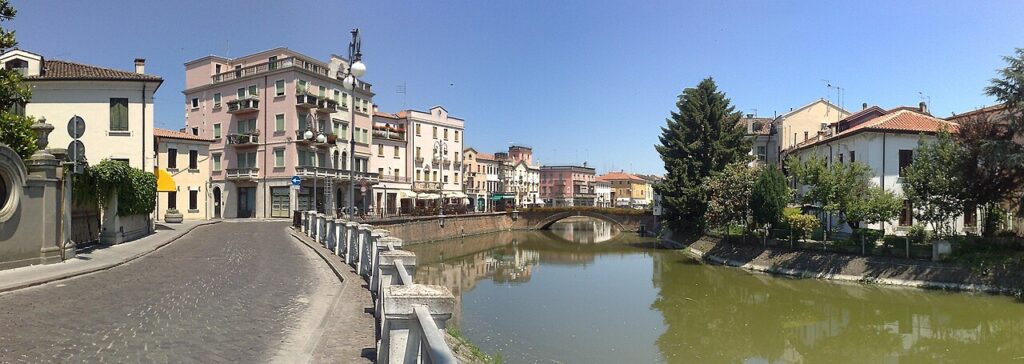
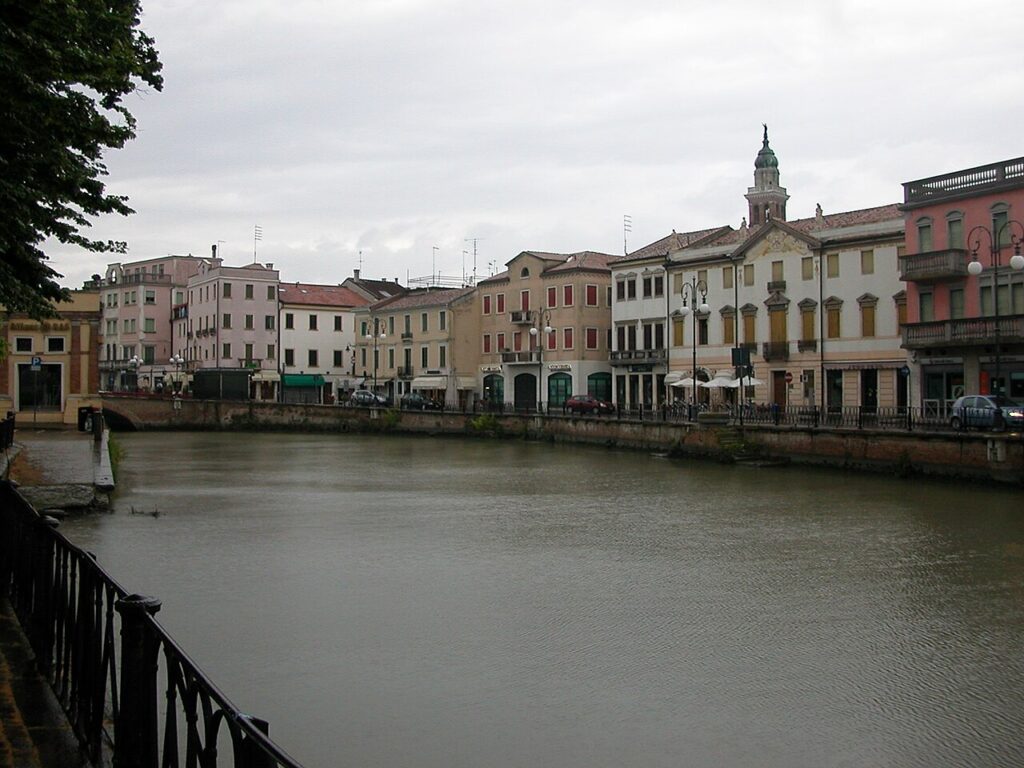
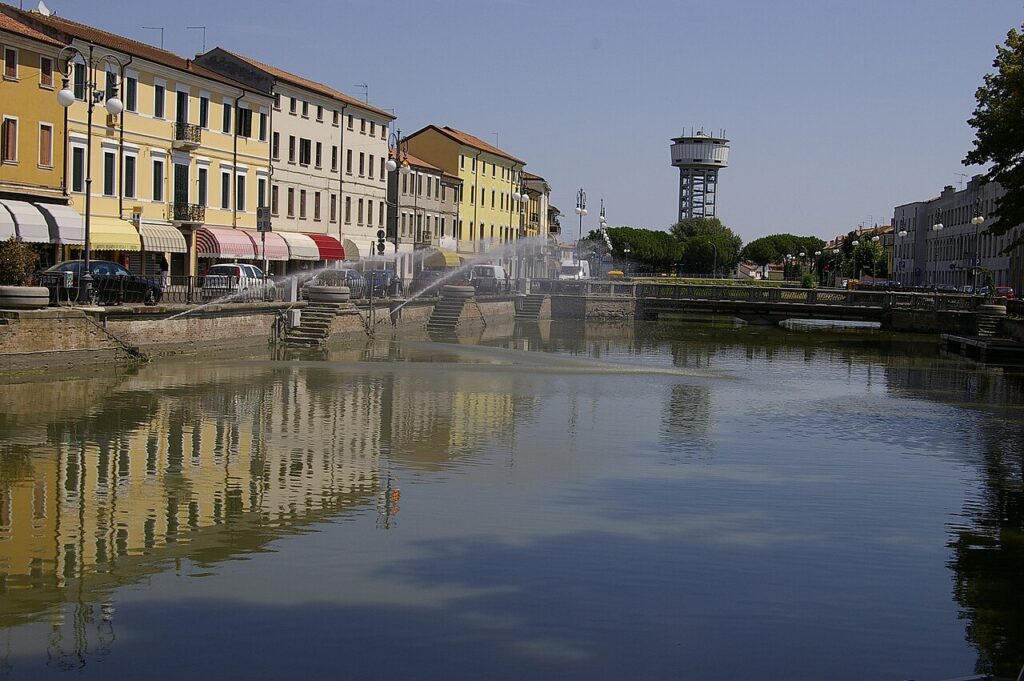
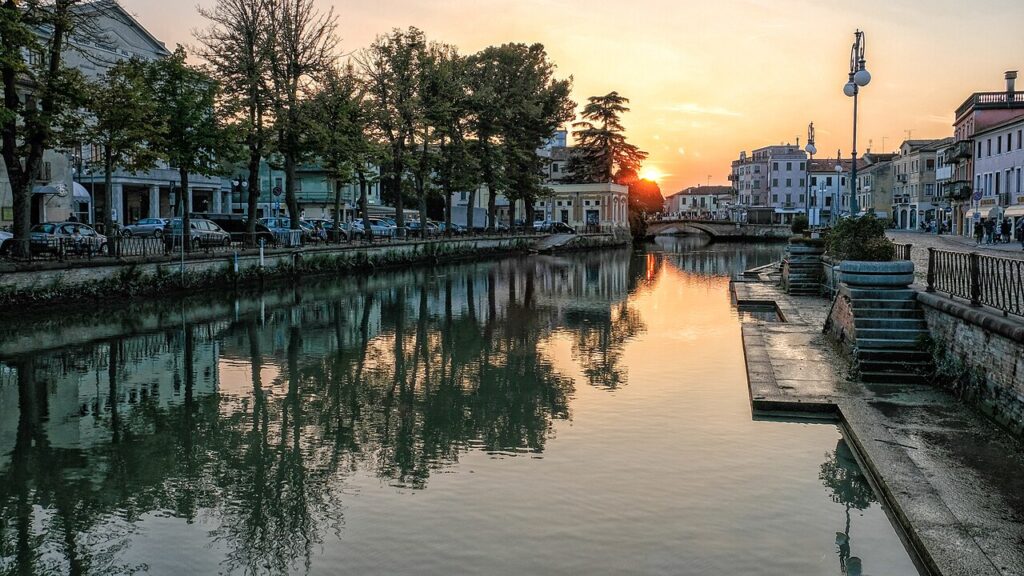
Adria’s identity rests on water as much as stone. The Canal Bianco follows the course of the ancient Adrias river, a thread connecting the Etruscan port to the modern town. The delta landscape—marshes, embankments, artificial canals—speaks to centuries of human effort to hold back water and claim inhabitable space. Unlike Venetian lagoon towns, Adria never embraced the water; instead, it endured it, drained it and learned to live above it.
The town’s patron saint is San Bellino, whose feast anchors the local religious calendar. The municipal coat of arms was officially recognised in a decree dated 22 May 1931; the standard (gonfalone) was granted by royal decree on 28 August 1930.
The regional agricultural wealth surrounding Adria connects the town to broader Polesine production networks. The Riso del Delta del Po (Delta of the Po Rice) holds IGP status, as does the Cozza di Scardovari (Scardovari Mussel), harvested from the northern lagoons. Nearby, the Radicchio di Chioggia (Chioggia Red Radicchio) represents the vegetable farming heritage of the lowlands. These products—rooted in the specific hydrology and soil of the region—are not confined to Adria but reflect the territorial identity that the town shares with its province.
Visiting Adria: Season, Access and Practicalities
Adria is reachable by car from Rovigo, the provincial capital, via state route SS16. The town sits at the intersection of regional roads linking the interior Polesine to the Venetian lagoon. The flatness of the landscape and the network of rural roads make cycling a natural way to explore the surrounding delta. Spring and autumn offer the most comfortable conditions for walking the town centre and visiting its churches; summer brings crowds but also clearer light for photography, while winter’s fog and dampness reflect the region’s hydrological character.
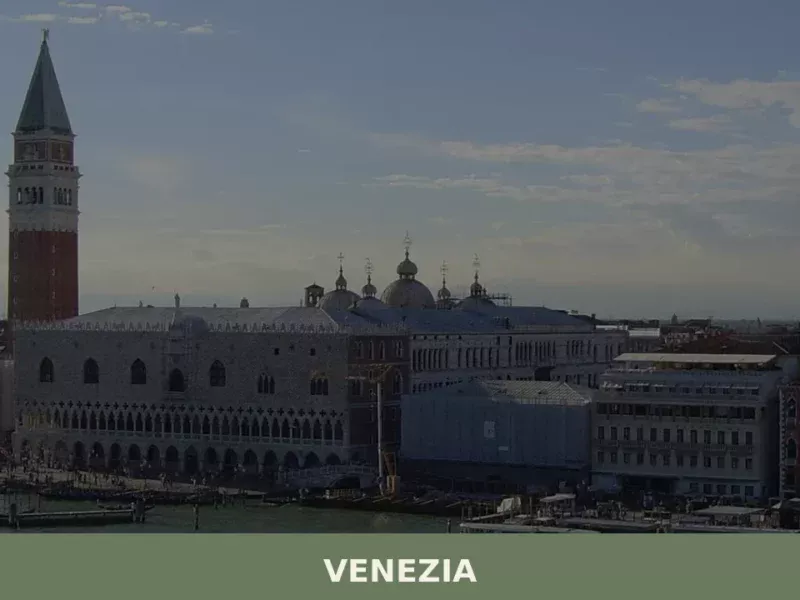
The nearest major airports are Venice Marco Polo (approximately 130 km north) and Bologna Marconi (approximately 85 km south-west). Regional train service connects Rovigo to the national rail network; from there, local buses and taxis serve Adria. Visitors exploring the broader Veneto can combine a visit to Adria with nearby Padova (a university city with Renaissance frescoes) or Venezia (the lagoon capital) as part of a longer regional itinerary.
| Departure Point | Distance (km) | Estimated Time |
|---|---|---|
| Rovigo | 30 | 35 minutes by car |
| Padova | 75 | 1 hour 15 minutes by car |
| Venezia (Marco Polo Airport) | 130 | 1 hour 45 minutes by car |
| Bologna | 85 | 1 hour 20 minutes by car |
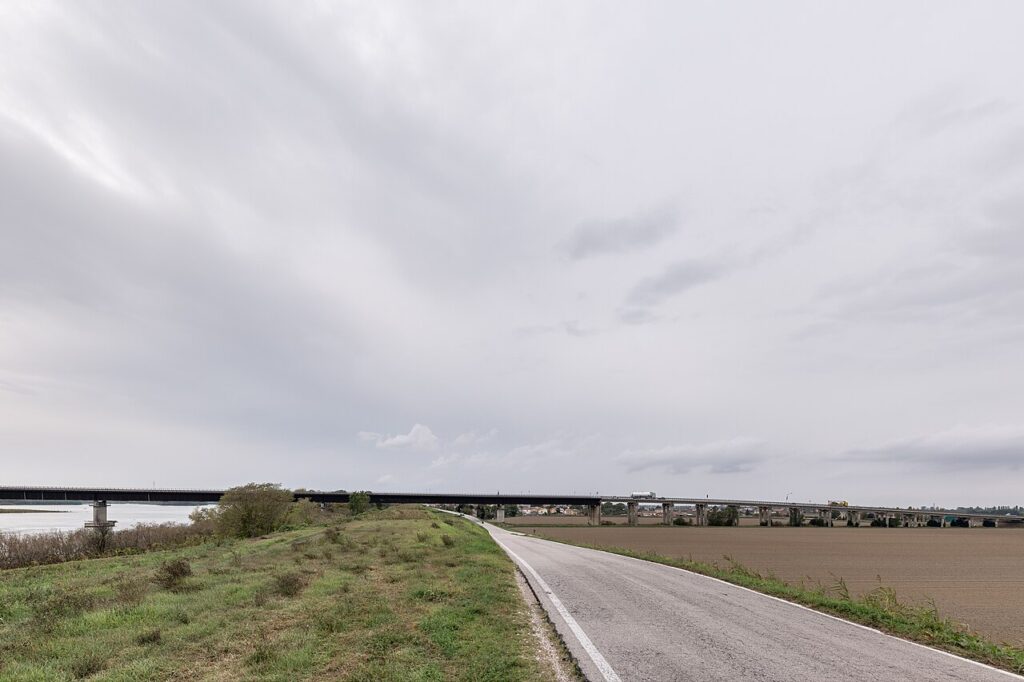
The town’s compact centre can be explored on foot in a few hours. Allow time to visit the cathedral and basilica interiors, examine the baptismal fonts and Byzantine frescoes, and walk the perimeter of the old town to sense the layout of medieval streets. The Polesine countryside beyond the town boundary rewards cyclists and drivers willing to venture into the flat agricultural hinterland, where embankments and canals create an unfamiliar but historically coherent landscape.
For those interested in broader Veneto culture and history, Adria functions as a stepping stone to understanding how lagoon settlements, river systems and episcopal authority shaped the region. It is not a tourist destination in the conventional sense, but rather a place where historical depth and geographical humility intersect.


 Mountain