


Barberino Val d’Elsa
 Plains
The grey sandstone stones of the Palazzo Pretorio still bear the coats of arms of the Florentine families entrusted with governing this medieval outpost: a register carved in stone that tells six centuries of political domination without the need to open a single archive. In this article History and origins of Barberino Val d’Elsa What […]
Discover Barberino Val d’Elsa
The grey sandstone stones of the Palazzo Pretorio still bear the coats of arms of the Florentine families entrusted with governing this medieval outpost: a register carved in stone that tells six centuries of political domination without the need to open a single archive.
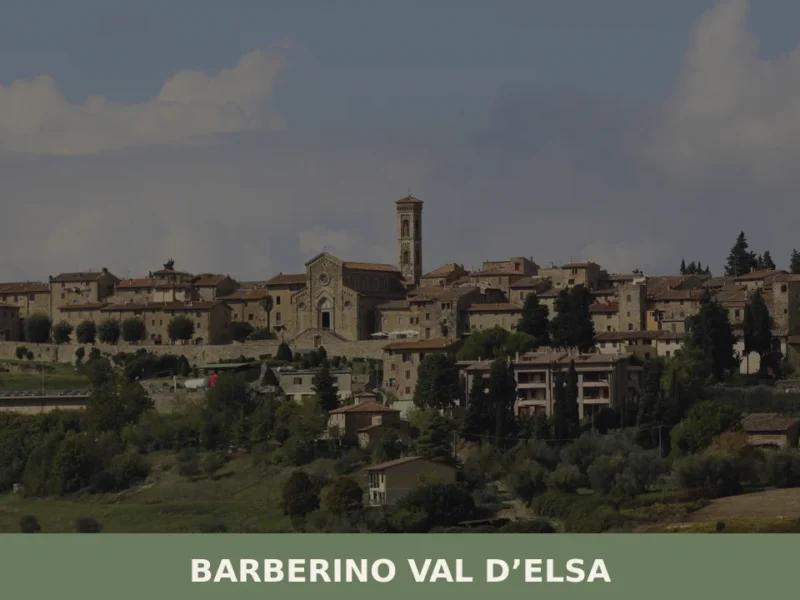
The village rises along a hillside ridge between the Val d’Elsa and Chianti, in that stretch of Tuscan territory where Roman roads give way to the routes of the Via Francigena and watchtowers once marked the distance between Florence and Siena.
What to see in Barberino Val d’Elsa is a question that finds a concrete answer as early as the first walk around the town walls, which stretch for approximately 500 metres and are still legible in their original structure.
A hamlet of the municipality of Barberino Tavarnelle, in the metropolitan city of Florence, the village offers visitors a compact historic centre featuring the Palazzo Pretorio, the Propositura di San Bartolomeo, the fourteenth-century walls, the Porta Senese and the remains of the Florentine defensive system.
Those who arrive with the aim of understanding how a walled Tuscan village of the fourteenth century functioned will find here one of the best-preserved architectural sequences in the Valdelsa.
History and origins of Barberino Val d’Elsa
The name Barberino appears in medieval documents in reference to the Barberini family, who controlled this territory before the Florentine expansion southward. The village’s position, on a ridge overlooking the confluence of several secondary valleys into the Elsa, made it a natural control point along the routes between Florence and Siena. The Via Francigena, which connected Canterbury to Rome through Tuscany, passed through this area and for centuries shaped the economic and demographic profile of the villages of the Valdelsa.
During the fourteenth century, Florence extended its dominion over this territory and had the defensive structures of the village built or reinforced, including the walls and the Palazzo Pretorio, intended to house the Florentine podestà.
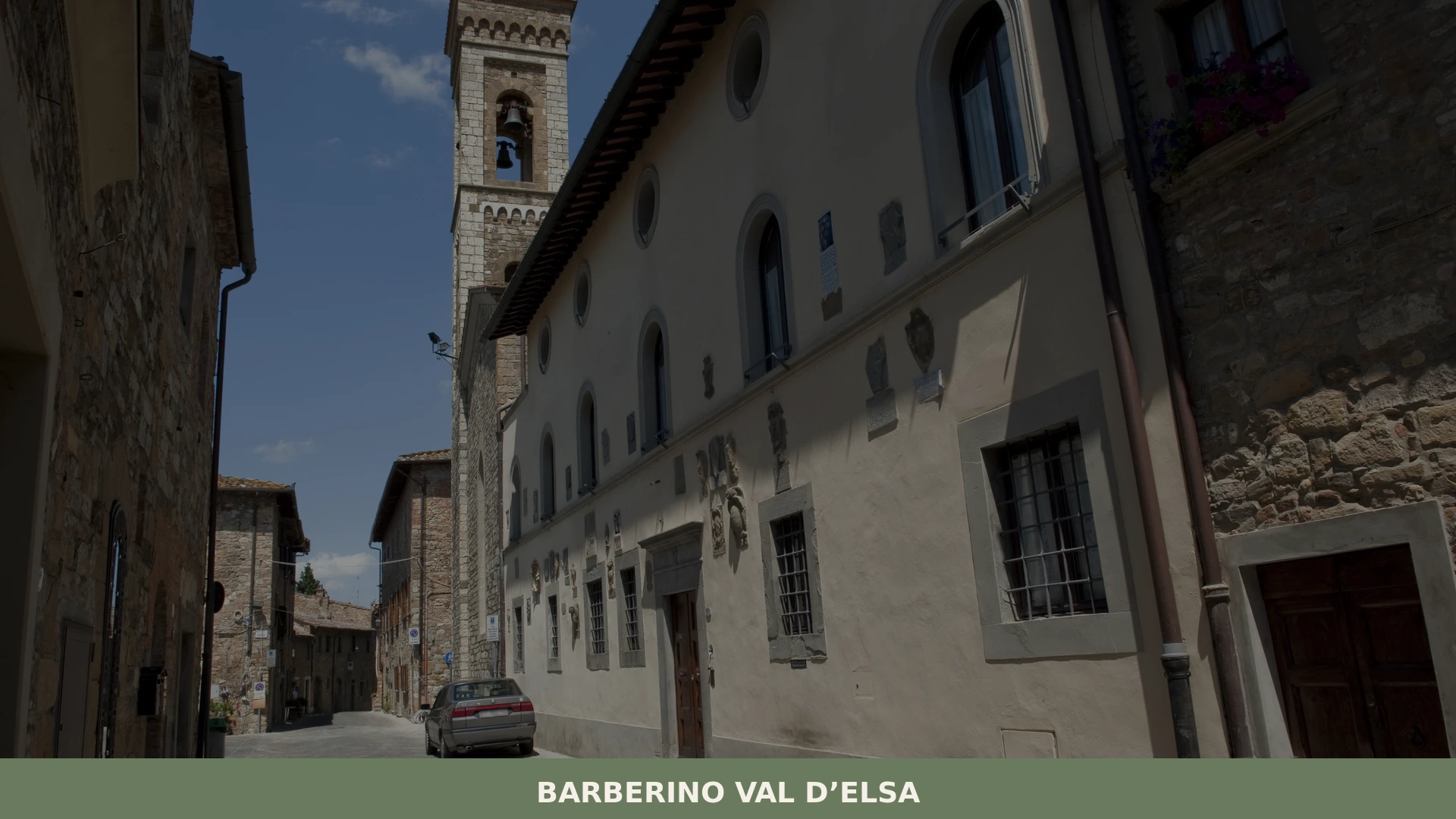
The stone and terracotta coats of arms embedded in the façade of the palace document the succession of podestàs and families who administered Barberino on behalf of Florence.
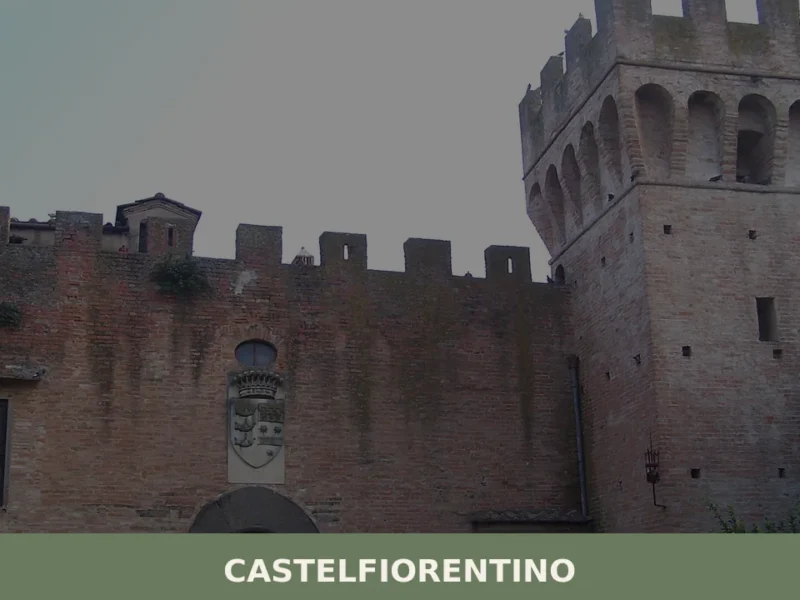
This system of administrative control through officials sent from the dominant city was widespread throughout communal Tuscany and left homogeneous architectural traces in many villages across the region, as can also be recognised when visiting Castelfiorentino, which shares with Barberino the same history of Florentine domination along the course of the Elsa.
Between the fifteenth and sixteenth centuries the village maintained its function as a territorial garrison without undergoing radical transformations, which partly explains the compactness of the urban fabric still visible today.
After the Unification of Italy, the municipality of Barberino Val d’Elsa remained autonomous for over a century, until the administrative reform of 2019, when it was merged with the municipality of Tavarnelle Val di Pesa to form the new municipality of Barberino Tavarnelle.
From that moment, Barberino Val d’Elsa officially became a hamlet, while retaining its intact historic centre and its own urban identity.
What to See in Barberino Val d’Elsa: Main Attractions
Palazzo Pretorio
The façade of the Palazzo Pretorio is a surface dense with historical information: rows of coats of arms in pietra serena and terracotta are layered across multiple registers, each corresponding to a podestà sent by Florence to govern the village. The building dates back to the 14th century and represents the main civic monument of the historic centre.
Its architectural structure reflects the model of the podestà’s palace widespread in Tuscan municipalities of the time: a compact body, local materials, and measured openings. Standing before the façade, one can read the stylistic changes in the coats of arms over time, from the older Gothic forms to the Renaissance solutions introduced in the 15th century.
The building overlooks the main square of the village, which serves as the natural point of reference for orienting oneself within the historic centre.
Medieval Walls and Defensive System
The circuit of walls of Barberino Val d’Elsa extends for approximately 500 metres and preserves significant sections of the original 14th-century structure.
The walls were built or reinforced during the period of Florentine control, with the aim of making the village a reliable defensive stronghold along the route towards Siena. The materials used are local sandstone and lime, with construction techniques following the military standards of the time.
Walking along the outer perimeter, the successive construction phases become distinguishable: the oldest sections display more irregular masonry, while later additions show greater regularity in the courses.
The system includes corner towers and the layout of the town gates, of which the Porta Senese is the most recognisable.
Porta Senese
The Porta Senese is the main entrance to the village from the southern side and takes its name from the road that led towards Siena, partly following the route of the Via Francigena. The sandstone arch retains the grooves of the hinges and the marks of medieval closing systems — technical details that convey the defensive function of the gateway with a precision no interpretive panel could match.
The gate forms part of the continuous circuit of walls and constitutes one of the two main entrances to the historic centre. Those who enter through the Porta Senese cross a threshold that for centuries marked the boundary between the countryside and the protected urban space, with all that this distinction implied in terms of taxes, control, and security in medieval Tuscany.
Propositura di San Bartolomeo
The Propositura di San Bartolomeo is the main church of the village and occupies a central position within the urban fabric of the historic centre.
The dedication to Saint Bartholomew the Apostle is documented in medieval ecclesiastical records and connects the building to the network of parish churches and dependent churches under the diocese of Florence that structured religious life in the Tuscan countryside.
The interior preserves decorative elements and works of art datable to various historical phases, allowing one to visually trace the evolution of taste and local patronage from the Middle Ages through the early modern period.
The sandstone façade reflects the architectural sobriety typical of rural Tuscan churches, where ornamentation was subordinate to structural solidity and liturgical functionality.
The church can be reached on foot within a few minutes from the central square.
Historic Centre and Medieval Urban Layout
The historic centre of Barberino Val d’Elsa has preserved its medieval urban layout sufficiently intact to allow the reading of the original settlement logic. The main streets follow the longitudinal axis of the hilltop ridge, with shorter transverse streets descending towards the walls on both sides.
This herringbone structure is common to villages founded or expanded during the communal era on hillside ridges, and responds to criteria of defensibility and management of interior space.
Residential buildings in many cases retain their original proportions, with narrow frontages and vertical development that optimised land use within the walled perimeter.
Exploring the historic centre on foot, without a predetermined destination, allows one to appreciate the constructive details that the most careful restoration works have preserved: stone corbels, carved door jambs, and traces of bricked-up openings.
Typical cuisine and products of Barberino Val d’Elsa
The territory of Barberino Val d’Elsa lies within that geographical belt where the gastronomic tradition of the Valdelsa overlaps with that of Chianti, two areas that share a central focus on unsalted bread, extra virgin olive oil and quality meat. The peasant cuisine of this area has historically been based on the integral reuse of ingredients and slow cooking, techniques born out of domestic economy logic that produce dishes of great concentrated flavour.
The proximity to Florence has always guaranteed these villages access to city markets, with consequences for the availability of ingredients and the diversification of the local diet.
Among the dishes belonging to the tradition of this area, ribollita holds a central place: a soup of stale bread, black cabbage, cannellini beans and seasonal vegetables, cooked the day before and reheated the following day — hence the name.
Pane sciocco, that is, Tuscan unsalted bread, is the base ingredient of many local preparations, from ribollita to the summer panzanella, which combines bread soaked in water and vinegar with tomatoes, onion, basil and olive oil.
The bistecca alla fiorentina, a T-bone cut from a young steer or heifer of the Chianina breed, features on the tables of this area thanks to its proximity to the Val di Chiana and to the Tuscan livestock-rearing tradition.
The extra virgin olive oil produced in the Valdelsa has been one of the key ingredients of local cuisine for centuries.
Olive trees grow on the hillside slopes between 200 and 400 metres above sea level and yield olives with organoleptic characteristics linked to the Frantoio and Moraiolo varieties, widespread throughout central Tuscany.
The wine of the area falls within the Chianti production zone, a denomination covering a vast territory between Florence and Siena that includes the surrounding hill vineyards.
Those wishing to explore what to see in Barberino Val d’Elsa through its local gastronomy may find similar points of interest by also visiting Filattiera, a village in Lunigiana where the tradition of bread and legumes has equally deep roots in the Tuscan countryside.
Local markets and village festivals represent the most direct opportunities to come into contact with the area’s products.
The autumn season, between October and November, is the time of the olive harvest and grape harvest, moments when the territory is at its most active and fresh products are available at the oil mills and cellars of the area.
For up-to-date information on local events and markets, the most reliable reference is the official website of the Municipality of Barberino Tavarnelle.
Festivals, events and traditions of Barberino Val d’Elsa
The village’s patron saint festival is connected to the Apostle Saint Bartholomew, to whom the main Collegiate Church is dedicated.
The liturgical feast of Saint Bartholomew falls on 24 August and has historically marked the civil and religious calendar of the village, with celebrations including a solemn mass and processions through the historic centre.
As in many Tuscan villages of similar size, the patron saint festival was also the occasion for fairs and seasonal markets, which attracted inhabitants from neighbouring municipalities and represented a moment of economic exchange as well as devotion.
The summer calendar of the Valdelsa includes food festivals and events in the municipalities of the area, often concentrated between June and September, when the flow of visitors is at its highest and the weather conditions are favourable for outdoor events.
Barberino Val d’Elsa, despite its modest size as a hamlet, participates in this shared system of events with the villages of the municipality of Barberino Tavarnelle. For the updated programme of local events, check directly with the Municipality or the tourist portals of the Metropolitan City of Florence, as dates and formats may vary from year to year.
When to Visit Barberino Val d’Elsa and How to Get There
The best time to visit Barberino Val d’Elsa is spring, between April and June, when the surrounding hills are covered in vegetation and temperatures allow visitors to walk along the town walls and through the historic centre streets without discomfort. Autumn, between September and November, offers similar conditions with the added advantage of the grape harvest and olive picking, which bring the area to life.
Summer concentrates the highest number of visitors across all of Tuscany, resulting in increased traffic on provincial roads and greater crowds in the most well-known villages in the area.
Winter is the quietest period, suited to those seeking a visit without crowds, bearing in mind that some accommodation and dining establishments may reduce their opening hours.
Those arriving by car from the direction of Florence can take the Via Chiantigiana state road or use the A1 motorway, exiting at Firenze Certosa or Incisa-Reggello depending on the section, then continuing along provincial roads towards Barberino Tavarnelle.
From Siena, the most direct route follows the SS2 Cassia as far as Poggibonsi, then provincial roads heading north.
The nearest railway station is Poggibonsi-San Gimignano, served by the Empoli–Siena line, approximately 10 kilometres from the village. The main reference airport is Florence Peretola Airport, approximately 40 kilometres away, reachable in under an hour under normal traffic conditions. For those travelling from Pisa, Galileo Galilei Airport is approximately 90 kilometres away.
| Starting Point | Distance | Estimated Time |
|---|---|---|
| Florence (city centre) | approx. 35 km | 40–50 minutes |
| Siena (city centre) | approx. 35 km | 35–45 minutes |
| Florence Peretola Airport | approx. 40 km | 45–55 minutes |
| Poggibonsi-San Gimignano Railway Station | approx. 10 km | 15 minutes |
Those planning a broader itinerary through northern Tuscany may consider a stop at Bagni di Lucca, a village in the province of Lucca reachable in approximately two hours, which offers a landscape and architectural setting very different from that of the Valdelsa — ideal for those wishing to extend their visit towards Apennine Tuscany.
Likewise, Podenzana, in the Lunigiana area, represents a further option for those wishing to discover small Tuscan medieval villages with settlement characteristics similar to those found when exploring what to see in Barberino Val d’Elsa.
Photo Gallery of Barberino Val d’Elsa
Do you have photos of Barberino Val d’Elsa?
Share your photos of the village: the best ones will be added to the official gallery, with your credit.
Send your photosFrequently asked questions about Barberino Val d’Elsa
What is the best time to visit Barberino Val d'Elsa?
The ideal time to visit Barberino Val d'Elsa is during spring (April-May) and early autumn (September-October). These months offer pleasant temperatures perfect for exploring the historic center, walking along the medieval walls, and enjoying the Chianti landscape. During late summer, specifically on August 24th, visitors can experience the local celebrations for San Bartolomeo, the patron saint, adding a traditional touch to their visit. Avoid peak summer months (July-August) if you prefer milder weather for outdoor activities, though the village's altitude provides some relief.
What are the historical origins of Barberino Val d'Elsa?
Barberino Val d'Elsa's origins trace back to medieval times, with its name linked to the Barberini family who held influence before Florentine expansion. Its strategic position on a ridge between the Val d'Elsa and Chianti, along routes like the Via Francigena, made it a crucial outpost. Florence fortified the village in the 14th century, building structures like the Palazzo Pretorio to house its podestà. This long history of Florentine domination shaped its architecture and urban identity. In 2019, it became a hamlet within the new municipality of Barberino Tavarnelle, preserving its historical core.
What to see in Barberino Val d'Elsa? Main monuments and landmarks
In Barberino Val d'Elsa, begin with a stroll through the compact Historic Centre, admiring its well-preserved medieval urban layout. Key landmarks include the Palazzo Pretorio, a 14th-century civic monument featuring numerous Florentine coats of arms on its façade, located on the main square. Explore the impressive Medieval Walls, extending for 500 meters, and pass through the historic Porta Senese, the main southern entrance. Don't miss the Propositura di San Bartolomeo, the village's main church, which offers a glimpse into local religious history and art. All these sites are easily accessible on foot within the village.
What are the main natural or scenic attractions of Barberino Val d'Elsa?
Barberino Val d'Elsa offers scenic views of the surrounding Tuscan landscape, situated on a hillside ridge between the Val d'Elsa and the famous Chianti region. The rolling hills, dotted with olive groves and vineyards characteristic of the Chianti production zone, provide a picturesque backdrop. Visitors can enjoy panoramic vistas from various points within and around the village, appreciating the natural beauty of central Tuscany. While there are no specific natural parks or documented trails mentioned, the entire area invites exploration of its rural charm and quintessential Tuscan scenery.
Where to take the best photos in Barberino Val d'Elsa?
For stunning photographs in Barberino Val d'Elsa, focus on the unique architectural details of the historic center. The façade of the Palazzo Pretorio, adorned with centuries of Florentine coats of arms, offers a rich historical backdrop. Capture the preserved Medieval Walls and the ancient Porta Senese, which provide evocative glimpses into the village's defensive past. Wandering through the compact historic center, look for charming alleys, stone corbels, and carved door jambs. Additionally, the village's elevated position provides picturesque panoramic views of the surrounding Val d'Elsa and Chianti hills, especially at sunrise or sunset.
Are there museums, churches or historic buildings to visit in Barberino Val d'Elsa?
Yes, Barberino Val d'Elsa features several significant historic buildings and a prominent church. The main attractions include the Palazzo Pretorio, a 14th-century civic building notable for its façade covered in Florentine coats of arms. The Propositura di San Bartolomeo serves as the village's main church, dedicated to the patron saint, and contains various historical artworks. Visitors can also explore the well-preserved Medieval Walls and the Porta Senese, which are integral parts of the village's defensive heritage. The entire historic center itself, with its medieval urban layout, offers a captivating journey through time.
What can you do in Barberino Val d'Elsa? Activities and experiences
In Barberino Val d'Elsa, visitors can immerse themselves in medieval history by walking the 500-meter circuit of the ancient walls and exploring the compact historic center, including the Palazzo Pretorio and Porta Senese. A key experience is indulging in the local gastronomy, sampling traditional dishes like ribollita, panzanella, and bistecca alla fiorentina, paired with local Chianti wine and extra virgin olive oil. Don't miss the opportunity to taste the distinct unsalted Tuscan bread, pane sciocco. If visiting on August 24th, you can participate in the traditional celebrations for the patron saint, San Bartolomeo.
Who is Barberino Val d'Elsa suitable for? Families, couples, hikers, solo travelers?
Barberino Val d'Elsa is ideal for travelers seeking an authentic and tranquil Tuscan experience, particularly those interested in medieval history, architecture, and local culture. It's perfect for couples looking for a romantic escape, solo travelers desiring peaceful exploration, and families who appreciate historical sites and gentle walks through charming villages. Food and wine enthusiasts will also find it appealing due to its rich gastronomic tradition within the Valdelsa and Chianti regions. Its well-preserved historic center offers a captivating journey back in time, away from the more crowded tourist hubs.
What to eat in Barberino Val d'Elsa? Local products and specialties
In Barberino Val d'Elsa, the local cuisine reflects the rich traditions of both Valdelsa and Chianti. Must-try specialties include ribollita, a hearty vegetable and stale bread soup, and panzanella, a refreshing summer salad made with soaked unsalted bread, tomatoes, and basil. The iconic bistecca alla fiorentina, a thick-cut T-bone steak, is also a staple. Accompany your meal with the renowned local extra virgin olive oil, typically from Frantoio and Moraiolo varieties, and a glass of Chianti wine, as the village is within this famous production zone. Don't forget to savor the simple yet essential pane sciocco, the traditional Tuscan unsalted bread.
📷 Photo Gallery — Barberino Val d’Elsa
Getting there
Via Cassia, 50021 Barberino Val d'Elsa (FI)
Nearby Villages near Barberino Val d’Elsa
 Mountain

🏡 Know Barberino Val d’Elsa better than we do?
If you’re a local or have been there, your knowledge matters: add what’s missing or fix a detail on this page.