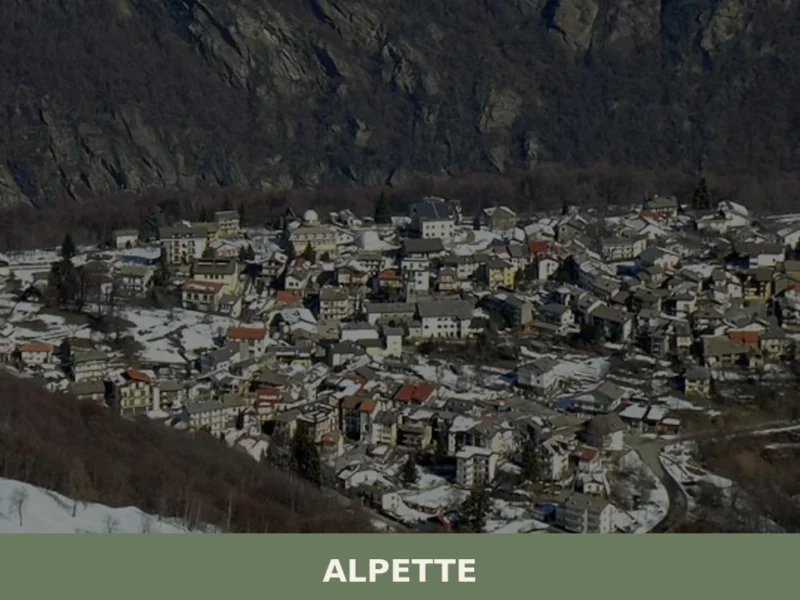
Stone walls rise from the slope behind the village, fragmentary and severe. The Rocca Canavese castle, reduced to perimeter ruins after three centuries of warfare, bombardment and abandonment, still commands the valley. Below it, in a natural bowl at the foot of Monte Sepegna, the village spreads across eighty-two outlying hamlets and scattered farmhouses, their roofs visible through beech, birch and chestnut woodland. The Malone torrent skirts the southern flank, its 1722 bridge still spanning the flow.
Rocca Canavese village in Piedmont occupies a 421-metre elevation in Turin Province, thirty kilometres north of the regional capital. This small borough of 1,718 inhabitants draws visitors for its medieval fortifications and its network of rural chapels, several dating to the 11th century. The parish church, rebuilt around 1660 from stone salvaged from the castle itself, houses a 1913 pipe organ and hosts the patronal feast of the Assumption on August 15.
A Fortress in the Marca d’Ivrea
Before the year 1000, Rocca’s lords were apparently Lombard descendants of Autari, though documentary evidence remains scarce. After 1000, the settlement became one of the defensive strongholds of the Marca d’Ivrea, a frontier territory whose southern boundary—marked by the Malone stream—separated it from the Marca di Susa. Successive lords belonged to a cadet branch of the Canavese counts, later passing under the dominion of the Biandrate and Valperga families, linked by marriage.
In the mid-12th century, the Marquis of Monferrato invaded the Canavese lands, prompting the local counts to form a confederation called De Canapicio for mutual defence. This alliance fractured in 1252 into two factions: the Valperghian lords (allied with Monferrato and holding Ghibelline sympathies) and the San Martino faction (Guelph supporters of Savoy and the Princes of Acaia). On 5 November 1295, Amedeo Cavalieri became lord of the castle, receiving the fiefs of Corio, Grosso and Rocca in exchange. His successors donated the fortress to Prince Philip of Savoy of Acaia in 1307, but within two years a dispute led the Prince to seize it by force and appoint Giorgio Provana as castellan.
The castle endured further violence. In 1552, French forces gravely damaged and partly destroyed the fortification. Rebuilding occurred in 1631 at a lower elevation, though the structure never recovered its original prominence. By the 18th century, after successive attacks, the castle lay in ruins and remained unrestored. Today only the perimeter walls survive.
Sacred Landscape: Monastery, Church and Mountain Sanctuaries
The religious identity of Rocca is layered and old. In 1109, Almeo of Barbania founded a women’s monastery dedicated to Santa Maria di Lucedio, establishing a spiritual anchor on the site that later became the parish church. Around 1660, using salvaged stone from the ruined castle, construction began on the present Church of the Assumption of Mary, a three-nave structure with a neoclassical two-storey façade. Inside, a baroque wooden tabernacle decorated with cherub faces survives from the earlier church, and the interior is crowned by an imposing crucifix beneath the dome. The church’s pipe organ, built by Carlo Vegezzi Bossi in 1913, features two manuals and some twenty stops and remains a focal point for both liturgy and local cultural events.
The village preserves a medieval Chapel of the Holy Cross, originally the castle’s private oratory and now deconsecrated. Its interior walls hold frescoes from the 15th and 16th centuries: Evangelists and Doctors of the Church in the vault, Apostles and saints along the sides, including depictions of the Madonna nursing the Christ Child, the Madonna of Mercy sheltering flagellants beneath her mantle, and figures such as Santa Apollonia, San Bernardino and Santa Caterina. A trapdoor in the floor once gave access to feudal burial crypts, now sealed.
At the summit of Monte Sepegna stands a small whitewashed sanctuary, the Chapel of Our Lady of the Snow, erected in 1673. Jointly owned by Rocca, Levone and Forno Canavese, it draws steady pilgrimage. On the first Tuesday of August, residents from all three communes gather to venerate the Virgin and celebrate together, a tradition that reflects a shared territorial spirituality across municipal boundaries.
The Land and Its Rhythms
The village sits in a natural amphitheatre ringed by green hills that rise towards the snowed peaks visible from lower elevations. The Malone torrent, colder with mountain melt, skirts the southern edge. Approaching from Turin, travellers pass through the moraine hills of the Vaude before climbing into the upper Malone valley, a landscape dominated by deciduous forest. Footpaths and minor roads connect the eighty-two named hamlets and dispersed houses that make up the commune, linking outward towards neighbouring settlements: Barbania, Corio, Levone and Cirié.
August marks the village’s primary observance. On the Assumption—August 15—the statue of the Virgin is carried through the streets in procession, and the feast of Santa Maria di Lucedio is solemnized, commemorating the 12th-century monastery. This dual religious focus, uniting post-Reformation parish practice with the memory of medieval female monasticism, structures the year and draws both residents and occasional pilgrims.
The centrepiece of village life remains the castello and its environs: the Romanesque bell tower of the cemetery church; a chapel of the 11th century still visible among the slopes; and the 1722 bridge with its archaic stone masonry crossing the Malone. These elements, combined with the natural conformation of the valley and the green coronal hills, create a coherent rural geography that has altered little in outward form for centuries.
The Seasons and How to Visit
Rocca Canavese is accessible by road year-round, though autumn and spring offer the most comfortable conditions for walking the hamlet network and woodland paths. Summer brings reliable weather but also draws the greater proportion of visitors. Snowfall is infrequent at this elevation, but occasional ice on rural roads and torrent bridges requires caution.
The village is reached from Turin by car in roughly 40–50 minutes, depending on traffic through the northern suburbs and passage via Cirié or Barbania. Travellers departing from Turin’s city centre may take the Torino Nord tangential ring road northward, then follow provincial routes into the Canavese foothills. Public transport is limited; local bus services are sparse, and an independent vehicle or taxi is practically necessary for visiting. The nearest towns offering railway stations or more frequent bus connections lie at greater distances.
| Departure Point | Distance | Approximate Time |
|---|---|---|
| Turin city centre | 30 km | 40–50 minutes (by car) |
| Cirié | 7 km | 12–15 minutes |
| Barbania | 5 km | 9–12 minutes |
If you arrive by car, central parking near the parish church serves most needs. The village’s modest size means that walking the hamlets, visiting the cemetery chapel and exploring the castle slopes can be completed in a half-day. For those interested in upland walks, the path to the Chapel of Our Lady of the Snow on Monte Sepegna offers both physical exercise and panoramic views across the Canavese. The route is marked but uneven; sturdy footwear is advisable.
Local Flavours and Agricultural Tradition
The Canavese region, of which Rocca forms a northern district, has long supported small-scale agriculture and pastoral activity across its scattered hamlets. Hazelnuts, chestnuts and apples grow in the sheltered valleys; dairy cattle and sheep graze the upper slopes. Visitors to the village encounter these products in modest local shops and at the homes of the inhabitants, though Rocca itself lacks a formal market or dedicated food establishment. The parish and community events often feature simple regional preparations—polenta, risotto, roasted meats and preserved vegetables—reflecting the subsistence patterns of a small highland commune rather than elaborate culinary innovation.
Connections and Context
Rocca Canavese belongs to Turin’s metropolitan territory, placing it within the administrative orbit of the regional capital while remaining culturally and geographically distinct. Nearby settlements such as Barbania, Levone and Corio share similar medieval origins and rural character. The Alto Canavese region, historically a confederation of small lords defending shared interests, still expresses itself through intercommune initiatives: the joint ownership of the Chapel of Our Lady of the Snow exemplifies this continuing territorial consciousness. Visitors moving between villages will encounter similar architectural styles, religious dedications and landscape patterns, evidence of a coherent historical region now divided into separate communes.


 Mountain