


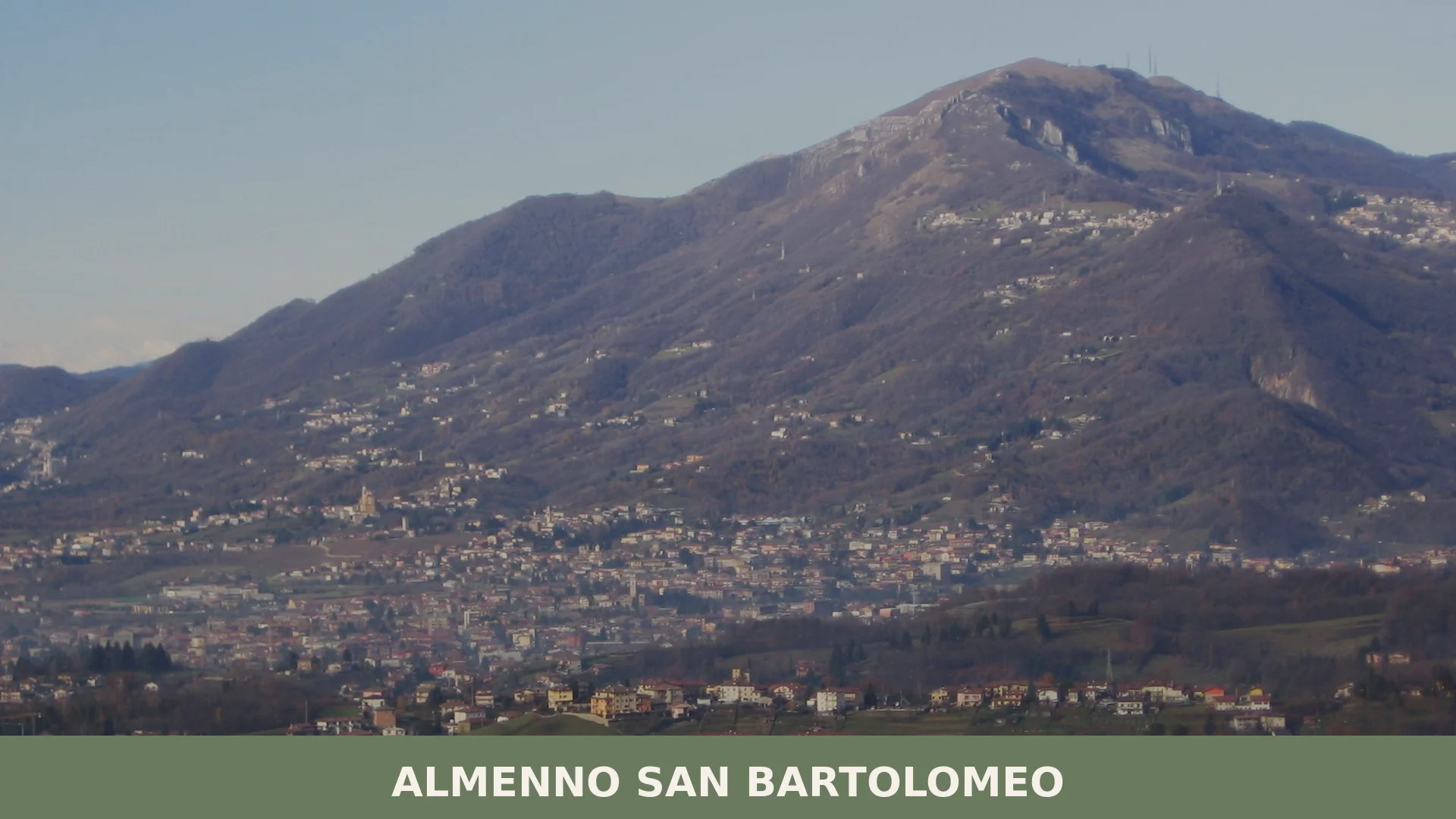

Almenno San Bartolomeo is a hilltop comune in the province of Bergamo, Lombardia, notable for its Romanesque Rotonda di San Tomè, a celebrated museum of woodworking and a layered history stretching ba
Discover Almenno San Bartolomeo
Almenno San Bartolomeo is a comune of around 6551 inhabitants in the province of Bergamo, Lombardia, sitting at 352 metres above sea level on hilly terrain roughly 12 kilometres north-west of Bergamo, reachable in approximately 20–25 minutes by road. Its territory extends from about 352 metres near the fraction of Campino to beyond 352 metres at the contrada Pradone, with the river Brembo marking the eastern boundary and the minor torrents Tornago, Lesina and Borgogna threading through the interior. The Touring Club Italiano awarded the comune its Bandiera Arancione recognition in 2016, a designation reserved for smaller inland centres that meet defined standards of cultural and environmental quality.
The Almenno San Bartolomeo village in Lombardy carries a layered past that spans medieval factional conflict, Venetian dominion and gradual territorial reorganisation, all of which left durable marks on the built environment. Visitors encounter a Romanesque rotunda that dates to the early twelfth century, several churches ranging from the Gothic to the Baroque, a dedicated museum of woodworking craftsmanship, a large parkland reserve and a golf course shared with neighbouring comuni. The landscape, described in earlier centuries as productive in grain, mulberry and wine, remains predominantly rural and collinare, making the commune a coherent destination for those drawn to the quieter hill country north of Bergamo.
Almenno San Bartolomeo village in Lombardy: history and origins
Almenno San Bartolomeo grew from the medieval commune of Lemine — documented with certainty by the mid-twelfth century and formally recognised on 3 March 1220, when the local bishop ceded feudal rights to the commune — and reached its present administrative form through centuries of factional conflict, Venetian rule and gradual territorial redefinition. The settlement’s long arc from a single unified comune to two distinct municipalities offers a particularly legible example of how political pressures reshaped Lombard communities across the medieval and early modern periods.
During the fourteenth century Lemine entered a prolonged decline, and by the latter half of that century the rivalry between Guelph and Ghibelline factions had split the territory into two separate communes: Almenno Inferiore and Almenno Superiore. The division was formalised by an act of 26 January 1393, with the boundary between the two confirmed in 1456. When the territory passed under Venetian authority in 1428, the two communities were treated very differently: Lemine Inferiore, having opposed Venice during the conflicts of 1428–1441, was razed in 1443 as a reprisal, while Lemine Superiore was rewarded with privileges, including the establishment of a Vicariato in 1428. That Vicariato — covering Lemine, Vall’Imagna and Palazzago — received its definitive territorial shape after 1443 and its own Statutes in 1444.
Churches, a Museum and Open Land: the Built and Natural Heritage of Almenno San Bartolomeo
Almenno San Bartolomeo offers visitors a Romanesque rotunda dating to the early twelfth century, five historic churches, a dedicated museum of woodworking craft, a castle, and several protected green areas extending from the valley floor to over 352 metres altitude.
Rotonda di San Tomè
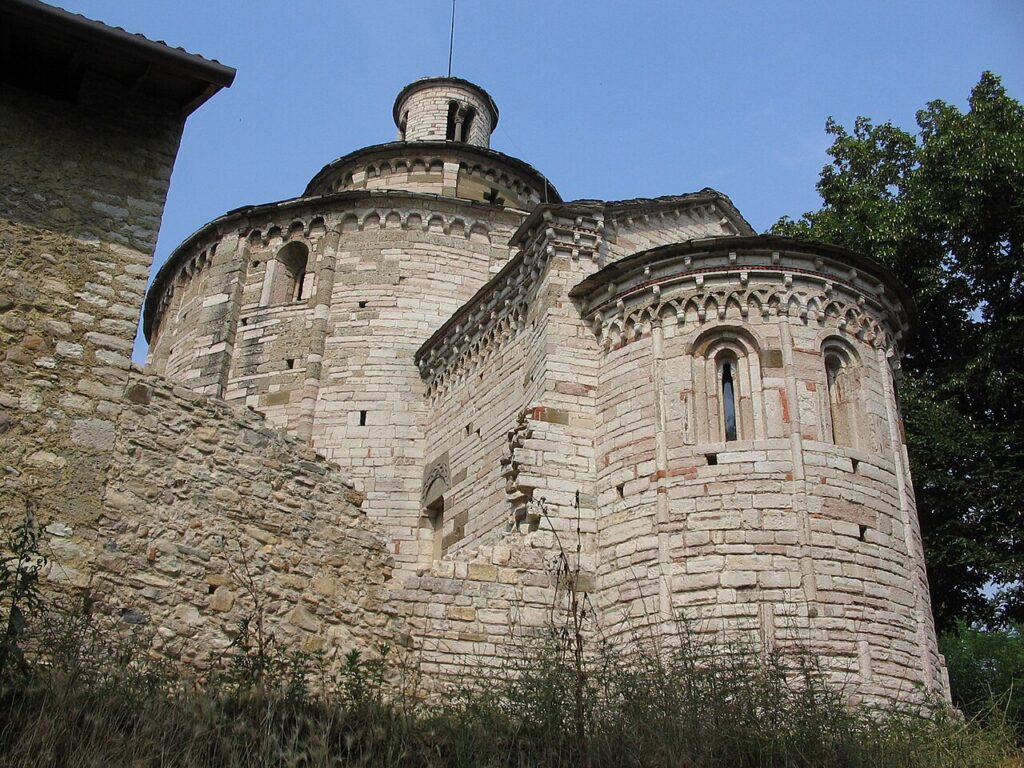
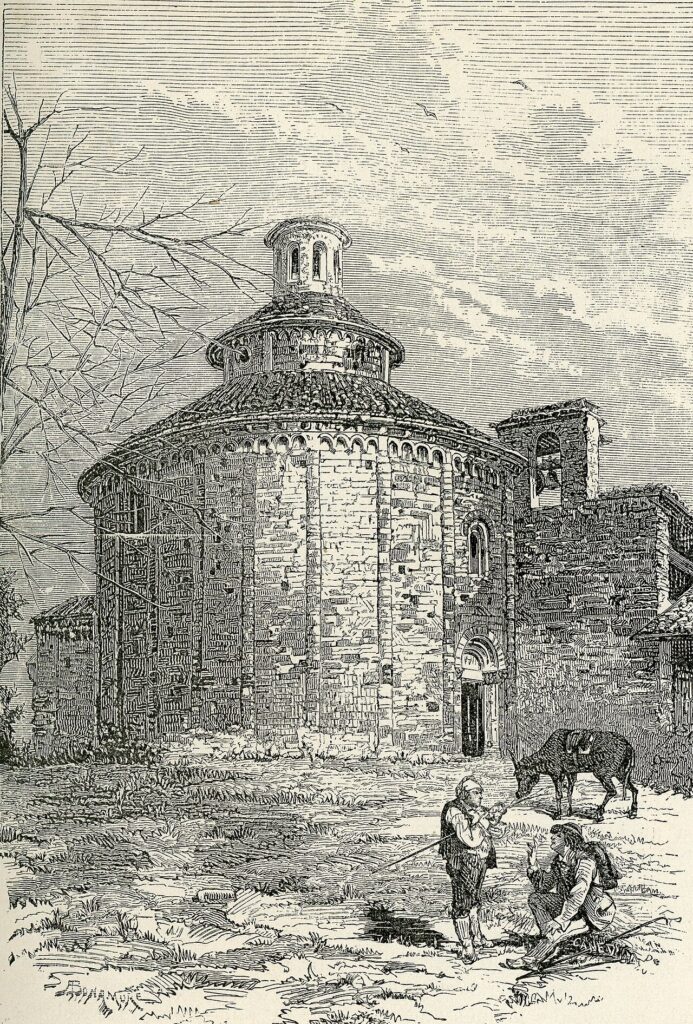
The Rotonda di San Tomè is a Romanesque ecclesiastical building dating to the early twelfth century. Its structure is cylindrical, formed by three superimposed bodies. The interior is circular and articulated by eight columns with a matroneo — an upper gallery — above. The building stands within the Agro del Romanico, which marks the eastern boundary of the municipal territory.
Parrocchiale San Bartolomeo di Tremozia
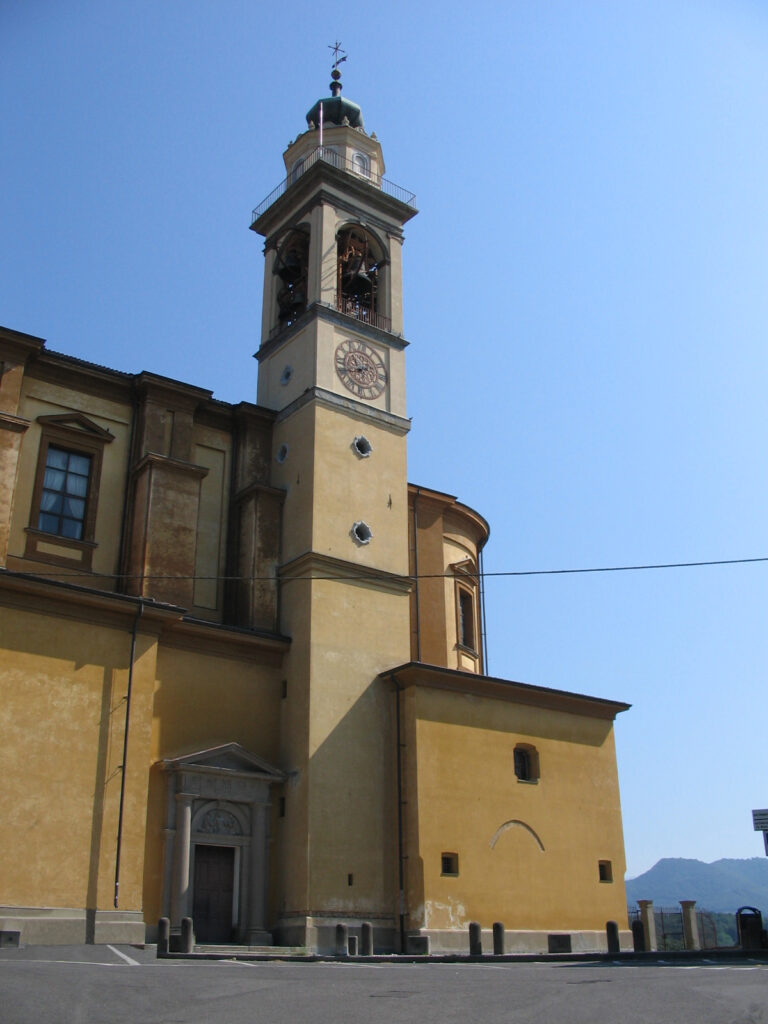
The parish church of San Bartolomeo is a Gothic building with three naves, subsequently rebuilt in the eighteenth century. It preserves a panel painting of the Madonna col Bambino con santa Caterina, as well as paintings attributed to Moroni.
Chiesa di Santa Caterina di Tremozia
Located in Via Castello Rescanzi, this church was built in 1514 at the initiative of Caterina de Gavazenis and Cristina de Manglijs, who also cofounded the associated monastery. The interior retains a cycle of sixteenth-century frescoes depicting six scenes from the life of Saint Catherine of Alexandria.
Chiesa di Santa Maria ad Nives
This church dates to the fifteenth century and stands close to a coppice woodland on the edge of the built area.
Chiesa di San Rocco
Situated in the locality of Albenza, the church was built in the sixteenth century and was already standing at the time of the pastoral visit of San Carlo Borromeo in 1575, in which it was explicitly cited.
Other Religious Buildings
The church of Santa Maria Nascente, in the locality of Barlino, dates to the sixteenth century and was built over a pre-existing votive shrine; it conserves a work dated 1558. The church of San Giuseppe, in the locality of Canova, is documented as constructed in 1712.
Castello
A castle is recorded within the municipal territory. The sources do not provide details on its current condition or history beyond its presence.
Museo del Falegname Tino Sana
Founded in 1987 by Costantino Sana, known as Tino, a local craftsman and entrepreneur, the museum is housed on three levels. It documents the woodworking trades through reconstructed workshops representing distinct specialisations: the chair-maker, the modelmaker, the cartwright, the inlay worker, the cooper and the luthier. The collections also cover the history of regional carts and puppets, and trace the development of the bicycle from the draisine onward.
Roccolone and Natural Areas
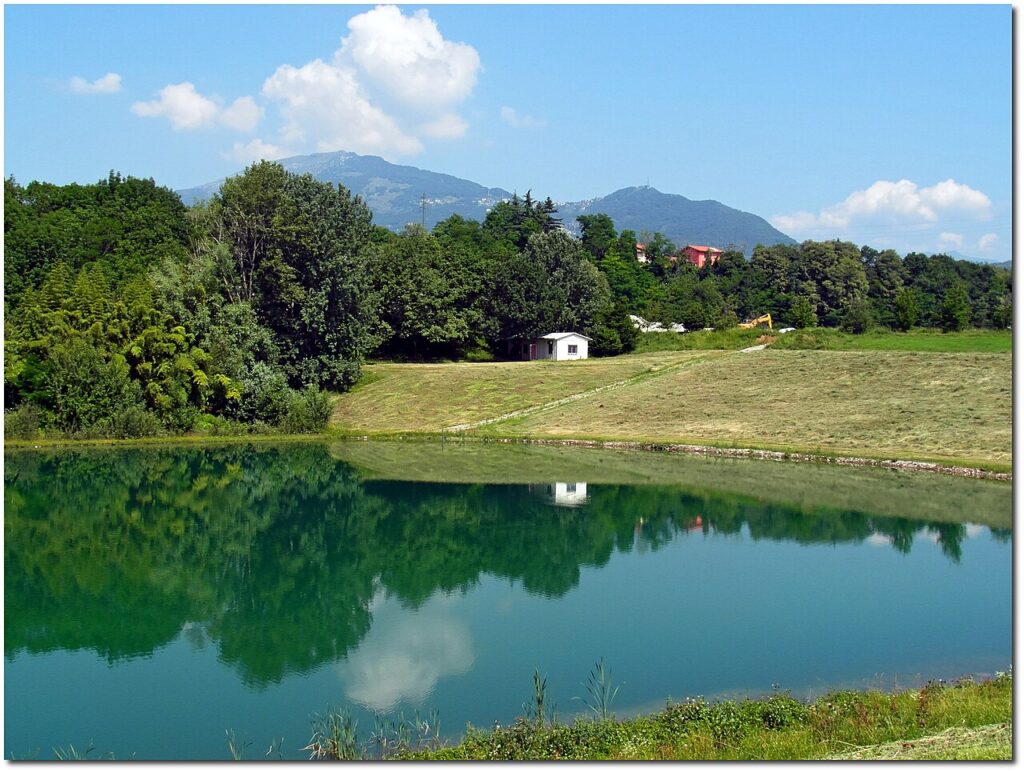
The Roccolone is a hillside woodland park extending across nearly thirty hectares at the centre of the municipal territory. It is crossed by a network of walking and cycling paths. A separate green area, the Parco Oasi sul Brembo, lies near the river and adjoins the site used each summer for the Campo Scuola Giovani Alpini. From the contrada Pradone, at over 352 metres altitude, departs the CAI trail 571, a long-distance route circling the Valle Imagna.
Certified Tastes from Almenno San Bartolomeo and the Bergamo Valleys
The territory around Almenno San Bartolomeo belongs to a province rich in certified products, including Grana Padano DOP, Gorgonzola DOP, Bitto DOP, Formai de Mut dell’Alta Valle Brembana DOP, and the Laghi Lombardi DOP olive oil, none of which are exclusive to this single commune but all of which are genuinely present in the local food culture. For wine, the closest denominations are Valcalepio DOC, Terre del Colleoni DOC, and the Bergamasca IGT, produced across the surrounding hills.
A historical note on the land itself: the naturalist Giovanni Maironi da Ponte once described this territory as fertile in grain and mulberry, producing generous quantities of wine — a portrait that still resonates in the vine-covered slopes visible from the village today.
Among regional PAT products associated with the broader Bergamo area, visitors will also find traditional soft drinks flavoured with ginger, chinotto and citrus, alongside artisan beers from Lombardy’s valleys. These are best encountered at local markets and festivals rather than sought in any single shop.
Reaching Almenno San Bartolomeo and Planning Your Stay
Almenno San Bartolomeo lies approximately 12 kilometres north-west of Bergamo, reachable by car in roughly 20–25 minutes via the provincial roads that climb into the Valle Imagna. The village sits at an altitude ranging from around 352 metres near the fraction of Campino to over 352 metres at the contrada Pradone, so visitors should dress in layers even in summer if they plan to explore the higher ground.
The hillside setting and the concentration of Romanesque churches, woodland parks, and the Museo del Falegname Tino Sana make the village well suited to a day visit from Bergamo, though the variety of walking routes — including the CAI 571 trail that begins at Pradone and circuits the entire Valle Imagna — rewards those who stay longer. The Roccolone park, nearly thirty hectares of oak, birch and chestnut at the centre of the commune, is accessible on foot or by mountain bike throughout most of the year. The Parco Oasi sul Brembo, along the eastern boundary, is particularly lively in July, when the Campo Scuola Giovani Alpini brings several hundred young participants and volunteers to the area.
Travellers arriving from the south can pass through Dalmine before heading north toward the Bergamo foothills. Those exploring the wider province might also consider Adrara San Martino as part of a broader itinerary through Lombardy’s lesser-known hill villages. Since 2016 Almenno San Bartolomeo has held the Bandiera Arancione recognition from the Touring Club Italiano.
| Departure | Distance | Time |
|---|---|---|
| Bergamo | approx. 12 km | 15–20 min in auto |
| Dalmine | approx. 15 km | 20–25 min in auto |
These practical references help organise the journey clearly, while the village itself is best understood slowly and on foot once you arrive.
Frequently asked questions about Almenno San Bartolomeo
How do I reach Almenno San Bartolomeo from Bergamo by car?
Almenno San Bartolomeo lies approximately 12 kilometres north-west of Bergamo city centre and is accessible by road in 20–25 minutes. From Bergamo, take the SS671 or follow local provincial roads northward toward the hillside comune. The village sits at 352 metres elevation on hilly terrain. Parking is available in the village centre. For those using motorways, the nearest major exit is at Bergamo on the A4 autostrada.
When is the best time to visit Almenno San Bartolomeo?
The patron saint feast day of San Bartolomeo and San Timoteo falls on 24 August, offering a traditional celebration with local cultural events. Spring and early autumn provide mild temperatures ideal for exploring the hilly landscape and rural countryside. The warmer months suit outdoor activities including walks through the parkland reserve and golf course. Winter is quieter but allows visits to churches and the woodworking museum without crowds.
What historical landmarks should I see in Almenno San Bartolomeo?
The village's most significant monument is a Romanesque rotunda dating to the early twelfth century, representing exceptional medieval architecture. Several churches span Gothic and Baroque periods, reflecting the comune's layered religious history. A dedicated museum showcases traditional woodworking craftsmanship, preserving local artisan heritage. These sites together document the village's medieval past and Venetian period influence, making them essential stops for history enthusiasts.
What outdoor activities are available in Almenno San Bartolomeo?
The comune features a large parkland reserve ideal for walking and nature observation across the hilly terrain. A golf course operates jointly with neighbouring comuni, welcoming players of all levels. The undulating landscape with elevations ranging from 225 metres near Campino to over 900 metres at Pradone offers excellent hiking opportunities. The Brembo river and minor torrents (Tornago, Lesina, Borgogna) add natural scenic value to rural exploration.
Does Almenno San Bartolomeo have official quality recognition?
Yes, the Touring Club Italiano awarded Almenno San Bartolomeo the Bandiera Arancione (Orange Flag) designation in 2016. This prestigious recognition is reserved for smaller inland centres that meet rigorous standards of cultural heritage preservation and environmental quality, confirming the village's commitment to sustainable tourism and authentic local character.
📷 Photo Gallery — Almenno San Bartolomeo


In Lombardy More villages to discover

Cassano Magnago
 Hills
Hills
Over 21,000 residents and a documented history stretching back to 1152. Cassano Magnago rewards visitors with a medieval castle, four ancient churches and a rich civic past.

Rogeno
Hills
 Lake
Lake
3,035 residents, one patron saint, and a village whose families shaped Italian history. Rogeno rewards slow exploration along the southern Brianza.
Brescia
 Plains
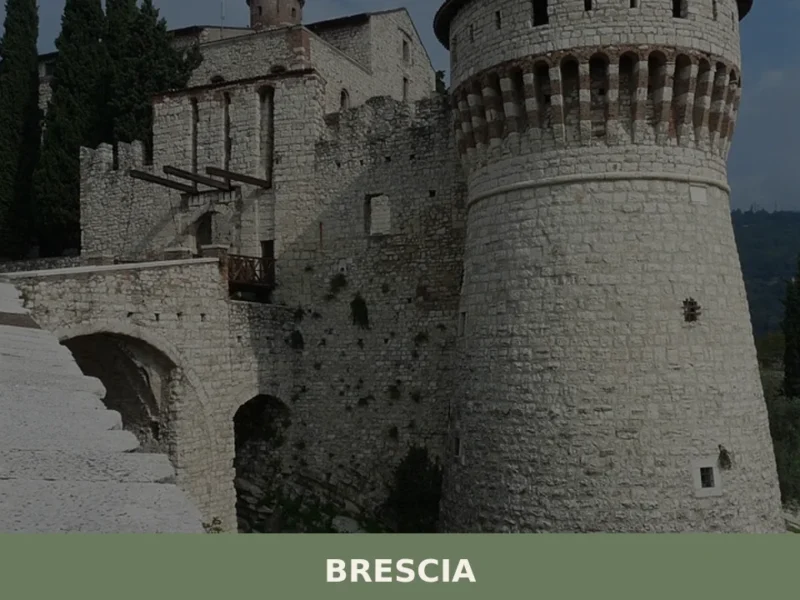
In 1826, during the excavation of a house’s foundations on Via Musei, the Winged Victory emerged from the ground — a Roman bronze from the 1st century AD, nearly two metres tall, and the symbol of a city that has layered twenty-five centuries of history upon itself. Anyone wondering what to see in Brescia today […]

Campospinoso
Plains
1,335 residents, two historic nuclei and eight centuries of feudal heritage. Campospinoso rewards visitors drawn to rural Lombardy's quieter, less-travelled corners.

Paderno Dugnano
Plains
A metropolitan comune of nearly 48,000 residents formed from five historic settlements. Medieval chapels, noble villas and the Seveso river define its rhythm.
Arsago Seprio
Hills
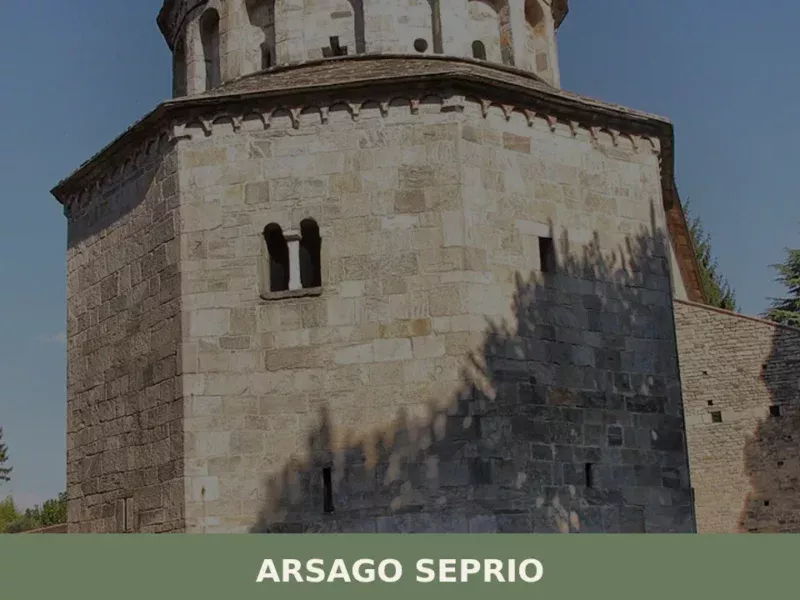
In Arsago Seprio, located in the province of Varese, the ancient Basilica of San Vittore Maggiore features structures dating back to the 9th century, indicating continuous settlement rooted in Roman times. This specific detail introduces a village of 4,869 inhabitants, located 290 meters above sea level, where historical layering is a tangible element. For those […]
Bergamo
Hills
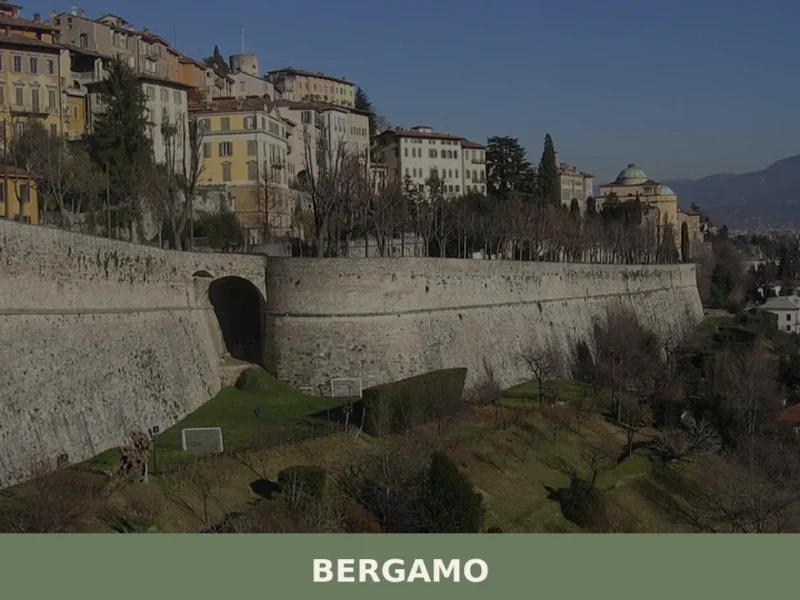
What to see in Bergamo? With 119,534 inhabitants, the city is famous for its Venetian Walls and Piazza Vecchia. Discover its rich history and typical dishes.
Brusimpiano
Hills
Lake
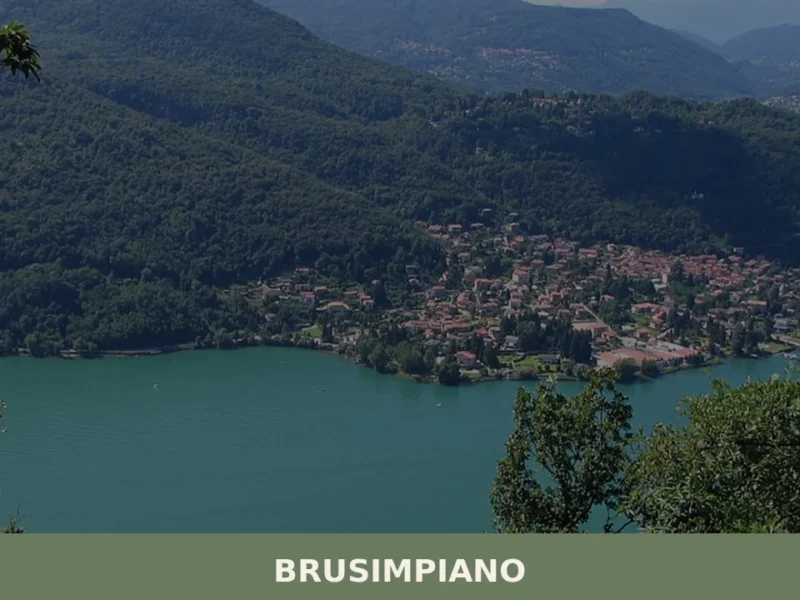
What to see in Brusimpiano: 1,229 inhabitants, 289m above Lake Lugano. Discover the Church of the Nativity, lakeside promenade and nature trails. Plan your visit now.
Besozzo
Hills
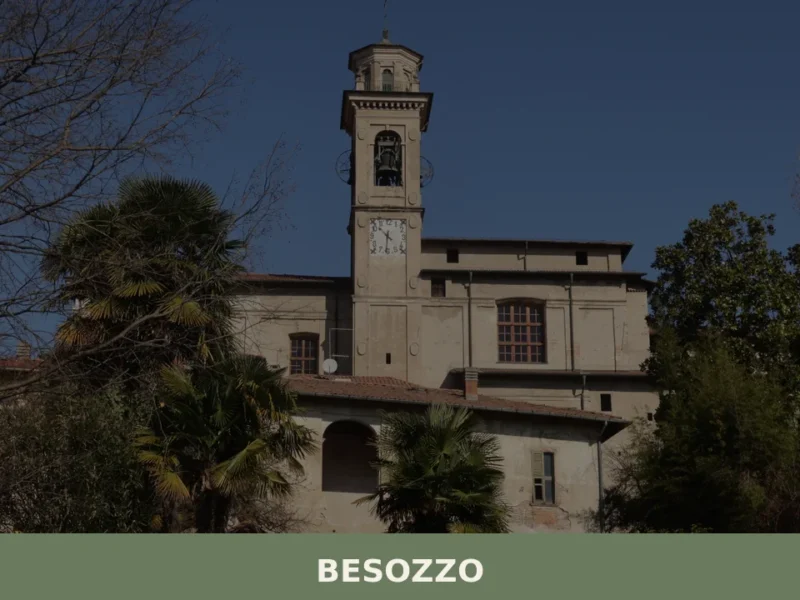
What to see in Besozzo, Italy: Explore the historic upper village (240 m a.s.l.), its noble Palazzi, and proximity to Lago Maggiore. Discover this Lombardian gem.
Bedero Valcuvia
Plains
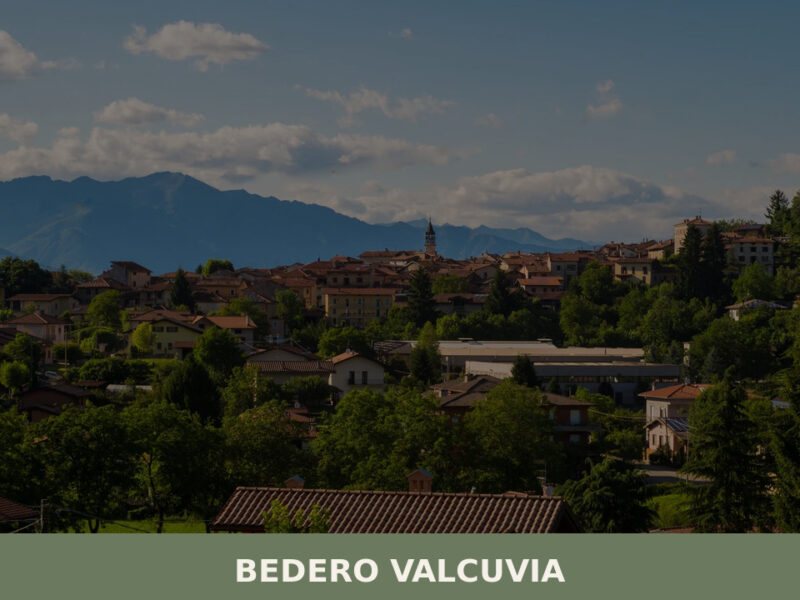
Morning light reaches Bedero Valcuvia in stages — first the bell tower of the parish church, then the stone walls along Via Roma, and finally the gardens where fig trees press against iron railings. The village holds 680 residents in the broad green trough of the Valcuvia, a valley running between Lake Maggiore and Lake […]

🏡 Know Almenno San Bartolomeo better than we do?
If you’re a local or have been there, your knowledge matters: add what’s missing or fix a detail on this page.