The Po flows past Brandizzo without hurry, marking the boundary between the village and the open countryside to the south. On the northern bank stands a modest settlement of eight thousand souls, a patchwork of old stone houses, modern apartment blocks, and industrial shells, interrupted by the railway that splits the comune in two. The light here is flat and northern—no drama, no romance—yet the presence of water and the gradual slope toward hills give the landscape a quiet sense of place.
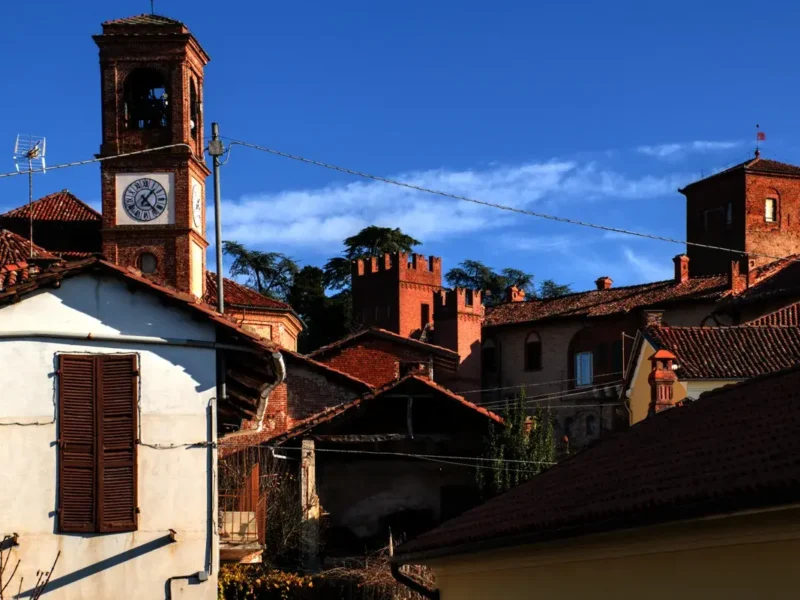
Brandizzo village in Piedmont occupies a strategic position in the Turin metropolitan ring, just nineteen kilometers northeast of the city, near the Malone stream and the Po. Most visitors come for the baroque church of San Giacomo Apostolo, the carnival masks tradition, or to trace the path of industrialisation that transformed the agricultural community into a worker’s town in the mid-twentieth century.
From Ancient Stone to Noble Hands: The Medieval and Early Modern Story
The name Brandizzo derives from a personal name of Frankish tradition—Brando or Prando—meaning a double-edged or glinting sword, paired with the diminutive suffix izzo. The first documented mention appears in 1035, in a deed of donation.
Long before the medieval comune took shape, the territory lay near Decimum, a Roman way station where travellers rested and changed horses on the road from Augusta Taurinorum (Turin) toward Ticinum (Pavia). When the Western Empire collapsed, Germanic peoples moved through the region. Under Frankish rule, Brandizzo fell within the County of Susa, a territorial division that shaped the entire Piedmontese plain.
In 1035, Olderico Manfredi II, Count of Turin and Marquis of Susa, gave the territory to the Abbey of Fruttuaria (now San Benigno Canavese), which then ceded it as a fief to the lords of Chivasso. By the mid-seventeenth century, the Nicolis family had obtained both ownership and a noble title tied to Brandizzo; their lineage split into two branches, establishing surnames that would remain locally prominent. Brandizzo followed the political and military rhythms of the Piedmontese kingdom under Savoy rule for centuries.
In 1701, the decision came to build the church of San Giacomo Apostolo, a project that would take half a century to complete—a commitment typical of a community willing to invest in permanence and faith.
Nineteenth-Century Industry and Modern Growth
The Napoleonic wars affected the region; the restoration returned Savoy rule. As Italy unified in the nineteenth century, Brandizzo shifted from a rural, thinly populated territory into a small industrial hub. Two enterprises defined the era: the large flour mill of the Re family, which operated until the 1960s and ranked among the region’s largest, and the Sarpa lace and embroidery factory.
The 1960s brought decisive change. Immigrants from the Veneto and southern Italy arrived in search of work, expanding the population significantly. Schools, civic buildings, and new neighbourhoods rose to accommodate the shift. The construction of road and rail infrastructure—the A4 motorway and the Turin–Milan railway dividing the settlement into north and south—further reshaped the urban fabric. By the late twentieth century, Brandizzo had become a commuter’s village, oriented toward Turin, yet retaining vestiges of its industrial and agrarian past.
The Church and Religious Life
San Giacomo Apostolo
The principal historic monument is the parish church of San Giacomo Apostolo. Construction began in 1701 and was completed in 1750, funded partly by donations from the faithful. The interior follows classical baroque style, with paintings and figures by local artists and a marble Pietà of unknown authorship. The church was solemnly consecrated in 1752. The bell tower was built before 1774; the sacristy and canonry followed in the nineteenth century. This was the spiritual centre around which the village’s identity consolidated.
La Madonnina
An ancient chapel known as La Madonnina stands within the territory, its oldest sections built with late Roman brick and believed to date to the seventh century. Renovated many times over the centuries, it represents one of the earliest structures on the site and testifies to continuous Christian presence across the medieval and modern epochs.
San Giovanni Evangelista
A second church dedicated to Saint John the Evangelist was constructed in 1977 in the northern zone, beyond the railway line, to serve the expanded community. The oratory of Gesù Maestro was inaugurated in October 1966 under the direction of Don Luigi Manassero, an event attended by the then-minister Oscar Luigi Scalfaro.
Carnival and Community Masks
Brandizzo’s carnival tradition centres on two historical masks: the Bela Cusôtera (the beautiful pumpkin vendor) and the Gran Giardiniere (the great gardener), accompanied by a court of attendants. The costumes, evolving each year yet rooted in eighteenth-century style, are predominantly orange and green—the colours of the pumpkin. Since 2006, an order dedicated to preserving the memory of past performers has maintained the tradition. The carnival parade, held in late winter, remains a defining social event and a link to the region’s folk memory.
Landmarks and Industrial Heritage
The Sarpa Factory and Library
The Sarpa factory, once a major employer in lace and embroidery production, was repurposed in 1996 to house the Biblioteca Cesare Pavese, established by municipal decision. The conversion of industrial space into a cultural venue reflects broader patterns of reinvestment in post-industrial towns. The library now participates in the regional library system and hosts exhibitions and community gatherings.
Civic Identity in Stone
The town hall and the remnants of the Re mill stand as architectural reminders of the governance and economic life that shaped modern Brandizzo. Plans exist for the restoration of the mill complex, a signal of interest in preserving industrial memory even as the village looks toward service and residential futures.
Landscape and the Po River Basin
Brandizzo’s territory straddles the plain between 182 and 196 metres above sea level—a minimal relief yet significant enough to influence settlement and agriculture. The Po forms a natural and administrative boundary to the south; the Malone creek delimits the eastern edge with Chivasso. Smaller watercourses—the Bendola and Malonetto streams in the north, the artificial canal called Gora del Mulino and the Sturella torrent in the south—drain the flat terrain toward the main river.
Part of the municipal territory falls within the Parco del Po Torinese, a protected area that encompasses part of the nature reserve along the Po basin. Brandizzo participates in territorial conservation projects and environmental improvement initiatives tied to the Po basin and regional green corridors. The landscape, though compromised by road and motorway crossings, retains ecological value and offers potential for naturalistic restoration along riparian zones.
Culinary Context and Agricultural Roots
The October Sagra della Zucca (pumpkin festival) anchors the village’s seasonal calendar and reflects the agricultural heritage of the Po plain. Pumpkins and winter squashes thrive in the alluvial soil and were historically preserved for winter consumption. The association between the vegetable and the carnival masks reinforces a cultural memory linking food, tradition, and civic identity.
Beyond this festival marker, Brandizzo’s gastronomic identity remains tied to piedmontese plains cooking—risotto, polenta, fresh pasta, and river fish—yet the sources do not detail specific house specialities or named dishes unique to the village. The food culture reflects working-class and agrarian traditions adapted over time to include modern restaurant and takeaway commerce.
Calendar of Civic Life
The village maintains an active social calendar. Spring brings the Mercà dla Teila (cloth market) in May and the Festa del Borgo Orchidea in June, followed by the in July, honouring the patron saints. Summer film screenings and a children’s cinema programme draw families. Autumn reopens with live music evenings in late September and October. The Concerto Bandistico di Santa Cecilia, performed by the Società Filarmonica Brandizzo—a band society—concludes the year, followed by Christmas celebrations in the main square. These rhythms bind residents and reinforce local identity across generations.
Getting to Brandizzo: Routes and Timing
Brandizzo lies on the Turin–Milan transport corridor, making it accessible by car, train, and bus. The A4 motorway (Turin–Trieste) has exits at Brandizzo and Volpiano, allowing drivers to reach the village from Turin in approximately twenty to twenty-five minutes under normal traffic. The Strada Statale 11 Padana Superiore, the historic national road linking Turin to Milan via Chivasso, passes through the southern zone near the Po.
By rail, the station serves the SFM2 suburban line (Servizio Ferroviario Metropolitano di Torino), a Turin metropolitan service, with regional trains to Novara. Journey time from Turin Porta Nuova station is roughly fifteen to twenty minutes. A private bus line, integrated into the local public transport network, links Brandizzo to Chivasso, Settimo Torinese, and Turin. The village is also within easy reach of neighbouring communes such as Volpiano to the north and Casalborgone, all part of the Turin metropolitan fabric.
| Departure Point | Distance | Travel Time |
|---|---|---|
| Turin (city centre) | 19 km | 20–25 min by car; 15–20 min by train |
| Turin Porta Nuova Station | Via rail | 15–20 min (SFM2 line) |
| Chivasso | 4 km | 8–10 min by car; local bus available |
| Settimo Torinese | 7 km | 12–15 min by car; bus service |
| Novara | Approx. 35 km | 35–45 min by car or train |
Visitors looking for cultural sites should plan a morning or afternoon visit in spring or early autumn, when weather is mild and the landscape around the Po is most inviting. The carnival season (February–March) is ideal for those interested in folk tradition and community celebration. If exploring the industrial heritage and Sarpa library, weekday hours are recommended. The village offers basic accommodation and dining through small hotels and family-run restaurants oriented mainly toward residents and commuters, so advance bookings are prudent for weekend visits.



 Mountain