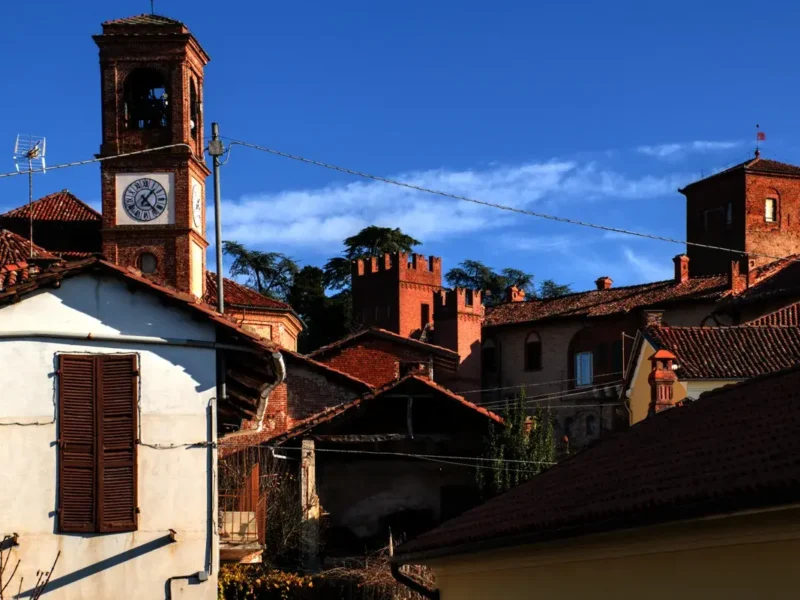
Pralormo sits on a low hill where the Piedmont plateau begins to soften toward the Roero, a landscape of gentle slopes and dispersed farmsteads. The village’s stone tower—a 13th-century signal post later converted to a bell tower and then a clock tower—still anchors the center, marking the hours since the clock was acquired in 1749.
Pralormo village in Piedmont is home to 1,852 residents and claims two anchor attractions: a 13th-century castle still inhabited by the Beraudo family and a parish church holding a Renaissance altarpiece painted in 1546. The village lies in Turin Province at 303 meters altitude, isolated from rivers but sustained by an old engineering solution—shallow ponds scattered across the plateau that collect rainwater for irrigation and livestock.
The first elm tree that gave Pralormo its name—pratum ad ulmum, a meadow marked by an elm—stood at the corner of Via Carlo Morbelli and Piazza Vittorio Emanuele II until a lightning strike felled it in the early 1900s. Two framed photographs of the tree, with its original bark, hang in the town council chamber.
From Longobard Roots to Medieval Reorganization
The toponym Pralormo derives from pratum ad ulmum, likely a Longobard practice of planting symbolic trees at settlement boundaries. Historical records name the area in the 13th century, though scholars propose earlier origins: a document dated 14 March 1065 mentions Predarolo in a land grant by Adelaide of Susa to the Bishop of Asti, possibly identifying the same location under a different name.
By the early 1200s, Pralormo lay divided between competing families. The lords of Anterisio and the Desaya held the eastern sector toward the Rioverde stream, while the Gorzano extended influence westward to the plateau’s rim. The original settlement occupied a southeastern site, marked today by a votive stone shrine to San Donato, the village’s patron saint; archaeological remains including human burials confirm a cemetery and early occupation that was later abandoned. A conflict between the lords of Biandrate and the city of Asti forced the community to relocate to its present location, likely around the mid-13th century alongside neighboring villages such as Poirino and Canale.
By 1276, the Gorzano emerged as sole lords of Pralormo’s castle and lands. In subsequent centuries, the fief passed to the Pelletta and then to the Roero family, whose heirs held portions of the estate into the 1800s. The 16th and 17th centuries saw the Roero line subdivide, bringing new families into lordship: the Costa, Petrina, Dal Pozzo, Beraudo, and Ferrero della Marmora. A 1574 partition between two Roero heiresses Luciana and Caterina set off decades of inheritance transfers that reshaped local power. Giacomo Beraudo acquired one-third of the fief in 1680 and received the title of count; by 1830, another Beraudo, Carlo Beraudo, unified the entire estate. His political career—diplomat, minister of finance and interior under Carlo Alberto of Savoia, negotiator of the Peace of Milan in 1849—made him one of Piedmont’s most influential figures of the 19th century.
The Churches and Their Artworks
Parrocchiale di San Donato
The modern parish church dominates the village center, completed in 1931–1932 on the site of the old rectory and a Bernardine confraternity building. Its artistic character derives from works transferred from earlier structures: a triptych by Jacopino Longo (1546) depicting the Madonna, Christ Child, Saint James, and Saint Donato; a carved and painted wooden Pietà attributed to Carlo Giuseppe Plura (circa 1715–1720); and a pipe organ built by Antonio Mola in 1898 for the earlier parish church. The triptych vanished in March 1997 but was recovered and returned by the Carabinieri of Savigliano in December 2000. The new church was built communally—residents carried sand and gravel from the Rioverde stream and dug foundations themselves—under the direction of parish priest Don Teobaldo Massasso. The former parish church, built between the late 17th and early 18th centuries, stands nearby in partial disrepair.
Santuario della Beata Vergine della Spina
A second sanctuary honors the Virgin of the Thorn, named after a local tradition: an image of Mary painted on a roadside pillar was scratched at the eye by a thorn branch and reportedly bled. The sanctuary’s documented history begins with a 1585 pastoral visit by the Bishop of Asti, who recorded crowds drawn by reported miracles and two altars in use. The main altar was constructed in 1632. Religious orders occupied the adjoining monastery—Trinitarians (1639–1652), Cistercians (1681–1797)—built on land donated by Gaspare Petrina in the mid-1600s. From 1797 to 1833, a Turin resident named Giuseppe Farò held the property; it then passed to the Ferrero della Marmora family. In 1877, a donor named Don Elia Francesco funded interior restoration, commissioning local painter Felice Barucco to paint figures flanking the Virgin’s image and decorate the ceiling vaults. The early 20th century brought further modifications—two bell towers and a portico were added, and the conical dome above the cylindrical bell tower was removed—under Don Rodolfo Piglione. Since 1991, the monastery has been owned by the Adorers of the Holy Sacrament of Cottolengo. The feast of the Virgin of the Thorn is celebrated on 15 August with the Assumption.
The Medieval Signal Tower
Between the parish church and the castle, a 13th-century tower originally served to relay signals across the plateau during conflicts over Asti’s commercial routes. It was later converted to a bell tower, then adapted as a clock tower. That same tower still marks the hours in the village center.
Castello dei Conti Beraudo di Pralormo
The castle’s first construction dates to the 13th century as part of Piedmont’s system of fortified settlements contested between Asti and the lords of Biandrate. The Gorzano, Pelletta, and later Roero families held it sequentially; Giacomo Beraudo acquired the southern third in 1680 and was invested with the comital title. Around 1730, architect Galletti designed a chapel within the structure, which was later enlarged with a frescoed hall. The decisive transformation came under Count Carlo Beraudo The moat and drawbridge were filled and removed, a portico and grand staircase were added, and the central courtyard was covered to form a double-height salon. The castle remains the residence of the Beraudo di Pralormo family and is open to visitors by guided tour.
Water, Agriculture, and the Plateau
Pralormo lies on the Piedmont plateau—a region historically lacking surface rivers and isolated from flowing water. The solution arrived in the form of peschiere, shallow artificial or semi-artificial basins distributed across the plateau to capture rainwater and drainage runoff. Concentrated in communes including Carmagnola, Poirino, and Pralormo, between the state road 231 and the Rio Secco stream, these ponds were dug near farmsteads and hamlets to supply irrigation and watering for livestock. They remain a defining feature of the agricultural landscape, allowing the hill settlements to sustain cereal crops, orchards, and pastoral farming without reliance on perennial streams. The ponds also anchor the visual rhythm of the countryside—quiet surfaces reflecting sky and seasonal growth, remnants of centuries-old water management ingenuity.
Visiting Pralormo
Pralormo is reached via car from Turin in roughly 45 minutes, following provincial roads through the Turin hills toward Chieri and the communes of the southeastern plateau. The village is small enough to walk in a single morning or afternoon, though visitors interested in the castle should book a guided tour in advance through the municipal website. The parish church is open during standard hours; the sanctuary of the Virgin of the Thorn operates year-round. Nearby municipalities—Arignano, Baldissero Torinese, and Moriondo Torinese—offer additional rural architecture and churches within a 15-minute drive.
The plateau enjoys warm summers and cool, damp autumns; spring (April–May) and early autumn (September–October) offer the most pleasant conditions for walking and viewing the countryside. There are no hotels within Pralormo itself, but Turin and nearby villages offer accommodations. Local restaurants serve traditional Piedmont fare, though advance reservation is recommended outside weekends.
| Departure Point | Distance | Approximate Time |
|---|---|---|
| Turin City Center | 35 km | 45 minutes by car |
| Chieri | 12 km | 20 minutes by car |
| Carmagnola | 8 km | 15 minutes by car |


 Mountain