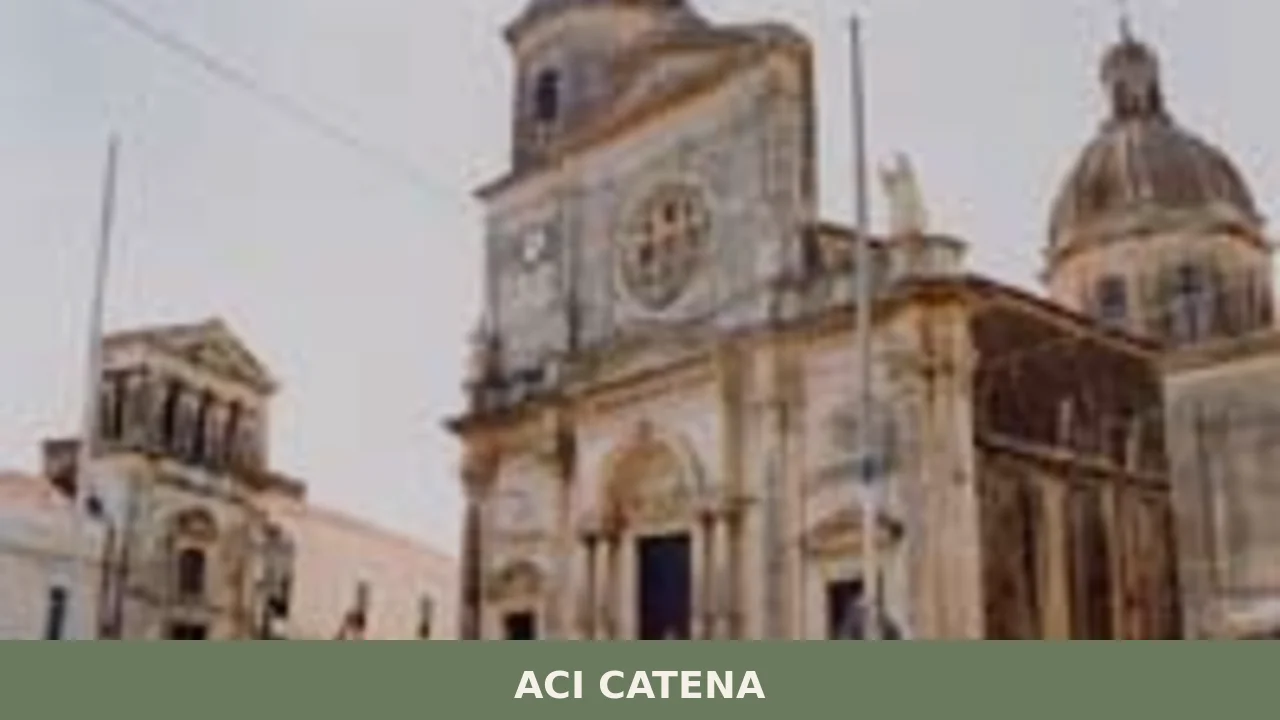
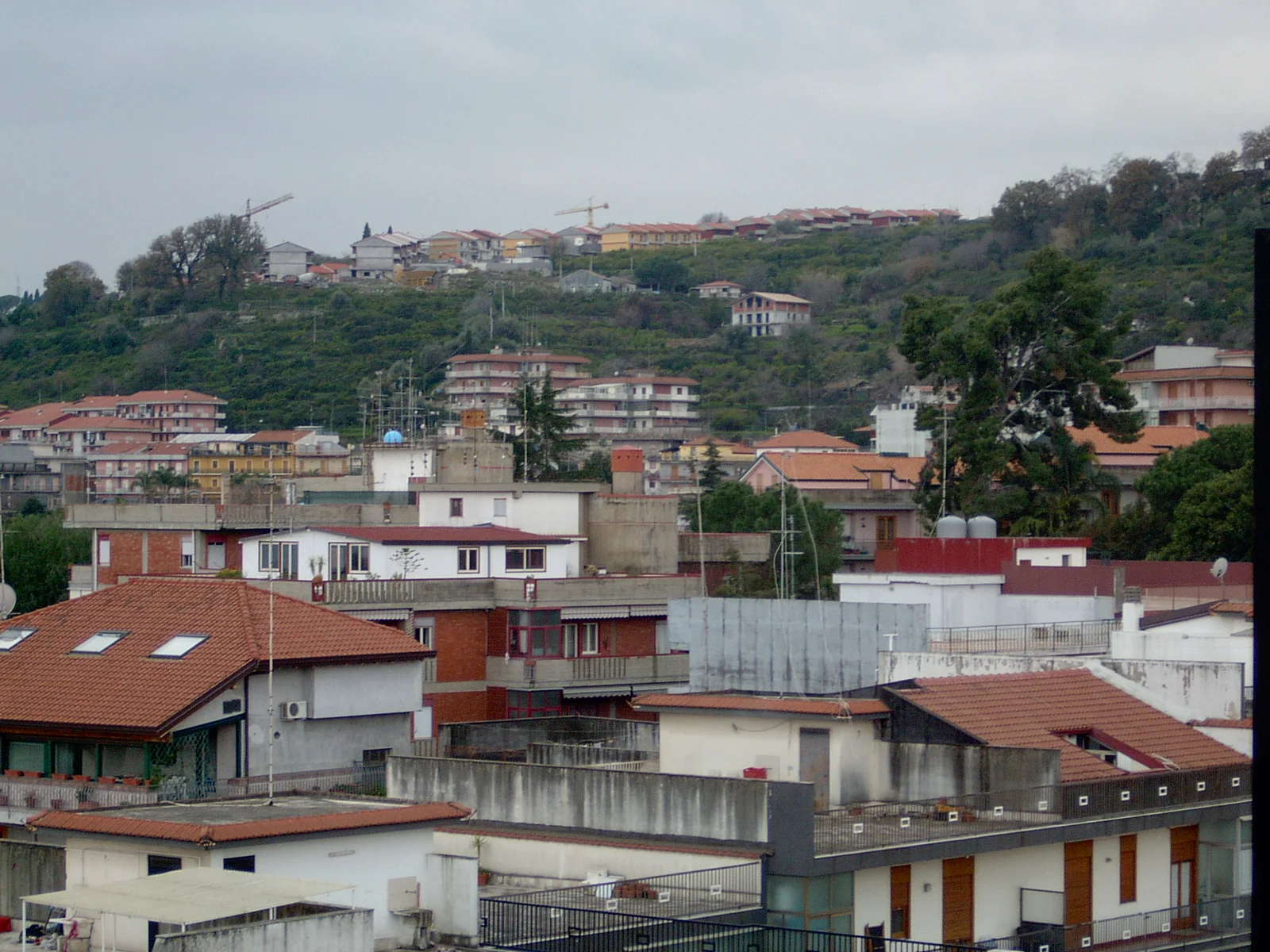
A low plateau at 170 metres above sea level, where autumn rains gather force before falling on the slope toward the Ionian Sea. Aci Catena village in Sicily rises from this threshold between the limestone hills of Acireale and the volcanic foothills of Etna, a town of nearly 27,500 people whose name carries both geography and faith—the river Aci and the Madonna della Catena, the patroness who is believed to have shielded her people when the earth split beneath them.
The streets of Aci Catena follow patterns laid down in the seventeenth century, when Spanish rule fragmented the inland Aci territory into independent communes. Yet the village’s identity is older, rooted in legend and poetry. The ancient Greeks knew this coast as Akis, a name wrapped in the tragic myth recorded by Virgil and Ovid—the love between a mortal youth named Aci and the sea nymph Galatea, watched jealously by the giant Polifemo. Modern visitors come for the baroque sanctuaries, the Festa della Madonna on 15 August, and the rare clarity of the mountain light.
The Myth and the Earthquake
Legend traces the Aci settlements to Xiphonia, a vanished Greek city, but history begins with documented presence. In antiquity, a city called Akis flourished here and took part in the Punic Wars. By the medieval period, the area was known by Arabic names—Jachium and Al-Yag—before splintering into distinct communities under Spanish administration in the seventeenth century.
The defining trauma came on 11 January 1693. A catastrophic earthquake, estimated at magnitude 7.4 on the Richter scale, devastated southeastern Sicily. Aci Catena was partly destroyed, yet the townspeople survived with fewer than 100 casualties. A church collapsed, but its precious fifteenth-century icon, the altar, and the statue of the patron saint emerged intact. The people interpreted this as miraculous intervention by the Madonna della Catena. That conviction took institutional form: in 1710, the noble Riggio family, who had settled in the village in 1672, donated the reliquies of San Candido Martire—brought from the catacombs of Rome—along with a marble altar, to the mother church. The feast of the Madonna on 11 January, celebrated annually since, commemorates deliverance.
“Between 29 and 30 December 1908, the archpriest Salvatore Bella, soon to become bishop of Acireale, composed an hymn of thanksgiving titled Ci Salvò (It Saved Us), with the text written between 29 and 30 December 1908 and the music composed in January 1909 by Maestro Giuseppe Monterosso—a verse that still opens the anniversary Mass.”
Other calamities followed: a violent flood in 1761 from the Lavinaio stream that courses through town; an earthquake in 1818 between the communes of Aci Catena and Aci Sant’Antonio, and another in 2018. Yet the narrative remained shaped by the 1693 survival, a pivot around which sacred observance and communal memory turn.
Sacred Monuments and Baroque Art
Santuario di Maria Santissima della Catena
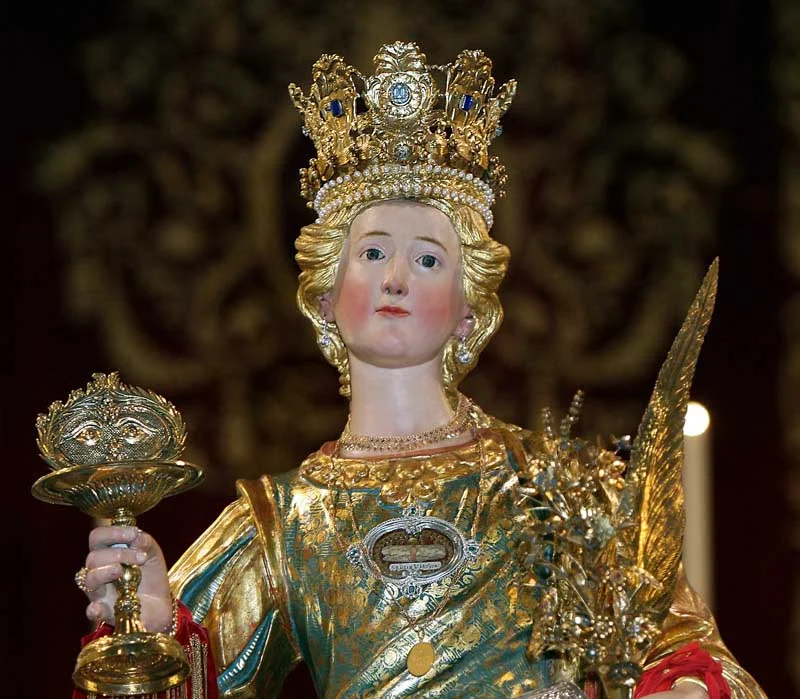
The mother church of Aci Catena, this sanctuary is the spiritual anchor of the village and the repository of the Madonna della Catena devotion. Built to replace an earlier parish destroyed in the 1693 earthquake, it houses the marble altar and reliquaries donated by the Riggio family. The façade and interior reflect late-baroque taste, though the precise dating and successive restorations are not fully documented. Pilgrims arrive in waves during the August feast, many arriving overnight on 14–15 August to be present for the procession of the statue, adorned with gold jewels accumulated as ex-voto offerings over centuries.
Chiesa di San Giuseppe
Designed by Francesco Battaglia, this church stands out for its rare Arab-Byzantine façade, a singular stylistic choice in Sicily’s ecclesiastical architecture. A ceremonial staircase of white limestone from Syracuse leads to the entrance, creating a formal forecourt effect. Inside, a magnificent altarpiece by Lorenzo Gramiccia (dated 1740) depicts the Holy Family’s flight into Egypt. The church exemplifies the wealth and artistic ambition of Aci Catena’s merchant and noble classes in the eighteenth century.
Chiesa di Santa Lucia
This church shelters works by Paolo Vasta, the prolific painter and stuccoist of the Sicilian baroque. The wooden ceiling, frescoes, and paintings reflect the devotional intensity of the period and the village’s connection to wider artistic networks. On 13 December, the feast of Santa Lucia draws pilgrims from across Sicily and southern Italy; tradition includes the throwing of ‘nzareddi (small sugar pastries shaped like rings) and the discharge of fireworks as the statue exits the church.
Chiesa di Sant’Antonio di Padova
Originally a parish church, it was adapted toward the end of the nineteenth century to serve as the municipal seat. Inside is a wooden crucifix carved by Giovan Francesco Pitorno, better known as Frate Umile da Petralia, a seventeenth-century friar-sculptor whose works appear in major churches across the island. The piece embodies the Counter-Reformation’s emphasis on emotional, carved devotional imagery.
Area Archeologica di Santa Venera al Pozzo
Within the municipality lies evidence of Roman settlement: the remains of a thermal complex dating to the late imperial era. Though modest compared to grand bath-houses of larger cities, it testifies to a settled community with access to piped water and organized leisure. The site enriches understanding of the territory’s classical-era economy and daily life before medieval transformation.
Seasonal Rhythms and Sacred Calendar
Aci Catena’s year revolves around three major observances. On 11 January, the Festa della Madonna della Catena marks the earthquake’s remembrance and the patroness’s intervention. The Venerdì Santo (Good Friday) procession moves a seventeenth-century effigy of the dead Christ through the streets; five confraternities participate, and cannon fire sounds hourly from dawn to the ceremony’s close.
The summer climax arrives on 15 August. The Madonna’s statue, weighted with donated gold ornaments, is carried in procession through decorated streets. Pilgrims arrive from Misterbianco, Acitrezza, and distant towns across eastern and western Sicily, as well as from Calabria, Puglia, and Campania. The morning unveiling of the statue is met with tears and shouts of devotion; the evening ends with fireworks. The ‘Trasuta o chianu’—the running entry of the litter into the main square—is the symbolic center, a moment of controlled chaos and joy that binds the village to its protectress.
On 13 December, Santa Lucia is celebrated with equal solemnity, her simulacrum carried in procession through the quarter bearing her name. The throwing of ‘nzareddi and cannon fire mark the saint’s departure from the church, drawing worshippers from across southern Italy.
Flavours of the Foothills
The territory of Aci Catena sits in the Colline Litoranee di Acireale (Coastal Hills of Acireale), a region of temperate climate and mixed agriculture. The autumn and winter rains concentrate between October and March, sometimes intensified by orographic lift from Etna’s presence. This climate suits citrus production: oranges, lemons, and the distinctive blood oranges of the certified Arancia Rossa di Sicilia IGP grow on the lower slopes. The volcanic soil of the province supports pistachios, hazelnuts, and the traditional Sicilian cactus pear (Ficodindia). Local tables feature these products fresh or transformed—jams, liqueurs, and oils—though Aci Catena itself has not published distinctive recipes or food products with protected designation.
Visiting Aci Catena
The best time to visit is late spring (May–June) or early autumn (September–October), when Mediterranean warmth is tempered by lower humidity and local streets are less crowded by summer pilgrims. Winter is mild but wet; summer heat is intense. The village is easily reached by car from Catania, the regional capital, or by regional train via the Circumetnea railway, which circles Mount Etna.
| Departure Point | Distance | Travel Time |
|---|---|---|
| Catania (city centre) | 20 km south | 25–35 minutes by car |
| Acireale | 5 km north | 10 minutes by car |
| Aci Castello | 8 km southeast | 15 minutes by car |
| Mount Etna summit | 35 km west | 45–60 minutes |
Parking is available near the main piazza and along the perimeter roads. The town centre is walkable; the Santuario della Catena lies at the heart, and the baroque churches are within a few minutes on foot. The village hosts a small stadium (Nino Bottino), a skating rink, and sports facilities, evidence of modern communal life. If you plan to visit during the August feast, book accommodation in Acireale or nearby Aci Castello weeks in advance, as rooms fill rapidly. The adjacent municipalities of Aci Bonaccorsi and the urban area of Catania offer additional lodging and dining options within short drives.
 Mountain