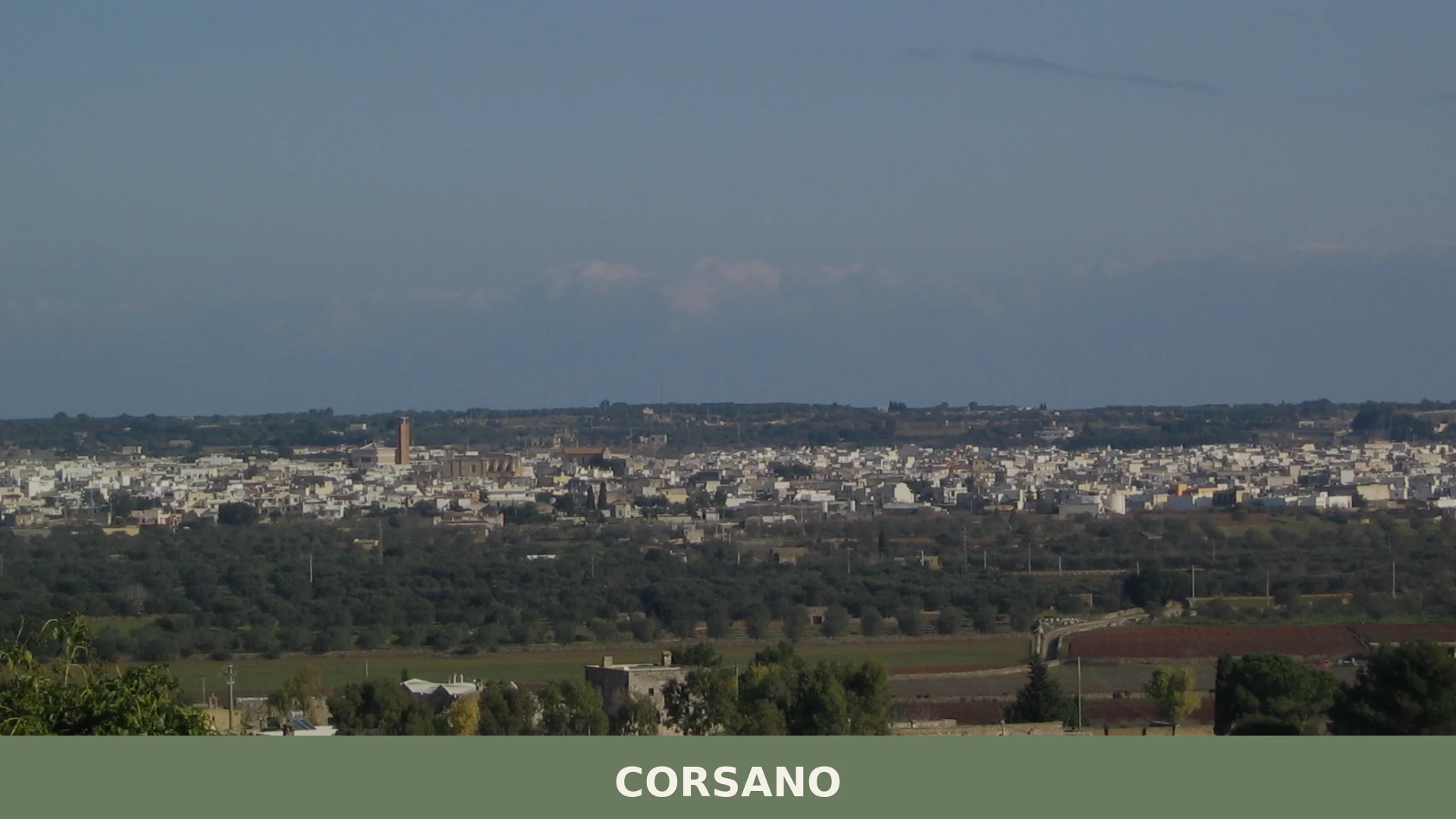
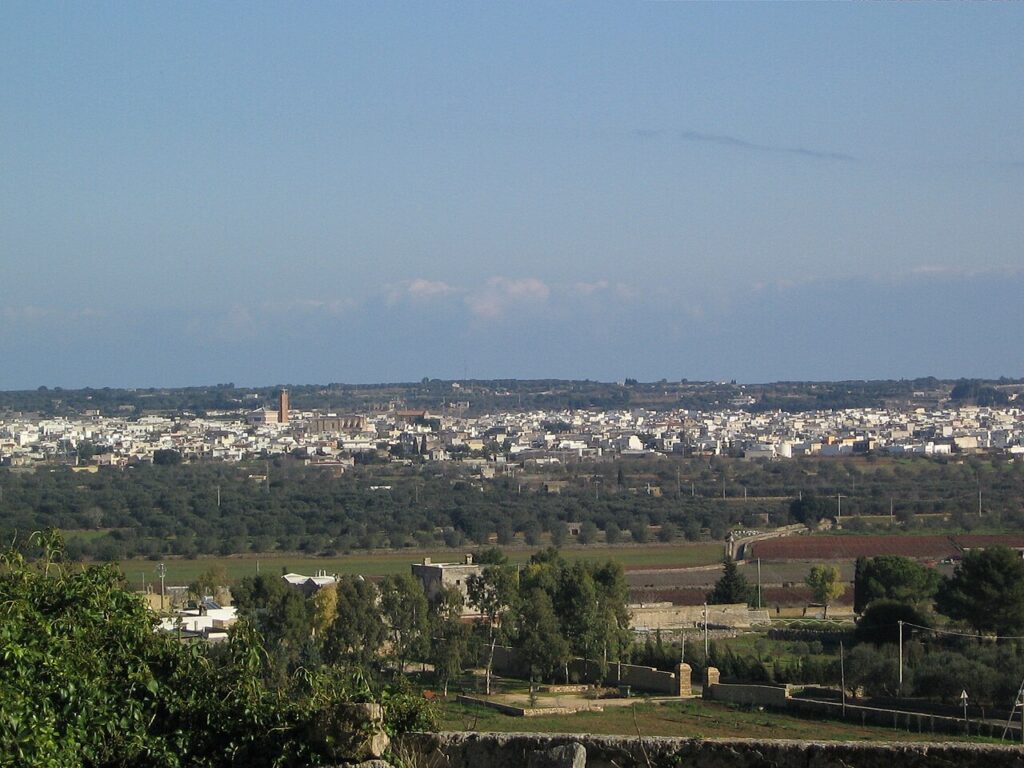
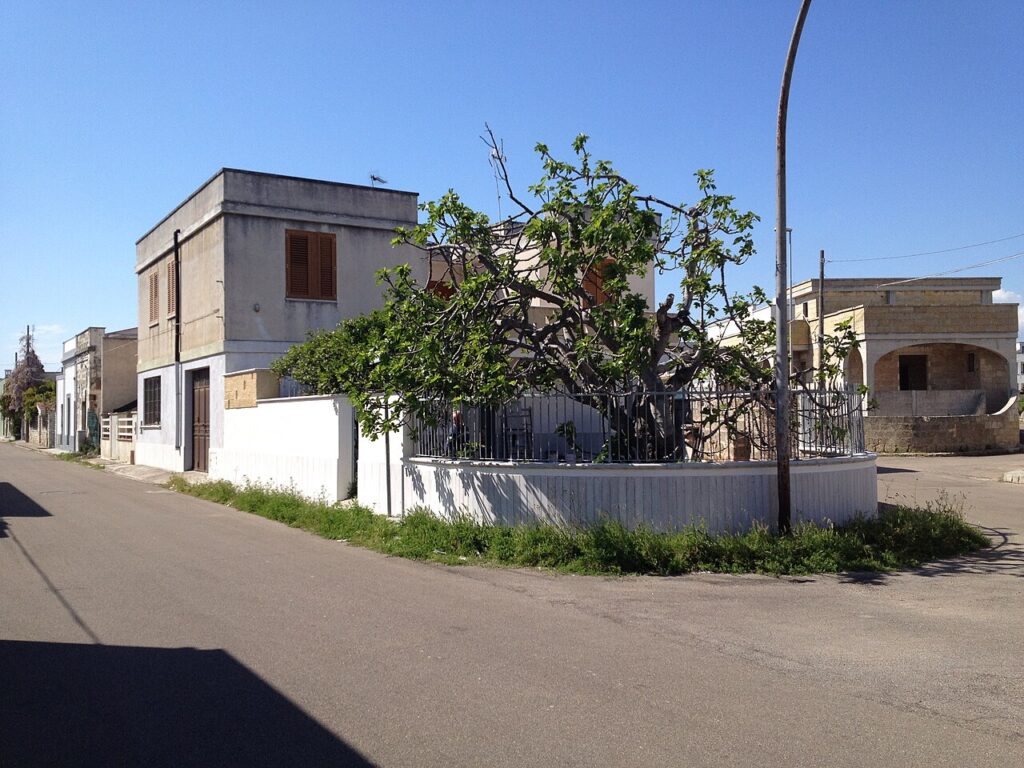
Corsano sits at 121 metres above sea level on the eastern slopes of the Salento peninsula, where limestone plateaus descend toward the rocky Adriatic coastline and the light is sharp and white across karst terrain. The village occupies a threshold between inland serra and open water, its narrow streets and stone buildings clustered on slopes that descend toward the sea four kilometres away.
Corsano village in Apulia Alessano and Tiggiano, and the Adriatic to the east. Two things draw visitors: the density of religious architecture—nine chapels and three churches within the village nucleus—and a living craft tradition of handmade ties that continues here while it has vanished from most of southern Italy. Since October 2006, part of the municipal territory lies within the Parco Costa Otranto – Santa Maria di Leuca e Bosco di Tricase, a regional park established to protect the coastline’s architectural heritage and rare flora and fauna.
From Roman Settlement to Medieval Fief
The territory shows signs of habitation in ancient times, marked by the presence of specchie—loose-stone beacon structures. According to historical study, the village name derives from Cortius, a Roman centurion to whom the territory was assigned following Rome’s conquest of the Salento peninsula. A foundation phase under Roman occupation in the fifth century BCE is supported by coins and domestic objects unearthed in the area, though the first substantial settlement likely emerged in the tenth century under Byzantine rule, confirmed by coinage and tombs found in the locality called “Pesco”.
The arrival of Basilian monks fleeing the iconoclastic persecutions of Emperor Leo III in the early eighth century left a lasting mark on Corsano’s religious identity. These monks from the Near East established the cult of two patron saints—Santa Sofia and San Biagio—and contributed to the village’s founding as a casale, or fortified agricultural settlement. The settlement then expanded when Saracen raids destroyed neighbouring hamlets such as Macurano and Vagliano, concentrating population in Corsano itself.
Medieval ownership passed through feudal hands in fragmentary patterns. The Norman king Tancredi d’Altavilla granted the borough to Fabiano Securo, who fortified it with walls. Over the following centuries, the fief divided and recombined: in the late thirteenth century it was split among four lords; by 1377–1378 it belonged to the brothers Filippo and Simone de Cursano. By 1525, the fief was held in two equal parts by Bernardo de Frisis and Angelo Securo. It subsequently became the fief of the De Capua and Filomarino families, who controlled it before the time of Giovan Giuseppe Securo, the last baron of the Securo family, who sold the casale on 24 May 1636 to Giovan Tommaso Capece. The Capece family retained the baronial title until the abolition of feudalism in 1806.
The Basilian monks carried with them not conquests or armies, but the faith and artistic traditions of the Christian East.
Religious Architecture and the Sacred Landscape
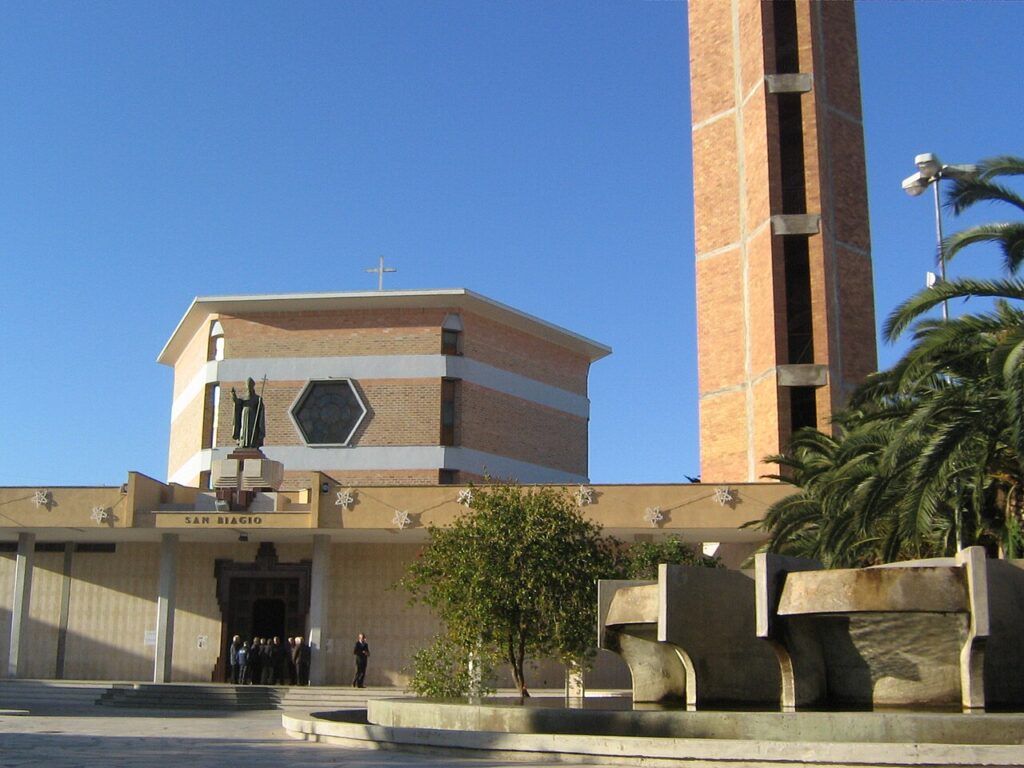
Chiesa di San Biagio
The current parish church dedicated to Saint Blaise, patron of Corsano, was inaugurated on 19 March 1967 in a modern architectural language. The structure comprises two geometric volumes—a lower, irregular pentagon and a central hexagon—supported by six pentagonal pillars at the hexagon’s vertices. Three altars occupy the interior; the lateral altars hold the tabernacle and a statue of the Madonna. Notable are the stained-glass windows commissioned for the Jubilee 2000 and a central chandelier with four concentric rings adorned with olive leaves in gold. Between 2023 and 2025, the original bell tower underwent reconstruction due to structural concerns, preserving its original form.
Chiesa di Santa Sofia
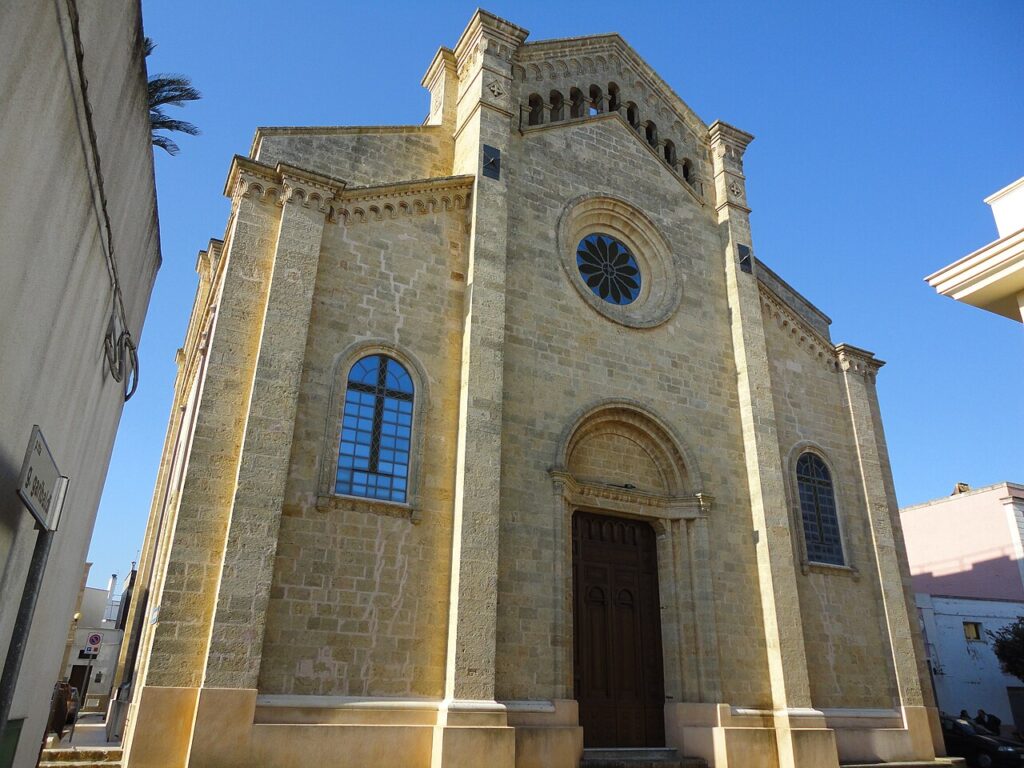
Santa Sofia was rebuilt in 1939 atop the ruins of a sixteenth-century church that collapsed on 17 April 1932 when its bell tower gave way. The rebuilt facade echoes Romanesque style. The interior follows a three-nave basilica plan with three altars: the high altar dedicated to Saint Sophia, and two side altars to Saint Blaise and Our Lady of the Rosary. A Carrara marble baptismal font from the early nineteenth century, wooden furnishings including a pulpit dated 1777, and a seventeenth-century wooden statue of San Biagio (transferred from the Church of the Immaculate in 2009) are preserved. The church underwent major foundation reinforcement work due to unstable calcareous subsoil and reopened to worship in April 2009.
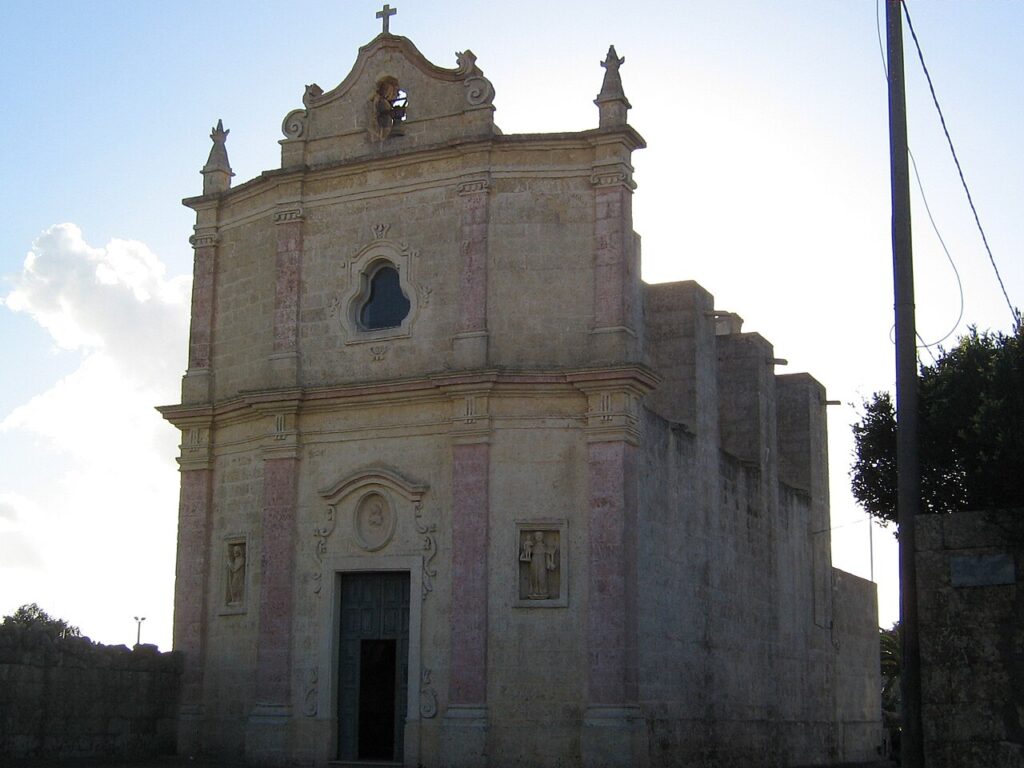
Chiesa dell’Immacolata (La Congrega)
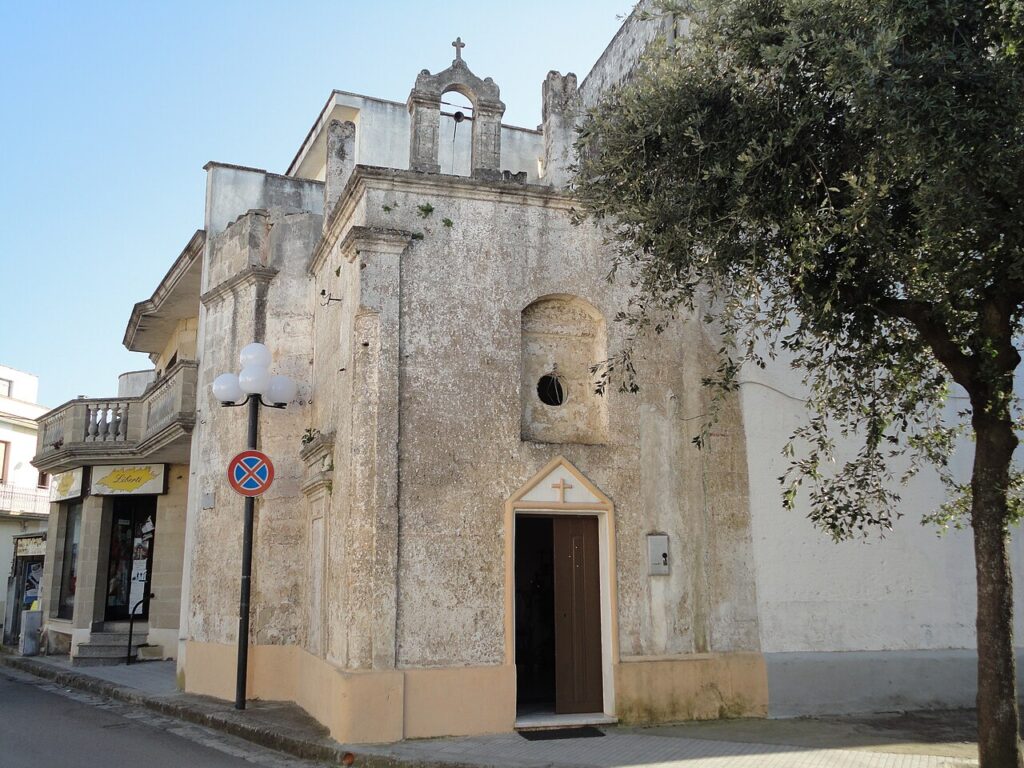
Known locally as La Congrega, the Church of the Immaculate was already standing in the eighteenth century—a parchment from 1777 records privileges granted to its resident confraternity. The sober Lecce stone facade features tall pilasters and two niches flanking the entrance portal, housing statues of Saint Anthony of Padua and Saint Francis of Paola. A single nave with three arches on each side and a ribbed vault comprise the interior. An ornate Baroque altar venerates the Immaculate, and a gallery accommodates the choir and pipe organ. A statue of the Immaculate dated 1871 is on display. When Santa Sofia collapsed in 1932, La Congrega served as the village’s mother church until 1939.
Cappella di Santa Maura
Standing alone in open countryside within the Santa Maura district, this chapel occupies a site of early medieval origin, possibly as a rupestral (rock-cut) church later expanded above ground. By the mid-twentieth century, deterioration led to demolition and complete reconstruction. The current simple single-room structure contains a statue of the saint and a stone altar. Every 1 May, a traditional country fair fills the plaza in front of the chapel, a custom that ties the sanctuary to the rhythm of local agricultural life.
Basilican Crypt and Scattered Chapels
A Basilian crypt carved entirely into calcarenite stone lies in the Li Tumari district along the road toward Marina di Novaglie. Two communicating rooms, an altar, incised marks, and a stone bed testify to monastic presence and worship. Additional chapels dot the village and countryside: the Cappella di San Bartolomeo (built 1714), with a painting of the saint’s martyrdom; the Cappella dei Santi Medici (Madonna dell’Alto), dedicated to Saints Cosmas and Damian, with fragments of fresco; and several others maintained by private families or dedicated to local devotions.
The Baronial Castle and Secular Heritage
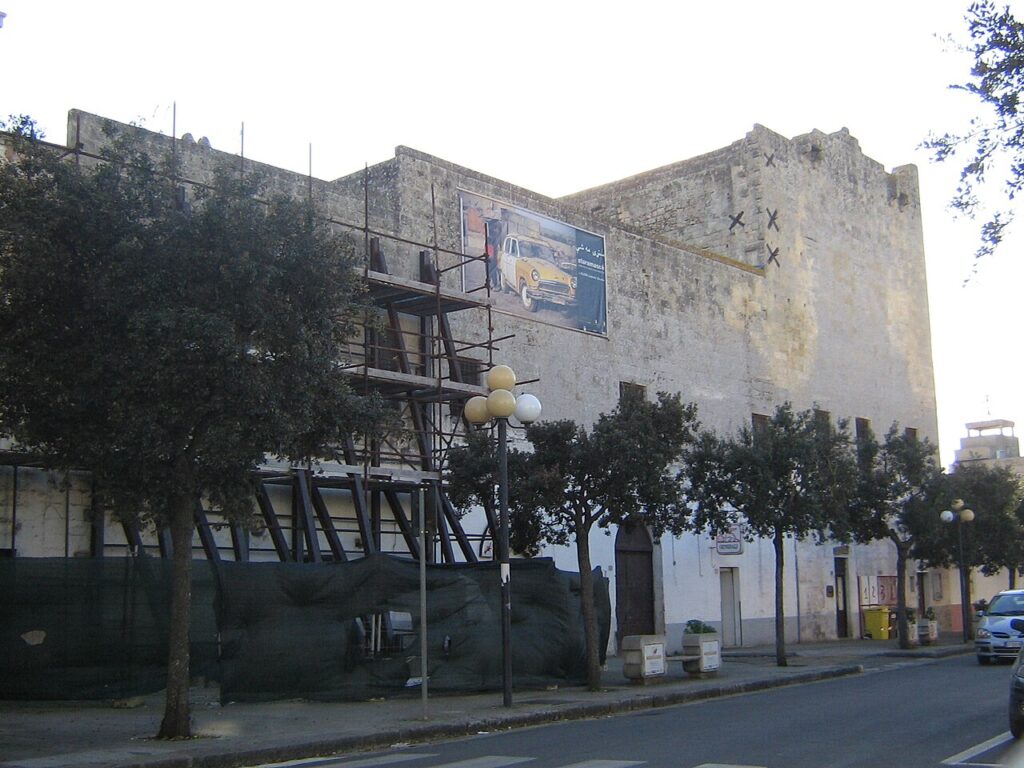
The Castello Baronale Capece was erected in the seventeenth century over the foundations of an earlier fortress. Over the centuries it underwent modification; in the modern era it served as a tobacco-processing depot. Stellar and barrel vaults crown the ceilings, and a hanging garden adorns one elevation. Fragments of frescoes and modest stone reliefs remain in the noble-floor rooms and throne hall. Local tradition speaks of a secret underground passage that allowed the baron safe passage to open countryside in times of danger—a detail whose authenticity is not documented with certainty.
Flavours of the Salento Lowlands
Corsano’s agricultural base and coastal proximity provide access to Salento ingredients and culinary traditions rooted in seasonal produce, Adriatic fish, vegetables preserved in oil, seafood pastas, and bread made from durum wheat. The region produces protected-origin products including olive oil carrying the IGP Olio di Puglia designation and regional wines. The village is also known for artisanal tie production—a craft heritage that persists in small family workshops.
Planning Your Visit
Corsano experiences a Mediterranean climate with mild winters (average January temperature around 9 °C) and warm, humid summers (August average 25 °C). Rainfall concentrates in autumn and winter; spring and summer are drier. The village is classified in seismic zone 4 (very low seismicity). Visitors arriving by car will find Corsano accessible from the provincial road network; the comune sits inland but within easy reach of the Marina di Novaglie locality on the coast and the broader Capo di Leuca peninsula.
| Departure Point | Distance | Approximate Travel Time |
|---|---|---|
| Lecce (provincial capital) | 37 km north | 45 minutes by car |
| Brindisi airport | 75 km north | 1 hour 15 minutes |
| Otranto (Adriatic coast) | approximately 35–40 km north | 30 minutes by car |
The village lies on the Cammino del Salento (Salento Pilgrimage Route), making it an accessible waypoint for walkers and spiritual travellers. The feast of the patron saint, San Biagio, falls on 3 February. Nearby Alessano and the municipalities around the Capo di Leuca peninsula offer extension routes for those exploring the southern Salento landscape. The incorporation of part of Corsano’s territory into the regional coastal park since 2006 has preserved the eastern approaches and marine ecology, making the village a point of entry to protected natural and archaeological zones.
 Mountain