Winter fog settles low over the fields south of Turin, and the houses of Riva gather close to the old stone paths as if they still remember the medieval walls now long gone. The air carries the weight of centuries—not in grand monuments, but in the particular quiet of a place rebuilt after devastation, where devotion and architecture speak together.
Riva presso Chieri village in Piedmont sits at 262 metres above sea level in the Turin province, a modest comune of fewer than 5,000 residents whose identity formed through proximity to the medieval powerhouse of Chieri and through a succession of rulers who left their mark in stone and privilege. Two principal draws shape a visit: the architectural legacy of the 18th century, visible in both sacred and civic buildings, and the lingering memory of a sanctuary built in response to a plague that mysteriously spared the village.
“In the name of Christ and in praise of the glorious Virgin Mary and the illustrious soldier Sant’Albano, patron of this land of Riva…” — from the municipal statutes of 1509, the oath sworn by the Podestà upon taking office.
From Barbarossa to Savoy: The Long History of a Border Village
The first documentary mention of Riva appears in 1152, when the Holy Roman Emperor Frederick I Barbarossa confirmed authority over the settlement to Guido, count of Biandrate. At that time, Riva was already substantial enough to warrant a castle, and control of it was contested—the emperor himself held feudal dominion over half the comune, while the Biandrate counts claimed the rest. This divided rule shaped centuries of local tension.
From the 13th century onward, Riva’s fate became inseparable from Chieri’s expansion. In 1223, Chieri purchased Riva outright, absorbing it into a growing network of territories. By the early 14th century, the village had become a refuge for Ghibelline exiles fleeing Asti, transforming it into a military stronghold. An assault in 1318 by forces under Ugone di Balzo brought devastating violence; the chronicles report the attackers showed no mercy once they breached the walls.
By the late 14th century, Riva had passed into Savoyard hands. The 17th century brought both favour and catastrophe. In 1630, as plague ravaged the region, Vittorio Amedeo I of Savoy and his court fled Turin and sheltered in Riva—the village, against all likelihood, remained untouched by contagion. This miraculous escape prompted a collective vow that would lead to the construction of the Sanctuary of the Madonna della Fontana. Sixty years later, in 1691, French armies under Louis XIV burned much of Riva in reprisal during campaigns against the League of Augsburg. That fire destroyed substantial medieval fabric, leaving modern Riva largely an 18th-century creation built upon older foundations.
Churches and Palaces: The Architectural Imprint of the Settecento
The Parish Church of Maria Vergine Assunta
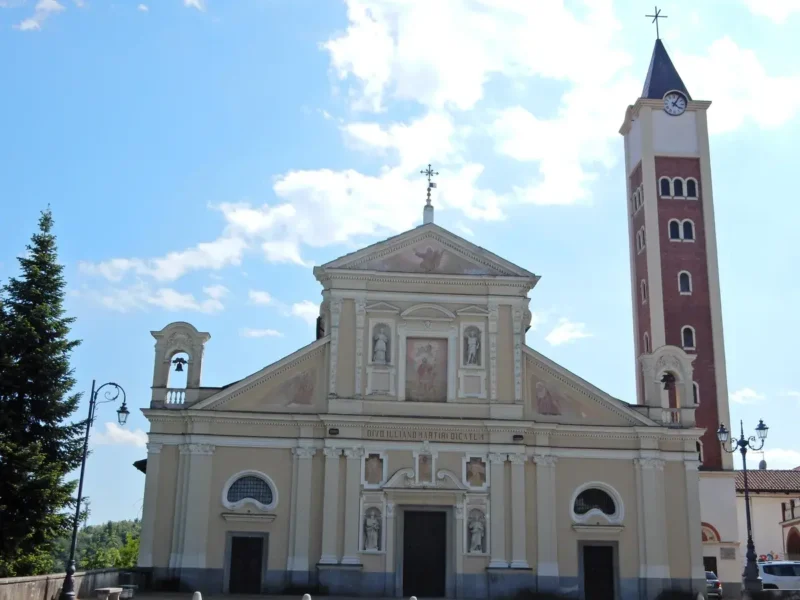
The present parish church arose in stages beginning in 1725, when municipal authorities decided the existing structure was beyond repair. Work proceeded fitfully under successive architects. Bernardo Vittone, a Piedmontese master of the period, took charge of the project and shaped the façade and the distinctive octagonal cupola before his death in 1770. The building was completed two decades later, in 1792. The interior preserves 18th-century frescoes, including a cupolino painted by Giuseppe Sariga in 1761. The church stands as a tangible record of how a small village could command the services of significant architectural talent and maintain construction across generations.
The Palazzo Municipale and Its Artistic Treasures
The noble palazzo now serving as the town hall was built by the Grosso family of Bruzolo, a lineage that had acquired both feud and castle of Riva. Constructed between 1760 and 1770 under Bernardo Vittone’s direction—and completed with contributions from other architects of the period—the palazzo exemplifies Piedmontese domestic grandeur of modest scale. Its interior walls carry frescoes by Giovanni and Antonio Torricelli, skilled painters from Como, and by Pietro Palmieri. The palazzo also preserves drawings by Leopoldo Pollack, an architect commissioned to design two gardens for the adjoining grounds in 1796–1797. These sketches, now held in the municipal archive, document Pollack’s work. The Grosso family donated the palazzo to the comune in 1834.
The Sanctuary of the Madonna della Fontana
Rising from a collective vow made in 1630 during the plague, this sanctuary embodies gratitude for deliverance. A simple chapel was erected in 1634 and enlarged into a church within a few years. The structure deteriorated, and in the 18th century a new building was commissioned. Bernardo Vittone designed it, but his death delayed execution; Luigi Barberis, trained under Vittone, completed construction between 1777 and 1779. The sanctuary stands as a focal point of local piety and architectural continuity—three generations of building shaped by single vision.
The Museum of Sound Landscape
Within the Palazzo Grosso, the comune has established a civic museum dedicated to the study and appreciation of sound as cultural heritage. The museum forms part of a regional library and cultural network, extending Riva’s reach beyond conventional tourism into contemporary interpretation of landscape and sense.
The Table of Sant’Albano and Local Devotion
Sant’Albano, identified by tradition as a martyr of the Theban Legion, has been the patron saint of Riva since at least the 12th century—a document from 1103 originating in the locality bearing his name confirms the cult was already established. The 1509 municipal statutes invoke him by name, and the oath of office sworn by the Podestà invoked his protection. Popular legend describes a miraculous encounter: a farmer’s cart, laden with sheaves, became mired in mud after rain. His oxen exhausted, the contadino cursed in frustration until Sant’Albano appeared and instructed him to hitch dogs to the yoke instead. The animals succeeded where oxen had failed, converting the farmer’s blasphemy into prayer at the sight of such wonder. Whether historical or purely devotional, the tale anchors the saint to rural life and divine intervention in earthly struggle.
Agriculture, Textiles and Industrial Roots
Like its neighbour Chieri, Riva based its economy for centuries on agriculture supplemented by textile manufacture. Historical records note that most residents worked the fertile surrounding countryside, while others wove linen and cotton fabrics—often on commission from the celebrated mills of Chieri. A significant portion also migrated seasonally to the Martini & Rossi vermouth and liquor factory at nearby Pessione. The village’s modern era brought industrialisation; today a substantial industrial zone hosts manufacturing enterprises, including biotechnology operations. This economic layering—agricultural foundation overlaid with textile craft, then industrial development—remains visible in the landscape and in the rhythm of local life.
Planning Your Visit: Season, Access and Practical Notes
Riva presso Chieri lies within the greater Turin metropolitan area, making it accessible year-round, though winter brings the famed Piedmontese fog that can obscure the landscape for weeks. Spring and autumn offer clearer skies and milder temperatures. The village centre retains a quiet, residential character; visitors should expect a slower pace than in nearby Chieri or Turin itself. Accommodation options are modest; most travellers use Riva as a day trip or overnight base while exploring the Turin province more broadly.
| Departure Point | Distance | Approximate Travel Time |
|---|---|---|
| Turin city centre | 25 km south-southeast | 30–40 minutes by car |
| Chieri town centre | 5 km northeast | 10 minutes by car |
| Turin Caselle airport | 40 km north | 45–55 minutes by car |
Public transport connects Riva to Turin and Chieri via regional bus routes; however, having a car simplifies exploration of the surrounding villages and countryside. The comune is situated in one of the colder and foggier microclimates of the Turin plain, a geographical quirk noted by residents and historians alike. Winter humidity can be intense, so waterproof layers and patience with reduced visibility are recommended.
The village pairs naturally with visits to nearby Chieri—a major medieval comune with its own cathedral and civic monuments—and with exploration of the network of smaller comuni that ring Turin’s southern suburbs. Andezeno, Arignano, and Moriondo Torinese all lie within easy reach and share similar historical layers—rural settlement, textile manufacture, 18th-century rebuilding, and integration into Savoyard administration.
The Rhythm of Local Life and Memory
Riva presso Chieri does not offer the monumental splendour of Turin or the intact medieval townscape of some hill villages. What it offers instead is the texture of a working comune that has survived plague, warfare, and industrial transformation while maintaining its core identity through architecture and faith. The churches and palazzo testify to periods of prosperity and ambition; the quiet streets acknowledge loss and adaptation. For visitors drawn to the quieter, less-publicised corners of Piedmont—places where history is embedded in domestic buildings and local devotion rather than broadcast through major attractions—Riva provides a genuine encounter with how ordinary communities navigated extraordinary events and preserved memory through stone.



 Mountain