On the flat limestone plain of southern Salento, where olive groves stretch across the horizon and medieval stone crypts lie hidden beneath the soil, San Cassiano rises as a modest but historically layered village. The settlement sits at 90 metres above sea level. Terracotta roofs and pale stone walls catch the Mediterranean light that defines this corner of Lecce province.
San Cassiano village in Apulia originated in the aftermath of catastrophe. When Saracen forces destroyed the nearby town of Muro Leccese around the early 11th century, survivors sought shelter near an ancient Christian crypt dedicated to the Madonna della Consolazione. Over time, this refuge became a permanent settlement, evolving through feudal hands and papal grants into the small comune it remains today, now an autonomous municipality since 1975.
Foundation and Feudal Passage
The name San Cassiano reflects a centuries-old veneration: tradition holds that San Cassiano, a bishop of Imola, passed through this place toward the end of the 3rd century and left his spiritual mark. The documented history, however, begins with survival. Presumed to have arisen around 1033 following Muro Leccese’s destruction, San Cassiano took shape as a small agglomerate of refugees clustered near a Christian crypt.
In the Norman period, Tancredi d’Altavilla brought the casale into the Contea di Lecce. From there, the feud passed through a succession of nobles: Raimondello Orsini del Balzo acquired it in 1398; Maria d’Enghien, countess of Lecce, granted it to her counsellor Agostino Guarini during the 15th century. When Marco Antonio Guarini took part in the baronial conspiracy against the crown in 1532, he was stripped of the domain, which then passed to Ludovico Peschin. The pattern repeated across the 16th and 17th centuries—Squarcifico, the Crown, Vittoria Doria (marchesa of Galatone), Panza, Mosco—until the Lubelli family held it from 1620 to 1747. The Frisari, who obtained the title of count in 1755, were the last feudal lords, ruling until the abolition of feudalism in 1808.
San Cassiano was not granted independence until 1975, when it separated from Nociglia by regional law, gaining its own municipal identity after centuries as a feud and a satellite settlement.
Sacred Spaces and Stone Memory
Cripta della Madonna della Consolazione
The crypt of the Madonna della Consolazione is the soul of San Cassiano’s antiquity. Carved entirely from soft calcarenite rock, this basilica-form sanctuary served the eastern Christian monks who kept vigil here. The interior opens into three naves with two oriented apses, its walls layered with frescoes spanning from the 11th to the 17th centuries—visual palimpsests of Byzantine devotion and later Latin faith. When the Counter-Reformation shifted the liturgy from Greek to Latin rite, the altar was rotated and repositioned; structural reinforcement in recent decades restored the crypt’s integrity while preserving the ghostly traces of its sacred imagery.
Chiesa Madre di San Leonardo Abate
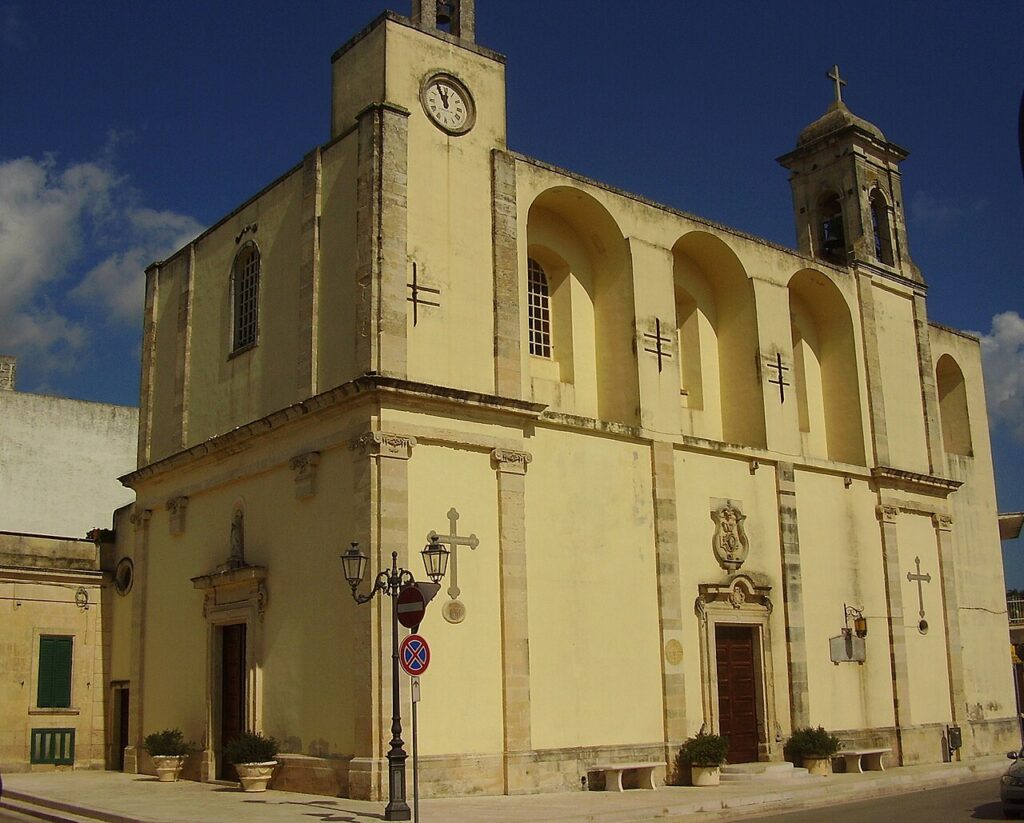
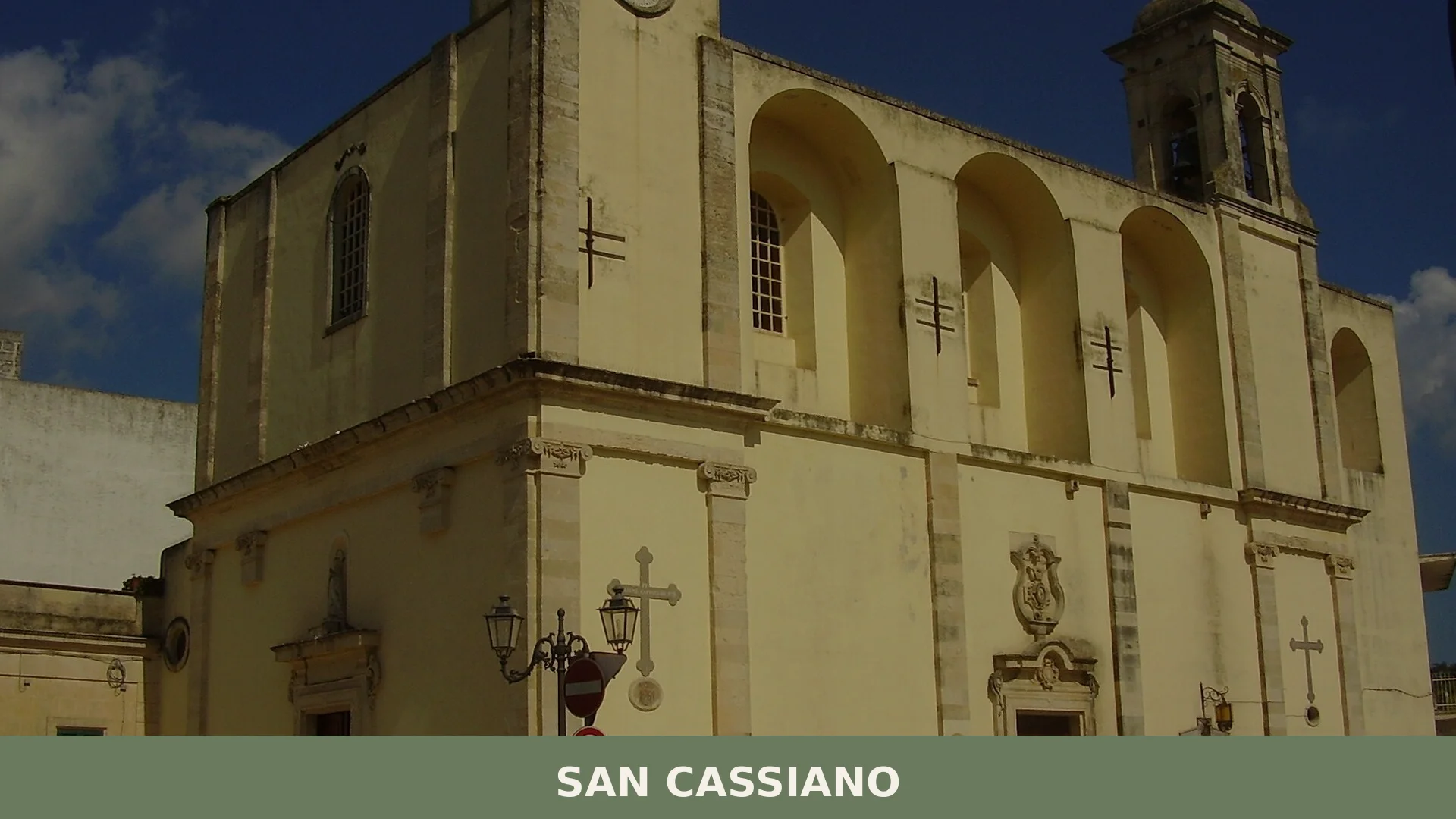
The parish church, dedicated to San Leonardo Abate, began as a 16th-century foundation—evidenced by a pastoral visit in 1522—but underwent near-complete rebuilding in 1849. The facade presents a central portal crowned by a statue of the Madonna of Lourdes, flanked by two bell towers. Inside, two naves unfold toward a limestone altar and wooden organ. Side chapels hold altars to San Rocco, San Francesco da Paola (the altar itself dated 1867), and to souls in purgatory. The church structure underwent radical reform in 1613 and sustained repairs into the 1750s before its 19th-century restoration returned it to use as the village’s spiritual anchor.
Chiesa della Congrega di Maria SS. Assunta
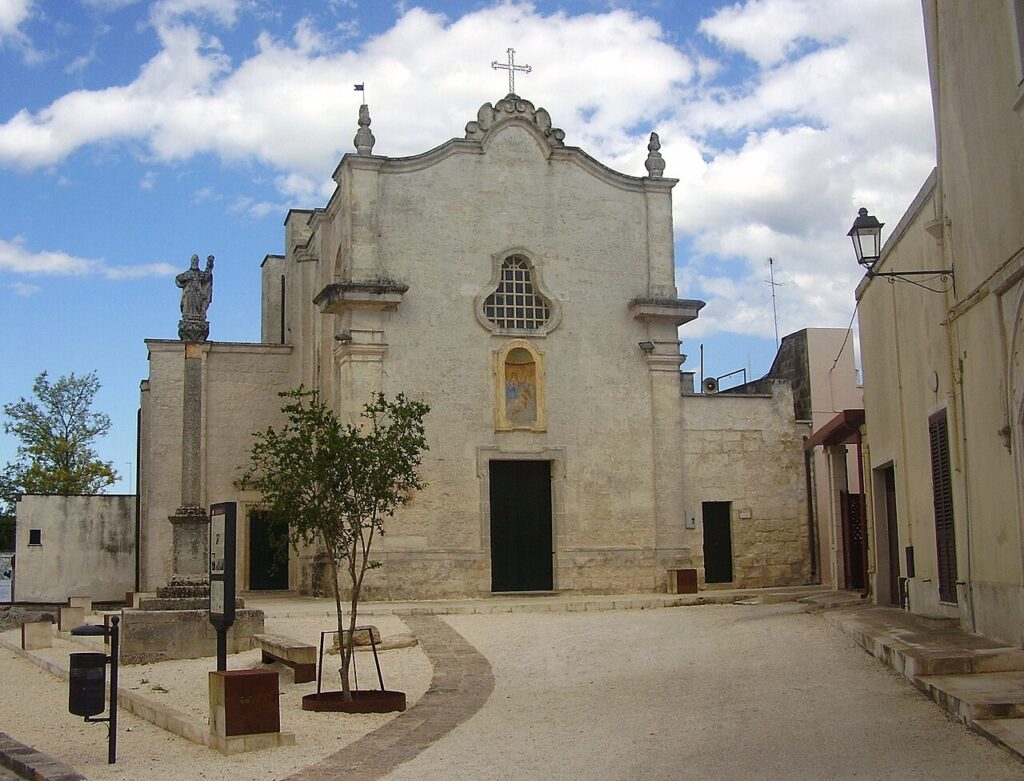
Erected in 1770 in late-Baroque taste, the Confraternity church sits near the former protected site of Sant’Eligio’s column. Its single nave is punctuated by three stone altars in local Lecce limestone: the high altar holds a painted Ecce Homo; the right altar honours Sant’Anna with the Holy Family; the left altar displays an Immacolata Concezione. Recent archaeology beneath this church has revealed a medieval cemetery, indicating that Christian worship on this spot reaches back beyond the 18th century. The Confraternity of the Virgin Assumed maintains the space as a focal point of devotional life.
Palazzo Ducale
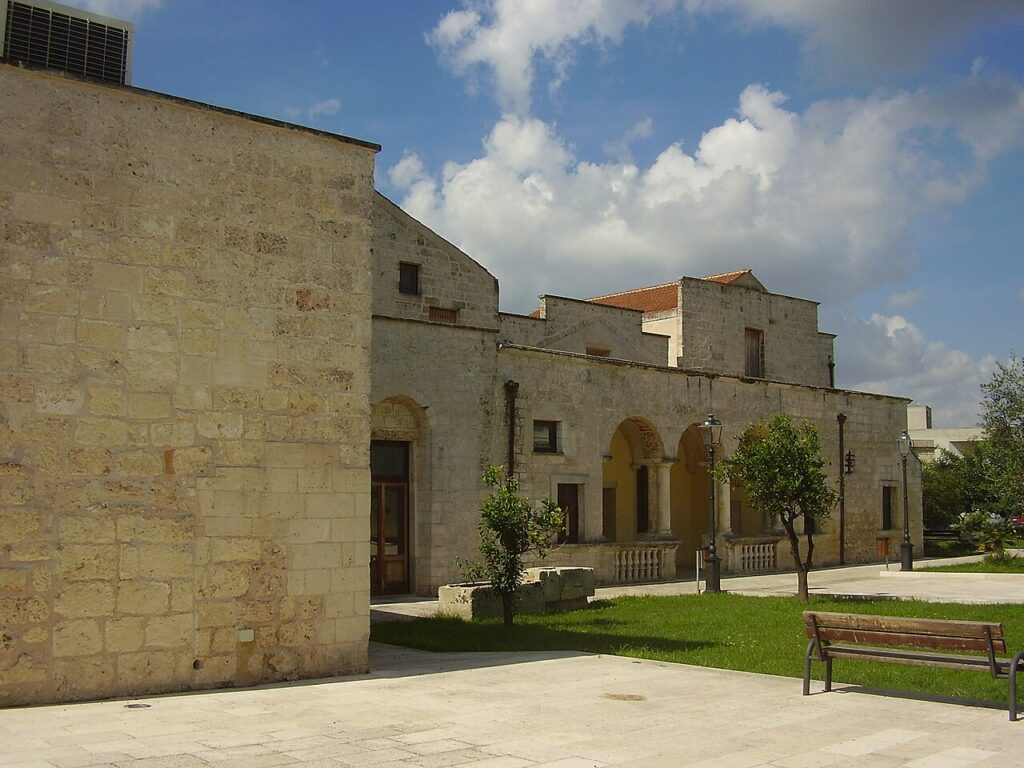
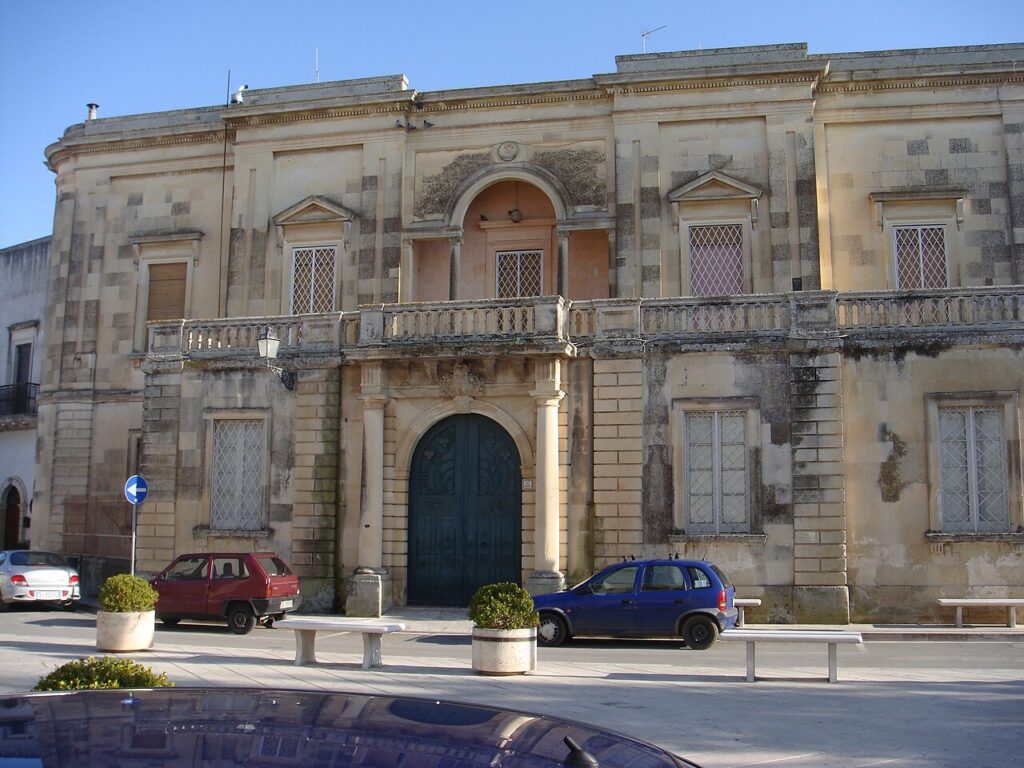
The Palazzo Ducale stands as a secular counterpoint to the sacred monuments. Originally a fortified castello from the 16th century, complete with watchtowers, it was reshaped dramatically during the 18th century, particularly around 1720 under the Lubelli family’s stewardship. The palazzo’s current form blends Renaissance structure with Baroque refinement. Since 1982, when the municipal administration purchased it, the Palazzo has served as the seat of local government, housing the comune’s offices and records within walls that once sheltered noble families and their feudal authority.
Landscape, Seasons and Agricultural Rhythm
San Cassiano occupies 8.55 square kilometres of the Salento’s characteristic flat or gently rolling terrain. The Parco dei Paduli, a rural expanse within the municipality, preserves an older landscape: ancient olive groves, some centuries old, share space with venerable oak trees—surviving remnants of the Bosco di Belvedere, a medieval woodland now fragmented. Elevation ranges narrowly between 82 and 114 metres. The climate is Mediterranean: mild winters averaging 9.9 °C in January, hot and humid summers reaching 41 °C by August. Rainfall is modest—around 67 millimetres annually—concentrated in autumn and early winter, leaving spring and summer dry. The Salento’s limestone ridges to the west shelter the village from harsh Atlantic gales, allowing southern and south-easterly winds to dominate autumn and winter weather.
The local dialect is the southern Salentine variant of Romance speech, bearing traces of Messapian, Greek, Roman, Byzantine, Norman, Albanian and Iberian influence accumulated across centuries of conquest and settlement.
Tastes of the Territory
San Cassiano inherits the agricultural tradition of the wider Salento. Olive oil, produced across the Puglia region under protected designation, anchors local economy and diet. The Olio di Puglia IGP protected-origin designation covers oils from this zone, from groves adapted to drought and salt wind. Beyond oil, the region yields vegetables and legumes adapted to dry conditions: preserved peppers, sun-dried aubergines, and pulse crops appear in traditional preparations across the province. If visiting during summer, the Festa de U Cannuzzutu (8 August) marks a moment when local tables celebrate seasonal produce and neighbourhood gathering.
Visiting San Cassiano: Season and Access
The village welcomes visitors year-round, though spring (April–May) and autumn (September–October) offer the most comfortable conditions. Summers are intensely hot; winters mild but subject to occasional rain. The main religious calendar pivots on the feast of San Rocco, celebrated 17–19 August, when the village hosts traditional observances honouring its patron. Summer also brings the Madonna della Consolazione festival (2 July) and the village’s spring sagra for San Giuseppe (the Saturday after 19 March).
San Cassiano is reached via the SS 275 state road linking Maglie and Santa Maria di Leuca. Provincial roads connect from Poggiardo (SP160), Surano (SP237), and the neighbouring town of Botrugno. The village sits within a cluster of small comuni in Lecce province; nearby places like Botrugno and Corigliano d’Otranto offer additional cultural routes through the southern Salento.
| Departure point | Distance | Approximate time |
|---|---|---|
| Lecce city centre | 40 km | 45 minutes by car |
| Brindisi airport | 60 km | 1 hour by car |
| Otranto (coastal) | 35 km | 40 minutes by car |
The village is best explored on foot. The crypt lies slightly outside the built centre and requires advance coordination with local custodians or parish authorities; enquire at the comune offices. A morning visit to the parish church and palazzo, followed by a walk through the olive groves of Parco dei Paduli, captures the layered identity of this small but historically resonant settlement.