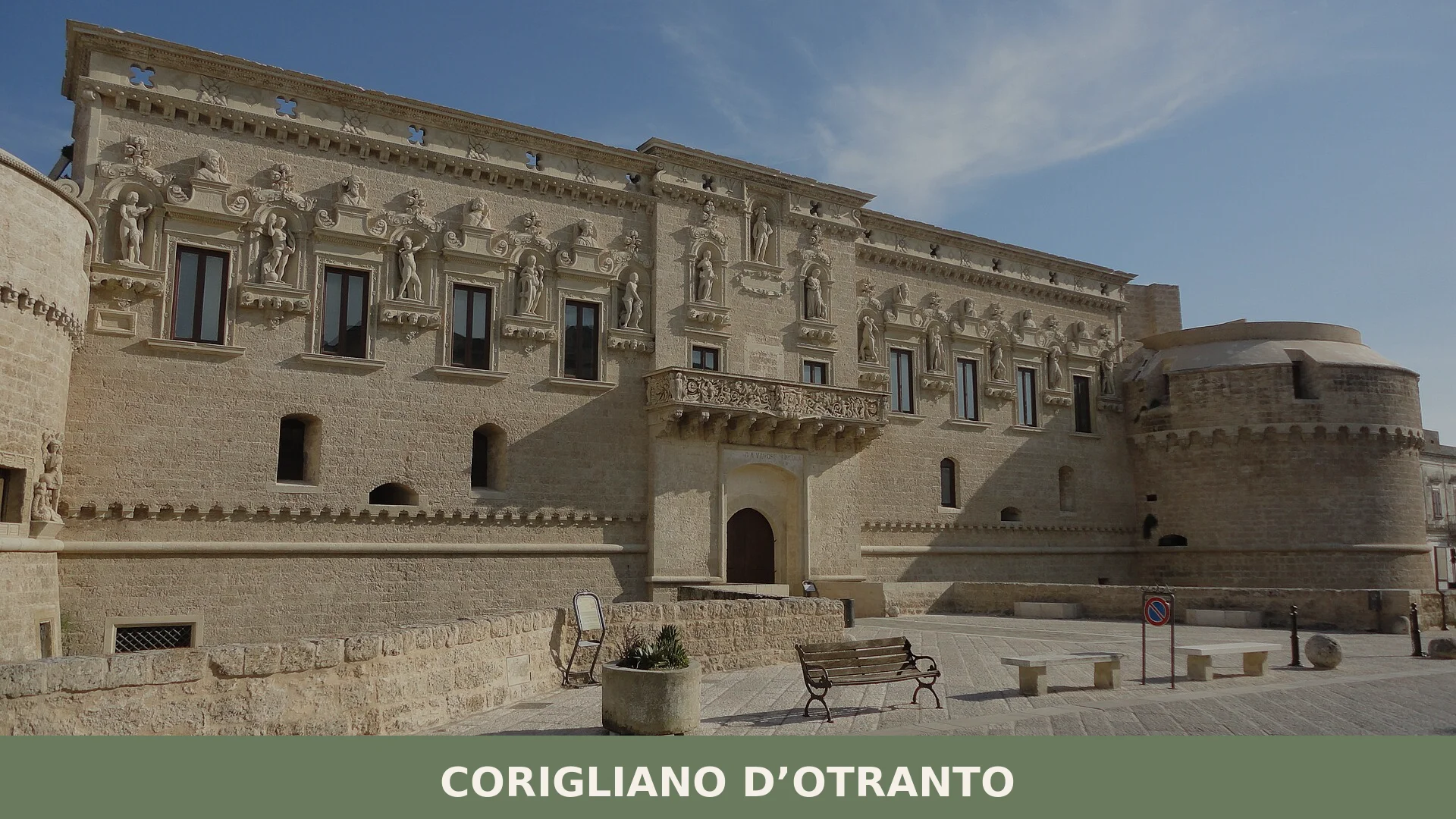
Stone pressed against stone in concentric streets, the center of Corigliano d’Otranto rises at 97 metres above sea level on the flat, calcareous shelf of the Cretaceous tableland. The walls are leccese limestone, warm and pale under the Mediterranean sun. A medieval tower stands at the core, with a campanile whose inscription on its facade records a 15th-century date.
Corigliano d’Otranto village in Apulia sits within the Grecìa Salentina, an enclave of Greek language and Byzantine culture in the province of Lecce. The village speaks grico—an ancient Greek idiom that has developed through centuries of Greek settlement and cultural layering. Visitors come to trace feudal history in the reconstructed castello, to read the names of saints in the tile work of the main church, and to hear a living language that feels like an echo from Constantinople.
Foundation, Feudal Rule and the Name
The territory of Corigliano d’Otranto was inhabited in prehistoric times, scattered with megalithic traces—specchie, dolmen, menhir—whose builders remain unnamed. The village itself may have originated in the Magna Grecia period, in Roman times, or among the Messapi, the indigenous Italic people. What survives from the Roman epoch is the urban plan of the historic center, where streets and property lots align with the module of the actus, the standard Roman land measurement. The precise founding moment is lost.
The name Corigliano likely derives from the Greek Byzantine term choríon (χωρίον), meaning village, country or territory—a label that stuck as Greek speech remained the everyday language here. A competing tradition ascribes it to a Roman centurion named Corelius, whose assigned lands might have evolved into the Latin forms fundus Corelianus or praedium Corellianum.
Leandro Alberti reported in his Descrittione di tutta Italia (1525) that the guards of Corigliano spoke only Greek.
The Byzantine Monastery and Medieval Transition
A cenobium dedicated to San Giorgio was built in the 9th century and became an intellectual engine for the village. Within its walls operated a school of Greek language and Byzantine culture, producing manuscripts that survive today in the collections of major Italian libraries. The monastery’s cultural reach extended until the late 15th century, when the destruction of the nearby monastery of San Nicola di Casole in Otranto severed the network that sustained it. Corigliano, as a grancia (dependent farmstead) of that larger foundation, felt the blow.
The first written mention of Corigliano appears in 1192, when the Norman king Tancredi d’Altavilla granted it as a fief to Pietro Indini. For the next three centuries, feudal authority passed through multiple families until 1465, when Nicola Antonio de’ Monti, a nobleman of French origin who had arrived during the Angevin period, purchased the territory from the royal treasury.
The de’ Monti Dynasty and Fortification
Under the de’ Monti lords, Corigliano acquired its military character. Giovan Battista de’ Monti, grandson of Nicola Antonio, undertook the work of transformation. Between 1514 and 1519, he fortified the paese and enlarged the castello with powerful artillery, four corner towers, munitions stores and defensive installations designed to withstand siege. In 1534, Emperor Charles V granted him the title of marquis, elevating the family’s status. For more than a century, the de’ Monti ruled continuously—Francesco II, Giovanni II, Geronimo and Giorgio in succession—until Giorgio’s early death in 1649 ended the dynasty.
The feud passed briefly to Giorgio’s sister Giulia and her husband Francesco Sanfelice, then to their son Alfonso. Disputes over the inheritance led to a public auction in 1651, where the wealthy baron Luigi Trane of Tutino acquired the entire estate. The name of the commune itself was formally changed in 1862 from Corigliano to Corigliano d’Otranto, reflecting its geographic and cultural ties to the broader Salento region. Official state recognition of its heraldic symbols—the stemma and gonfalone—followed in 1956.
The Castle and Sacred Architecture
The Castello
The castello rebuilt and strengthened by Giovan Battista de’ Monti between 1514 and 1519 remains the village’s focal point. Its four corner towers and consolidated walls stood as the mark of feudal power and defensive preparedness. Though now integrated into the urban fabric rather than isolated, the structure preserves the imprint of Renaissance military engineering.
Chiesa di San Nicola Vescovo
The mother church of San Nicola Vescovo was erected in the second half of the 16th century on the foundations of an older chapel. Its Renaissance portal, dated 1573, is crowned by a lunette bearing statues of the Redeemer, the Virgin and Saint Nicholas of Myra. The structure was extensively renovated in 1622 and displays a Latin cross plan with three naves supported by columns. An intricate mosaic floor depicting biblical scenes arranged along the Tree of Life was installed in the church. The church houses multiple side altars, including a carved altar dedicated to San Nicola.
Campanile della Chiesa Madre
The campanile (bell tower) rising from the medieval defensive walls presents an architectural puzzle. An inscription on its facade records a 15th-century date.
Chiesa dell’Addolorata
Built in neogothic style, the Chiesa dell’Addolorata houses the Confraternity of Sorrows, which originally met in the now-demolished church of the Assunta. The earlier sanctuary was demolished to make room for the enlargement of Piazza San Nicola. The current facade features a single portal adorned with geometric motifs and topped by a relief of the Pietà sculpted by the mason Giovanni Malorgio. Inside, a canvas depicting the Immaculate Madonna from the late 17th century is displayed, while a 1979 work by the native painter Raffaele Del Savio titled La vita dell’uomo (The Life of Man) adorns the inner facade.
Chiesa della Madonna delle Grazie
The Chiesa della Madonna delle Grazie, rebuilt in the first half of the 17th century, replaces an older sanctuary of the same dedication. It retains a Byzantine fresco of the Madonna of Constantinople from its predecessor. The church follows a single-nave plan with a barrel vault and houses altars to Saint Anthony of Padua and Santa Marina.
Landscape, Climate and Territory
The comune extends across 28.06 square kilometres of limestone plateau, with the village center at 97 metres altitude and the surrounding land ranging from 73 to 109 metres—a modest vertical relief of 36 metres. The bedrock is ancient Cretaceous limestone, fractured and overlain with terra rossa (iron-rich red soil). Because of the terrain’s permeability, rainfall drains rapidly underground, leaving no surface rivers or streams. The traditional solution was the construction of cisterns and shallow wells—pozzelle—scattered across farmland to capture and store seasonal precipitation.
The agro is devoted primarily to olive groves, a foundation of the local rural economy. The climate is Mediterranean: winters mild, averaging 9°C in January; summers warm and humid, 25.1°C in August. Annual rainfall totals approximately 676 millimetres, concentrated in autumn and winter, with dry springs and summers. The comune borders Galatina and Sogliano Cavour to the west; Zollino, Martano and Soleto to the north; Castrignano de’ Greci and Melpignano to the east; and Maglie and Cutrofiano to the south—all within the province of Lecce.
Planning Your Visit
Corigliano d’Otranto lies in the central province of Lecce, easily accessible by car from Lecce city or from the national highways that cross Puglia. The village sits at low altitude on a plateau in a zone of low seismic risk (zone 4). The medieval core is compact and best explored on foot; parking near Piazza San Nicola or at the edge of the historic center is typical. The village functions as a residential and agricultural comune rather than a major tourist resort, so services are local and modest—cafés, a small supermarket, a few restaurants—sufficient for a day visit or a brief stay, but not equivalent to larger Salento centers.
The Cammino del Salento, a regional pilgrimage route, passes through or near the village, linking it to a broader network of cultural and spiritual walking paths across the Salento. Visitors interested in Greco-Italian heritage will find Corigliano d’Otranto a gateway: the municipalities of the Grecìa Salentina, including Calimera, form a linguistic and cultural continuum worth extended exploration. The feast of San Nicola, the village patron saint, falls on 6 December and draws local observance.
| Departure Point | Distance | Travel Time |
|---|---|---|
| Lecce city center | 30 km | 35–40 min by car |
| Brindisi airport | 50 km | 50–60 min by car |
| Otranto (coastal town) | 25 km | 30 min by car |
| Maglie (neighboring comune) | 8 km | 12 min by car |
The best season to visit is spring (April to May) or autumn (September to October), when temperatures are moderate and the landscape is animated by rural work and local festivals. Summer brings heat and can draw tourist crowds to the coast; winter, though mild, often sees grey skies and frequent rain. Visitors should expect a quiet village oriented to agricultural rhythms rather than tourism infrastructure. The appeal lies in its authenticity: an intact feudal core, functioning churches, medieval walls and a living Greek dialect spoken by residents of this centuries-old community.

 Mountain