 Mountain
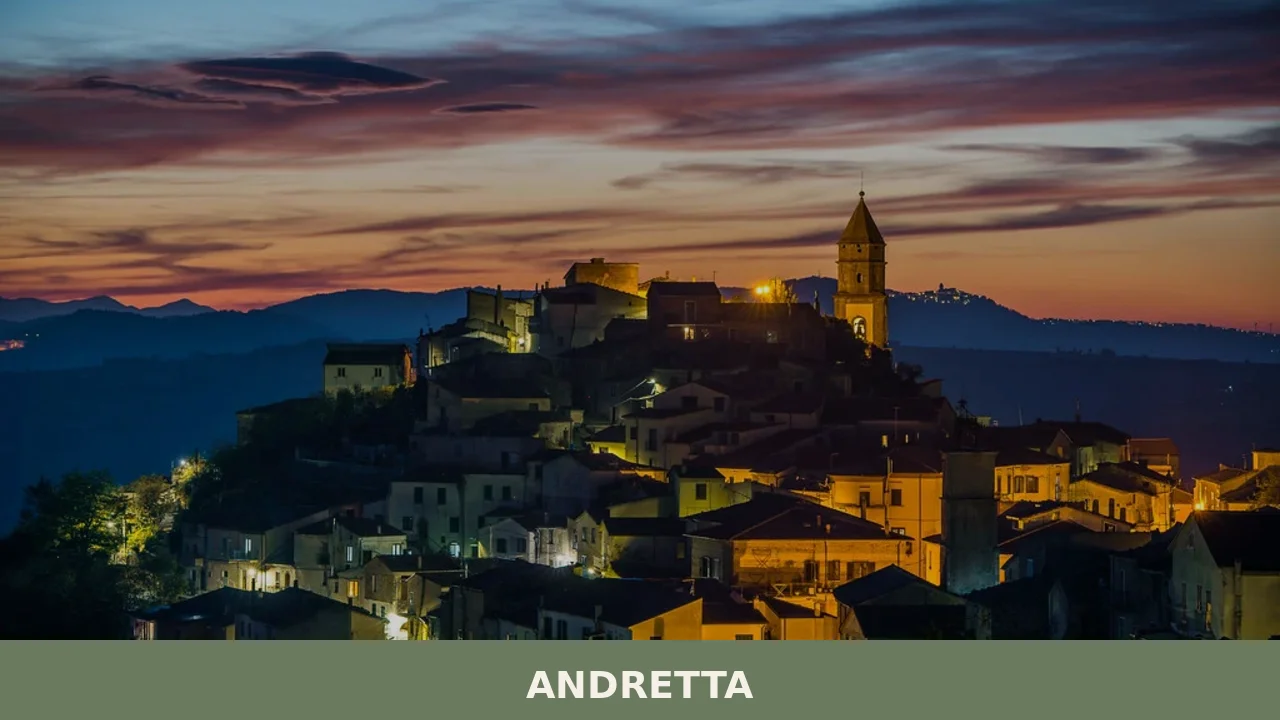
 High on a limestone ridge at 850 metres, Andretta commands the upper Ofanto valley with the compact geometry of a mountain village built to survive. Stone walls rise in tiers from a central spine; the light changes sharply as you move between shadowed alleys and sudden open squares. The air carries the clarity of altitude and the smell of slate roofs after rain.
Andretta village in Campania belongs to the province of Avellino, in the heart of the southern Apennines. It is a place where the rhythm of the mountain still governs the rhythm of inhabitants—a population of roughly 1,647—and where the accumulated knowledge of peasant life persists visibly in the architecture, the festivals and the local museum dedicated to rural craftsmanship.
Origins and Identity of the Mountain Comune
The name Andretta may derive from the Greek term andreia—meaning firmness or fortitude—a name that sits aptly on a village built into steep terrain. Other etymological hypotheses link it to the cognomen Andretta or to a diminutive of Andria, though the precise origin remains debated among scholars.
The territory around Andretta has been inhabited since antiquity. Archaeological traces reveal human presence during the Bronze Age, and later the settlement of Samnite peoples in the 4th century BCE. The village itself appears to have coalesced around an ancient castrum—likely of Norman foundation—that organized the high ground defensively. The commune sits within the Alta Irpinia mountain community, a territorial association that links it to neighbouring comuni of Avellino province including Cairano, Morra De Sanctis, Conza della Campania, Guardia Lombardi and Bisaccia.
The territory’s proximity to the Ofanto river and the enclosing Apennine peaks created a natural fortress, where stone and altitude became the village’s most reliable allies against both invaders and the shifting seasons.
In the modern era, Andretta experienced severe damage from the 1980 earthquake of Irpinia, an event that reshaped buildings and collective memory across the region. Recovery and reconstruction have been ongoing, with civic infrastructure such as the sports centre of Polisportiva Andretta undergoing renovation as recently as 2022.
Sacred Sites and Community Landmarks
Chiesa Madre di Santa Maria Assunta
The parish church dominates the heart of the village. Its present structure dates to the 18th century and exhibits baroque stylistic traits, a rebuild undertaken to repair damage from multiple seismic events. The original edifice rose during the 16th century, anchoring the spiritual life of the community across centuries of geological upheaval. The church remains the focal point of religious observance and civic gathering.
Monte Airola: A Spiritual Mountain
Perched in the upper section of the village lies Monte Airola, a sanctuary carved from natural cavities and shaped into a path of contemplation. At its summit stands a large iron cross. The route is marked by stations depicting the Passion of Christ, with a stone altar and a tilework shrine—decorated with maiolica scenes of the Madonna—at its heart. This sacred space was realized through the vision of Don Leone, a Cairanese priest and significant figure in local spiritual history, whose commitment to creating a mountain sanctuary left a lasting imprint on village identity.
Santuario della Stella Mattutina
Adjacent to an ancient Cistercian convent dating from the 16th century stands the Sanctuary of the Morning Star, also known as the Sanctuary of the Virgin, Star of the Morning. The convent structures and the chapel form a compound of monastic heritage that bridges Renaissance architecture with the devotional landscape of the mountain community.
Piazza Francesco Tedesco and Civil Memory
The central piazza bears the name of a statesman from the village and is fronted by the palazzo of the Tedesco family, a noble residence that stands as a marker of local civic authority. Nearby, a monument to the fallen of the First World War—the work of sculptor Torquato Tamagnini—honours those from Andretta who died in the conflict, embodying the village’s collective grief and remembrance.
Museo della Civiltà Contadina e Artigiana
The Museum of Rural and Artisanal Civilization preserves the knowledge embedded in traditional crafts and agricultural practice. Housed in the village, it displays tools, techniques and domestic objects that document how inhabitants of the mountain region lived, worked and built community across generations. The museum functions as a repository of material memory, offering visitors insight into the rhythms and resourcefulness of peasant life before mechanization.
The Food Culture of the Mountain Territory
The agricultural landscape surrounding Andretta produces foods typical of the Irpinian highlands and the broader Avellino province. The territory yields chestnuts and marrons as well as the Melannurca Campana, a traditional apple variety prized across the region. The Castagna di Montella and Marrone di Serino, both protected designations, are produced in the separate municipalities of Montella and Serino, which lie at a considerable distance from Andretta. Grapes for the wines of the Fiano di Avellino, Greco di Tufo and Taurasi appellations are cultivated in specific neighbouring zones with distinct geographical boundaries—Greco di Tufo in the area around Tufo near the Benevento border, and Taurasi around the town of Taurasi—both well removed from Andretta’s immediate territory. These wines represent the enological character of the Irpinia.
The village kitchen reflects the seasonal availability of mountain produce: legumes, preserved vegetables, grain-based dishes and the cheeses of the upland pastures. The tradition of rural cooking, still visible in household practice and communal meals, rests on ingredients sourced from the immediate territory rather than distant trade—a rhythm that defines the eating calendar across the year.
How to Reach Andretta
Andretta lies in the interior of Campania, distant from major coastal centres. The nearest substantial town is Avellino, the provincial capital. Visitors travelling by private vehicle will find that the road network connecting to the Apennine towns of the province is well maintained, though winding in places. The village itself is compact and best explored on foot once you arrive in the centro storico.
Rail access exists via the station at Conza-Andretta-Cairano, situated in the neighbouring comune of Conza della Campania, on the Avellino–Rocchetta Sant’Antonio line. Currently, this railway operates services for historic and tourist trains rather than regular passenger schedules, making it less practical for everyday access. Regional bus services operated by AIR Campania connect Andretta to surrounding comuni.
| Departure Point | Distance | Approx. Driving Time |
|---|---|---|
| Avellino town | 32 km | 45 minutes |
| Naples (Capodichino) | 78 km | 1 hour 20 minutes |
| Salerno | 64 km | 1 hour 10 minutes |
The best time to visit is late spring through early autumn, when the mountain climate is mild and the landscape most accessible. Winter brings rain and occasional snow at this altitude, reducing visibility and ease of movement. The feast of the patron saint, Sant’Antonio di Padova, falls on 13 June and marks a moment of village celebration. Those interested in rural heritage, mountain spirituality, or simply the material culture of the southern Apennines will find in Andretta a place where such themes remain woven into daily life rather than relegated to museums alone.