


Cellino Attanasio
 Mountain
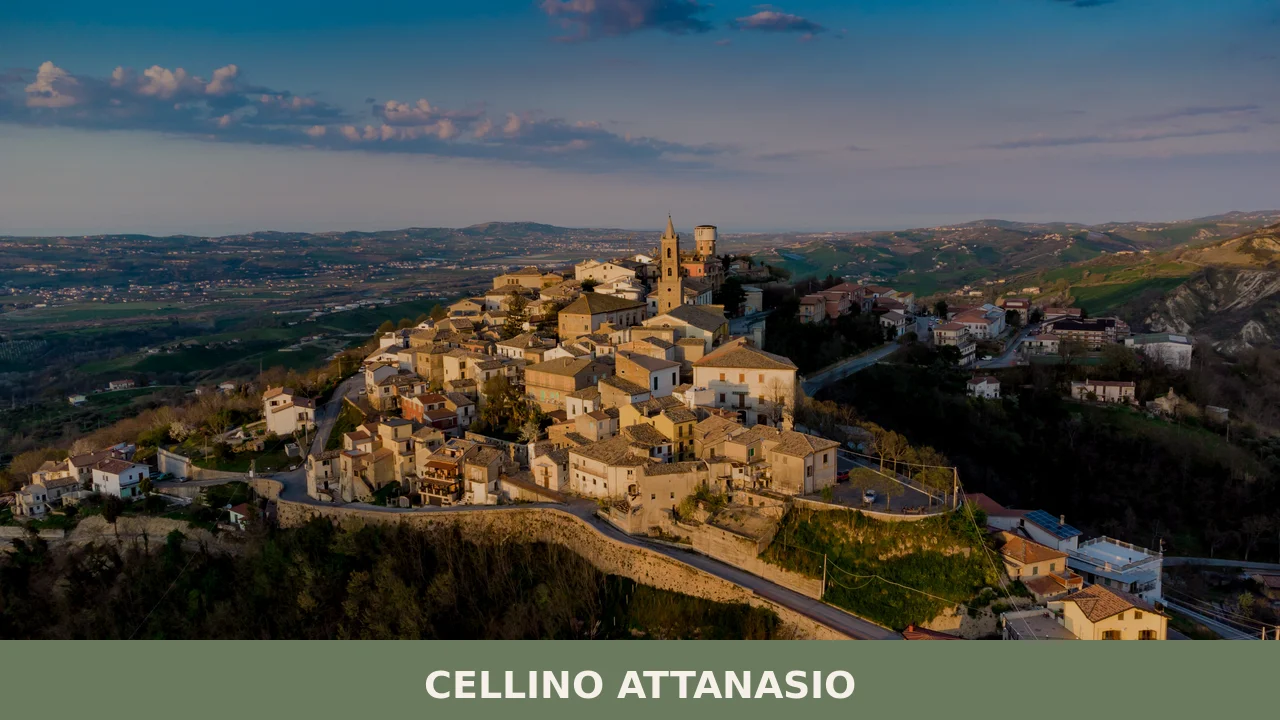
A village of 2,188 residents with Acquaviva fortress walls and a church holding a 15th-century altarpiece by Andrea De Litio. Two valleys, one medieval skyline.
Cellino Attanasio: Between Two Valleys, Centuries of Stone
Stone lanes open out by the occasional small square, the bell tower of Santa Maria La Nova rises above terracotta rooftops, and somewhere beyond the last houses the land drops away into clay gullies that catch the afternoon light at an angle peculiar to this stretch of the Teramano hills. The air carries the altitude — around 443 metres — without the severity of the mountains to the west, and the Adriatic, visible on clear days, keeps the winters damp and the summers bearable.
Cellino Attanasio, a village of about 2,2188 inhabitants in the province of Teramo, sits on the watershed between the Vomano valley and the Valle del Piomba. Two things distinguish it immediately for a visitor: a defensive circuit built by the Acquaviva dukes of Atri, of which two cylindrical towers survive in sound condition, and a parish church whose portal, carved in the early fifteenth century, belongs to the same workshop tradition as monuments in Atri and the wider Adriatic Gothic world.
Feudal Power and a Walled Village: Centuries of Acquaviva Rule
The territory, covering 44.01 square kilometres, holds evidence of human presence going back to the Bronze Age. Roman-period remains — traces of a vicus and rural farmsteads — have been recorded across several localities, a reminder that these inland hills were neither remote nor marginal in antiquity. By the early medieval period the land had passed to the Benedictine monks of the abbey of San Giovanni in Venere, one of the major monastic landowners along the Adriatic slope of Abruzzo.
From the late fourteenth century the village became a fief of the Acquaviva, dukes of Atri, who held it with few interruptions until the family line ended in the eighteenth century. It was under Acquaviva authority that the settlement took its defensive character. Giulio Antonio Acquaviva received the fief in 1463 and began the construction of the fortified circuit; the works were completed in 1480 under Andrea Matteo III Acquaviva. The finished system comprised nine towers — cylindrical corner towers and interval towers along the curtain wall — a scale of fortification that points to the strategic value the dukes placed on this hilltop position. A generation later, between 1485 and 1486, it repelled an attack by Ascanio Colonna, who had been authorised by King Ferdinando I of Naples to take possession of the duchy. Both episodes reflect the wider contest between Aragonese and rival dynastic interests across southern Italy rather than purely local conflict.
The French republican army entered the village on 8 December 1798, marking a moment of external rupture in what had otherwise been a long, internally structured feudal history. By that point the Acquaviva were long gone, but the stone fabric they had commissioned — walls, towers, churches — still remains, as the physical skeleton of the old centre. The medieval street pattern survives largely intact: narrow lanes, stepped passages and small open spaces that follow the logic of the original defensive layout rather than any later replanning.
The Churches, Towers and Fountains That Define the Old Centre
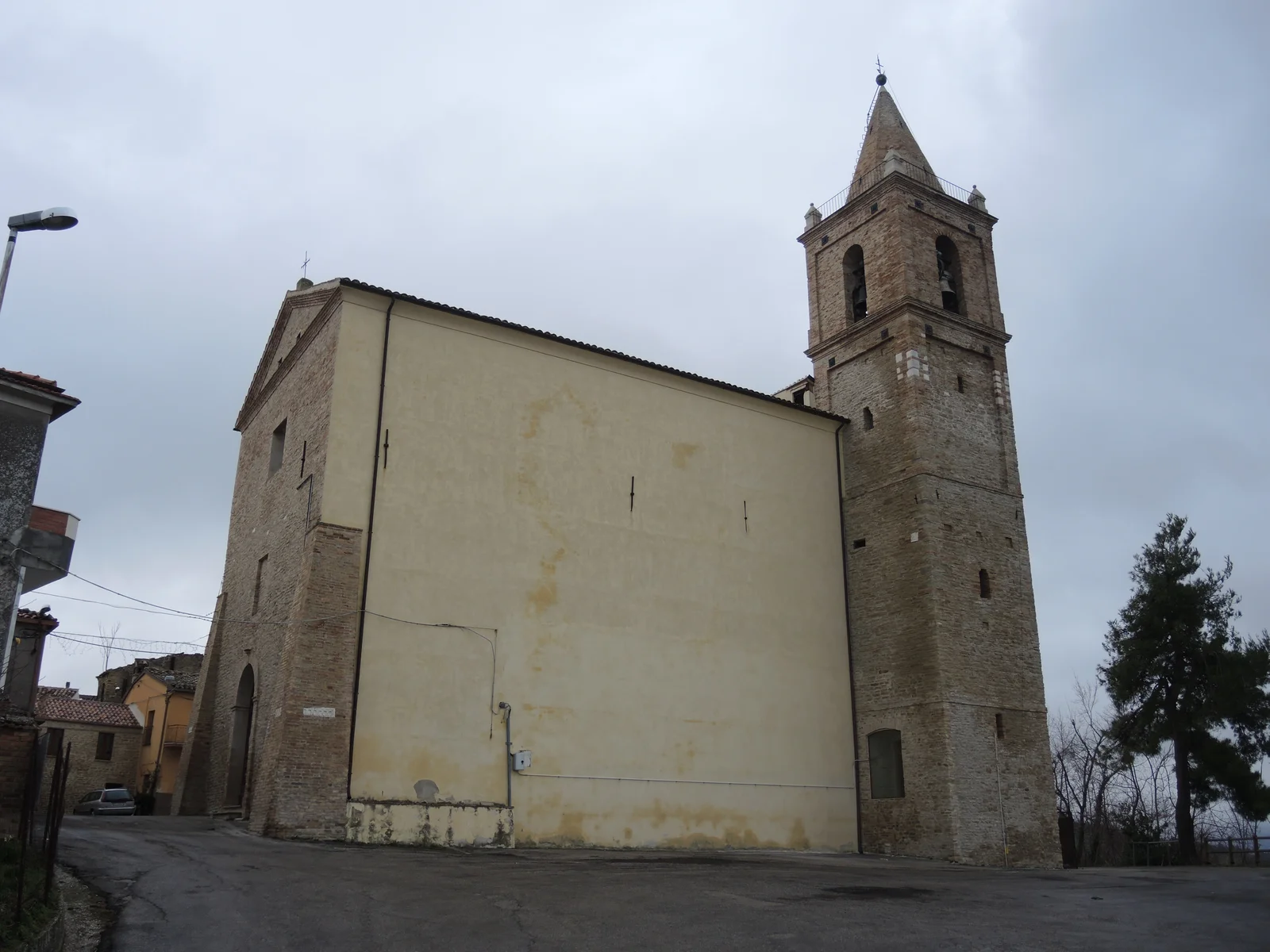
Church of Santa Maria La Nova
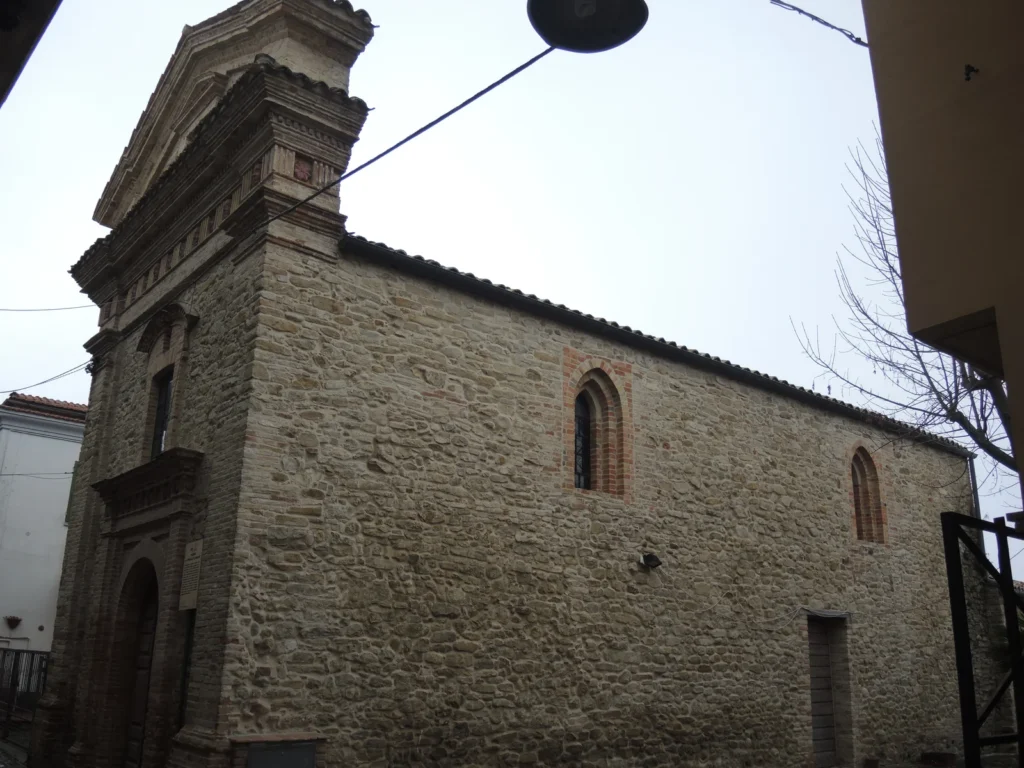
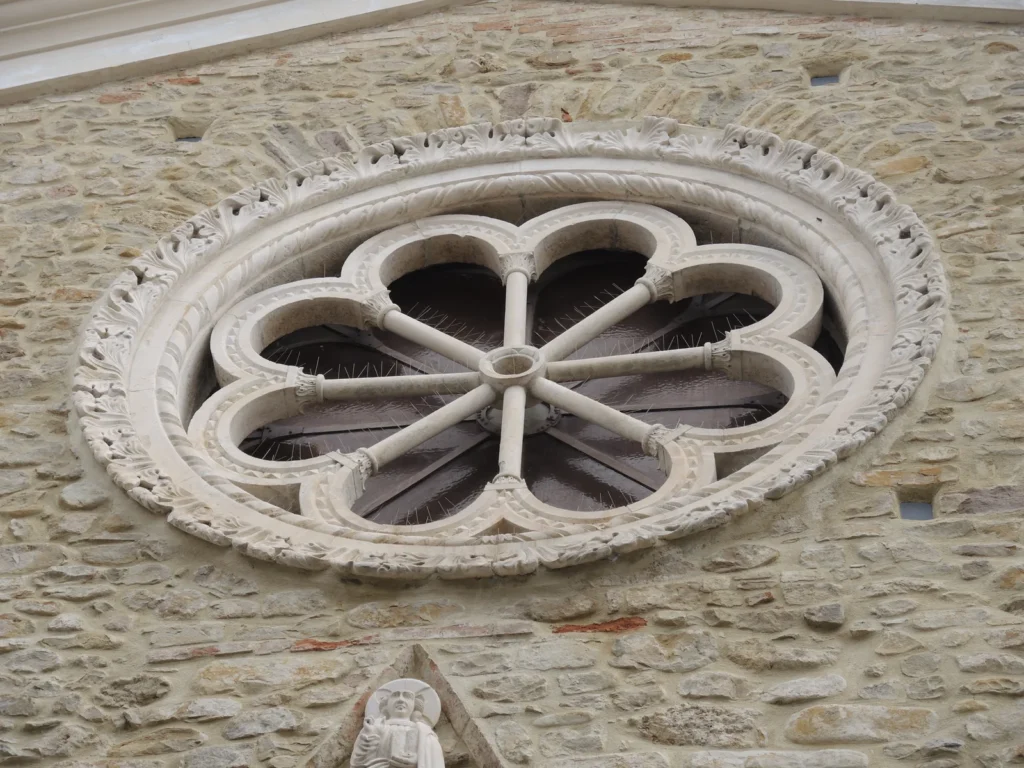
The parish church stands at the centre of the village and is documented from 1330 onward, though it has been modified repeatedly. Its portal, carved in the early fifteenth century, follows the Adriatic Gothic tradition: multiple receding orders with inset colonnettes, anthropomorphic floral decoration and a full-round arch framed by a continuous horizontal cornice. The bell tower, also completed in the early fifteenth century under Acquaviva patronage, uses the same master-builder tradition brought to Teramo and Atri. Inside, the church preserves a gilt altarpiece by Andrea De Litio dating from the fifteenth century, a carved wooden tabernacle of 1583, and an eighteenth-century pipe organ by the Fratelli D’Onofrio, restored in 2000. In the choir, behind the high altar, a Renaissance funerary monument commemorates Giovanni Battista Acquaviva, who died aged fourteen in 1496.
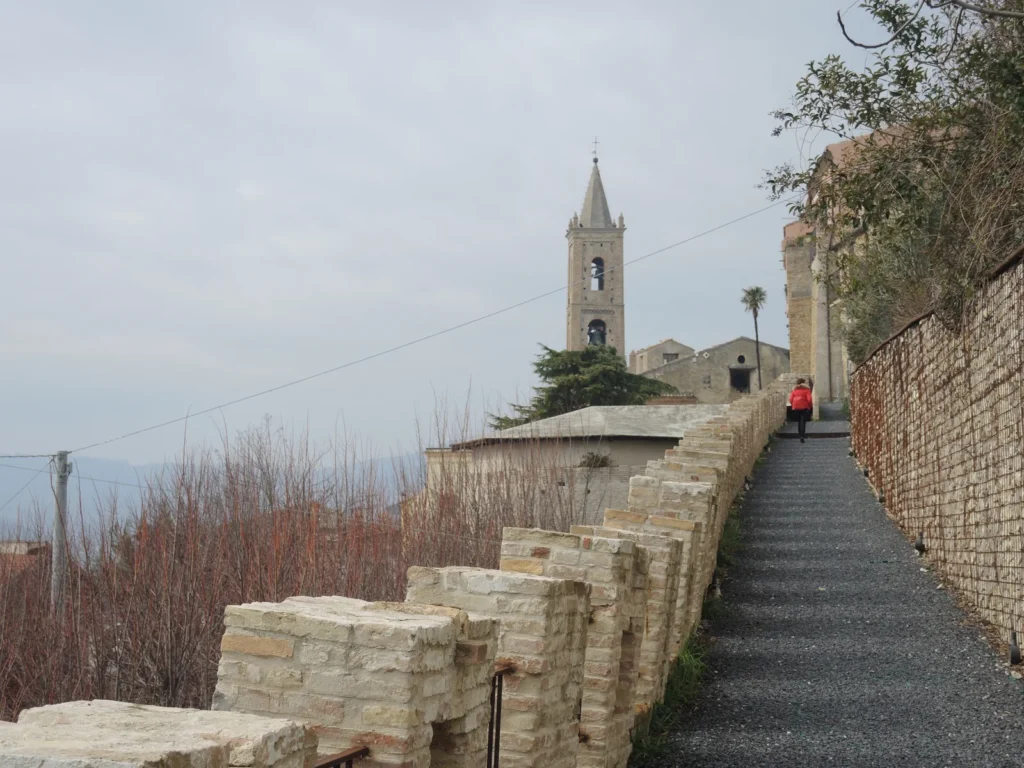
Fortified Walls and Cylindrical Towers
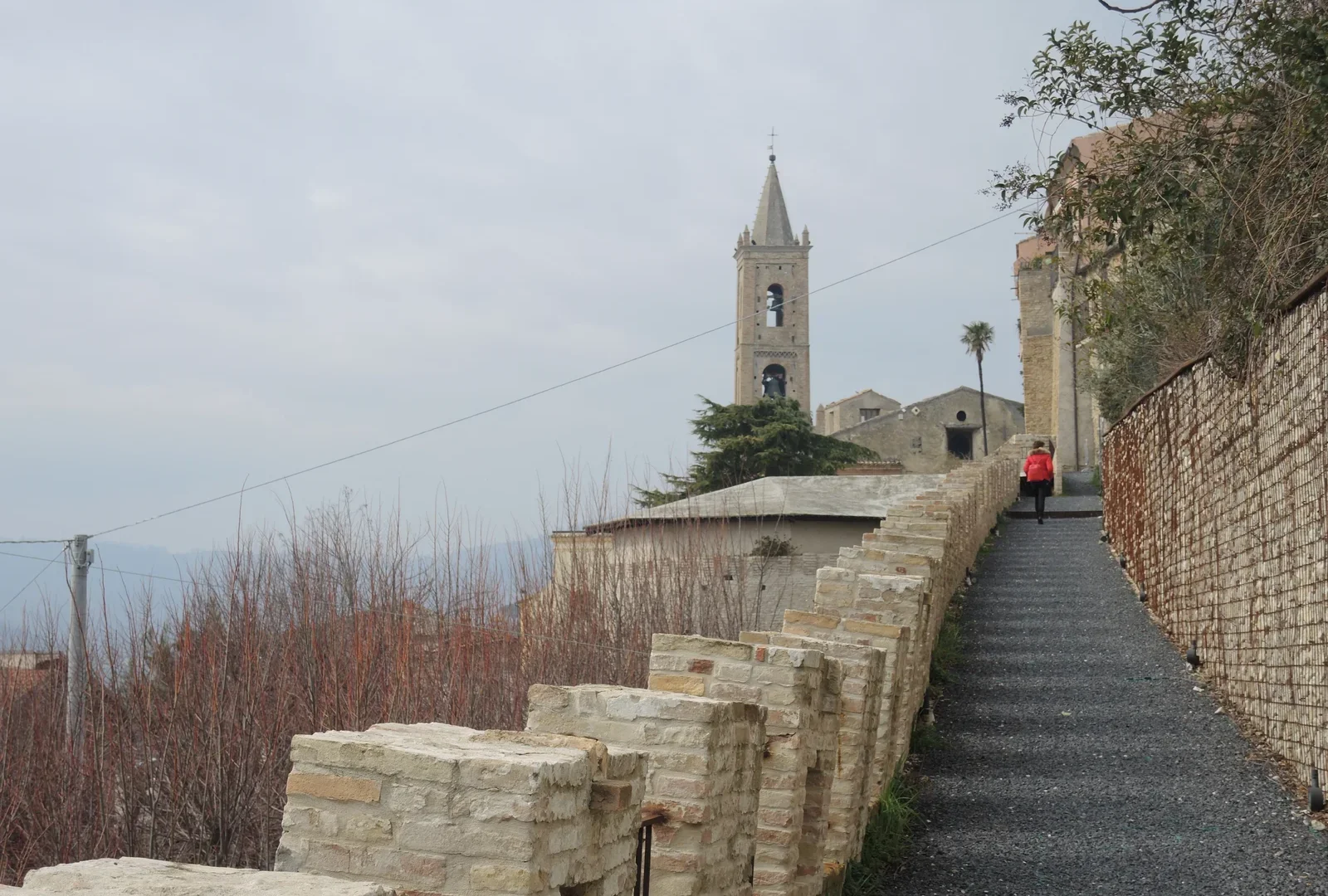
The Acquaviva defensive circuit, located along Via Duca degli Abruzzi, survives in partial but legible form. Of the original nine towers, two cylindrical examples remain in good condition. The better-preserved tower is a solid drum of brick with putlog holes for the original scaffolding and ghibellina-style merlons — that is, merlons with a forked or swallow-tail profile, as opposed to the squared guelfa form — at the summit. A second tower retains its brick facing and stone corbels but is partly ruined. The circuit once included a fortified residence for the feudal family near the church of San Francesco; no identifiable trace of that structure survives above ground. Walking the stretch of wall that remains gives a concrete sense of the fifteenth-century urban perimeter.
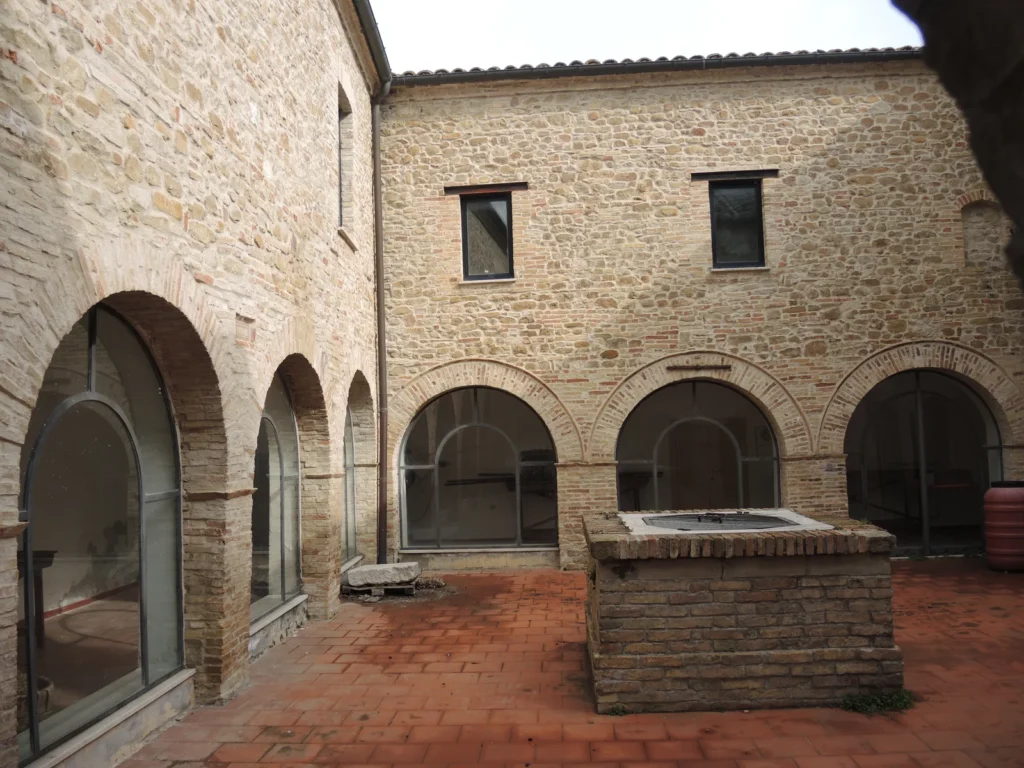
Church and Convent of San Francesco
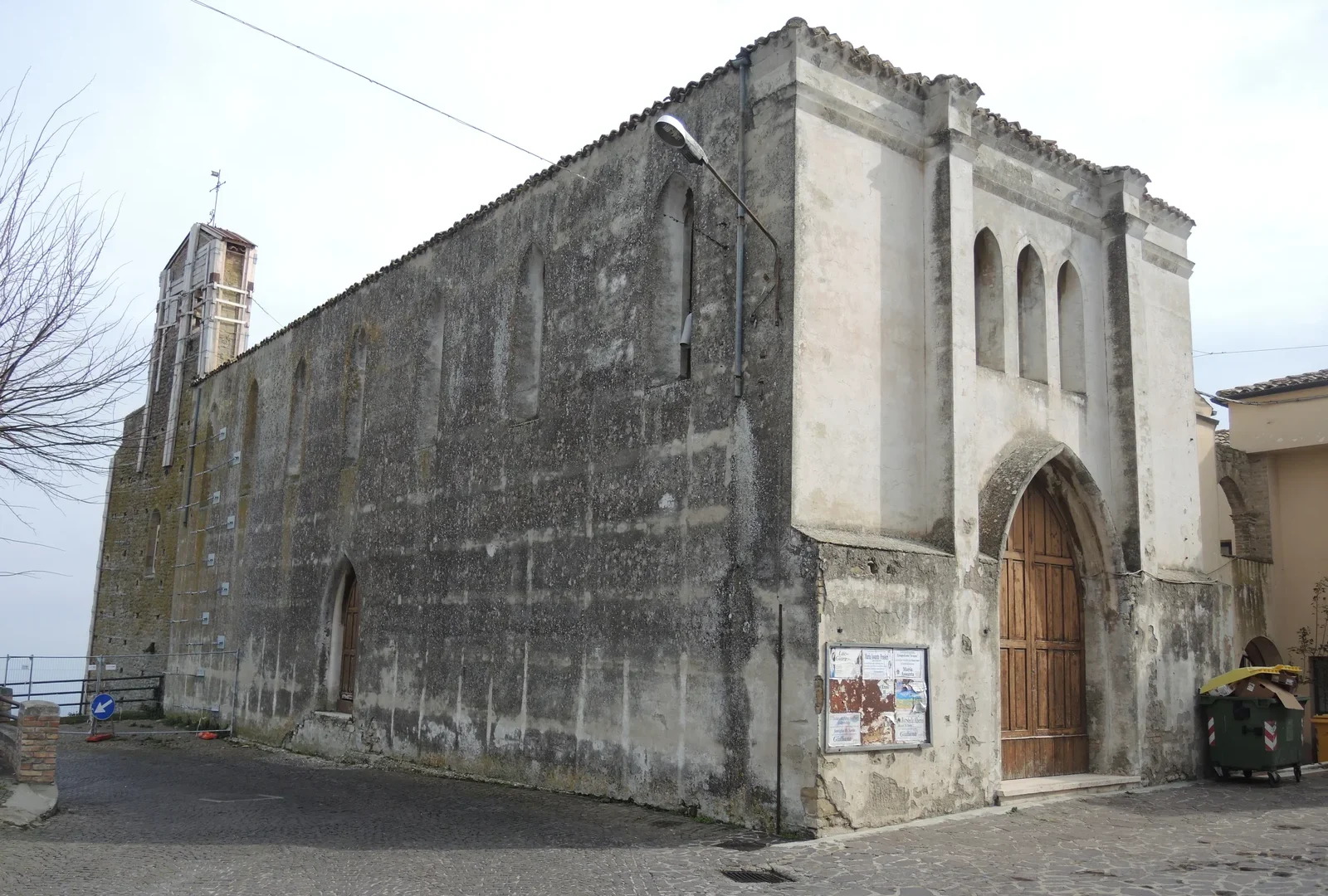
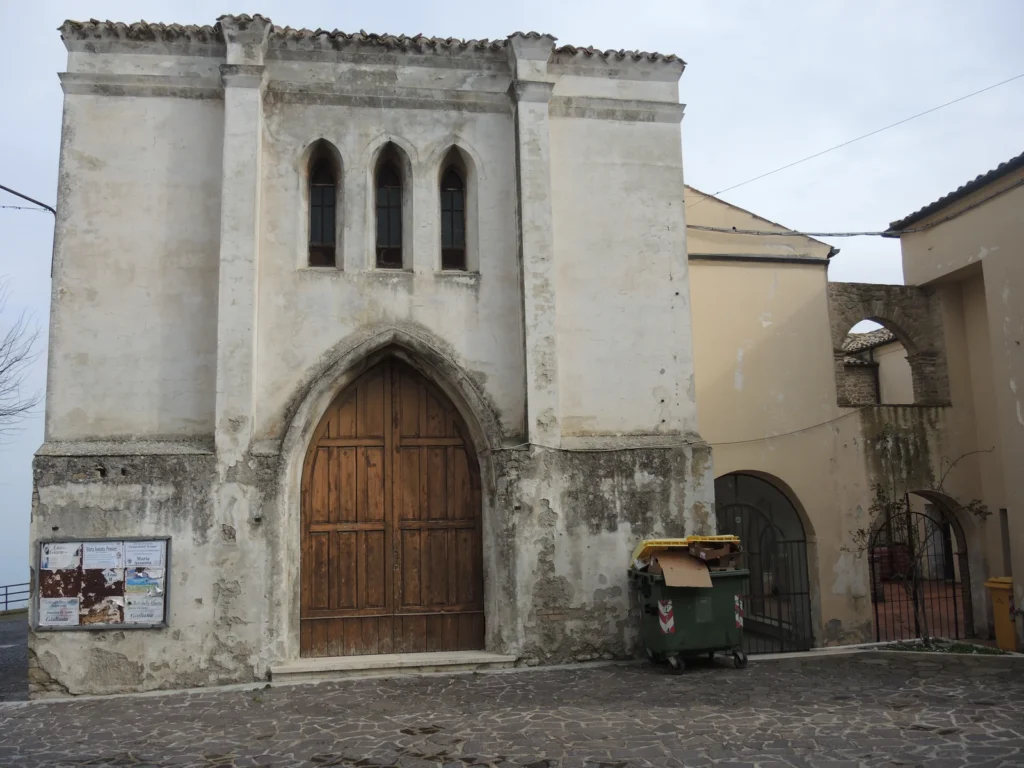
Set on Largo San Francesco, this church was founded as part of a Franciscan convent. The convent was later suppressed and converted into a carabinieri barracks, a transformation that nevertheless preserved the internal layout; the porticoed cloister is still visible. Restorations carried out in the nineteenth and twentieth centuries gave the facade a simplified pointed arch portal and lancet windows that approximate a Gothic appearance without reproducing it convincingly. The lateral and rear walls are supported by heavy buttresses, one of which carries a small campanile a vela — a bell-gable, a single pierced stone or brick wall holding one or two bells in place of a full tower.
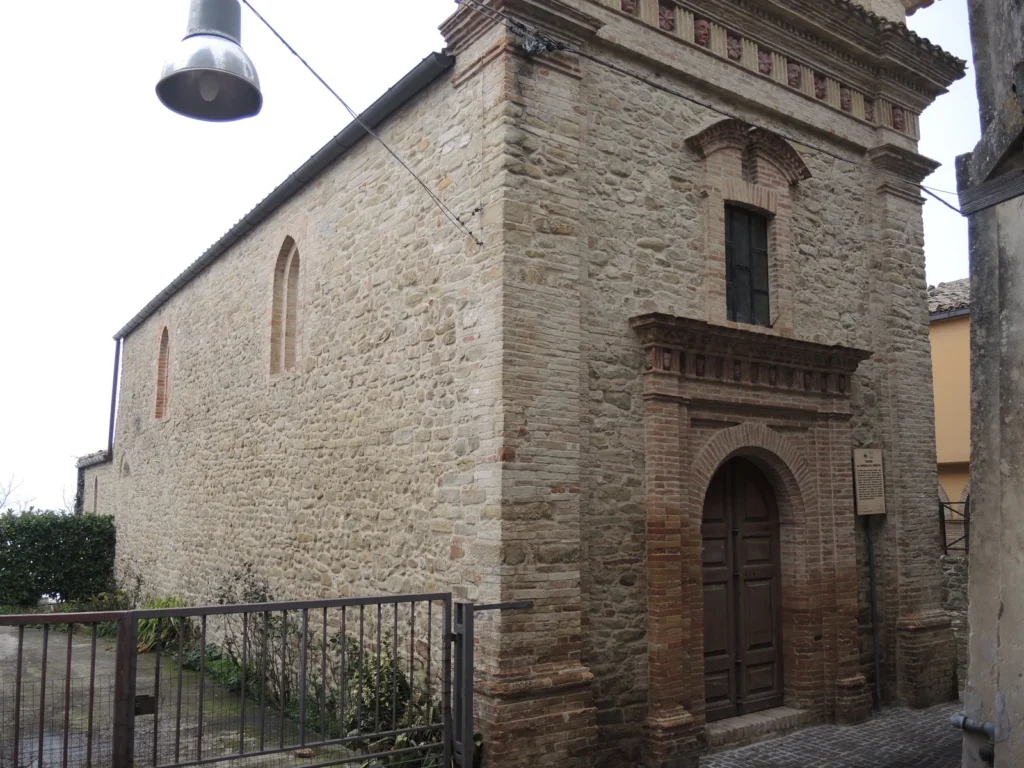
Ex Church of Santo Spirito
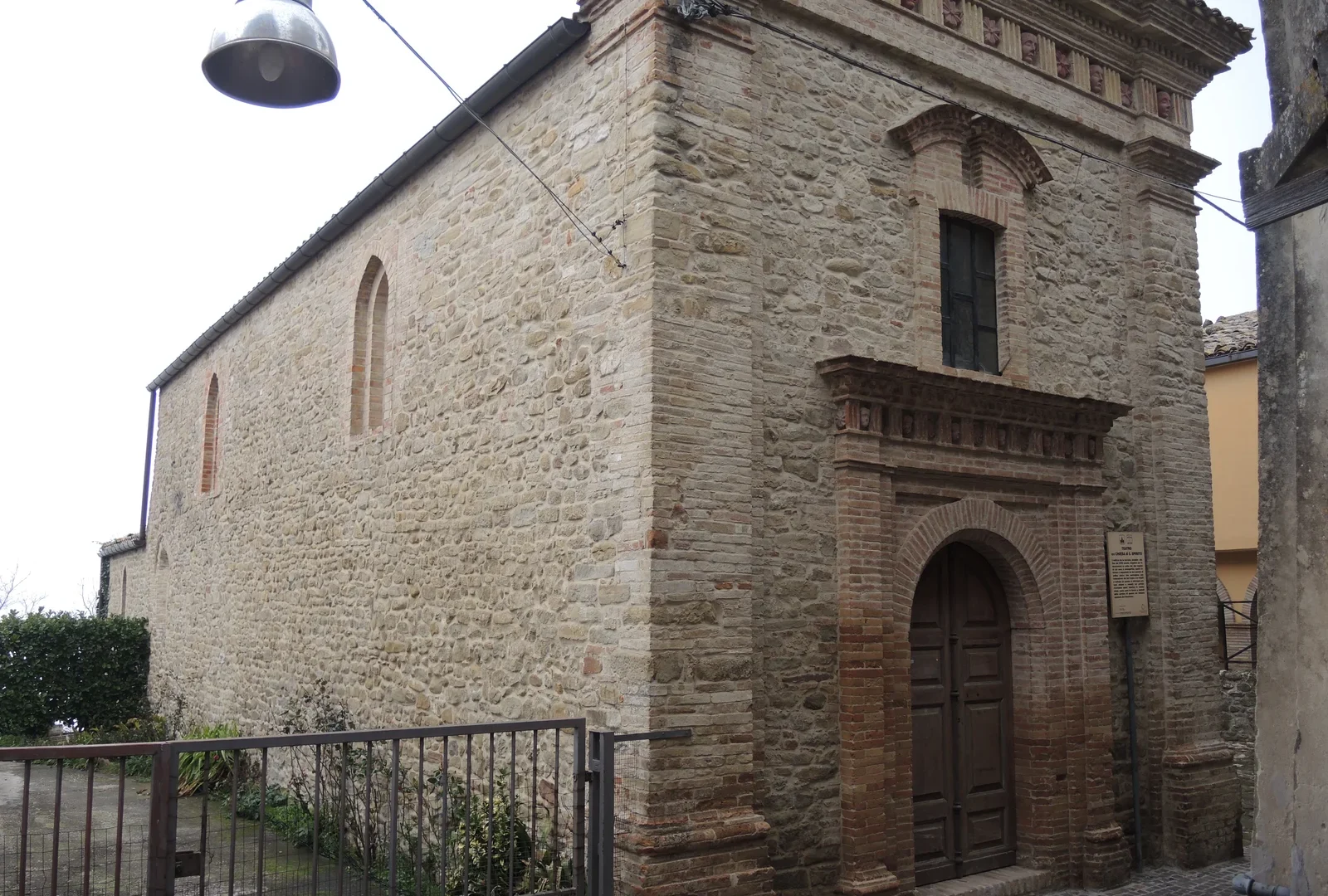
This eighteenth-century building on Via San Francesco is now deconsecrated and serves as the village civic theatre. The brick facade retains terracotta decorative bands along the entablature and around the full-round arch portal, which is framed in a classical moulding. Above, a window with a broken pediment follows the standard vocabulary of the period. The pointed-arch lateral windows suggest an earlier structure may underlie the current fabric, though the visible building dates substantially from the 1700s. The adaptive reuse as a theatre has kept the shell alive without altering the exterior significantly.
Fraction of Scorrano and Its Churches
Scorrano is a small satellite hamlet that sits on a ridge slightly higher than the main village. Its two churches cover distinct periods. Santa Maria di Musano preserves a carved wooden statue of the Madonna and Child dating from the late seventeenth century. The church of Santi Biagio e Nicola, which dates from around 1513 and was partly rebuilt in the early twentieth century, holds a canvas of the Madonna del Rosario attributed to Vincenzo Tudini and a 1607 plaque recording a Cross of Indulgences. Relief decorations on the exterior buttresses, with interlaced cornice patterns, are considered by local sources to be considerably older than the current building.
Palazzo Marcellusi and the Fountains
A seventeenth- to eighteenth-century noble palazzo on Via Rubini and Via San Francesco, identified by its rusticated stone portal and a large frescoed reception hall, has been converted into accommodation. The building is associated with the poet Vincenzo Marcellusi (1886–1962), a figure of the crepuscolare movement in Italian literature, who was born here. Two historic fountains — the fifteenth-century Fonte Cisterna and the eighteenth-century Fonte Luccio — stand close to what were once the main entry gates of the medieval town, and remain functional landmarks of the old civic infrastructure.
The Flavours of an Inland Teramano Village
The agricultural economy of this stretch of the Teramano hills has historically centred on olives, vines and livestock, and the food culture of the village reflects that continuity. The wines produced across the broader territory include the Montepulciano d’Abruzzo DOC, Trebbiano d’Abruzzo DOC and the rosé Cerasuolo d’Abruzzo DOC, as well as the Controguerra DOC and the Colli Aprutini IGT — designations that cover significant portions of the Teramo province. Only the sub-denomination Montepulciano d’Abruzzo Colline Teramane holds DOCG status. Lamb, beef and cured meats from the Apennine interior follow similar provincial-scale quality frameworks.
Among the traditional preparations associated with the wider Abruzzo territory, vino cotto — cooked grape must reduced over heat — and ratafia, a cherry-based liqueur, appear at domestic and festive tables in this area. The local folkloric calendar centres on Lu Giuviddì Sande, the Holy Thursday folk festival, which provides a seasonal gathering point that combines music, food and collective memory in a format specific to this village.
Planning your visit and getting there
Cellino Attanasio can be reached easily from the lower Val Pellice and the Turin area. The practical distances and journey times below are kept concise on purpose, so the access information stays clear and consistent.
| Departure | Distance | Time |
|---|---|---|
| Teramo | approx. 25 km | approx. 30 min |
| Pescara | approx. 50 km | approx. 50 min |
| Roma | approx. 200 km | approx. 2 hours and 30 min |
| L'Aquila | approx. 90 km | approx. 1 hour and 20 min |
Frequently asked questions about Cellino Attanasio
When is the best time to visit Cellino Attanasio?
May is ideal, coinciding with the Feast of Sant'Attanasio on May 2nd, when the village celebrates its patron saint with traditional festivities. Spring offers pleasant mountain weather with blooming landscapes. Summer provides warm conditions perfect for exploring the medieval fortifications and surrounding valleys. Autumn brings mild temperatures and olive harvest season, reflecting local agricultural rhythms. Winter can be cold at 443 metres altitude.
How do I reach Cellino Attanasio by car?
Cellino Attanasio is located in Teramo Province, Abruzzo, positioned between the Vomano and Piomba valleys. From the A14 motorway, exit towards Teramo and follow regional roads towards the Teramano valleys. The village sits on a ridge above the valley floor. GPS coordinates and detailed directions are available through major navigation apps. Local tourism offices in Teramo can provide specific route guidance.
What is the historical significance of Cellino Attanasio's fortifications?
The intact 15th-century medieval walls were constructed by the Acquaviva dukes of Atri, powerful feudal lords who controlled the territory from the late 14th century onwards. These fortifications represent the family's military and political dominance in the region. The stone structures have survived centuries and remain a defining architectural feature of the village, standing as physical testimony to feudal power and rural resilience in medieval Abruzzo.
How long should I plan to spend in Cellino Attanasio?
A half-day to full-day visit allows adequate time to explore the medieval fortifications, narrow stone lanes, and the Church of Santa Maria La Nova. Walking the compact village and appreciating Renaissance art requires two to three hours minimum. If visiting during the May feast or planning outdoor routes through surrounding valleys and olive groves, extending to a full day or weekend stay is recommended for deeper immersion in local culture and landscape.
Are there Bronze Age or Roman archaeological sites in the area?
Yes, the territory preserves evidence of human presence from the Bronze Age onwards. During Roman times, a vicus (small settlement) and rural villas were established in the landscape, leaving archaeological foundations. These sites demonstrate continuous occupation across centuries. Visitors interested in Roman Abruzzo should consult local archaeological museums in Teramo Province or contact regional heritage authorities for guided tours and documented excavation sites.
📷 Photo Gallery — Cellino Attanasio
In Abruzzo More villages to discover
L’Aquila
 Lake
Mountain
Lake
Mountain
what to see all'Aquila: 5 attractions storiche, prodotti PAT e consigli pratici per visitare la città abruzzese a 714 m s.l.m. Pianifica il tuo itinerario.
Canosa Sannita
 Hills
Hills
At 231 metres above sea level, on the plain that opens between the Maiella massif and the Teatine coast, Canosa Sannita is home to 1,268 inhabitants spread across an agricultural landscape where the cultivation of vines and olive trees marks the rhythm of the seasons. The village’s very name carries a precise indication: a reference […]
Lecce nei Marsi
Mountain
Lecce nei Marsi has 1,534 inhabitants spread between the main centre and outlying hamlets along the eastern slope of the Marsica area, at 740 metres above sea level. The municipal territory borders the Abruzzo, Lazio and Molise National Park and falls within the province of L’Aquila. Anyone looking into what to see in Lecce nei […]
Dogliola
Hills
what to see in dogliola, Italy: Discover the 445 m elevation, 311 residents, and San Rocco festival. Explore rich history and stunning landmarks.
Colledimacine
Mountain
One hundred and eighty-eight residents in the 2001 census, now down to 158: Colledimacine contracts with the regularity of a slow heartbeat, yet it holds on along the eastern ridge of the Majella massif, at 770 metres above sea level, in the province of Chieti. Anyone wondering what to see in Colledimacine should be prepared […]
Canistro
Mountain
A village of mineral springs and stone alleys split between two elevations in the Valle Roveto. Here is what to see in Canistro, Abruzzo.
Santa Maria Imbaro
 Sea
Sea
The hill that supports Santa Maria Imbaro stands out sharply against the outline of the Chieti countryside: the low rooftops, the local stone façades and the bell tower of the parish church form a compact silhouette that can be read from the provincial road, even before turning into the village. The local dialect calls it […]
Crognaleto
Mountain
What to see in Crognaleto, Italy: Discover this 1,094m altitude village in Abruzzo. Explore the Monti della Laga and Gran Sasso National Park.
Roccaspinalveti
Mountain
What to see in Roccaspinalveti? Discover 5 must-see attractions in this Abruzzese village. Guide covers things to do & how to get there. Plan your visit!
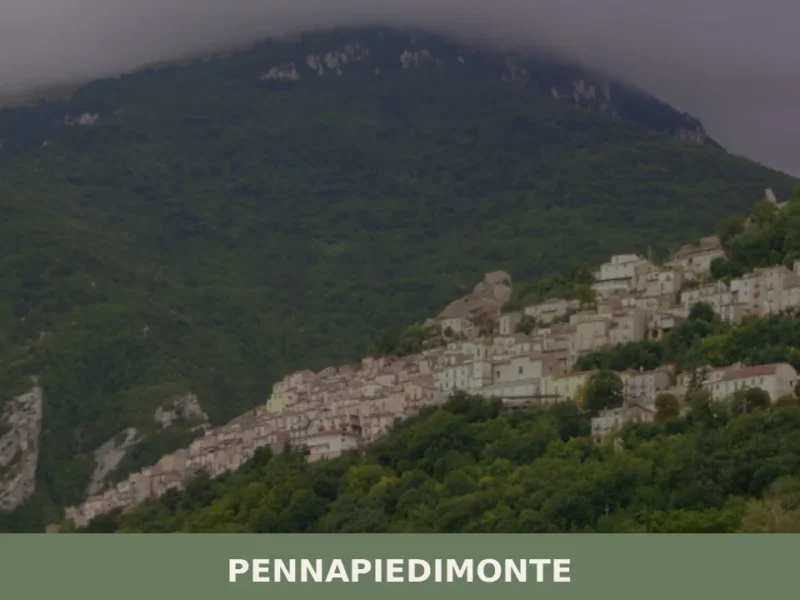
Pennapiedimonte
Mountain
what to see a Pennapiedimonte: 5 attractions nel village a 669 m s.l.m. in Abruzzo. Scopri il centro storico, la Majella, le festivals di agosto e i prodotti PAT.





🏡 Know Cellino Attanasio better than we do?
If you’re a local or have been there, your knowledge matters: add what’s missing or fix a detail on this page.