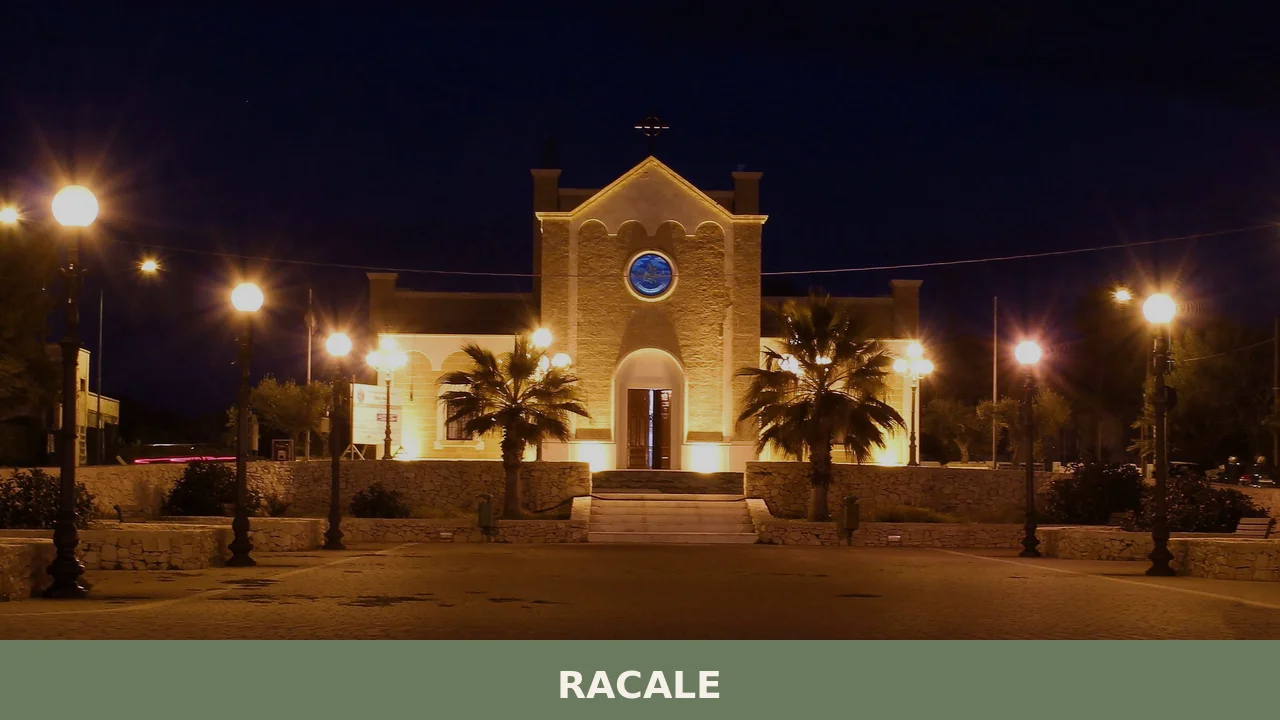
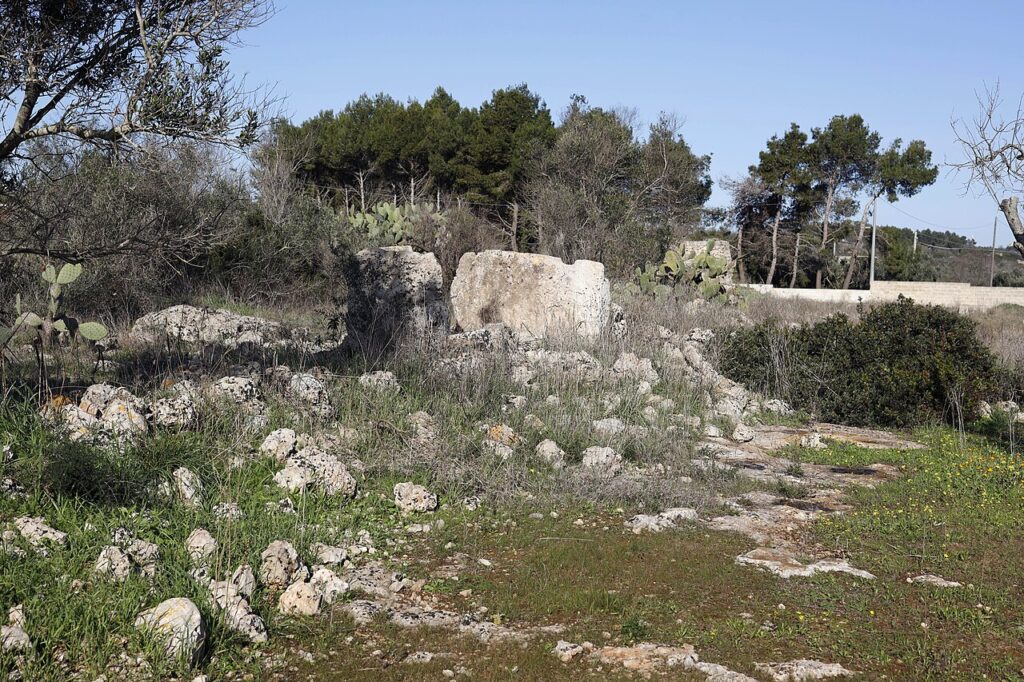
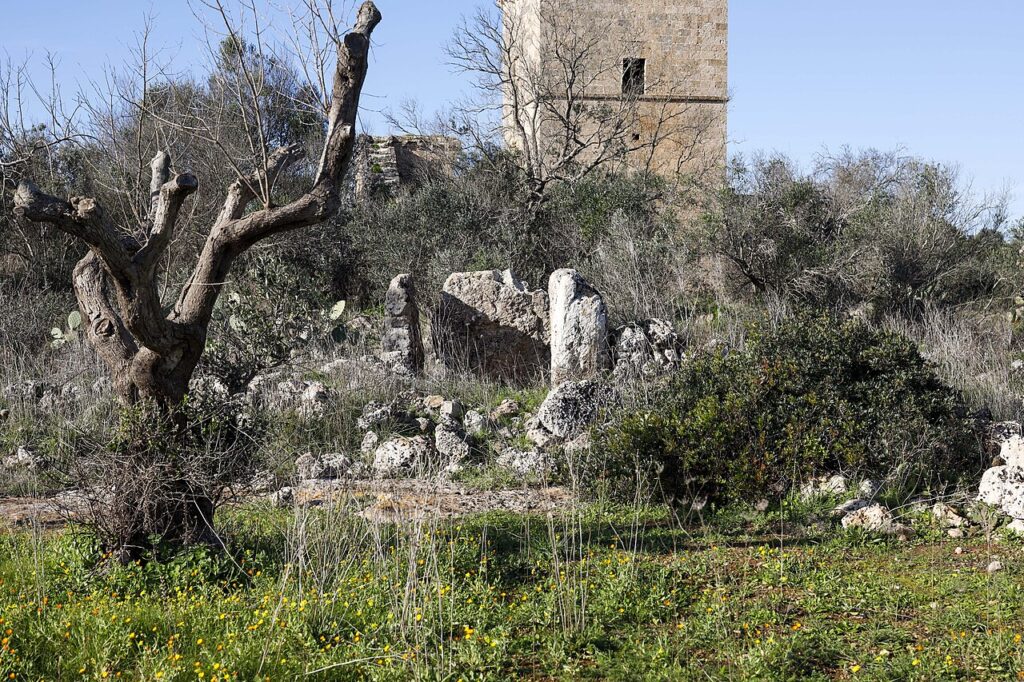
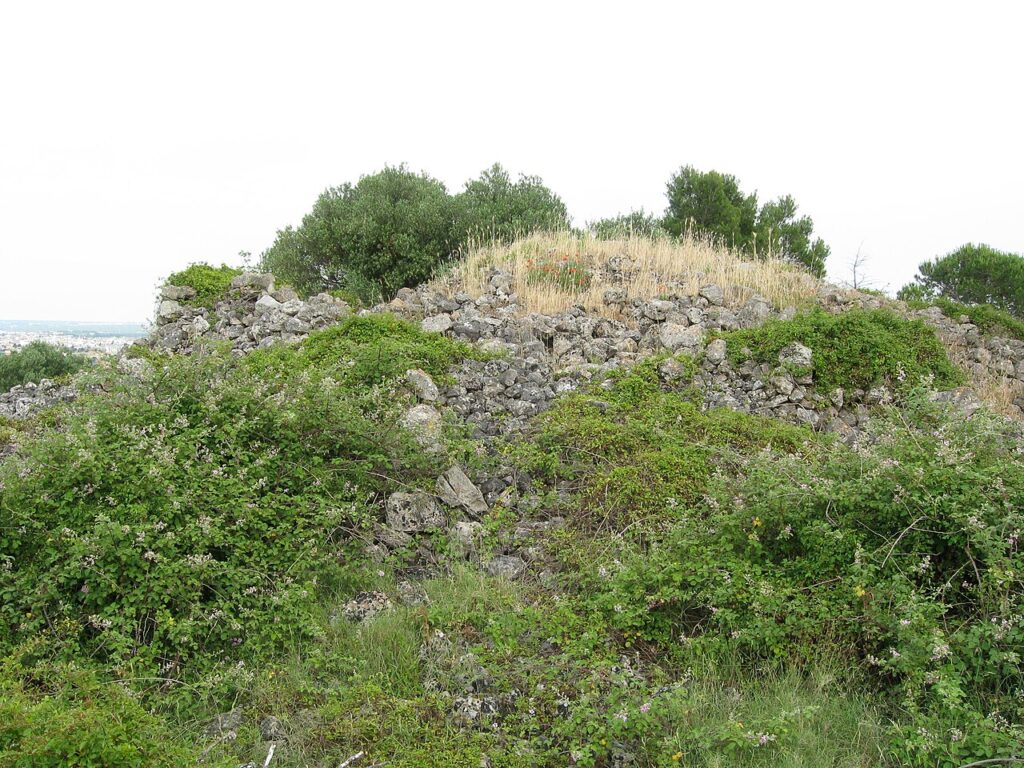
The Collina degli Specchi—the Hill of Mirrors—rises just beyond Racale’s edge, its flanks scattered with megalithic stones and the memory of ancient peoples. This modest limestone ridge, reaching approximately 104 metres above sea level, stands as both guardian and witness to the village, sheltering the flat Piana di Racale where ten thousand souls have built their homes across centuries of conquest and renewal. Here in lower Salento, the land opens wide and low toward the Ionian Sea, and the rhythm of community life moves through baroque churches and Monday markets, much as it has since the Middle Ages.
Racale village in Apulia carries the weight of three competing origin stories and the concrete evidence of rule by some of Salento’s most notable families. Since 1999, the comune has held the official title of city, though its character remains rooted in the intimate scale of a medieval town. Visitors arrive for the feudal architecture scattered across its churches, the working textile heritage embedded in its identity, and the coastal fraction of Torre Suda, which opens the village to the sea.
Three Theories of Foundation and Medieval Rise
The origin of Racale’s name and settlement defies simple certainty. One tradition holds that the town was founded by Eraclio, a Roman freedman whose name mirrors the village’s own—a connection preserved, some say, in the civic emblem of the she-wolf nursing Romulus and Remus. A second hypothesis suggests that in antiquity, Greeks established a sanctuary dedicated to the hero Heracles at this location. The third, perhaps most suggestive, proposes that settlers from Eraclea Pontica arrived under orders from the Byzantine emperor Basilio I il Macedone, tasked with repopulating the Salento territories between Ugento and Gallipoli after decades of Saracen raids.
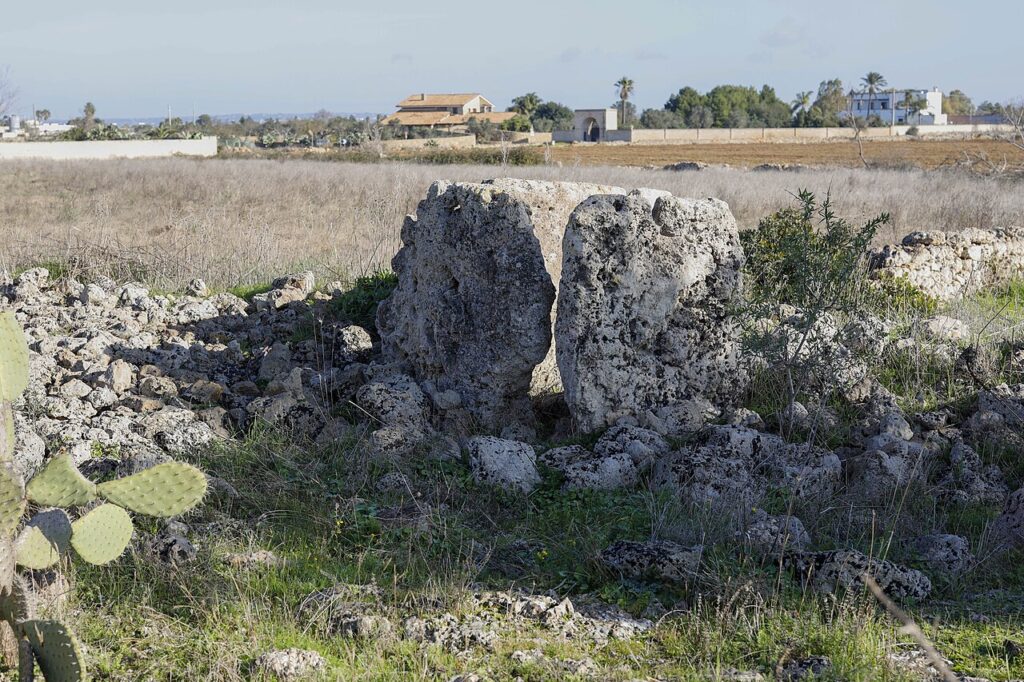
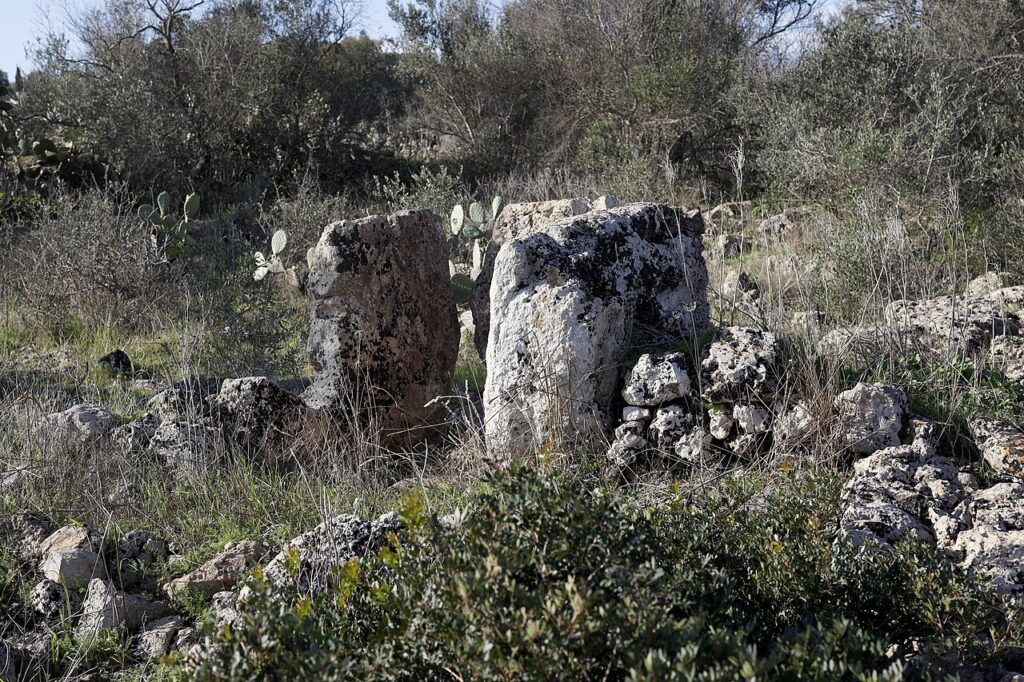
What is verifiable is far older: archaeological evidence—a dolmen and a well-preserved specchia, or dry-stone heap—confirms that this corner of Salento saw human habitation in prehistoric times. Messapic, Greek, and Roman populations each left their mark before the Norman period brought a decisive transformation. In the early 12th century, the De Tallia family, Norman feudatories, established a small town with a quadrangular plan, the form that still governs Racale’s core. After Agnese de Tallia’s death and that of her daughter Margherita—who had married Guglielmo De Parisio—the fief passed to the Della Marra, a noble Ravello dynasty whose principal members included Pietro, Risone II, Giovanotto, and Riccardo. In 1295, under Pietro della Marra and his co-baron Gionata de Luco of Bari, Racale obtained from Carlo II d’Angiò a charter to hold a weekly market of food goods every Monday—a privilege that persists to this day.
The last Della Marra, Riccardo, died in 1470 without passing his holdings to his children Giovanni and Menga; the fief instead transferred to the Tolomei, a Sienese family of considerable standing. The Tolomei era marked a period of demographic growth and prosperity. From Racale’s Tolomei line came Marc’Antonio Tolomei, who served as bishop of Lecce from 1485 to 1498. The family also claimed kinship with Pia de’ Tolomei, immortalized by Dante in the Divine Comedy—though she herself was born elsewhere. After the Tolomei came the Guevara, the Beltrano, and finally the Basurto barons, who held Racale until the abolition of feudalism in 1806.
In 1547, Turkish raiders who had looted Ugento, Felline, and Alliste turned their assault on Racale itself. They were repulsed at the town gates near the Collina degli Specchi, sustaining heavy losses—a rare military victory for a Salento village against the Ottoman threat.
The earthquake of 1743 dealt severe damage to the medieval parish church of Santa Maria de Paradiso, destroying much of its original 12th-century structure. Reconstruction began in 1756 and restored the building to liturgical use. The tremor remains the single most traumatic natural event in Racale’s modern memory, though the town’s fortified core had previously resisted Turkish raids that devastated neighbouring settlements. In 1971, Racale received its civic coat of arms and banner by presidential decree, and three decades later, in 1999, it was formally granted city status.
Sacred Geometry: Churches and Devotional Life
Chiesa Madre di Santa Maria de Paradiso
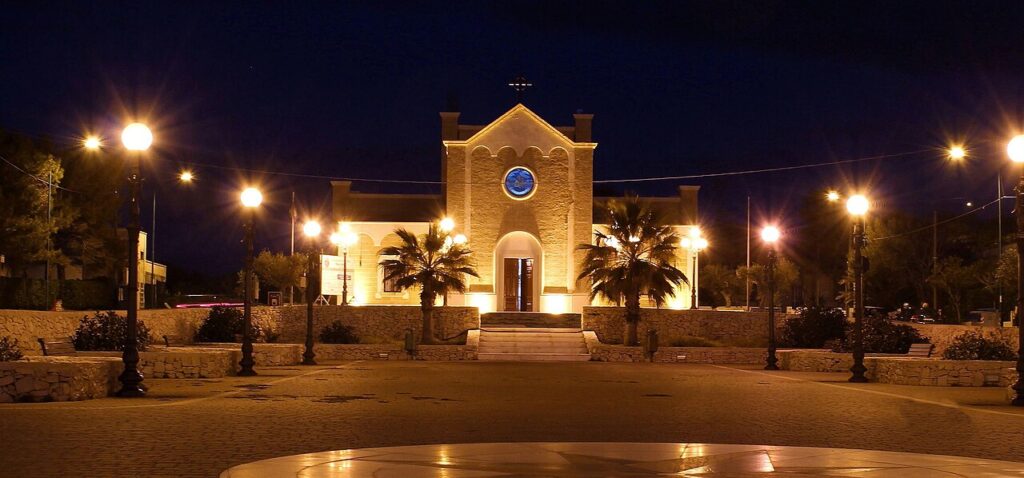
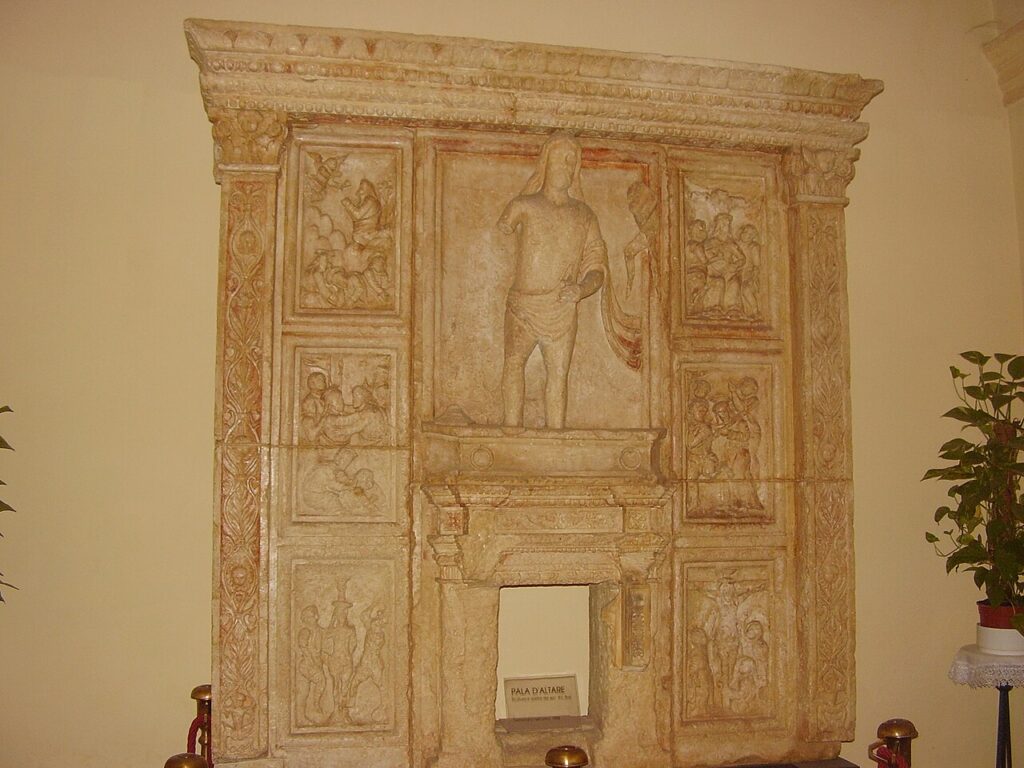
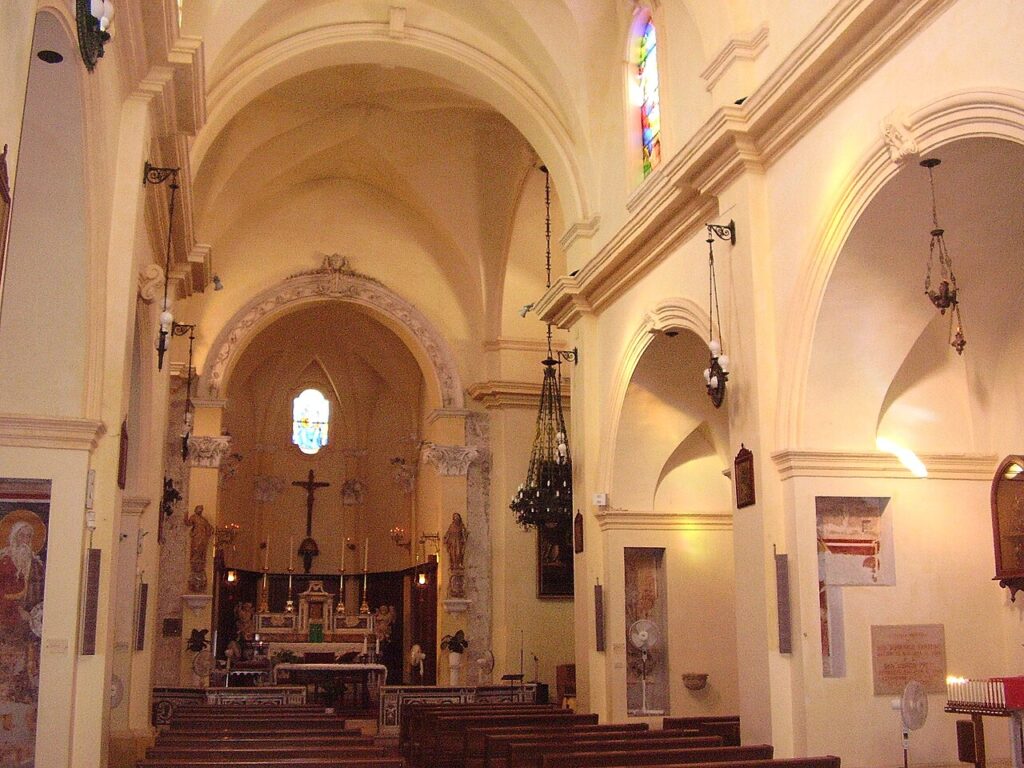
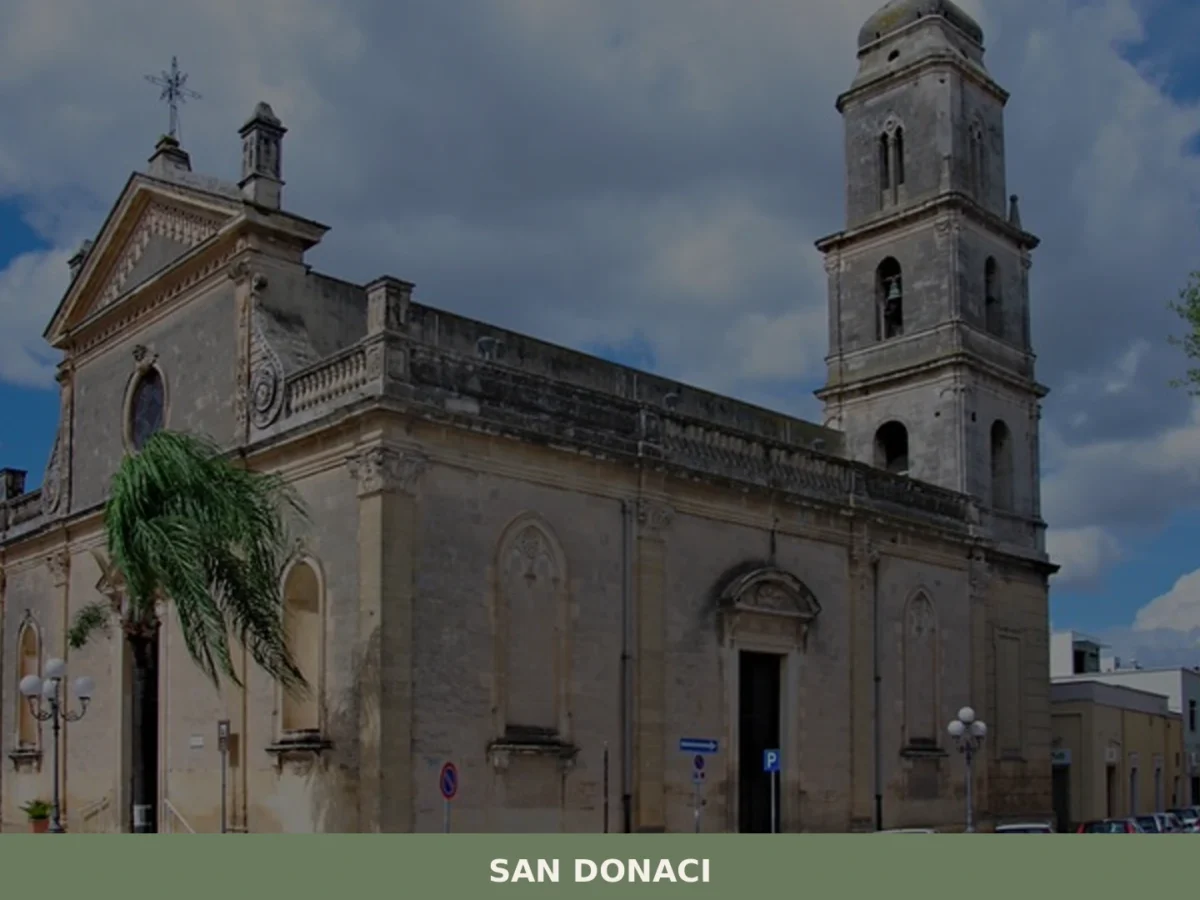
The mother church of Santa Maria de Paradiso, seat of the parish of San Giorgio Martire, was built by popular devotion around the 12th century, as a stone inscription attests. Its original structure survived in fragments after the 1743 quake; reconstruction in 1756 gave it a restrained façade of two tiers in pietra leccese (a soft, honey-coloured limestone worked throughout the region). Within, a single nave shelters a notable high altar and a 15th-century bas-relief in stone depicting Christ flanked by Passion scenes. Fragments of late-Gothic frescoes—the Crucified Christ in Pietà, Saint Elia, and Saint Leonard—remain visible, evidence of the older building. The sacristy functions as a small museum holding Roman, Byzantine, and Venetian coins found during restoration work. Adjacent to the church stands a tower erected in the 12th century as a defensive watchtower at the town’s main gate; reshaped and heightened across subsequent centuries (most recently in 1535), it now serves as the bell tower.
Chiesa della Madonna dei Fiumi
Located near the municipal cemetery, the Church of the Madonna of the Rivers occupies ground once inhabited by italo-Greek monks. These communities disappeared in the 14th century, leaving behind a small stone shrine carved entirely into the bedrock—a hypogeum, or underground chamber. In 1611, a vaulted rectangular chapel was built over the ruined vault. Inside hangs a Byzantine-inspired fresco of the Madonna di Costantinopoli, venerated locally as the Madonna dei Fiumi (the Virgin of the Rivers), known in Orthodox tradition as the Hodegetria or Portinaia—the guide stationed at the entrance to protect the monastic refuge. The interior walls display later seventeenth-century frescoes: an Annunciation (1613), a Deposition (1614), and figures of Saint Elia and Saint Leonard. A hemispherical vault painted in 1718 shows scenes from the life of Mary and figures of Saints Peter, Paul, Sebastian, and George—a baroque elaboration of an early medieval site.
Chiesa della B. V. Maria Addolorata
Built in the early 1600s by public will on the outskirts in the quarter called “Li curti de lo Leo,” this church was first dedicated to Santa Maria delle Grazie. A substantial renovation in 1721 enlarged it to meet growing devotion. By the early 19th century, veneration of the Gracious Virgin had waned, and the building fell into disrepair. Renewed interest in honouring the Sorrows of the Passion and the Mater Dolorosa led, in the second half of the 19th century, to the founding of the Confraternita di Maria SS. Addolorata within its walls. This confraternity undertook comprehensive restoration and completion of the structure in 1897. The church displays a neoclassical style with a three-nave interior furnished with pietra leccese altars. On 29 October 1961, it was formally elevated to parish church status under the title of the B.V. Addolorata.
Chiesa dell’Immacolata Concezione
The Church of the Immaculate Conception was erected by a local confraternity, with construction completed on 12 February 1677, as a lapidary inscription over the main entrance declares. The building stands as a modest but whole baroque statement of lay religious commitment.
Chiesetta di San Nicola Pellegrino
This small chapel was built to honour Saint Nicholas the Pilgrim. The foundation stone is preserved inside and bears witness to its 12th-century origin. Damaged in the 1743 earthquake, it retained its portal, sections of façade, and the lower-right wall with part of the original apse. Abandoned in the latter 18th century, it passed in 1828 to the Basurto barons, who converted it to a straw store. Later purchased by Alessandro Caputo, it became a private dwelling and then a stable. In the early 20th century, Caputo donated the building to the parish priest Don Tommaso Schito on condition of restoration and return to worship.
The Territory: Stone, Serre, and Sea
Racale spreads across 24.47 square kilometres in the gently undulating plateau known as the serre salentine—the Salento ridges. The landscape here is neither mountain nor coastal plain but rather a modest series of limestone rises, nowhere exceeding 104 metres above sea level, arrayed to shield the village from westerly winds. The town proper sits at 55 metres above sea level, cradled in the Piana di Racale, a broad shallow depression ringed by dry-stone walls, abandoned quarries, and scattered farmsteads devoted to orchards and market gardens. The territory extends between 0 and 104 m s. l. m., with the coast some kilometres to the west being rocky and unrelentingly low, giving Racale no maritime spectacle but rather a discrete boundary to open Mediterranean light. The frazione of Torre Suda, a coastal settlement within the comune’s bounds, opens this perspective to salt air and horizon.
Bordered by Taviano to the north, Melissano and Ugento to the east, Alliste to the south, and the Ionian Sea to the west, Racale occupies a pivotal position in lower Salento’s human geography. The climate is Mediterranean in the full sense: winters mild (January averages around 9 °C), summers warm and humid (August near 25 °C), with annual rainfall concentrated in autumn and winter. Seismic risk is minimal—classified in zone 4, the lowest danger category.
Work and Tradition: Textiles and Markets
For much of the 20th century, Racale earned its living from textile manufacture, particularly hosiery production. The town became one of the Salento’s principal centres for sock and stocking manufacture, a trade that still inflects the local economy and identity. The Monday market, established by royal privilege in 1295, continues as a weekly gathering of food vendors and local commerce—one of the oldest regular markets in the southern Mezzogiorno with an unbroken institutional record.
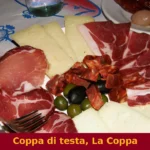
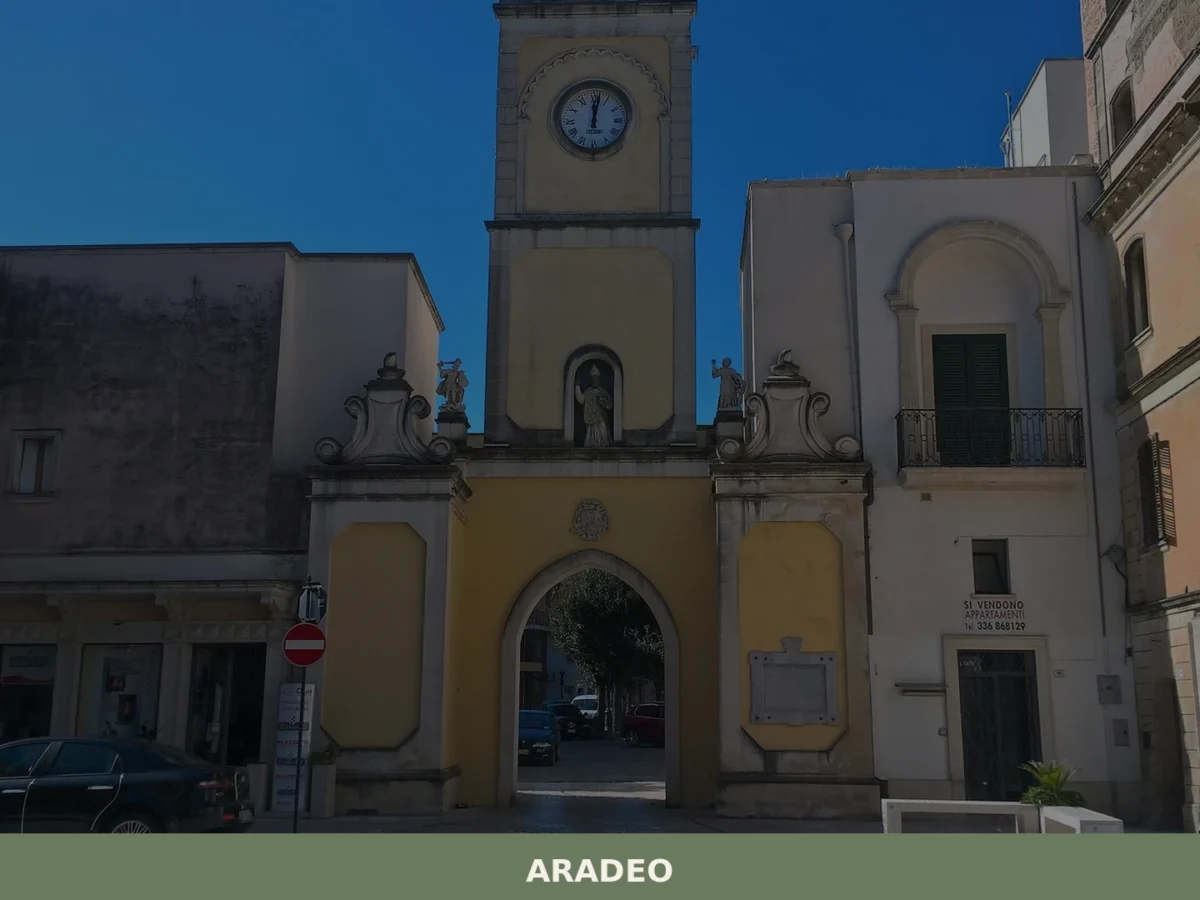
The agricultural surround yields the vegetables and fruits typical of Mediterranean Apulia: tender spring asparagus, summer tomatoes bred for storage, olives and grapes ripening in the autumn heat. The province of Lecce benefits from protected designations for products including olive oil (Olio di Puglia IGP) and table grapes (Uva di Puglia IGP), and while Racale itself does not produce a distinct DOP or IGP, its kitchens draw freely from this regional larder. Neighbourhood villages such as Alliste and Aradeo contribute their own specialities to the broader Salento table.
Planning Your Visit
Racale lies in the flat, road-friendly terrain of lower Salento, accessible from major centres by provincial highways. The nearest commercial airport is Brindisi–Casale, roughly 90 kilometres to the north; Lecce, the provincial capital and a major cultural hub, sits about 40 kilometres north-east. Most visitors arrive by private car, allowing flexible movement through the comuni of lower Salento and access to both the inland baroque villages and the coastal landscapes. The town itself is small enough to explore on foot; a morning visit to the churches and a leisurely lunch at a local restaurant can fill half a day comfortably.
| Departure Point | Distance (km) | Estimated Time |
|---|---|---|
| Lecce | 40 | 45 minutes |
| Brindisi Airport (Casale) | 90 | 1 hour 15 minutes |
| Gallipoli (coast) | 25 | 30 minutes |
| Taranto | 110 | 1 hour 30 minutes |
The feast of San Sebastiano, Racale’s patron saint, falls on 20 January and draws local devotion and processions. Beyond this date, visit anytime between May and September for stable weather; autumn (September to November) offers softer light and fewer crowds. The Monday market, held year-round, provides a window into working village life. A longer Salento itinerary might combine Racale with the fortified towns of Alezio and Collepasso inland, and the coastal resort of Gallipoli to the west—all within 30–40 minutes’ drive.
 Mountain