


Craco
 Mountain
What to see in Craco, Italy: explore the abandoned town at 400 m (1,312 ft), its medieval tower, film locations, and Basilicata’s landscape. Discover it all here.
Discover Craco
The cliff drops 400 m (1,312 ft) to the Cavone River valley below, and from the summit the bare mounds of eroded clay — the calanchi, badlands shaped by centuries of rain cutting through unstable soil — stretch in every direction without a tree or a roof to interrupt them.
The Castle Tower still stands at the highest point of the settlement, its stone mass visible for kilometres across the plateau.
No one has lived here permanently since 1980, yet the buildings remain: walls intact enough to frame a doorway, floors collapsed enough to reveal what lies beneath.
Deciding what to see in Craco begins with understanding the scale of the site — a complete medieval and post-medieval urban fabric set at 400 m (1,312 ft) altitude, roughly 40 km (25 mi) inland from the Gulf of Taranto in the province of Matera, Basilicata, Italy.
Visitors to Craco find a walled ghost town included in the World Monuments Fund watch list since 2010, a landscape of eroded calanchi formations, and a documented history of over a thousand years compressed into a single site accessible by guided tour.
History of Craco
The name Craco appears in written records from 1060 AD, when the Archbishop of Tricarico, Arnaldo, referred to the territory as Graculum, a Latin word meaning “little plowed field.” The area’s human presence, however, predates that document by nearly two millennia: tombs found at the site date from the 8th century BC, and around 540 BC Greeks who had settled the coastal town of Metaponto moved inland and occupied this elevated position. The choice of a steep summit was deliberate — the height provided a defensive advantage over the valley floor, and that logic governed the layout of everything built afterward.
From 1154 to 1168, a nobleman named Eberto, likely of Norman origin, established the first feudal control over the town. In 1179, Roberto of Pietrapertosa became its landlord.
Under the Holy Roman Emperor Frederick II, Craco functioned as a military centre, and the Castle Tower held Lombard prisoners who had fought against the Emperor. A university was founded in the town in 1276, and the population grew steadily — from 450 residents recorded in 1277, to 655 in 1477, to 1,718 in 1532, reaching a peak of 2,590 in 1561.
Four large palazzi — Palazzo Maronna, Palazzo Grossi, Palazzo Carbone, and Palazzo Simonetti — defined the civic fabric of the town by the 15th century. A plague in 1656 killed hundreds and sharply reduced the number of families present. By 1815, the settlement had grown large enough to be divided into two formal districts: Torrevecchia, the uppermost area near the castle, and Quarter della Chiesa Madre, the area surrounding San Nicola’s Church.
The 19th century brought political upheaval followed by slow demographic erosion. In 1799, during the brief Parthenopean Republic, the townspeople overthrew the Bourbon feudal system; the republican movement was suppressed within months, and Craco passed under the Napoleonic occupation before returning to Bourbon rule. On 18 July 1807, brigand bands attacked the town, killing pro-French notables and looting it. After Italian unification, brigand leader Carmine Crocco took Craco in 1861.
Between 1892 and 1922, more than 1,300 residents — known as Crachesi — emigrated to North America, driven by poor agricultural conditions.
Landslides beginning in 1963 forced the evacuation of the remaining population, who relocated to the valley settlement of Craco Peschiera. A flood in 1972 made any return to the historic centre impossible, and the 1980 Irpinia earthquake completed the abandonment. In 2007, descendants of the emigrants formed the Craco Society, a non-profit organisation based in the United States dedicated to preserving the town’s history and culture.
What to see in Craco, Basilicata: top attractions
The Castle Tower
The tower is the tallest surviving structure in the settlement, positioned at the highest point of the Torrevecchia district, which was formally designated the upper quarter of the town by 1815. Its stone walls held Lombard prisoners under Frederick II in the 13th century, giving it a function that went well beyond simple observation. Standing at its base, visitors look directly down the cliff edge to the Cavone River valley, a vertical drop of 400 m (1,312 ft).
The tower is accessible only as part of an organised guided visit, which is the required format for all entries into the abandoned site; access is not permitted independently for safety reasons.
The Calanchi Landscape
The bare, vegetation-less clay mounds surrounding Craco are the result of intensive erosion acting on unstable subsoil over a long period — the same geological instability that provoked the 1963 landslides and made permanent habitation untenable.
Each calanco ridge forms a sharp, layered profile that changes colour between ochre and pale grey depending on the light and season. The landscape extends for several kilometres in each direction from the town, and it reads as a direct explanation of why Craco was built on a cliff rather than on flat ground.
Early spring, when rain sharpens the gully edges and the air is clear, offers the most defined views of the formation patterns from the town’s perimeter.
The Church of San Nicola and the Quarter della Chiesa Madre
San Nicola’s Church gave its name to one of the two official districts established by 1815, which reflects the degree to which religious institutions structured daily life in Craco for centuries — a relationship that traces back to Archbishop Arnaldo’s ownership of the territory in 1060. The building stands in the lower section of the abandoned town, its facade still largely intact while the interior shows significant structural compromise.
The Church’s long association with the town, documented across nine centuries, makes it one of the most historically layered structures on site. Visitors approaching from the Quarter della Chiesa Madre side of the settlement pass the remains of residential buildings that illustrate how domestic and religious architecture were interwoven in the same urban block.
The Film Location Sites
Craco has served as a set for more than ten international film and television productions, a fact that makes several specific spots within the ruins recognisable to cinema audiences.
Mel Gibson’s The Passion of the Christ (2004) used the town’s streets and crumbling facades for sequences set in ancient Jerusalem. Marc Forster’s Quantum of Solace (2008) filmed an action sequence here.
Earlier productions include Francesco Rosi’s Christ Stopped at Eboli (1979) and Bruce Beresford’s King David (1985). The guided tour route passes through the areas most frequently used as sets, and guides identify specific wall sections or open spaces that appeared on screen.
For visitors familiar with any of these productions, the physical scale of the spaces — narrow lanes, steep stone stairways — is immediately apparent.
The Panoramic Ridge over the Cavone Valley
The ridge that runs steeply to the southwest of the town centre is where the older defensive logic of the site becomes most legible: the drop toward the Cavone River is immediate, and the newer buildings constructed in the lower sections of the settlement are visible below, separated by exposed rock faces. From this vantage point the full extent of the calanchi terrain spreads across the valley in a continuous band. The ridge is approximately 40 km (25 mi) from the Gulf of Taranto coast, and on clear days the coastal plain is visible in the distance.
The best light for photography falls in the late afternoon, when the clay formations cast long lateral shadows that define their structure most clearly.
Local food and typical products of Craco
The cuisine of the area around Craco reflects the agricultural economy that sustained the town through its inhabited centuries — an economy based on wheat cultivation, sheep grazing, and the cultivation of legumes on the steep fields of the Matera province.
The term Graculum, meaning “little plowed field,” in the 1060 document is itself a reference to this agrarian foundation. The mass emigration of more than 1,300 residents to North America between 1892 and 1922 disrupted local food traditions, but the broader culinary culture of the Matera province remained intact and continues in the valley settlements around Craco Peschiera.
The dominant grain-based tradition produces several bread and pasta forms common across the Matera plateau. Pane di Matera, a large durum wheat sourdough loaf with a dense crumb and thick crust, is baked in wood-fired ovens and forms the basis of several dishes. Crapiata is a legume and grain soup traditionally prepared on the first of August in the Matera area, combining chickpeas, broad beans, lentils, wheat berries, and corn in a single pot without added fat; the technique relies on the natural starch from the grains to thicken the broth.
Lagane e ceci — wide, flat pasta ribbons served with chickpeas, garlic, and olive oil — represents one of the oldest documented pasta forms in southern Italian cooking, with no egg in the dough.
The pastoral component of the local economy produced a range of sheep’s milk cheeses.
Pecorino di Filiano holds a Protected Designation of Origin (PDO) and is produced in the Basilicata region using milk from Gentile di Lucania, Leccese, and Moscia sheep; it is aged for a minimum of 180 days for the mature version and develops a hard, granular texture with a slightly pungent finish. Canestrato di Moliterno is another Basilicata PDO cheese, produced from a mix of sheep’s and goat’s milk and aged in the natural caves of Moliterno.
Lamb, particularly slow-roasted or braised with wild herbs including peperone crusco — the dried, sweet red pepper that is a defining ingredient of Basilicata’s cooking — appears regularly in the trattorias of the valley communities near Craco.
The peperone crusco deserves separate attention: these thin-walled sweet peppers are dried whole, then fried briefly in olive oil until they turn crisp, and used as a condiment or garnish across a wide range of dishes. They are produced in the Senise area of Basilicata and carry an IGP (Protected Geographical Indication) designation under the name Peperone di Senise (IGP). Local markets in Matera and the surrounding municipalities stock them in both dried and fried form, and autumn is the primary harvest and drying season, making September and October the most direct time to see them being processed in the area.
Festivals, events and traditions of Craco
The patron saint of Craco is San Vincenzo, a martyr associated with the town.
The historical relationship between the Church and the community of Craco was substantial and continuous from at least 1060, when the Archbishop of Tricarico held the territory, through the formal division of the town into the Quarter della Chiesa Madre district in 1815. Religious observance structured the civic calendar for the entire period of the town’s inhabitation.
Since the abandonment of the site after 1980, formal religious events have transferred to Craco Peschiera, the valley resettlement where the displaced population established its new centre of community life.
The Craco Society, founded in 2007 by descendants of the 1892–1922 emigrants to North America, organises periodic commemorative and cultural events that draw people of Crachesi origin back to the site. These events are not fixed annual festivals but rather organised gatherings tied to the Society’s preservation mission. The site itself has hosted film shoots and music video productions — including the 2020 video for “Paradise” by Italian dance project Meduza featuring Dermot Kennedy — which function as a distinct form of cultural event, bringing temporary international production crews and audiences into contact with the abandoned town.
When to visit Craco, Italy and how to get there
The best time to visit Craco is between April and June, and again in September and October.
Spring keeps the calanchi terrain at its most visually defined, with recent rainfall having sharpened the erosion gullies while the air remains clear enough for long views across the valley. Summer heat at 400 m (1,312 ft) altitude is manageable compared to the coast, but the exposed site offers little shade, and midday visits in July and August are uncomfortable. Autumn brings lower temperatures and the added context of the agricultural season in the surrounding countryside, with peppers drying on farmhouse facades along the approach roads.
Winter visits are possible but guided tour availability may be reduced.
Craco sits about 40 km (25 mi) from the Gulf of Taranto and approximately 35 km (22 mi) southwest of Matera. From Rome, the drive covers roughly 400 km (249 mi) via the A2 motorway southbound toward Salerno, then the SS407 Basentana eastward into the Matera province — a journey of approximately four hours by car. Matera itself makes a practical base for a day trip to Craco, with the drive taking under an hour. The nearest major train station is in Matera, served by Trenitalia connections from Bari and other regional hubs; from the station a car rental or taxi is necessary, as no regular bus service connects Matera to Craco.
The nearest airport with regular domestic and international connections is Bari Karol Wojtyła Airport, approximately 100 km (62 mi) from the site. Entry into the abandoned town is by guided tour only — independent access is not permitted. International visitors should note that English is not widely spoken at smaller local services in this part of Basilicata, and carrying cash in euros is advisable as card payment terminals are not universally available in the area.
Visitors combining Craco with other villages in the Basilicata interior may find it worth including a stop at Cancellara, a hilltop settlement in the province of Potenza that shares the same pattern of defensive upland positioning and a comparable medieval built fabric.
For those approaching from the northern part of the region, Albano di Lucania offers another example of a Basilicata village built on elevated terrain with a layered history extending from the medieval period through to the modern era.
Frequently asked questions about Craco
What is the best time to visit Craco?
Early spring (March–April) offers the sharpest views of the calanchi formations, as recent rainfall defines the gully edges and the air remains clear. Late afternoon visits in any season reward photographers with long lateral shadows across the clay ridges. The feast of the patron saint San Nicola falls on the second Saturday of October, coinciding with mild autumn temperatures and softer light — a good combination for both the guided tour and the surrounding landscape. Summer midday heat can be intense at the exposed 391 m site, so morning departures are advisable in July and August.
What are the historical origins of Craco?
Craco's documented history begins in 1060 AD, when Archbishop Arnaldo of Tricarico referred to the territory as Graculum — Latin for 'little plowed field.' Human presence on the site, however, dates to the 8th century BC, with Greek settlers from Metaponto occupying the elevated position around 540 BC for its defensive advantage. Norman feudal control followed from 1154, and under Frederick II the town became a military centre. A university was founded in 1276. The population peaked at 2,590 in 1561 before plague, emigration, and landslides led to complete abandonment by 1980.
What to see in Craco? Main monuments and landmarks
The Castle Tower at the summit of the Torrevecchia district is the tallest surviving structure, with direct views down the 400 m cliff to the Cavone valley. The Church of San Nicola, which gave its name to the Quarter della Chiesa Madre, has a largely intact facade and nine centuries of documented history. Four 15th-century palazzi — Maronna, Grossi, Carbone, and Simonetti — remain within the urban fabric. The entire abandoned town is accessible only by organised guided tour; independent access is not permitted for safety reasons. Booking a guided visit is mandatory before arrival.
What are the main natural or scenic attractions of Craco?
The calanchi — bare, eroded clay badlands — surround Craco in every direction, stretching several kilometres across the plateau without vegetation to interrupt the layered ochre and pale-grey ridges. The same geological instability that produced this landscape triggered the 1963 landslides that evacuated the town. The panoramic ridge to the southwest offers unobstructed views of the Cavone River valley 400 m below and, on clear days, the coastal plain of the Gulf of Taranto approximately 40 km away. Early spring sharpens the calanco profiles most dramatically, making it the optimal season for appreciating the natural setting.
Where to take the best photos in Craco?
The panoramic ridge to the southwest of the town centre provides the widest view of the calanchi terrain and the Cavone valley below — late afternoon is the recommended time, when low-angle light casts long lateral shadows that define the clay formation structure most clearly. The base of the Castle Tower frames the cliff edge and the valley drop simultaneously. The perimeter of the abandoned settlement at dawn or dusk offers silhouettes of the intact rooflines against open sky. All these vantage points are accessible within the guided tour route; bringing a wide-angle lens is advisable given the scale of the site.
Are there museums, churches or historic buildings to visit in Craco?
The Church of San Nicola is the principal religious building within the abandoned town, its facade substantially intact while the interior shows structural compromise. It anchors the Quarter della Chiesa Madre, one of the two formal districts established by 1815. The Castle Tower, built during the Norman period and used as a military prison under Frederick II, is the dominant civic structure. Four 15th-century palazzi — Maronna, Grossi, Carbone, and Simonetti — are distributed across the settlement. All buildings are visited exclusively through the mandatory guided tour; there is no independent entry and no separate museum facility on site.
What can you do in Craco? Activities and experiences
The primary activity is the organised guided tour of the abandoned town, which covers the Castle Tower, the Church of San Nicola, the four historic palazzi, and the film location sites used in productions including The Passion of the Christ (2004) and Quantum of Solace (2008). The tour route also passes through areas that appeared in Francesco Rosi's Christ Stopped at Eboli (1979). Guided visits must be booked in advance through the official local operator. Beyond the town itself, the surrounding calanchi landscape offers documented scenic walking in the valley and along the plateau edge in the Matera province.
Who is Craco suitable for?
Craco suits travellers with a specific interest in abandoned urban heritage, medieval southern Italian history, and dramatic erosion landscapes. The guided tour format and uneven terrain make it more appropriate for adults and older teenagers than for young children or visitors with limited mobility. Film enthusiasts familiar with The Passion of the Christ, Quantum of Solace, or Christ Stopped at Eboli will find direct, identifiable connections on the tour route. Photographers — landscape and architectural — benefit especially from late-afternoon visits. Those seeking conventional tourist infrastructure such as shops, restaurants, or accommodation within the site itself will not find them; the valley settlement of Craco Peschiera serves those needs.
What to eat near Craco? Local products and specialties
The culinary tradition of the Matera province centres on durum wheat, legumes, and sheep's milk products. Pane di Matera is a large sourdough loaf baked in wood-fired ovens, forming the base of several local dishes. Crapiata is a legume and grain soup — chickpeas, broad beans, lentils, wheat berries, and corn — traditionally prepared on 1 August in Matera. Lagane e ceci, egg-free flat pasta ribbons with chickpeas and olive oil, is one of the oldest documented pasta forms in southern Italian cooking. Pecorino di Filiano PDO, a sheep's milk cheese produced in Basilicata, represents the pastoral side of the local food economy.
📷 Photo Gallery — Craco
Getting there
Via Monsignore Mastronardi, 75010 Craco (MT)
Nearby Villages near Craco
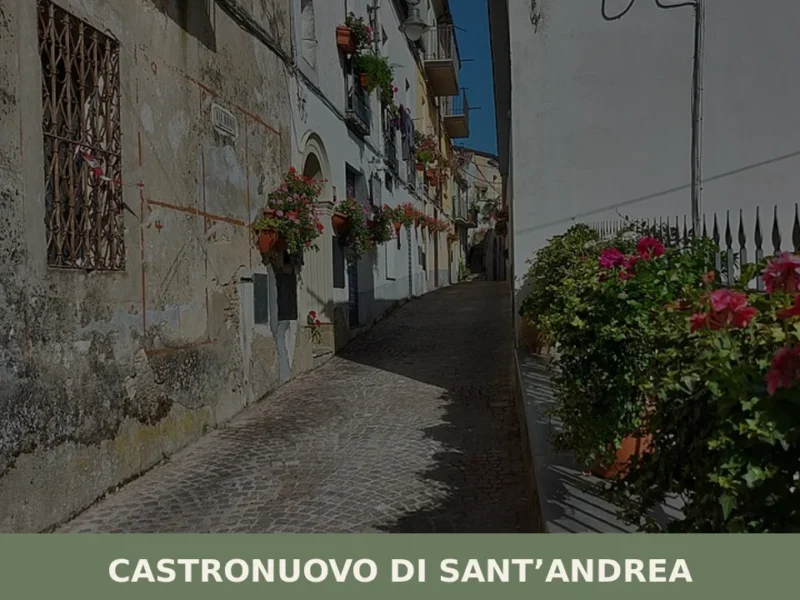
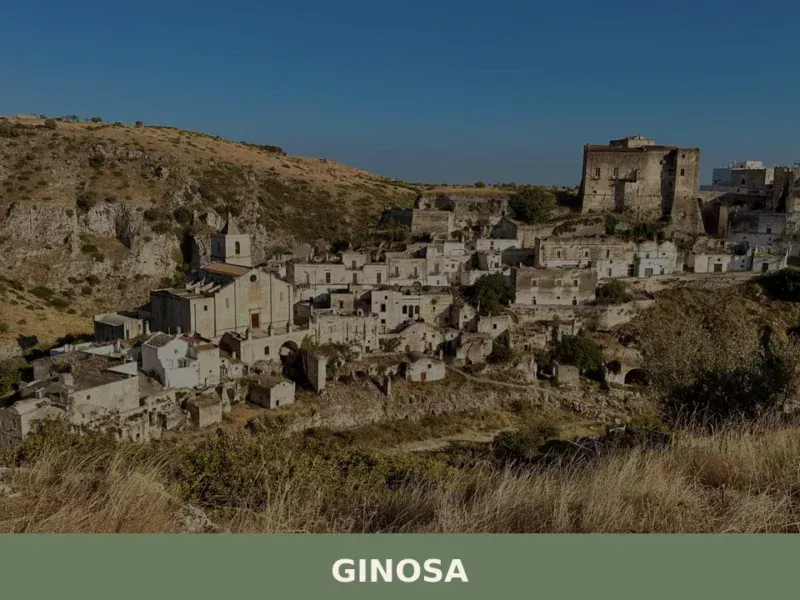
In Basilicata More villages to discover
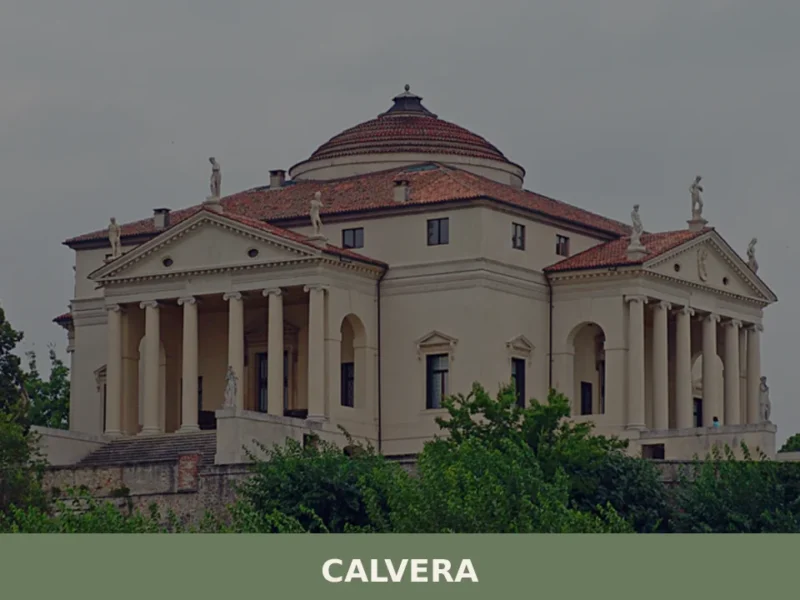
Calvera
Mountain
At 630 meters above sea level, in the heart of the province of Potenza, lies Calvera, a small Lucanian municipality distinguished by its elevated position and authentic atmosphere. The village, with its stone houses clinging to the hillside, offers panoramic views of the surrounding valley, bearing witness to a history of mountain life and a […]
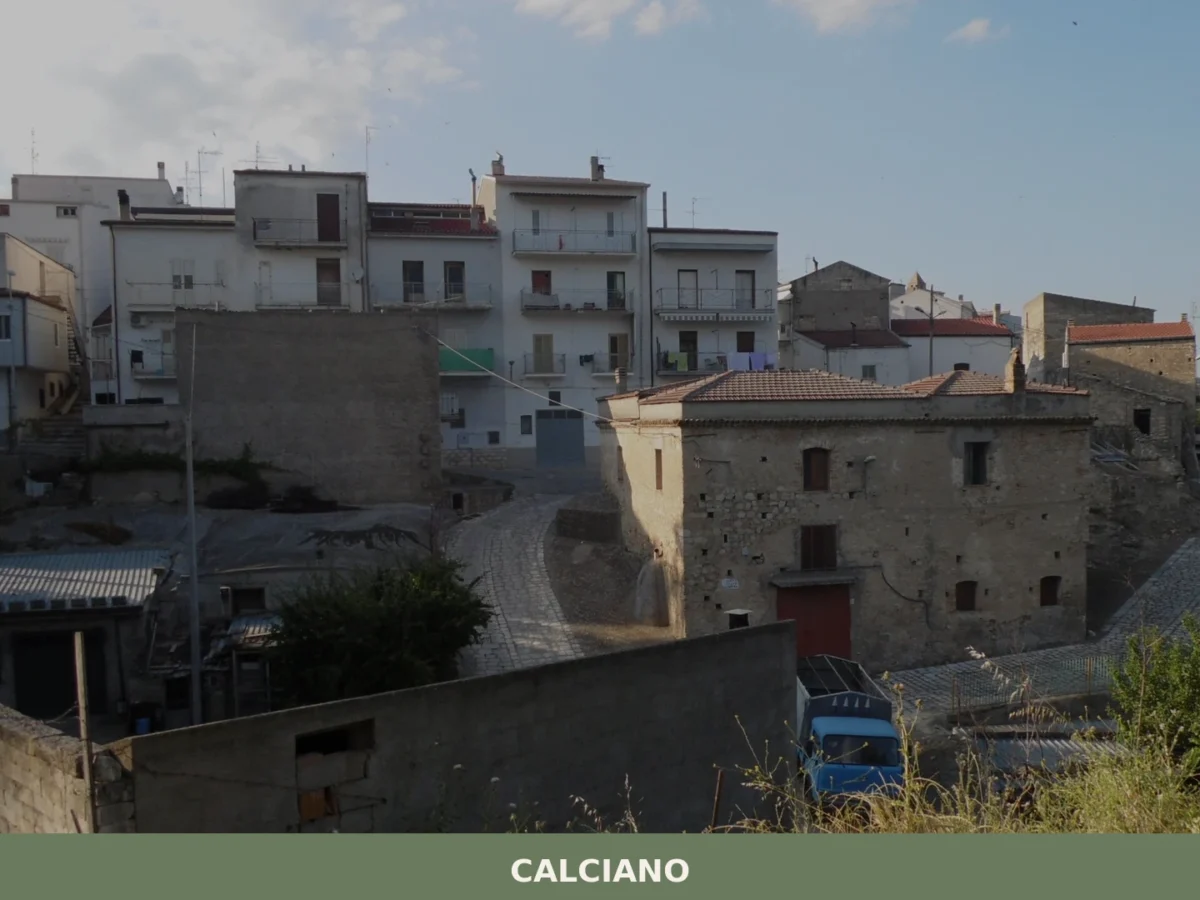
Calciano
 Hills
Hills
Six hundred inhabitants, a dialect that calls the town Caucësciànë, and a landscape that the province of Matera renders with geometric precision: clay hills that change colour with the passing hours, narrow streets where the wind carries dust in summer and silence in winter. In this article History and origins of Calciano What to See […]

Colobraro
Hills
What to see in Colobraro, Italy: explore the village at 630 m altitude known as 'that village'. Discover its curse legend, Sinni valley views & local food. Read the guide.

Castelluccio Inferiore
Mountain
What to see in Castelluccio Inferiore: 5 must-see attractions, from the historic center to baroque churches. Discover the complete guide to this Basilicata village.
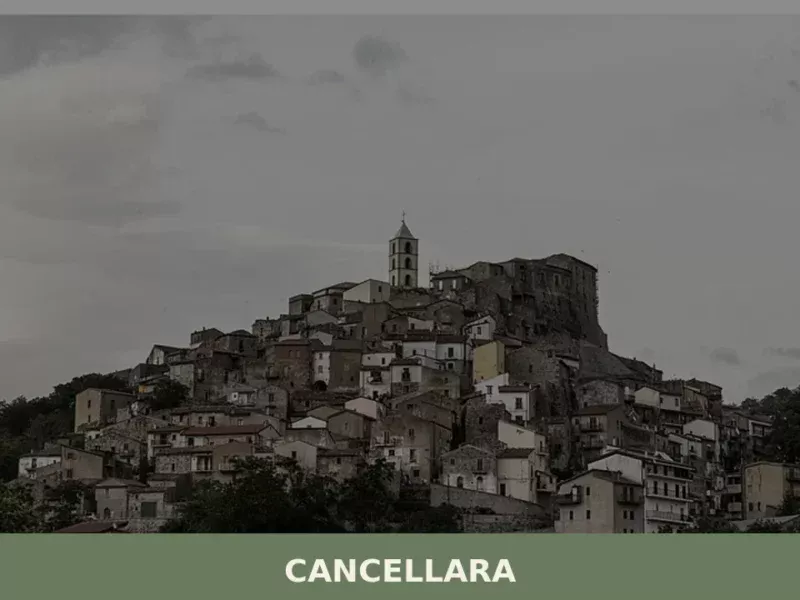
Cancellara
Mountain
What to see in Cancellara: Discover Italy's Basilicata region, a village at 680 m (2,231 ft) known for its medieval castle and ancient necropolis. Explore its history and salami festival.
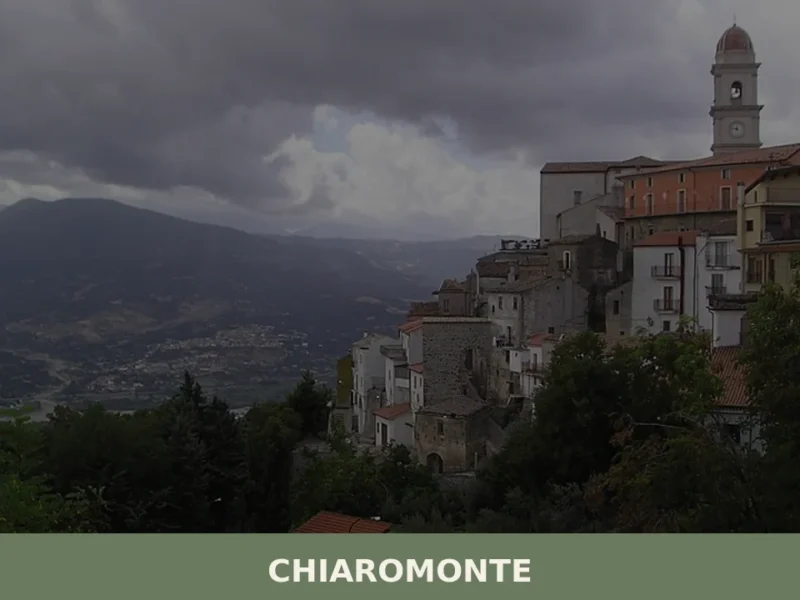
Chiaromonte
Mountain
what to see in chiaromonte, Italy: Discover its 794m altitude and delve into its history, from ancient roots to the case study of Montegrano. Explore Basilicata.

Cirigliano
Mountain
What to see in Cirigliano, Italy: a medieval village with a 17th-century Pietu00e0, an oval castle tower, and local pasta traditions. Discover 5 top attractions.

Ferrandina
Hills
What to see in Ferrandina, Basilicata, Italy: 6 historic churches, olive oil production, and a hilltop at 482 m. Discover top attractions and how to get there.
🧀 Italian traditional products

🏡 Know Craco better than we do?
If you’re a local or have been there, your knowledge matters: add what’s missing or fix a detail on this page.