


Cutrofiano
 Plains
A rural comune of 8,657 souls at 85 metres altitude in southern Lecce province. Visit for medieval crypts, baroque architecture and the living memory of a once-thriving ceramic tradition.
Cutrofiano: A Salento Village Between Greek Roots and Baroque Stone
In the flat, ochre expanse of southern Salento, where late afternoon light softens the terracotta roofs and limestone walls, Cutrofiano emerges as a living village of modest streets and deep historical layers. The air carries the faint mineral scent of the clay soil beneath—the same earth that fed kilns for centuries and shaped the rhythms of everyday life. At 81 metres above sea level, this comune occupies the central-southern belt of Lecce province, its territory spanning 55.72 square kilometres of agricultural land where olive groves and vegetable fields still define the landscape as they have for generations.
Cutrofiano village in Apulia belongs to the Unione dei comuni della Grecìa Salentina (Union of Greek Salento municipalities), a union of towns that preserve the cultural memory of a once-Greek-speaking region. Today the village draws visitors for its Byzantine crypts and baroque churches, its connection to pre-Christian monastic communities, and its role in the ceramics economy that once sustained the entire region. The comune is also a gateway to the Cammino di Don Tonino, a pilgrimage route that connects the villages of southern Puglia.
Origins, Feudal Holding and the Ceramic Craft
The name Cutrofiano carries traces of its ancient past. Scholars link the toponym to the Greek khytra (vessel) and the practice of producing cutrubbi—earthenware pots that became the village’s economic signature. An alternative derivation suggests roots in the Greco-Latin personal name Oecotrophius or the Oscan Octufrius, though the ceramic connection remains most plausible given the village’s later prominence as a pottery centre.
The earliest documented evidence places Cutrofiano in the feudal system of the 12th century. In 1192, a royal grant assigned the casale to Riccardo Panvino, alongside the lands of San Pietro di Galatina—a document that confirms an established settlement already existed. From the mid-13th century onward, Cutrofiano became part of the Contea di Soleto (County of Soleto), passing through the hands of successive feudal lords: the De Matino family, the Principality of Taranto and the Del Balzo-Orsini dynasty. In 1482, the Del Doce-Capece family acquired the fief, holding it until the Filomarini purchased it in 1664, a tenure that lasted until feudal abolition in 1806.
By the mid-18th century, when Naples conducted its Catasti Onciari (fiscal surveys), Cutrofiano housed approximately 650 inhabitants. The Foresta di Cutrofiano (Forest of Cutrofiano), a remnant of the Mediterranean scrubland that once blanketed lower Salento, supplied the wood that fed the kilns. Spanning nearly 1,000 tomoli (approximately 716 hectares) in the 1700s, this forest was essential to production, though later division between feudal lord and municipality reduced its extent by half.
In the 1700s, of Cutrofiano’s approximately 650 inhabitants, roughly 150 depended entirely on the ceramic craft—potters whose hands shaped the vessels that served households across Salento and beyond.
Rural Life and Modernization in the Twentieth Century
From the 1950s through the early 1970s, Cutrofiano underwent significant public modernization. Schools, postal services and a covered market were built. The municipal building was expanded, and new water and sewage networks brought basic infrastructure to the village. Public health regulations began to curtail kiln emissions in the centre, and traditional practices—such as the collection of household waste by cart—gave way to more systematic sanitation. The village also pioneered social initiatives: low-interest mortgages for first-home purchases and daytime care for people with disabilities ranked among Italy’s earliest municipal services of this kind.
Yet these improvements could not stem substantial emigration. From the mid-1950s onward, waves of residents left for industrial cities in the north and abroad, seeking work in Switzerland, Germany and Belgium where economic prospects far outpaced the opportunities of the Salento countryside. For the agricultural labourers who remained—often members of large families working on daily wages—life continued as it had: dawn-to-dusk fieldwork, seasonal harvesting of olives and grapes, and at night, families gathered around small fires to share stories. Evening meals were simple: legume soups cooked with dried vine cuttings or spent tobacco plants. In summer, workers slept in the fields. Water, collected in deep wells fed by the clay subsoil, allowed farmers to irrigate by day and accumulate reserves for the dry season. The same plots that produced wheat or tabacco in one season could yield chicory, turnips, cabbage, celery and fennel by winter—a rhythm enabled by both soil fertility and human labour.
From the 1970s onward, rural electrification and the completion of infrastructure networks transformed agricultural output and livestock management. Cutrofiano evolved into a reference point for commerce and services across the broader Salento region.
Sacred Architecture and Medieval Crypts
Chiesa Matrice di Nostra Signora della Neve
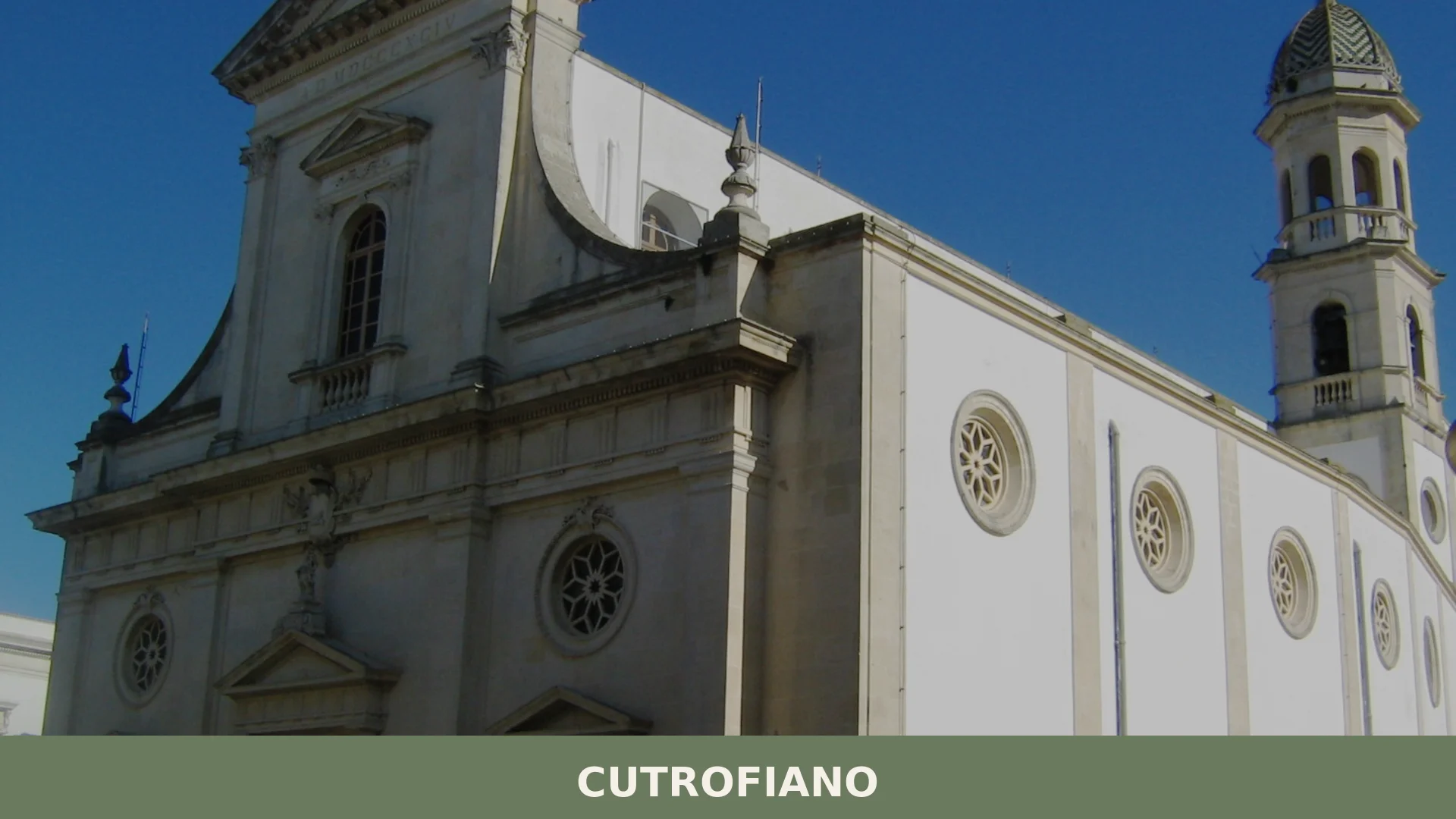
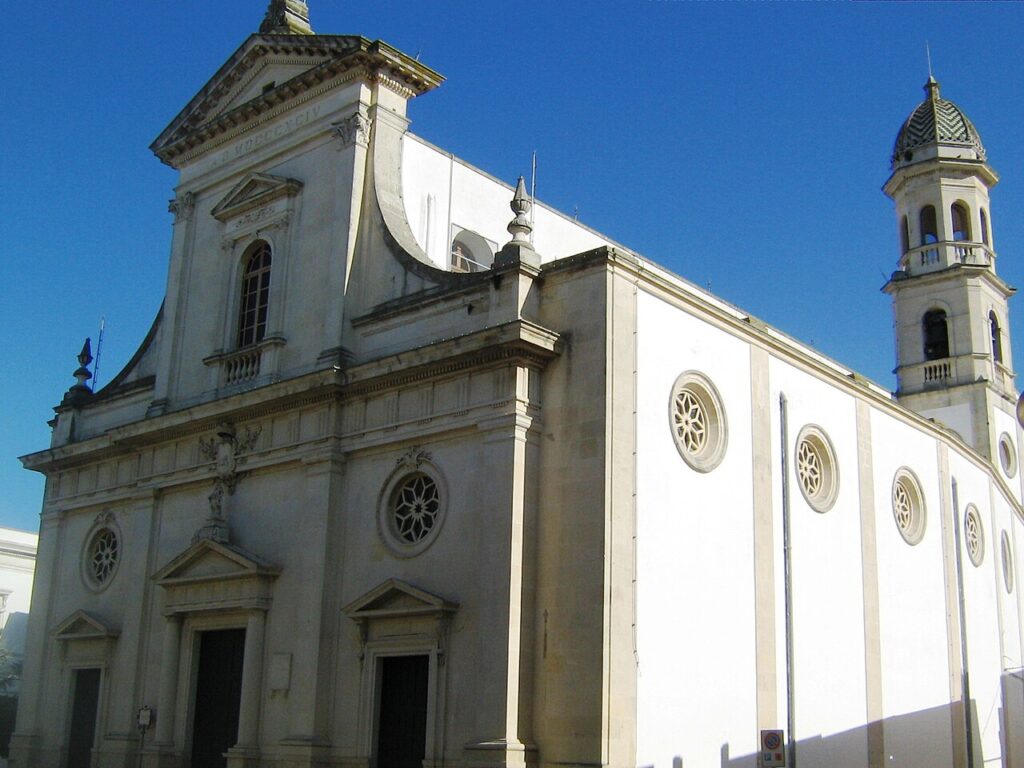
The parish church stands as the spiritual and architectural centre of Cutrofiano. Originally built in the 17th century and substantially rebuilt in the late 19th century, the Chiesa Matrice (Mother Church) now displays a neoclassical façade that rises above the main piazza. Three portals, each topped with triangular pediments, frame the entrance. Inside, three barrel-vaulted naves are separated by columns and lined with seven baroque altars salvaged from the earlier 17th-century structure. A 17th-century wooden crucifix of notable craftsmanship is also preserved here.
Chiesa dell’Immacolata
Completed in 1772, the Chiesa dell’Immacolata (Church of the Immaculate) embodies the faith and resources of Cutrofiano’s ceramic guilds. Completed in 1772, the church rises with an unusual octagonal floor plan and an elegant façade divided into two storeys. A richly decorated central window adorns the façade, and at the roofline stands a statue of the Immaculate Virgin. Inside, simplified by 19th-century renovations, the church preserves a series of rococò medallions carved in local limestone, each framing paintings of episodes from the life of Mary. These include works attributed to Maria Rachele Lillo.
Cripta Rupestre di San Giovanni Battista
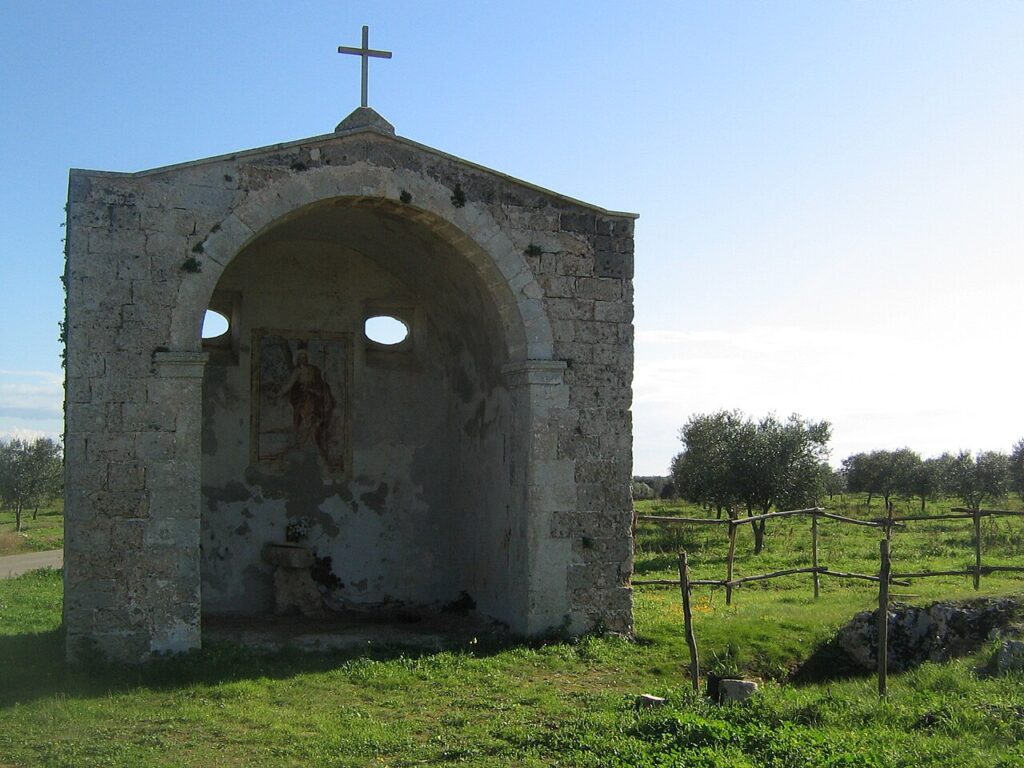
About one kilometre from the village centre lies a site of profound historical resonance: the Cripta di San Giovanni Battista (Crypt of Saint John the Baptist). This underground chapel shows evidence of religious use. The walls retain faint traces of once-vibrant frescoes, now largely faded. Beside the crypt entrance stands a small stone chapel built in honour of Saint John. The surrounding locality includes a medieval necropolis, an underground oil press, and a large cistern—evidence of continuous habitation across centuries. This complex represents the deep continuity of monastic settlement in southern Salento and the Byzantine cultural landscape that shaped the region long after the collapse of the Eastern Empire.
Palazzo Filomarini
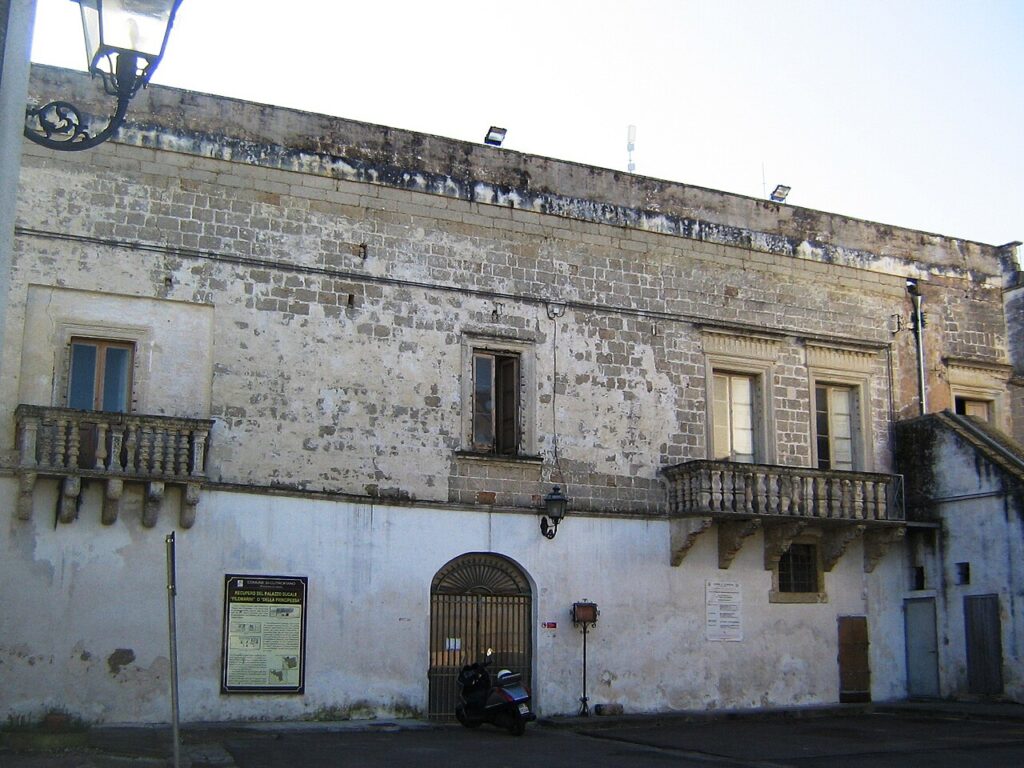
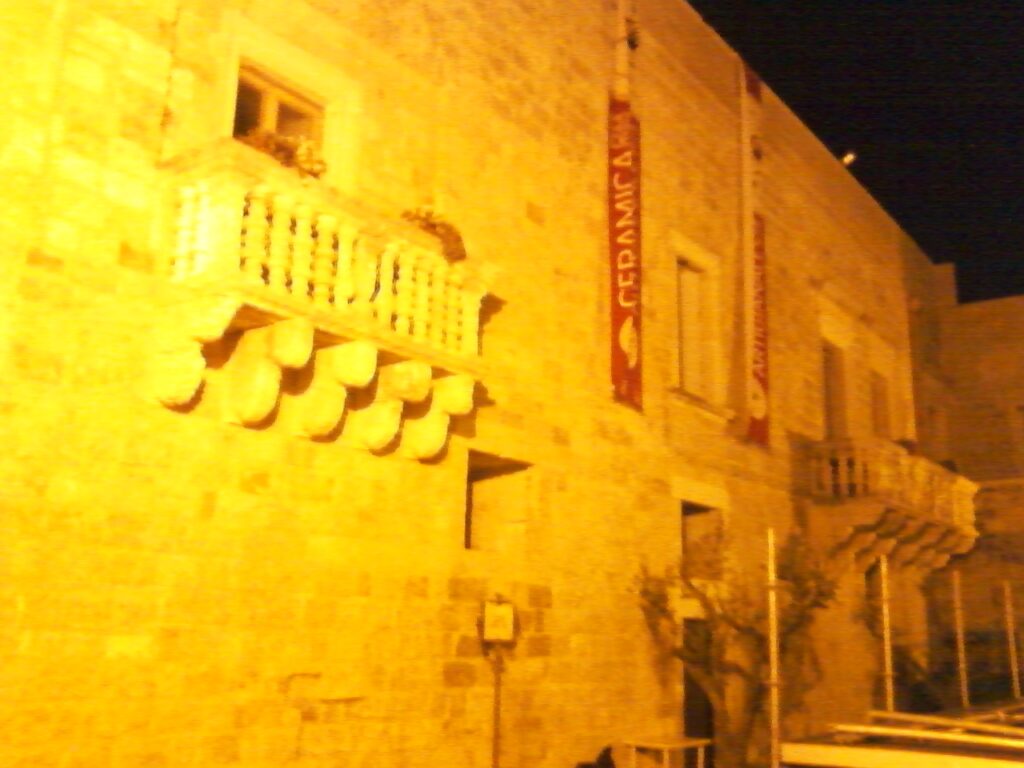
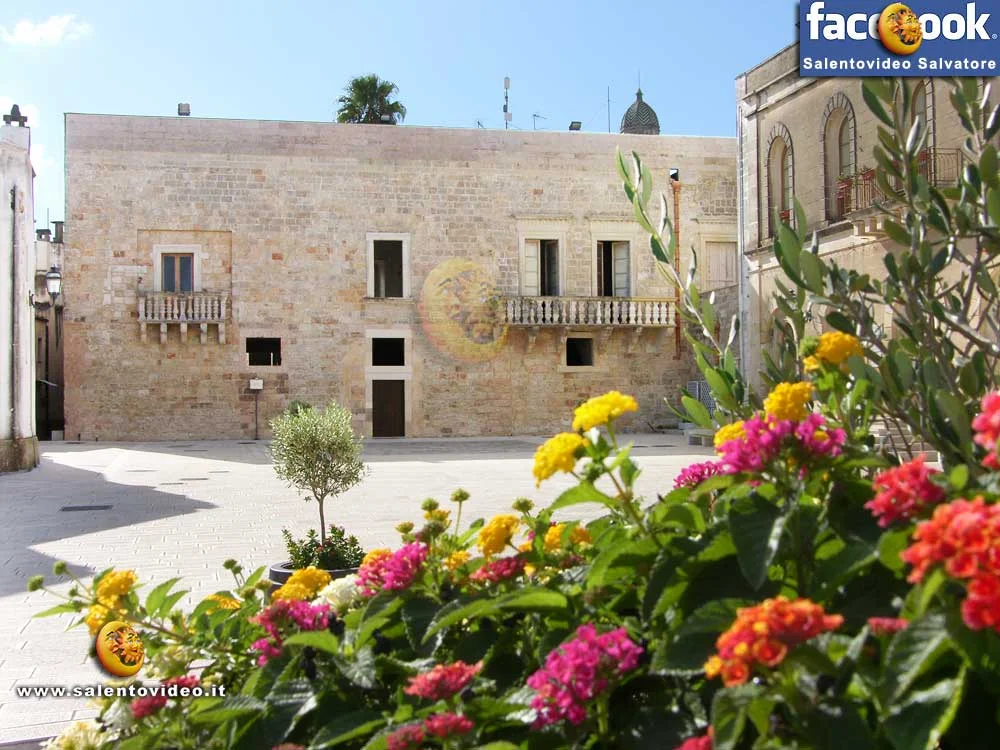
Dominating Piazza Municipio stands Palazzo Filomarini, a 17th-century noble residence built on the foundations of an earlier castle. The structure blends multiple periods: the ground floor preserves sections of the medieval stronghold, with Renaissance elements visible in the upper storeys. Renaissance balconies with finely wrought ironwork adorn the upper façades, facing both the main square and the interior courtyard. The sober stonework and anthropomorphic water spouts of the Via Filomarini elevation date to the 17th century. The palazzo is now used for temporary art exhibitions and cultural events, keeping the interior accessible to visitors and supporting contemporary cultural events.
Sito Archeologico di Scacciato
In the locality called Scacciato lies evidence of Roman settlement: the remains of a pottery kiln of the Imperial period, discovered during recent excavation. This site underscores that Cutrofiano’s relationship with clay and fired ceramics extends back at least two thousand years, long before the medieval guilds flourished. The finds, now preserved and documented by local authorities, confirm occupation and craft production in the Roman era.
Territory, Landscape and the Geology Beneath
Cutrofiano sits in the flat, agricultural interior of the Salento peninsula, approximately 32 kilometres south of the provincial capital, Lecce. The terrain rises and falls modestly between 65 and 119 metres, with an elevation range of only 54 metres—a landscape shaped entirely by clay and limestone rather than by dramatic relief. The clay subsoil has made the region’s water resources accessible to shallow wells, a resource that farmers exploited for centuries. The Mediterranean climate brings mild winters (average January temperature around 5°C) and warm, humid summers (August averaging 30°C). Annual rainfall concentrates in autumn and winter, reaching about 676 millimetres per year, with spring and summer notably dry.
Nearby municipalities include Aradeo and Neviano to the west, Corigliano d’Otranto and Soleto to the east, Galatina to the north, and Collepasso to the south. Together they form a constellation of small towns, each with its own agricultural and religious heritage, linked by winding roads and family networks that have endured across centuries.
Flavours of the Salento Countryside
The cooking of Cutrofiano reflects the produce of the land and the rhythms of agricultural life. Salads of bitter greens, vegetables preserved in oil, and simple pasta dishes seasoned with tomato and local herbs sustain daily meals. Lamb appears on feast tables, often paired with peas and eggs—a dish tied to the Easter calendar and the pastoral traditions of rural Salento. The province of Lecce produces several protected designation products: Burrata di Andria (IGP), a creamy fresh cheese from the neighbouring region; Olio di Puglia (IGP), the olive oil that anchors every kitchen; Patata novella di Galatina (DOP), young potatoes from nearby fields; and Terra d’Otranto (DOP), a wine that carries the name of the southern peninsula itself. While Cutrofiano’s own ceramic workshops have largely closed, the memory of clay-pot cooking and the flavours absorbed during centuries of terracotta-fired meals remain woven into local food culture.
Planning Your Visit
Cutrofiano is best visited in late spring (May) or early autumn (September–October), when temperatures are moderate and the landscape is either freshly green or golden with harvest. The village observes the feast of its patron, Sant’Antonio, and maintains the rhythms of Catholic liturgy; visiting during these observances offers insight into local religious tradition, though these dates vary by the ecclesiastical calendar. The comune is accessible by car from Lecce, or by regional bus services that connect to neighbouring towns. There are no direct train stations within the municipality, though connections through larger centres like Lecce or Maglie provide transit options.
| Departure Point | Distance | Approximate Travel Time |
|---|---|---|
| Lecce (provincial capital) | 32 km south | 35–45 minutes by car |
| Brindisi airport | 65 km northeast | 1 hour 15 minutes by car |
| Bari airport | 180 km north | 2 hours 15 minutes by car |
| Aradeo (nearby village) | 8 km west | 12 minutes by car |
| Galatina (nearby village) | 10 km north | 15 minutes by car |
Visitors with an interest in pilgrimage routes may follow the Cammino di Don Tonino, which passes through Cutrofiano and links several villages of the Grecìa Salentina. The crypt of San Giovanni Battista is accessible on foot from the village centre and rewards the walk with a profound encounter with Byzantine monastic life. Photography is permitted in the churches and public spaces; respectful dress is expected when entering active places of worship.
The village offers modest hospitality: a few small guesthouses and restaurants operate in or near the piazza, serving local fare. Cutrofiano functions primarily as a residential and agricultural centre rather than a mass-tourism destination, which preserves its character but means fewer commercial amenities than larger towns. The official municipal website (www.comune.cutrofiano.le.it) provides practical information in Italian, including details on local services, municipal events and cultural initiatives.
Frequently asked questions about Cutrofiano
How do I reach Cutrofiano by car from Lecce?
Cutrofiano is located in central-southern Lecce province, approximately 30 kilometres south of Lecce city. From Lecce, take the SS16 state road southbound towards Maglie, then follow local directions towards Cutrofiano. The journey takes roughly 40–50 minutes by car. There is no direct motorway access; the nearest major motorway (A3/Salerno–Reggio Calabria) is over 100 kilometres north.
What is the patron saint of Cutrofiano, and when is the feast celebrated?
Sant'Antonio is the patron saint of Cutrofiano. The traditional feast day of Sant'Antonio Abate is celebrated on 17 January, though local celebrations may extend across the nearest weekend or include preparatory events. This is the principal religious and community celebration in the village calendar.
How long should I plan to spend visiting Cutrofiano?
A full visit typically requires 3–4 hours. This allows time to explore the baroque churches, Byzantine crypts, and the village's modest street layout at a leisurely pace. If you include nearby sites within the Unione dei comuni della Grecìa Salentina or plan to walk sections of the Cammino di Don Tonino pilgrimage route, allocate a full day.
Is Cutrofiano part of any cultural or pilgrimage network?
Yes. Cutrofiano belongs to the Unione dei comuni della Grecìa Salentina, a consortium preserving the cultural heritage of Greece-influenced Salento. The village also serves as a gateway to the Cammino di Don Tonino, a pilgrimage route connecting villages across southern Puglia, making it both a cultural landmark and a waypoint for spiritual walkers.
What is the historical significance of ceramics in Cutrofiano?
Ceramics shaped Cutrofiano's economy for centuries. The village's argillaceous soil—rich in clay—fed numerous kilns that sustained local artisans and trade networks throughout the region. This ceramic heritage remains a defining aspect of Cutrofiano's identity and continues to draw visitors interested in traditional craftsmanship and medieval economic history.
📷 Photo Gallery — Cutrofiano
In Apulia More villages to discover
Collepasso
Plains
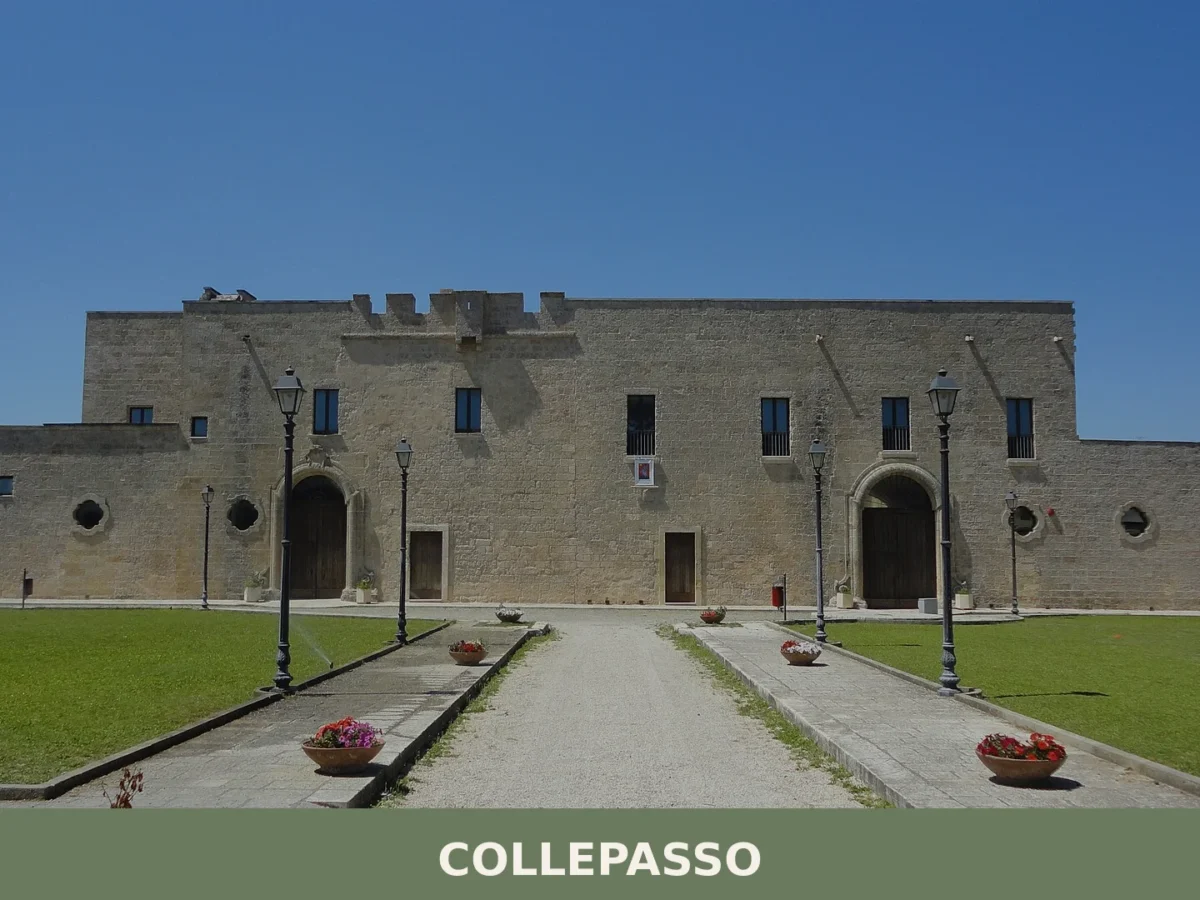
A village of 5,500 souls on the Salento plateau, founded in 1805 by a noble couple from Naples. Explore baroque churches, strategic hilltop setting and agricultural heritage.
Cellino San Marco
Plains
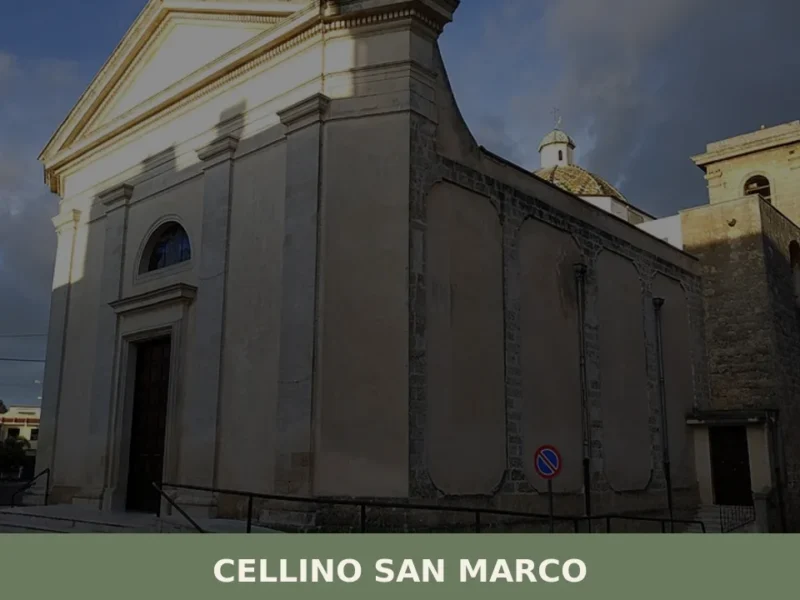
Scopri Cosa vedere a Cellino San Marco: un borgo agricolo ricco di storia e tradizioni in Puglia. Pianifica la tua visita e assapora l'autenticità del Salento.
Bitritto
Plains
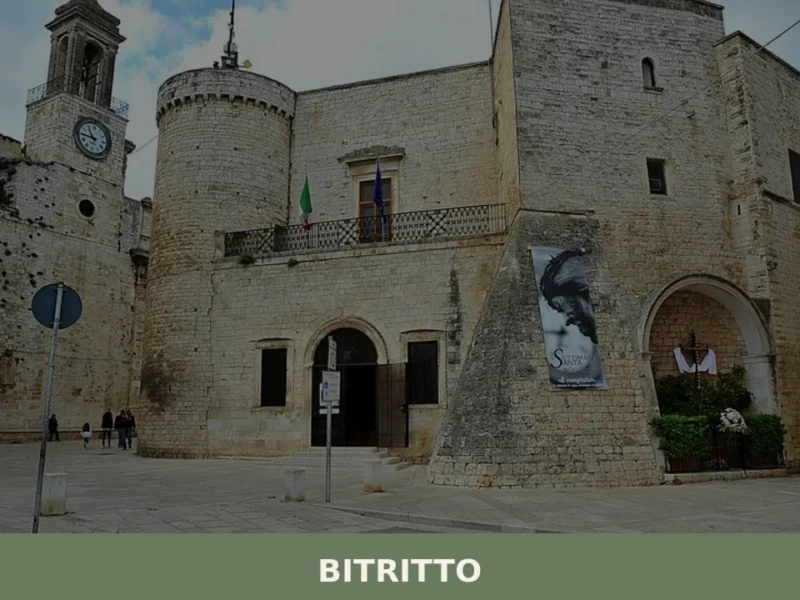
Approximately 11 kilometers southwest of Bari, in the basin opening towards the hinterland, lies Bitritto, a municipality with 11,046 inhabitants, situated 102 meters above sea level. Its territory, marked by olive groves and almond orchards, is an integral part of the Apulian agricultural landscape and reflects the region’s farming heritage. For those wondering what to […]
Volturino
 Mountain
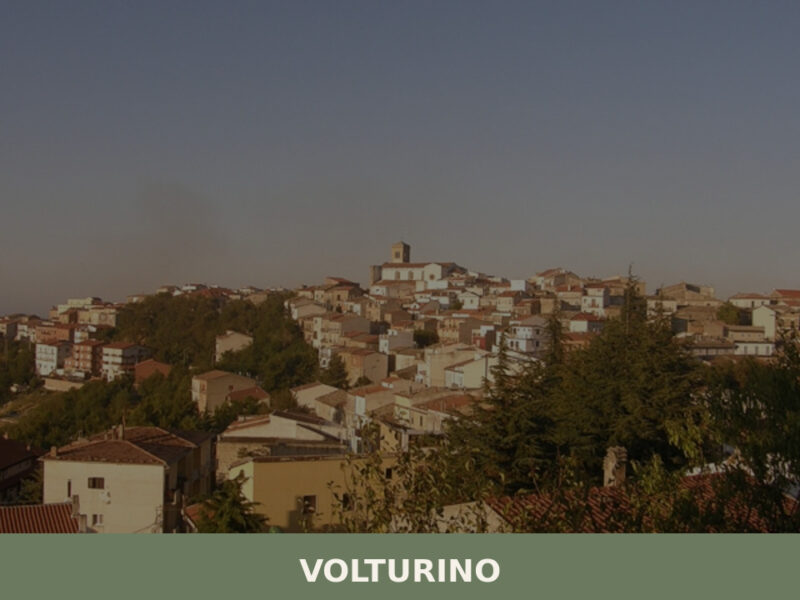
A ridgetop village of 1,554 inhabitants in Puglia's Daunia mountains, Volturino overlooks the Tavoliere plain from 735 metres. Medieval lanes, stone churches, and panoramic silence.
San Donaci
Plains
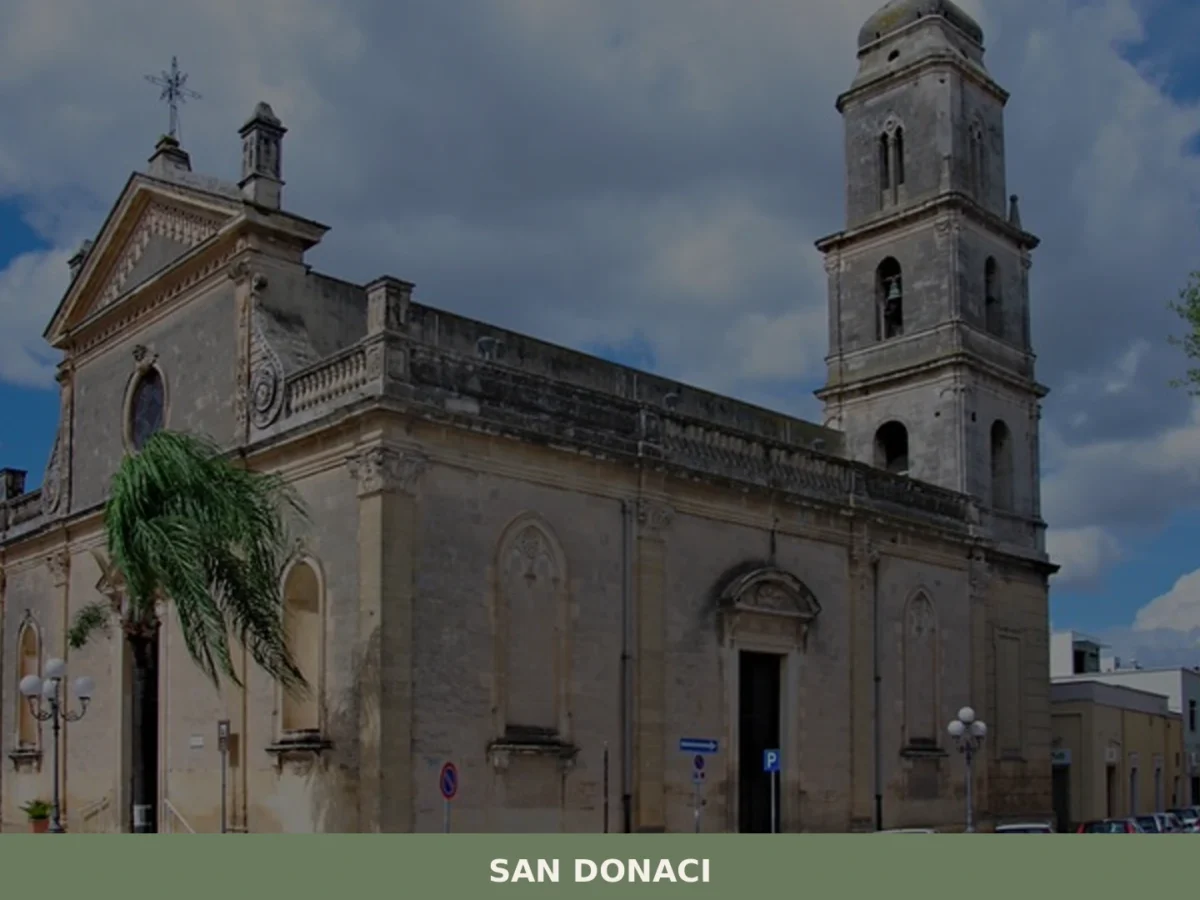
What to see in San Donaci? Discover the 5 must-see attractions of this Puglian village. Plan your perfect visit with our complete guide!
Ostuni
 Sea
Sea
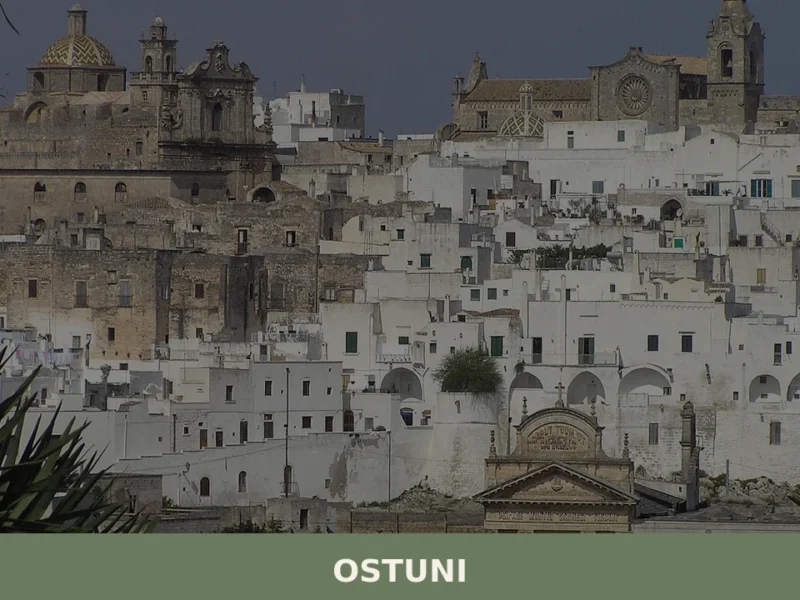
What to see in Ostuni, Italy: Discover the 'White Town' with its 30,143 residents and explore 5 key historical sights. Read our guide for top attractions and travel tips.
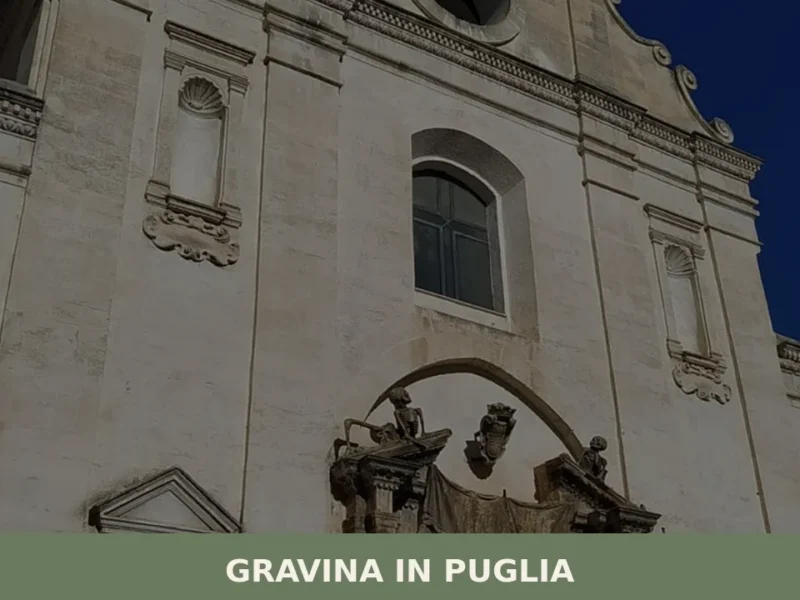
Gravina in Puglia
 Hills
Hills
In 1092, Humfred of Hauteville confirmed the privileges of the cathedral dedicated to Santa Maria Assunta, a document that fixes in the historical record the ecclesiastical rank of Gravina in Puglia well before Frederick II chose it as an imperial hunting reserve. Today, anyone walking along the edge of the gravina — the karstic canyon […]
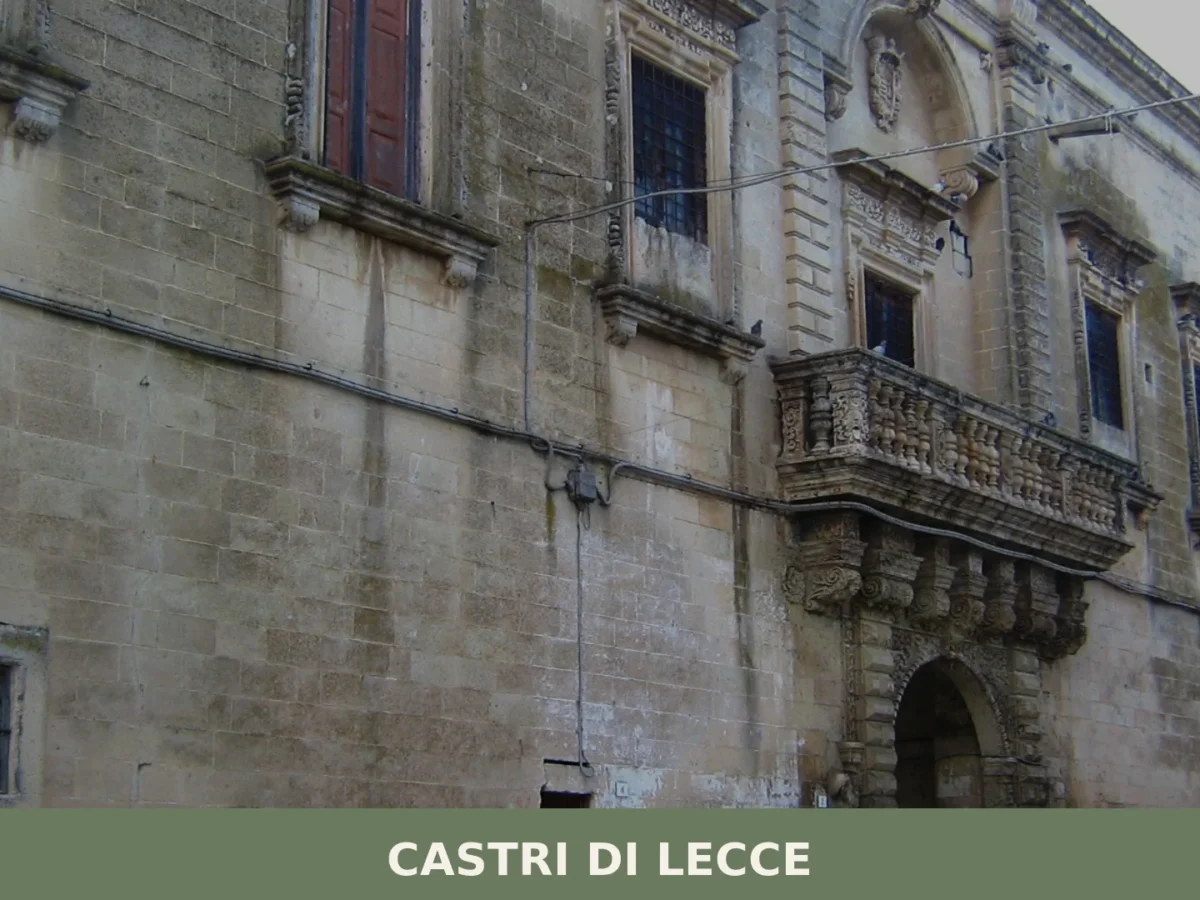
Castri di Lecce
Plains
Population 2,721. A limestone plateau village born from the union of two distinct feudal estates, held together by baroque chapels and standing menhirs from the Bronze Age.
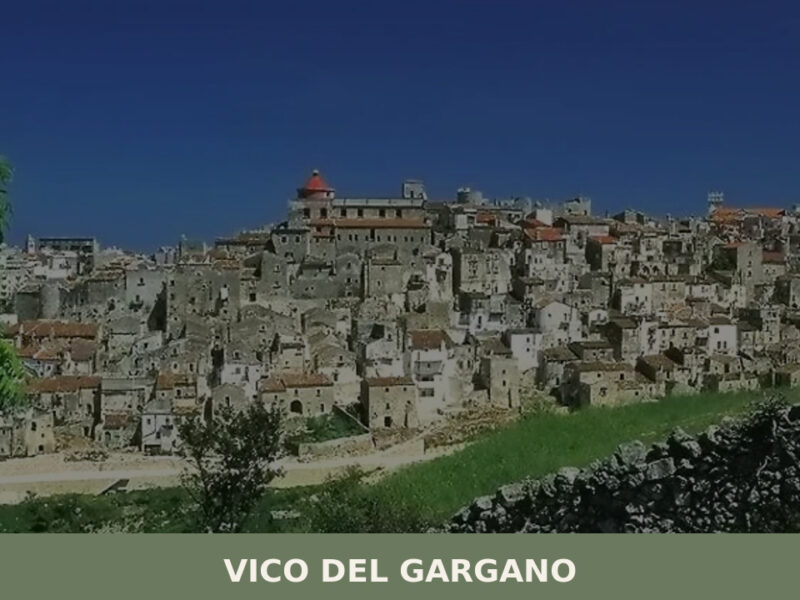
Vico del Gargano
Sea
A hilltop village at 445 metres on the Gargano promontory, Vico del Gargano rewards slow exploration — medieval alleys, underground olive presses, and ancient forest at its edge.
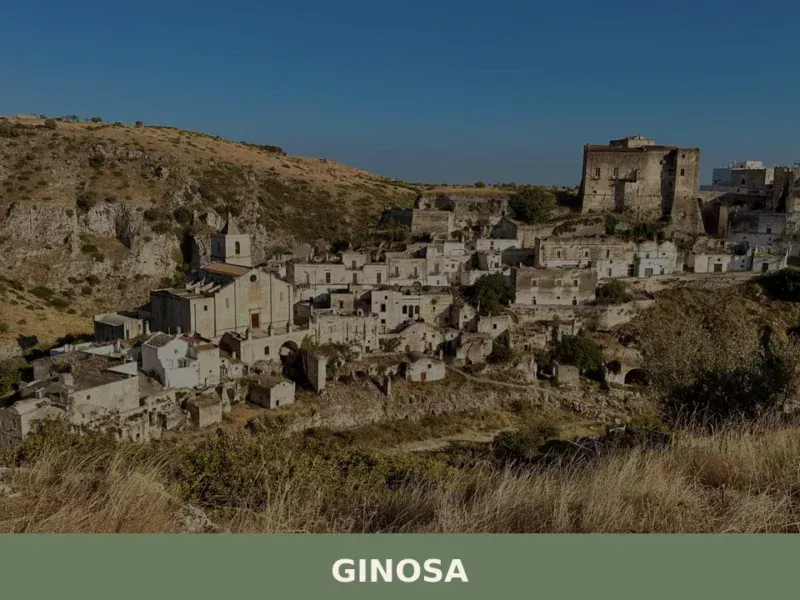
Ginosa
Sea
Discover what to see in Ginosa, Puglia: the dramatic gravina, rupestrian churches, castle, cathedral and Ionian coast. Practical travel guide with tips.

🏡 Know Cutrofiano better than we do?
If you’re a local or have been there, your knowledge matters: add what’s missing or fix a detail on this page.