Collepasso rises on the undulating heights of the Salento uplands, where limestone ridges shelter inland valleys from coastal wind. The village spreads across modest elevations between 102 and 180 metres above sea level, its streets arranged around a baroque core of stone buildings and modest piazzas. This is not a medieval settlement reclaimed from abandonment, but a deliberately planted village born from the ambition of a Neapolitan nobleman and his baroness in the opening years of the nineteenth century.
Collepasso village in Apulia is a study in planned settlement and family enterprise. Today it holds around 5,500 residents in the province of Lecce, and its character rests on two anchors: the religious and civic identity forged through its churches, and the agricultural rhythms that still animate the surrounding countryside. The village invites visitors drawn to understated religious architecture and the quiet story of how the Salento interior was repopulated after centuries of dispersal.
From Byzantine Fragments to Baronial Foundation
The territory of Collepasso carries traces of much earlier occupation. A Greek document from the twelfth century records the toponym as Koulopatze, and later Latin forms such as Colopati and Colopaci appear in medieval records. The name itself evolved through centuries of linguistic change. Medieval documents suggest origins in personal or religious references—either a casale (farmstead) associated with a figure named Nicola Ippazio, or a village connected to Saint Nicholas. The modern name Collepasso crystallised in the eighteenth century, drawn from Latin terms referencing the geography: collis passus, the hill of passage, marking this as a natural crossing point through the Salento highlands.
A small settlement called Colopati or Colopaci is documented from the thirteenth century onward. Between 1240 and 1269, the territory likely fell within the holdings of Gervasio de Matino, the baron of neighbouring Matino, and then his son Glicerio. From 1269, the lands passed to the County of Soleto, granted by the Angevin rulers to Anselino di Toucy after he married Sibilla de Matino, daughter of the Matino lord. Yet these early centuries leave little trace: the settlement appears to have vanished during the economic and plague crises of the fourteenth century that erased dozens of small casali from Terre d’Otranto.
The village’s true founding came only in 1805. The baroness Maria Aurora Leuzzi Contarini and Count Bartolomeo degli Alberti di Enno, arriving from Naples, took residence in an existing palazzo built in 1576 by Pietro Massa, itself raised perhaps on the ruins of an earlier Norman-era structure. They modernised the structure and set about attracting settlers to the baronial lands, offering tenancy agreements for building plots and for orchards and vineyards. The village was formally established as a frazione (ward) of the neighbouring municipality of Cutrofiano. Between 1813 and 1816, dwellings rose in irregular patterns around the baronial seat, establishing the foundations of agricultural and manual work that would sustain the community. The completion in 1851 of the state road linking Maglie to Gallipoli, passing through Collepasso, opened the village to broader regional commerce. By the first census in 1861, the settlement had grown to 1,067 inhabitants. Population climbed to 2,700 when the village secured administrative independence in 1907 through royal decree signed by King Vittorio Emanuele III, on the proposal of deputy Antonio Vallone of Galatina. On 18 February 1912, the first elected town council convened, with Carlo Viva as the first elected mayor.
The village took form not through conquest or ancient dynasty, but through the deliberate enterprise of two nobles from the capital, who furnished the template and the incentive for peasants to settle on an interior plateau far from the sea.
Religious Architecture and Civic Symbols
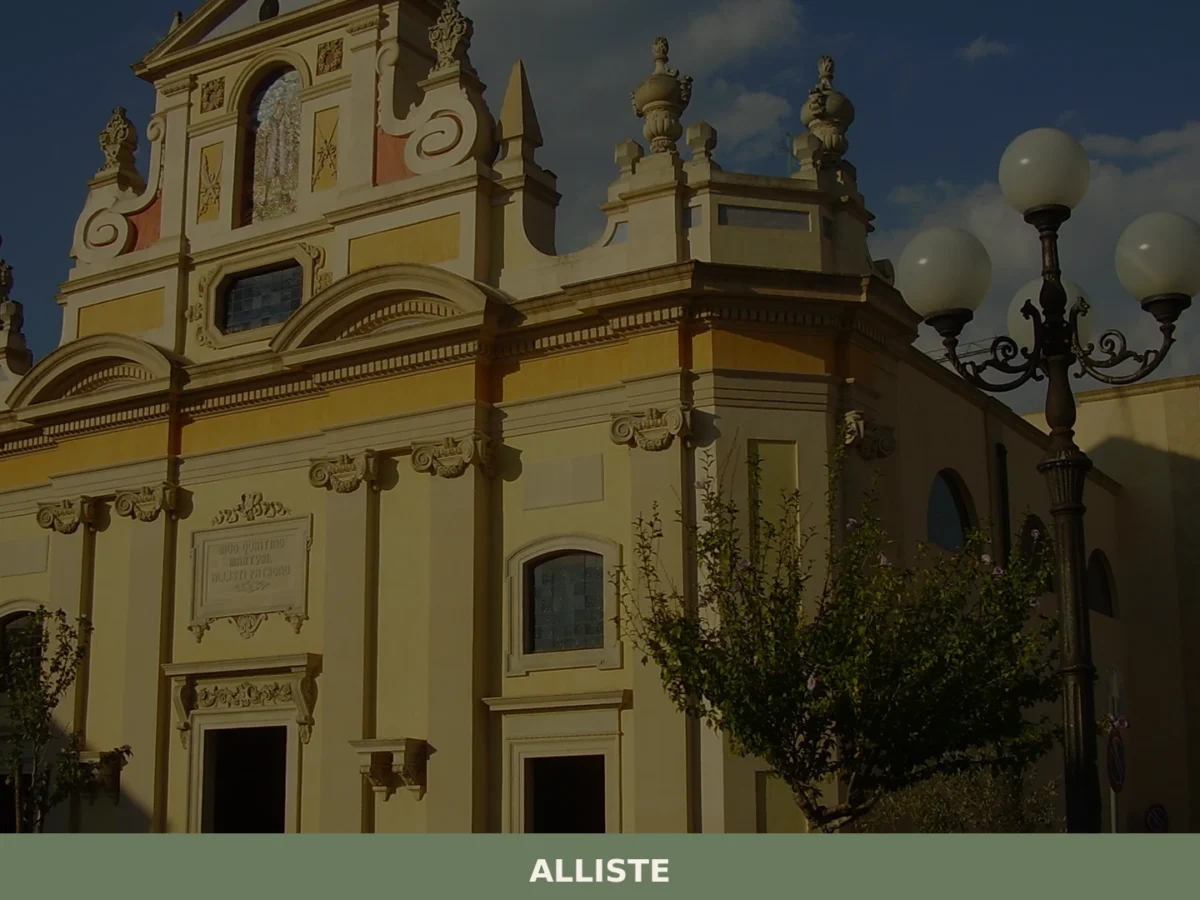
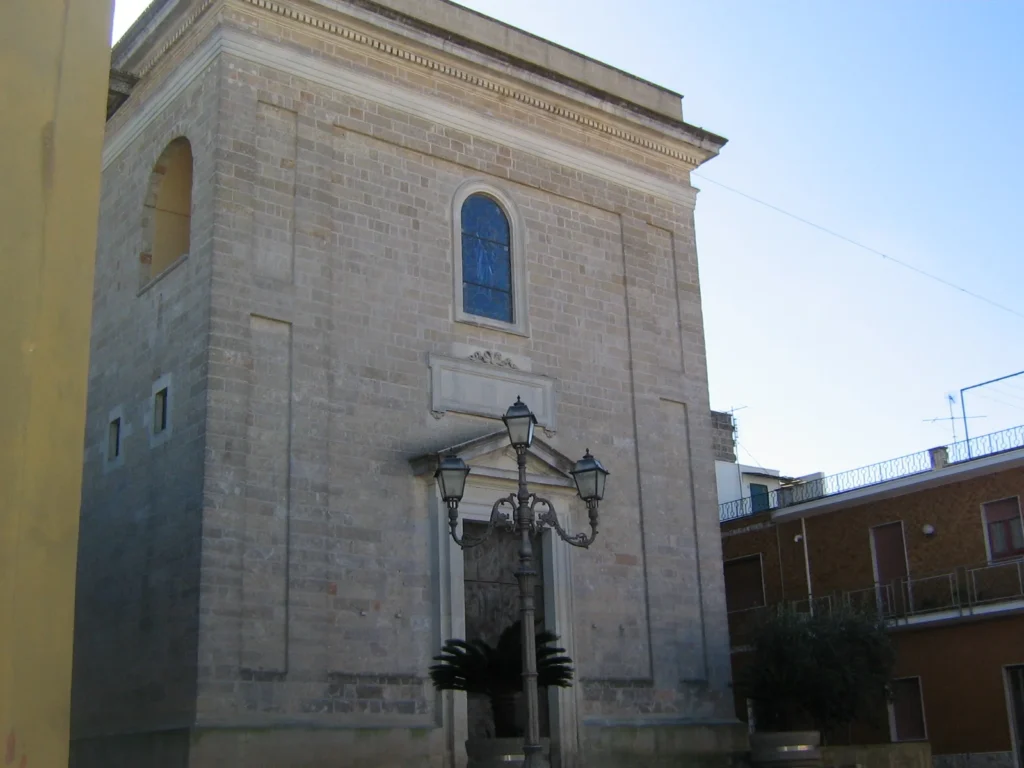
The Church of the Nativity of Mary (Chiesa della Natività di Maria Vergine) stands as the spiritual centre of Collepasso. Built between 1865 and 1871, it was gifted to the parish. The structure rises in local limestone and carparo stone, with a restrained façade dominated by a pedimented portal and bronze door. The interior follows a Latin cross plan with a single nave and a low dome over the crossing. Four lateral altars and a high altar all worked in local stone frame the sacred space. In 1944, painter Leonida Cortesi added extensive frescoes depicting saints and gospel scenes across the walls.
The Chapel of the Holy Trinity (Cappella della Santissima Trinità) is the older sanctuary. Built in the seventeenth century for the spiritual needs of the feudal castellans and the small farming population, it held devotions to the Trinity and the Madonna of Graces. A neoclassical refacing of the façade occurred in 1870. The interior follows a Greek cross plan with a low hemispherical dome carried on four columns and arches. Two stone altars hold nineteenth-century painted canvases. A bell cast in 1857 remains in the bell tower.
The Chapel of the Immaculate (Cappella dell’Immacolata), positioned next to Palazzo Pesce, dates to the eighteenth century. After the construction of the mother church, it served industrial purposes before being reconsecrated as a place of worship in 1945.
The Church of Saint Francis, built in 1980 at the initiative of Don Salvatore Miggiano, represents modern Salentine ecclesiastical design—clean lines and unadorned surfaces. Inside hangs a Crucifixion of unknown authorship, restored by craftsman Lionello Mandorino. The Church of Christ King of the Universe, the parish’s second centre, sits on the road toward Casarano in contemporary architectural idiom.
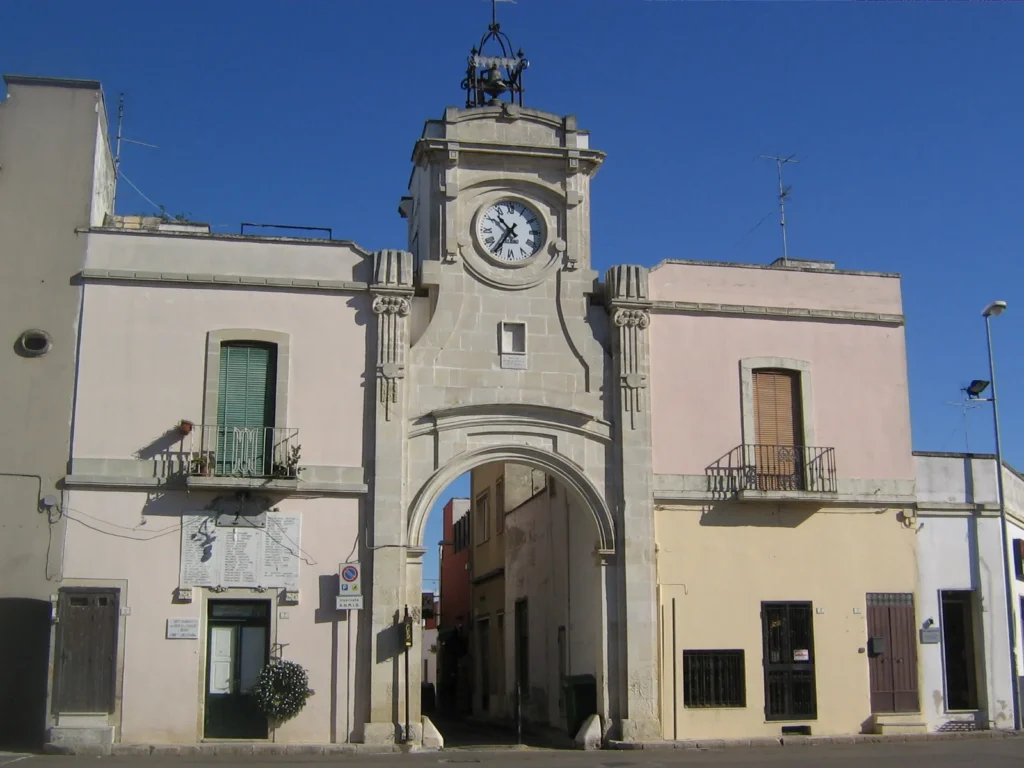
Civic identity crystallised with the granting of a coat of arms and civic banner on 10 January 1951 by presidential decree. The Clock Tower, erected between 1913 and 1914 in Piazza Dante at the village centre, marks the temporal rhythm of the community.
Civic Palaces and Material Memory
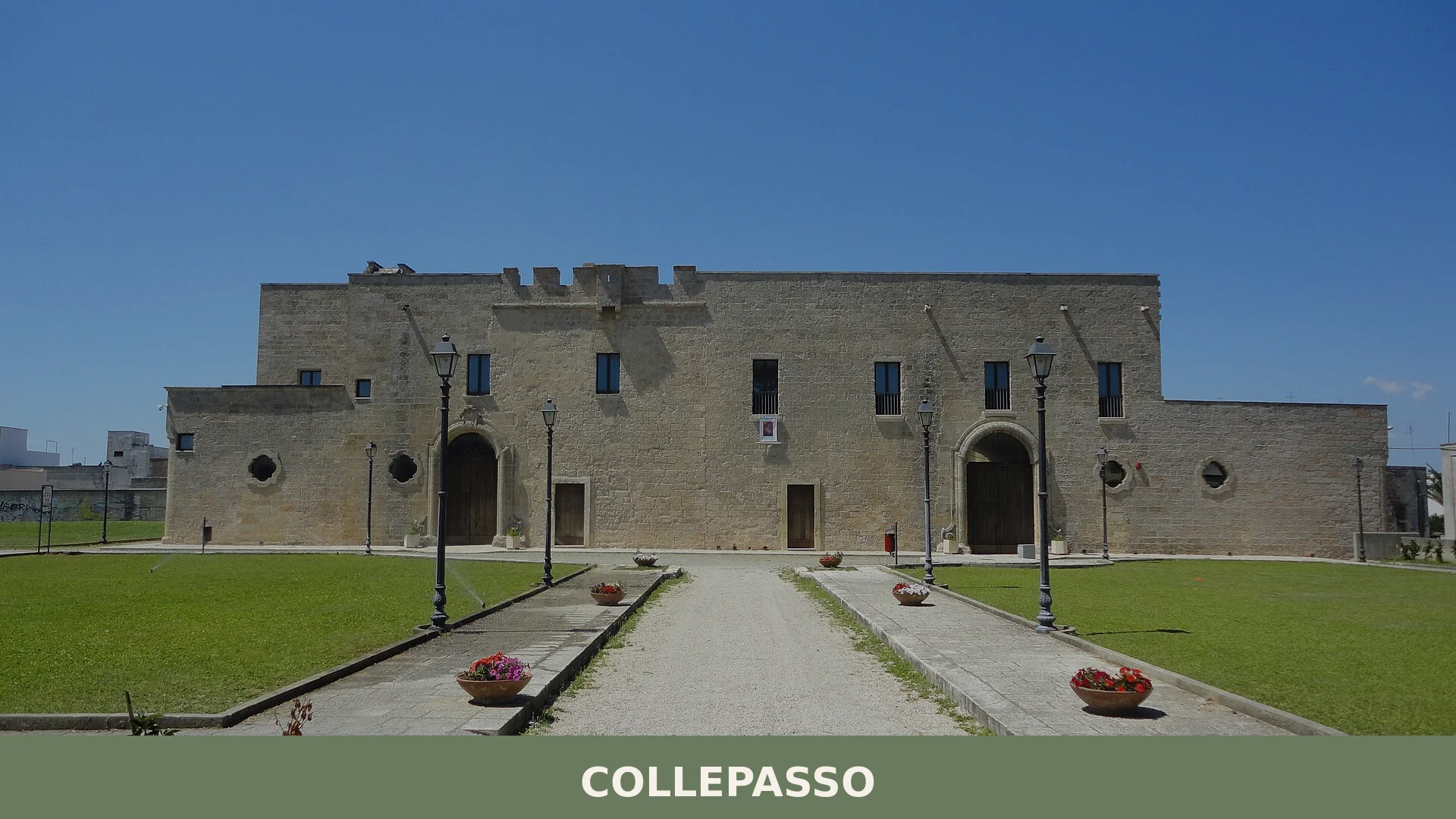
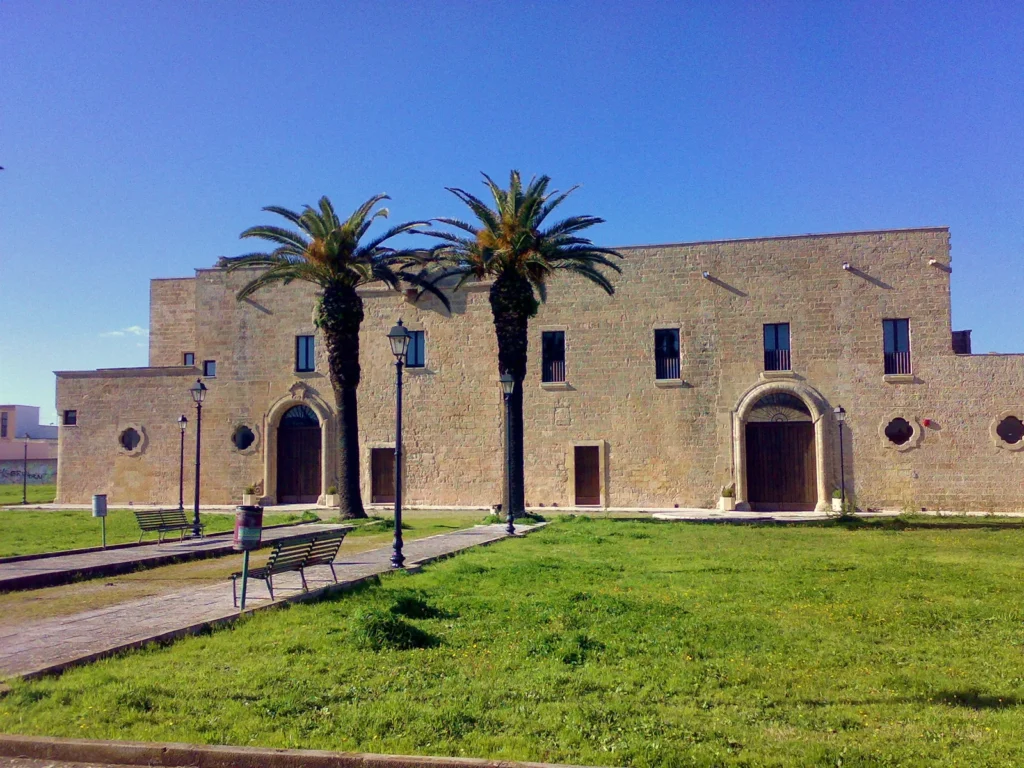
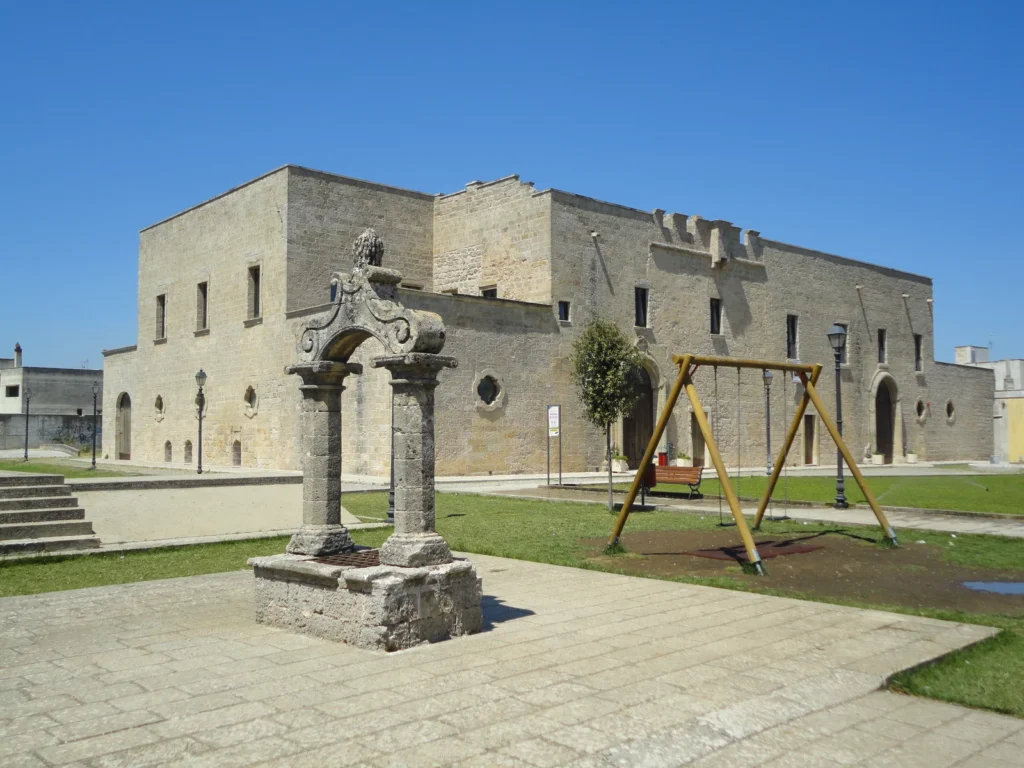
The Palazzo Baronale accumulated its form over centuries. It became the seat of feudal authority and was enlarged in successive phases, culminating in the eighteenth century under feudatary Oronzo Leuzzi. The palazzo served as the administrative and cultural nucleus under the reign of Baroness Aurora Leuzzi, and it remains the architectural anchor of Collepasso’s civic identity. Following its transfer to municipal ownership in 1987, the structure acquired formal status as a cultural asset of note. Restorations occurred in 1992 and 2006.
The Palazzo Nuovo, constructed around 1840 by Count Alberti to distinguish it from the older baronial seat, was remodelled in 1912. It initially housed members of the noble families associated with the estate and remains occupied by their descendants. The palazzo stands in Piazzetta Cristoforo Colombo, accessed through Via Conte Alberti.
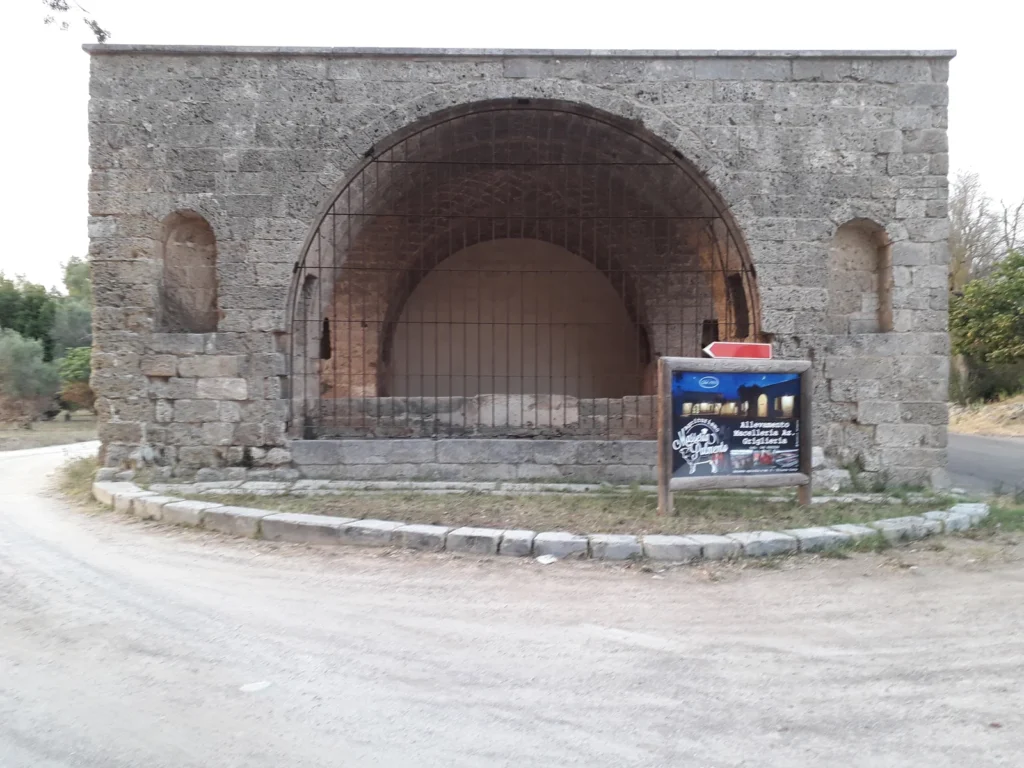
The Palmento, a wine-pressing installation, sits at the village entrance on the road toward Noha and Galatina. Nearly reduced to ruin, it was restored by the Province of Lecce and testifies to the ancient viticulture that anchored the local economy. The Palazzo Viva in Piazza Dante, an imposing structure from the late nineteenth century, displays an elegantly ornamented entrance portal.
Flavours of Salento Agriculture
The fields surrounding Collepasso belong to the broad agricultural belt that defines the interior Salento. Wheat, wine and olives have long formed the foundation of rural subsistence, though the village itself sits too far inland for citrus cultivation. The province of Lecce has yielded several products of protected origin: Olio di Puglia (protected-designation oil), Patata novella di Galatina (a tender new potato), Terra d’Otranto (wine), and Uva di Puglia (table grapes). The Burrata di Andria (a fresh cheese) originates instead from the province of Barletta-Andria-Trani. While these do not originate specifically in Collepasso, they exemplify the regional agricultural identity to which the village belongs. Traditional Salentine tables feature braised lamb with potatoes, fried wild greens, gratinéed cardoons, fresh bread, and preserved vegetables dried under the southern sun. The modest restaurants and family-run cantinas of Collepasso draw on this reservoir of local practice, though without formal recognition as products of the village itself.
Visiting Collepasso: Season, Access and Practicalities
Collepasso sits at a modest elevation on the Salento plateau, insulated from the most intense coastal heat by its inland position and the shelter afforded by the local highlands. The Mediterranean climate brings mild winters (average January temperature around 9°C) and warm summers (average August around 25°C). Rainfall is concentrated in autumn and winter, with annual totals near 676 millimetres. Spring and early summer offer the most comfortable conditions for walking the village streets and exploring the surrounding countryside. Avoid the peak heat of August if you prefer cooler conditions; November through March brings occasional rain but fewer crowds.
By road, Collepasso lies in the south-central interior of the Salento peninsula, reachable via the SS614 from Maglie to the north or Gallipoli to the southwest. The drive from Lecce city centre takes approximately 40 minutes (roughly 35 kilometres); from the coastal resort of Gallipoli, about 25 minutes (20 kilometres) inland. Neighbouring villages such as Aradeo, Galatina (a centre of baroque architecture and religious tradition), and Botrugno lie within easy reach for a multi-village itinerary of the interior Salento. Parking is straightforward in the village centre; facilities for basic refreshment exist, though dining and lodging options are modest and suited to short visits rather than extended stays.
| Departure Point | Distance | Driving Time |
|---|---|---|
| Lecce city centre | 35 km | 40 minutes |
| Gallipoli (coast) | 20 km | 25 minutes |
| Brindisi airport | 60 km | 55 minutes |
| Galatina | 12 km | 15 minutes |
The village celebrates its patron, Maria SS. delle Grazie (the Blessed Virgin of Graces), on 2 July each year. This date anchors the calendar of local religious observance and offers a window into village tradition for those present during the feast. The comune maintains an official website at https://www.comune.collepasso.le.it/ for current municipal information and local services.
 Mountain