


Castri di Lecce
 Plains
Population 2,721. A limestone plateau village born from the union of two distinct feudal estates, held together by baroque chapels and standing menhirs from the Bronze Age.
Castri di Lecce: Where Two Medieval Casales Became One
A Village Woven from Two Medieval Casales
Castri di Lecce sits 13 kilometres inland from the Adriatic, on a chalk-and-clay plateau in the northeastern corner of the province of Lecce. At barely 47 metres above sea level, this modest settlement of around 2,700 people carries an unusual origin: it was born of the merger of two separate feudal estates, Castrifrancone and Castriguarino, which operated as distinct jurisdictions for over six centuries before uniting in 1891. Walking its streets today, you encounter the material evidence of that marriage—twin parish churches, overlapping family palaces, and a municipal identity forged only in the modern era.
Castri di Lecce village in Apulia occupies territory that has been inhabited since the Bronze Age, marked by the presence of megalithic monuments and defence works that speak to prehistoric continuity. The village’s name descends from the Latin castrum (fortress or settlement). Two things draw visitors here: the richness of surviving 17th- and 18th-century religious architecture, and the layer of prehistoric standing stones—menhirs—that punctuate the agricultural landscape around the comune.
From Bronze Age to Bourbon Unification: Nine Centuries of Division
The documented history of Castri begins in 1190, when the Norman count Tancredi d’Altavilla donated the casale to the Church of Lecce. For more than seventy years, it remained part of the bishop’s landed domain. Then in 1262, the casale was divided. One portion went to Olivi De Lettere; the other to the Bonsecolo family. From that moment, two separate villages developed side by side.
Castrifrancone, the western half, passed through the hands of the De Lettere family until 1353, when it was purchased by the Napoletan Frantone family. Over the succeeding centuries, ownership fragmented among the nobility: the Dell’Acaya, Valentini, Grimaldi, Mattei and Cicala families all held stakes in its revenues and justice. Castriguarino, the eastern portion, passed to Agostino Guarino in 1302—his name gave the place its distinctive suffix—and remained with the Bonsecolo clan until 1709, when it was acquired by the Genoese Vernazza family. From 1709 forward, both casales belonged to the Vernazza, yet they remained administratively and socially distinct.
This dual existence persisted until the late 19th century. On 12 November 1891, a municipal council resolution enacted by royal decree formally unified the two casales into a single comune, initially named Castrì and later Castri di Lecce. The decree granting the village its coat of arms and civic banner came in 1957.
Sacred Architecture and the Marks of Noble Patronage
Chiesa di San Vito
San Vito, the patron saint of Castri, is honoured in a church that was completely rebuilt between 1734 and 1772 in the Baroque idiom. The church rises on foundations laid in the 16th century and served originally as the mother church of Castrifrancone. Its two-storied façade, crowned by a restrained pediment, gives way to an interior laid out as a Latin cross. The large Baroque high altar in pietra leccese (the region’s characteristic limestone) dominates the presbytery, richly decorated and monumental in proportion. A wooden pulpit from the 18th century and a gold-lacquered statue of San Vito complete the sacred furnishings.
Chiesa di Santa Maria della Visitazione
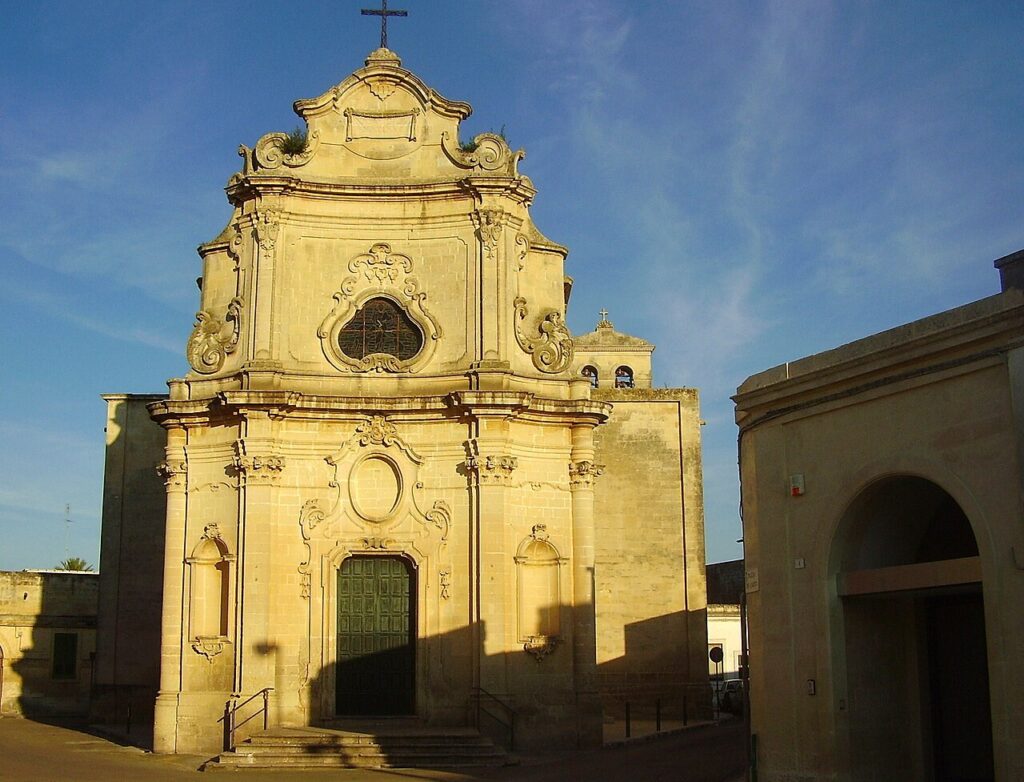
Originally the mother church of Castriguarino, this building was reconstructed in the mid-17th century on 16th-century footings and received its Baroque façade in the second half of the 18th century—though only the lower storey was completed. Lesenes topped with Corinthian capitals, floral festoons and putti ornament the front. The interior spans a single nave arranged as a Latin cross with a barrel-vaulted ceiling. Four chapels per side line the nave and transept, dedicated to San Vito, San Luigi, the Pietà, the Madonna of the Rosary, Sant’Antonio da Padova and the Madonna of Good Counsel.
Chiesa di Santa Maria delle Grazie
Built in the mid-17th century, this church combines Renaissance geometric order with Baroque embellishment. A dramatic baldachin crowns the portal; niches punctuate the lower façade; a mullioned window rises above. The interior, a single rectangular hall with incorporated chapels, preserves an exceptional high altar, a sculptural achievement in local limestone. An image of the Madonna nursing the Christ Child remains the focal point of veneration.
Cappella della Madonna della Luce
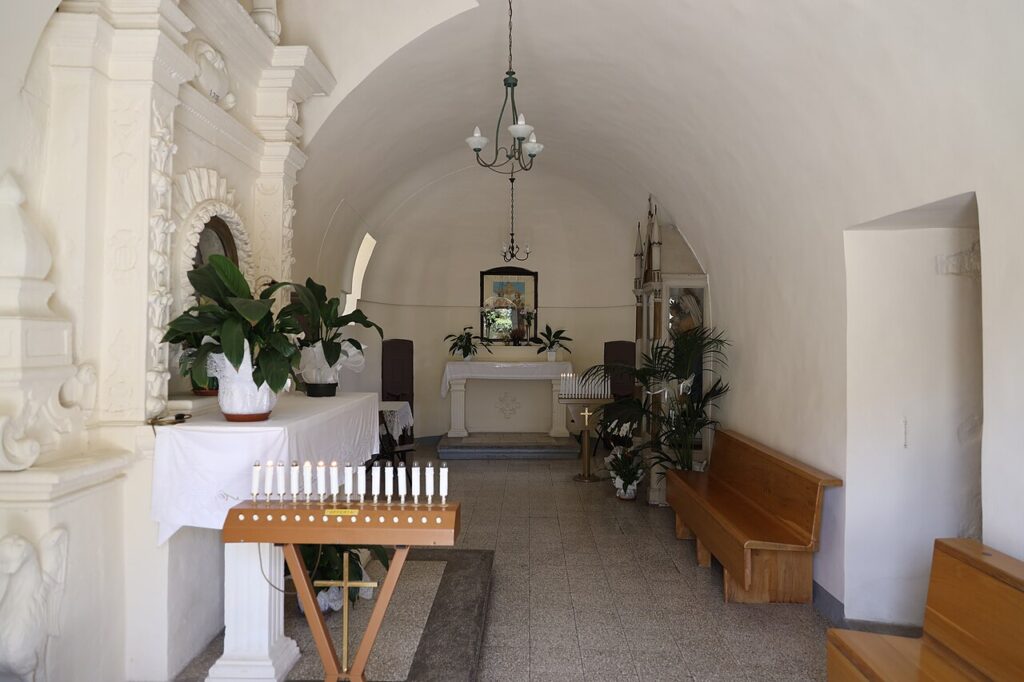
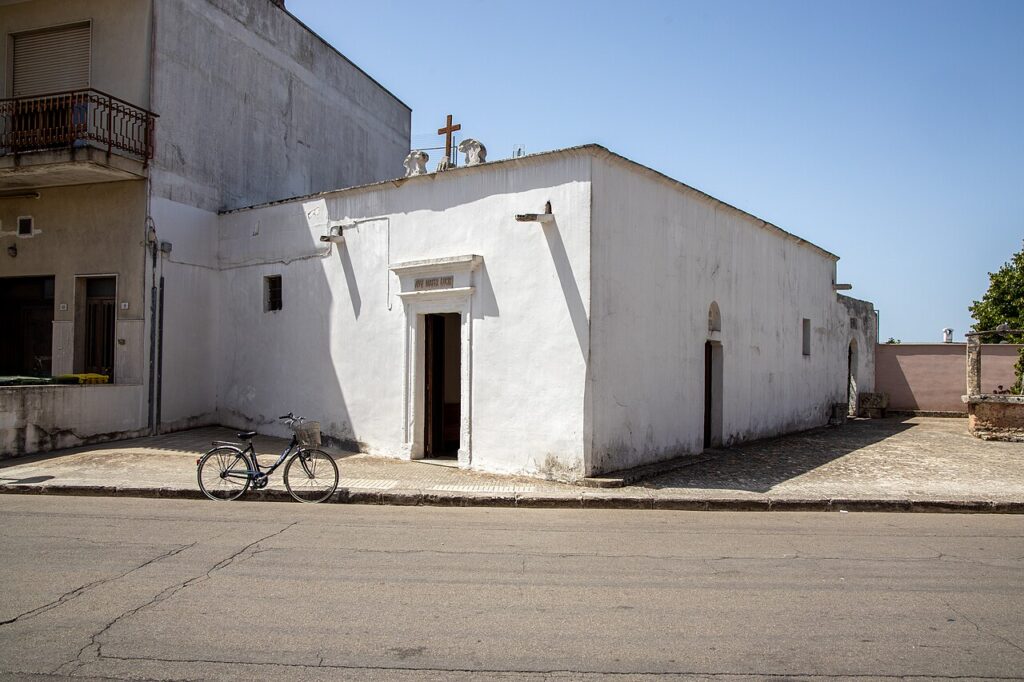
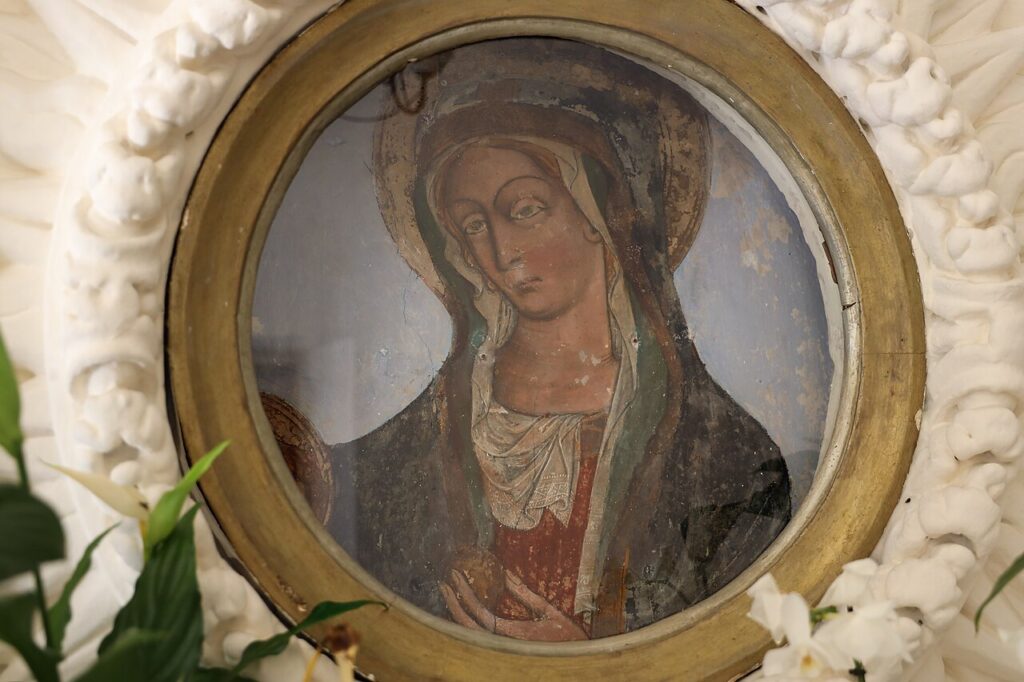
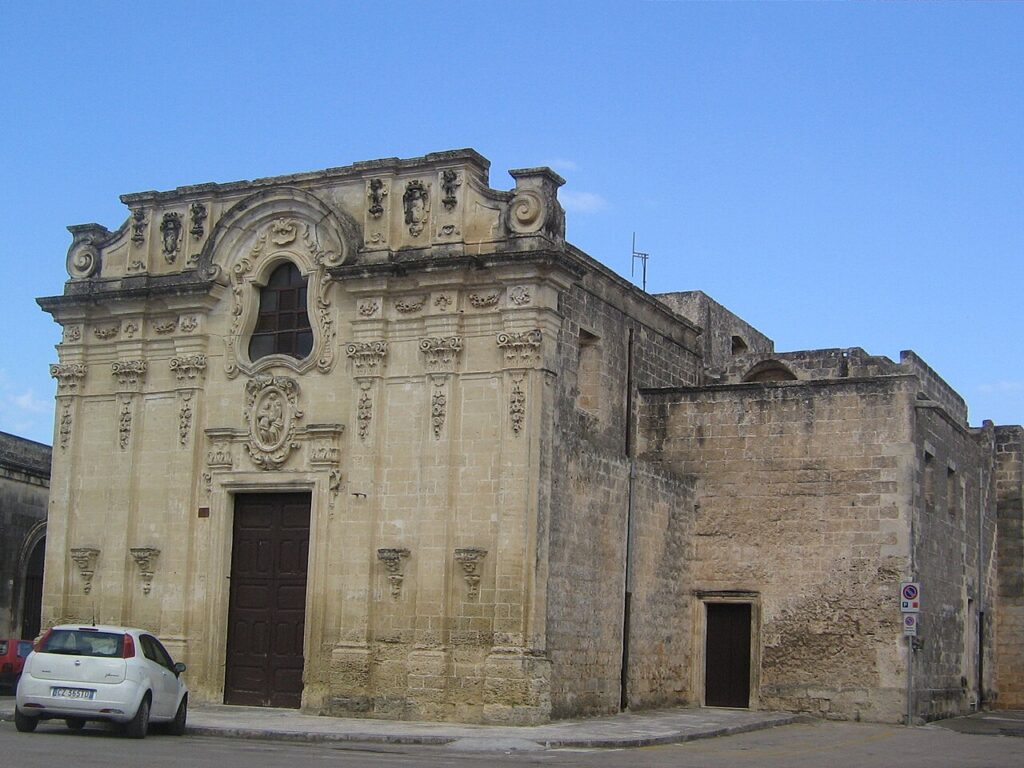
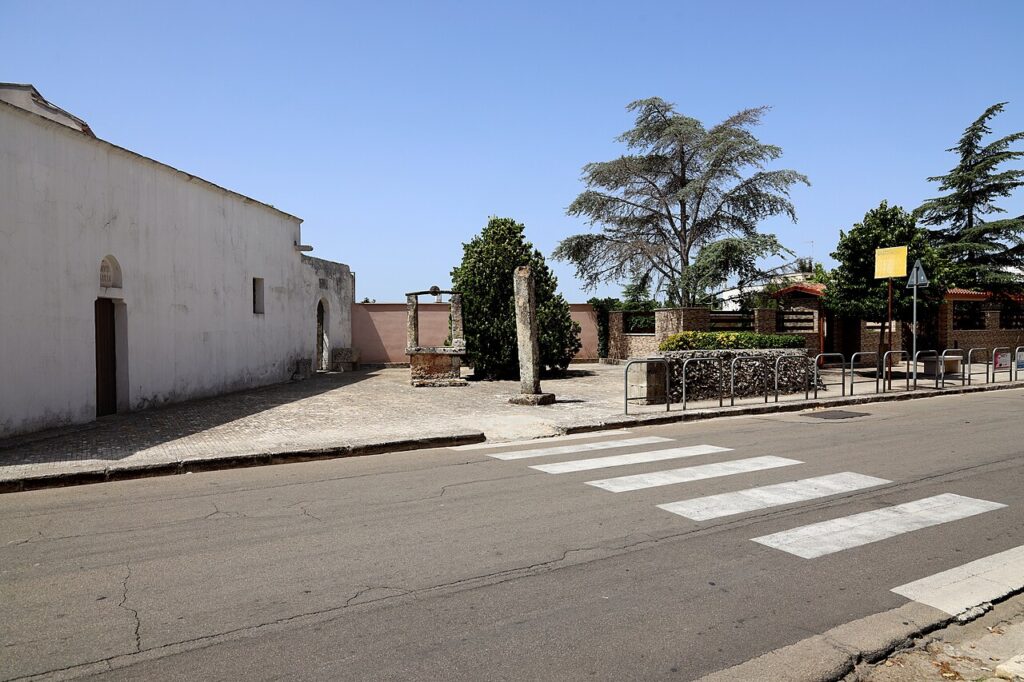
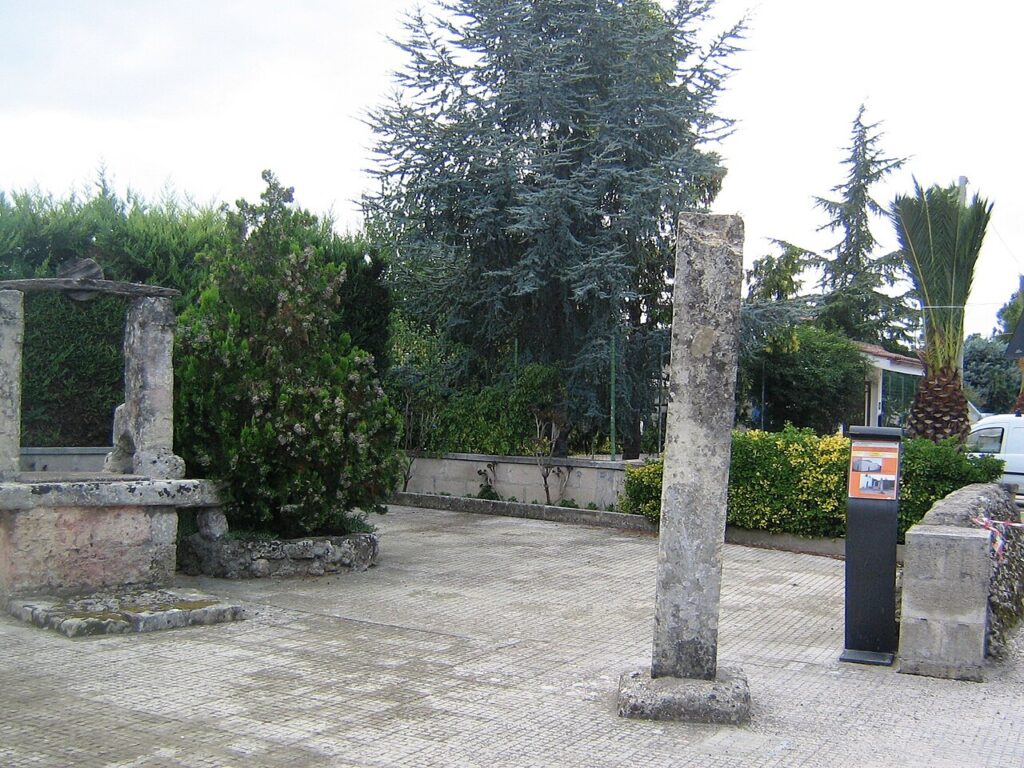
This small chapel, built in 1570 by local craftsmen, marks the former boundary of the comune. Its interior is austere—a barrel vault, plain walls—yet it contains a modest altar erected in 1702 and preserves a 13th-century fresco of the Virgin with Child. Beside the chapel stands an ancient menhir, a prehistoric stone sentinel erected thousands of years before the chapel was built.
Prehistoric Stones and the Deep Archaeology of the Salento
The territory of Castri di Lecce bears witness to habitation from the Bronze Age onward, evidenced by menhirs and *specchie*—dry-stone defensive works of megalithic date. Two vertical stones survive as named monuments. The Menhir della Luce, standing 2. 80 metres tall, is aligned with its broadest faces toward the east and west; its top has been roughly truncated. A third stone, the Menhir Aja, no longer survives. These megaliths, set in an agricultural landscape of low relief, speak to ritual or territorial practices of peoples whose names are forgotten but whose material signatures endure.
Palazzo Vernazza and Civic Memory
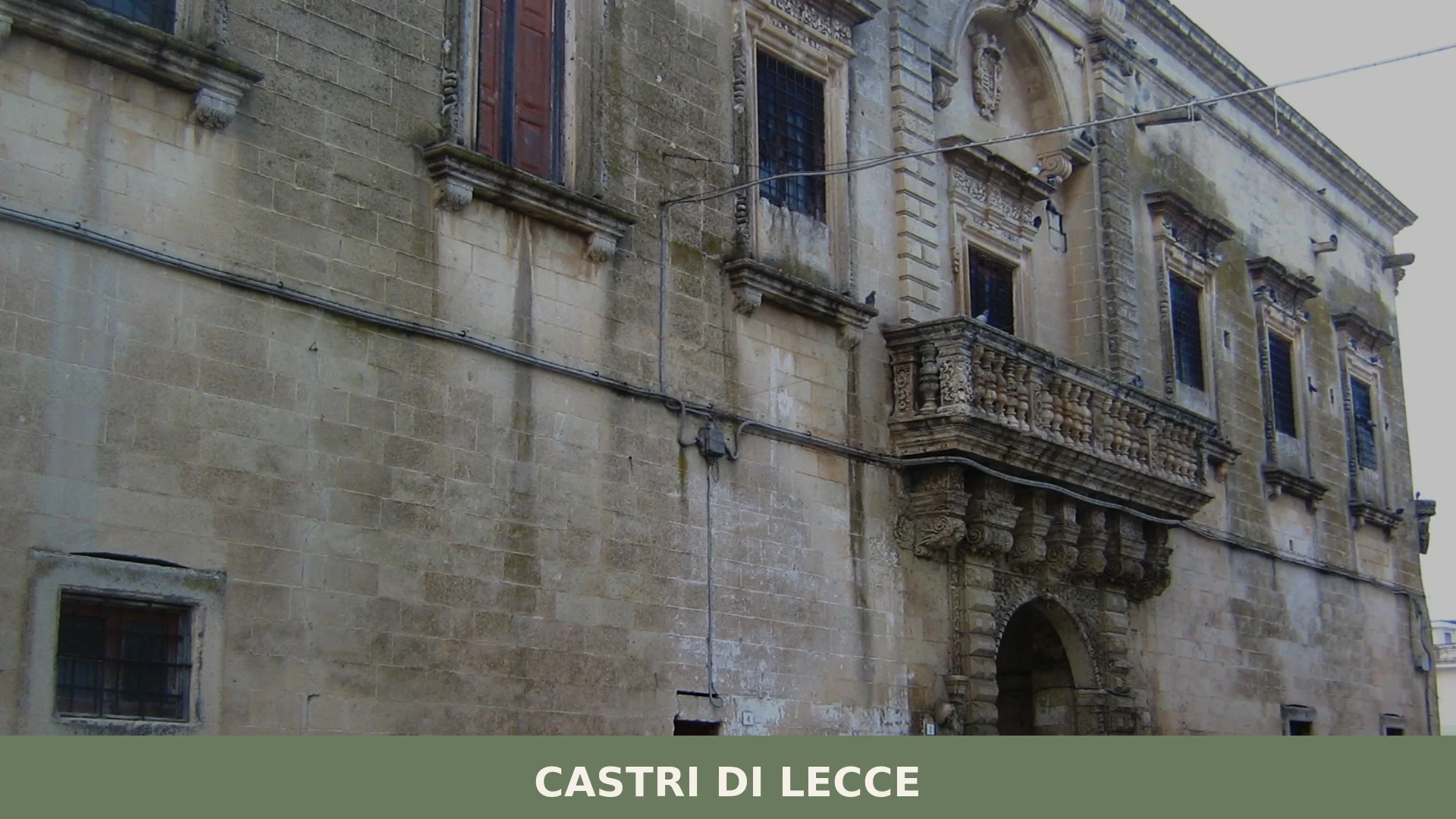
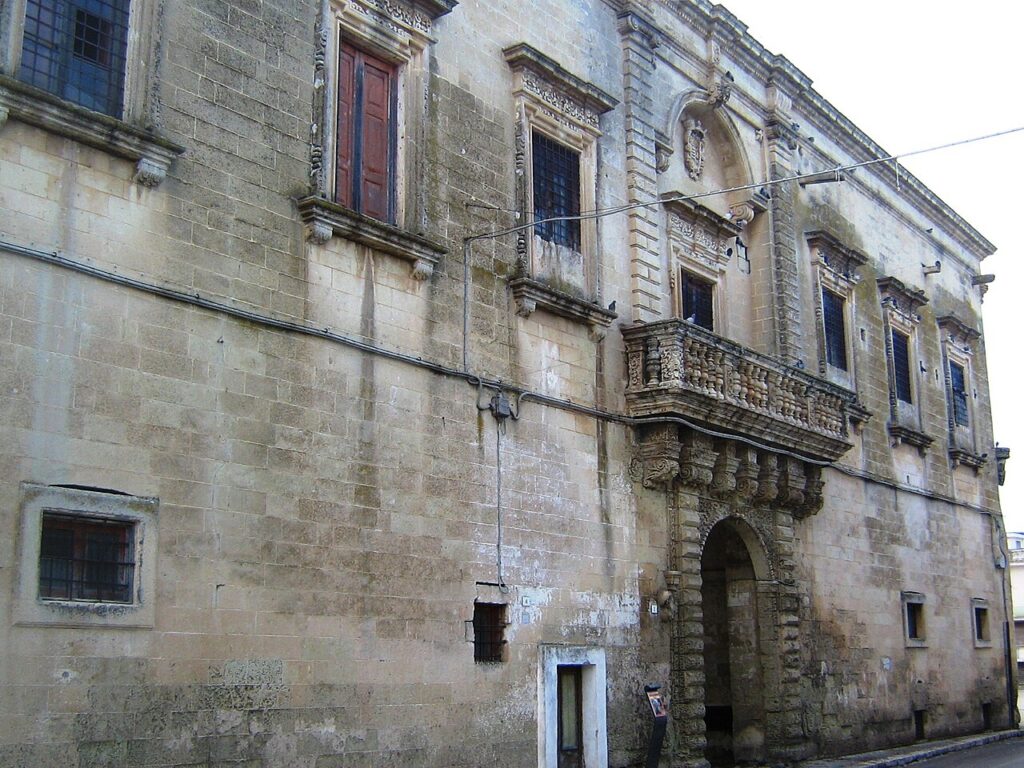
Palazzo Vernazza, the residence of the Vernazza family, underwent radical transformation in 1724. Its long, ornate façade displays a broad rusticated portal adorned with floral festoons and crowned by a Baroque balcony carved with putti and lion masks. The interior rooms, organized around a central courtyard, retain 18th-century architectural motifs. The palazzo stands as a reminder of feudal authority consolidated and redirected toward Enlightenment aesthetics.
The municipal palace, designed to house civic offices as well as educational and public functions, underwent reconstruction in 1978 to achieve its present form.
The Land and the Climate of the Adriatic Salento
Castri di Lecce spreads across the plain of Serra di Galugnano, a landscape of chalk and clay with springs of fresh water that have supported agriculture for millennia. The municipality covers 12.22 square kilometres at a population density of 247 inhabitants per square kilometre. Between its lowest point at 33 metres above sea level and its highest at 51 metres, the relief barely undulates; the total vertical span is just 18 metres.
The climate is Mediterranean, with mild winters averaging 9 degrees Celsius in January and warm, humid summers reaching 24.7 degrees Celsius in August. Annual rainfall amounts to approximately 626 millimetres, concentrated in autumn and winter months; spring and summer are marked by prolonged dry periods. The wind regimes bring cold currents of Balkan origin alternating with hot air masses from Africa. The comune sits in seismic zone 4, an area of very low seismic activity.
The Rhythms of Local Food and Agriculture
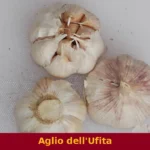
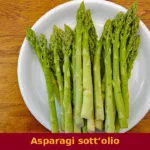
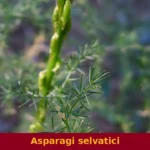
Burrata di Andria (IGP), a protected product originating from the Andria area in the province of Barletta-Andria-Trani, together with oils and potatoes of recognized quality from the region, represent the agricultural heritage of Apulia. The regional tradition of traditional food productions (Prodotti Agroalimentari Tradizionali) encompasses everything from wild chicory and fresh fava beans to stuffed peppers, roasted lamb, and preserved capers—dishes rooted in the Salento’s long coexistence with Mediterranean and Adriatic resources.
The landscape—market gardens, olive groves, and proximity to both inland springs and the Adriatic 13 kilometres distant—has shaped what appears on local tables. Visitors interested in regional gastronomy will find deeper exploration of Puglian food culture among satellite articles dedicated to the wider province.
Planning Your Visit: Season, Access and Practical Information
Castri di Lecce is best visited in the shoulder seasons of spring (April–May) and autumn (September–October), when temperatures are moderate and the landscape turns green with seasonal growth. Summer heat can be intense; winter is mild but rainy. The village is accessible by road from the main provincial hubs and lies on the route between the larger towns that dot the northern Lecce territory.
If you arrive by car, the village is reached via the SS 16 Adriatica (the main coastal highway) or via provincial roads SP 140 and SP 317, which connect Castri to neighbouring towns. The comune sits 13 kilometres from the Adriatic shoreline, making it convenient to combine a visit with time spent at coastal areas or in the villages of Caprarica di Lecce and Calimera, which are neighbouring comuni.
| Departure point | Distance | Approximate time |
|---|---|---|
| Lecce (city centre) | 20 km | 25–30 minutes by car |
| Brindisi airport | 35 km | 40–50 minutes by car |
| Adriatic coast (Melendugno) | 8 km | 12–15 minutes by car |
| Galatina (inland town) | 12 km | 18–22 minutes by car |
A visit of 2–3 hours allows time to walk the village streets, visit the principal churches, and view the surviving menhirs at leisure. The feast day of San Vito falls on 15 June and draws local observance. The official website of the comune (comune.castridilecce.le.it) provides municipal information and may offer practical details for visitors planning their arrival.
The twin parishes of Castri di Lecce stand as silent witnesses to a nearly 700-year chapter of division—two church bells that rang in separate jurisdictions until the stroke of a royal pen in 1891 unified what feudal politics had rent asunder.
Frequently asked questions about Castri di Lecce
When is the best time to visit Castri di Lecce?
Late spring through early autumn (May–September) offers warm, pleasant weather typical of the Adriatic Salento region. The patron saint feast of San Vito on June 15th brings local celebrations and vibrant street life. Summer temperatures can be intense; consider visiting in shoulder seasons for comfortable exploration of the village's medieval churches and piazzas without excessive heat.
How do I reach Castri di Lecce by car?
Castri di Lecce lies 13 kilometres inland from the Adriatic coast in northeastern Lecce province, Puglia. The nearest motorway exit is on the A16 near Lecce. From Lecce city (approximately 25 km southeast), follow the SS16 or regional roads northward. The village is accessible by standard car; parking is available in the central piazza and surrounding streets.
What is unique about Castri di Lecce's history?
Castri di Lecce is exceptional for originating from two separate feudal estates—Castrifrancone and Castriguarino—that operated as distinct jurisdictions for over six centuries before administratively uniting in 1891. This dual heritage is visible in the twin parish churches, overlapping noble family palaces, and a civic identity shaped only in modern times, making it a rare example of late-unified village formation.
Are there archaeological sites to explore near Castri di Lecce?
The territory surrounding Castri di Lecce has been inhabited since the Bronze Age and contains prehistoric megalithic monuments and ancient defence structures. These archaeological remains testify to continuous human settlement across millennia. Visitors interested in deeper archaeology of the Salento should consult local heritage offices or guided tours for documented sites and access protocols.
How long should I plan to spend in Castri di Lecce?
A half-day visit (2–3 hours) suffices to walk the village streets, view the twin parish churches, and observe the noble family palaces that reflect its dual medieval origins. Those interested in local history, religious architecture, and the surrounding Salento agricultural landscape may extend to a full day, combining visits with nearby towns or countryside exploration.
📷 Photo Gallery — Castri di Lecce
In Apulia More villages to discover
Cassano delle Murge
 Hills
Hills
Cassano delle Murge, a municipality in Puglia located in the Metropolitan City of Bari, stands at 341 meters above sea level, positioned on the Murge plateau. Its territory, spanning approximately 89 km², includes a significant portion of the Bosco di Mercadante, a forest area important for the local ecosystem. With a population of 14,395 inhabitants, […]
San Pietro Vernotico
 Sea
Sea
What to see in San Pietro Vernotico, Italy? Discover its 14th-century Torre Quadrata and the historic Chiesa Matrice. Explore this village, 36 m above sea level, for its rich past.
Stornarella
Plains
A working agricultural village on the Tavoliere plain near Foggia, Stornarella offers wheat-field panoramas, rural chapels, and the elemental cuisine of northern Puglia.
Cellamare
Plains
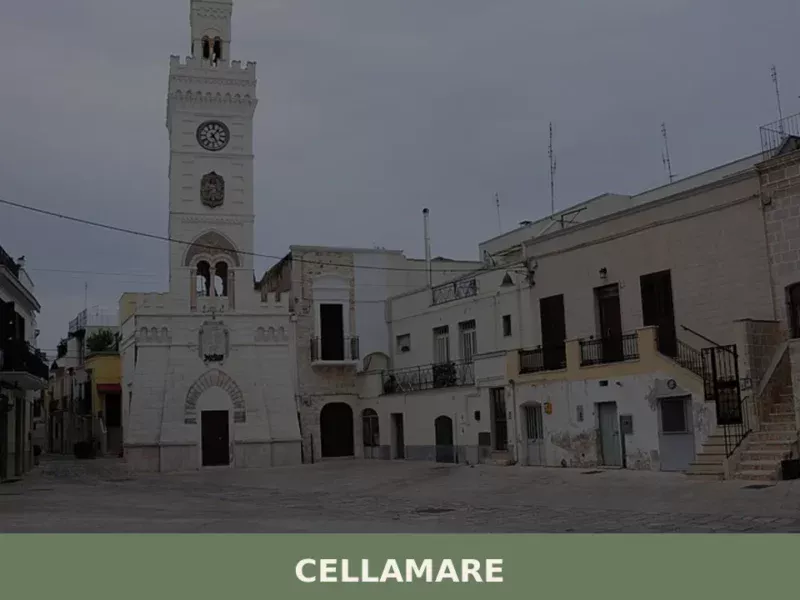
What to see in Cellamare, Italy: Explore this historic village, founded in 1171, located 110 m (361 ft) above sea level. Discover its grape industry and ancient origins.
Alezio
Plains
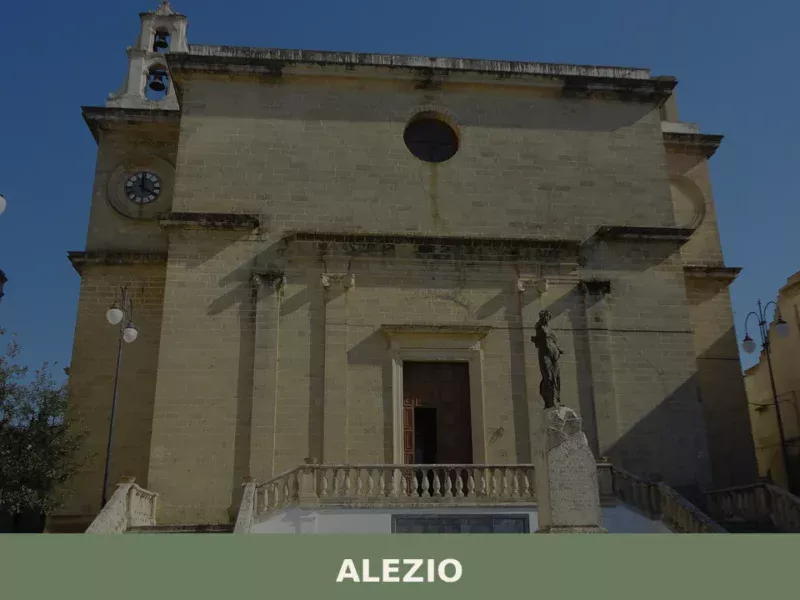
Discover what to see in Alezio, a Salento village with Messapian roots, a national archaeology museum, and ancient olive groves near Gallipoli in Puglia.
Bitonto
Plains
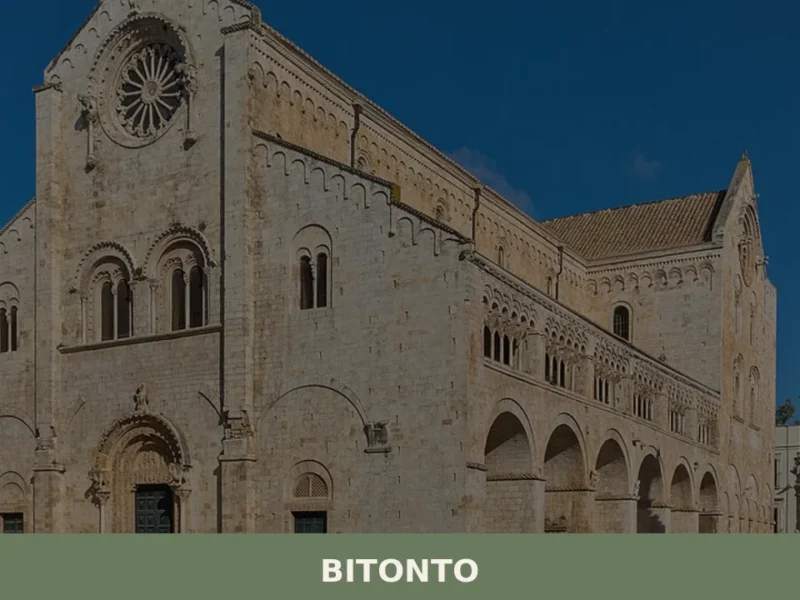
In 1089, Pope Urban II consecrated the cathedral of Bitonto, a building in local limestone that still dominates Piazza Cattedrale today with its sixteen-spoke rose window and its sculpted portal. That ceremony marked the city’s definitive entry into the network of major Apulian episcopal seats, confirming a political and religious role that Bitonto had maintained […]
Motta Montecorvino
 Mountain
A 651-inhabitant hilltop village in Puglia's Daunia hills, Motta Montecorvino rewards slow visitors with medieval lanes, long views over the Tavoliere plain, and robust mountain cooking.
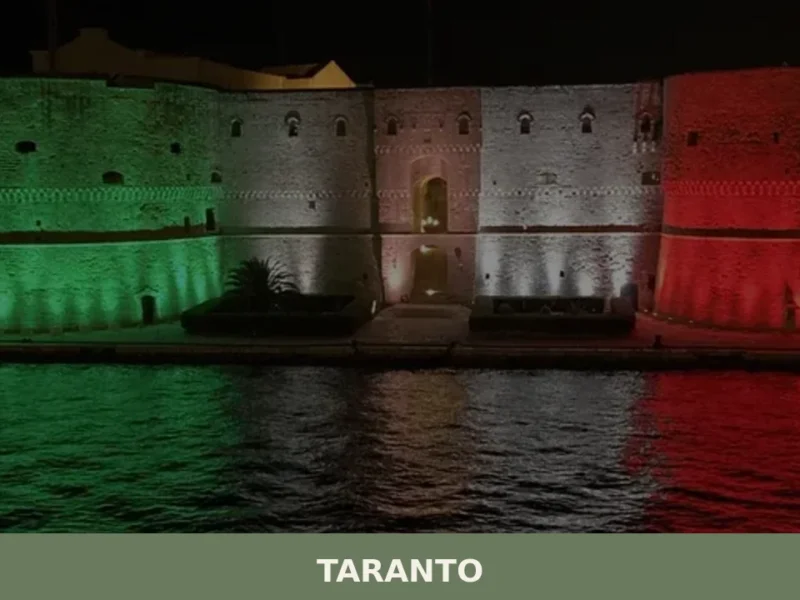
Taranto
Sea
A port city of 186,000 on Apulia's coast, Taranto lives by the rhythm of its ancient harbour and working waterfront, not heritage tourism.
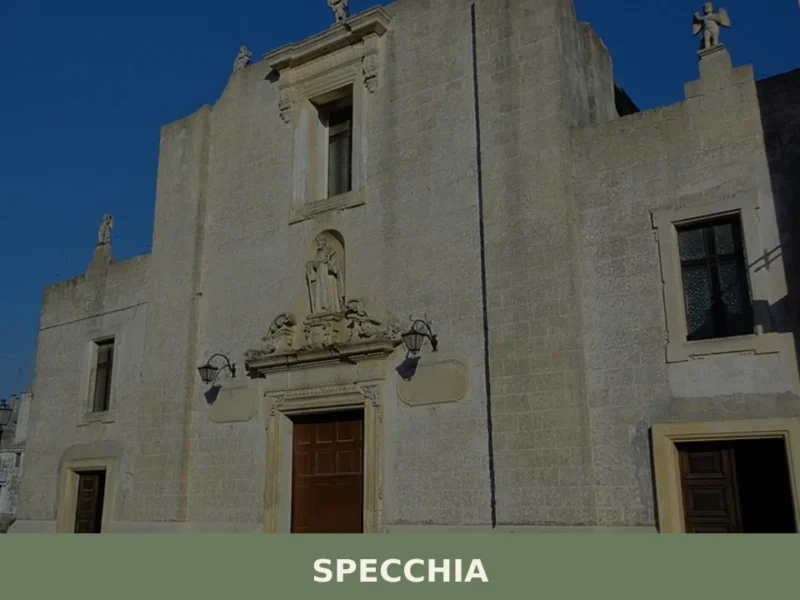
Specchia
Plains
What to see in Specchia: a medieval village at 131m in Salento with 4,569 residents. Explore Castello Risolo, the historic centre and PAT-certified local food. Plan your visit.
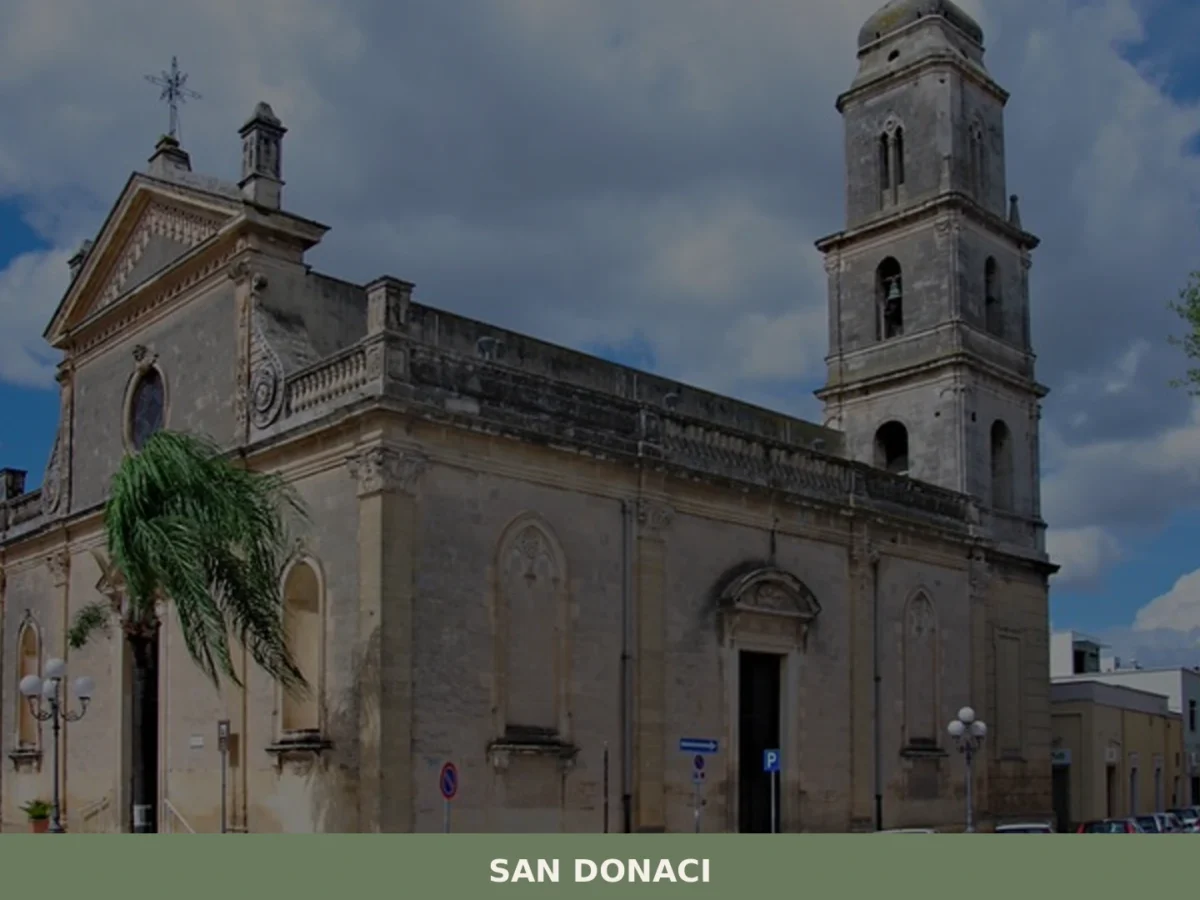
San Donaci
Plains
What to see in San Donaci? Discover the 5 must-see attractions of this Puglian village. Plan your perfect visit with our complete guide!

🏡 Know Castri di Lecce better than we do?
If you’re a local or have been there, your knowledge matters: add what’s missing or fix a detail on this page.