


Grosseto
 Sea
Sea
What to see in Grosseto: Medici walls, San Lorenzo Cathedral and the Maremma Natural Park in a city of 79,216 inhabitants. Plan your visit with our complete guide.
Discover Grosseto
Grosseto sits just 10 metres above sea level on the plain of the Tuscan Maremma, and serves as the capital of the province that shares its name, with a population of around 79,216 inhabitants.
Anyone wondering what to see in Grosseto will find a city that combines a well-preserved medieval past with a surrounding territory of natural parks and coastal reserves.
The Medici walls encircling the historic centre, the cathedral dedicated to Saint Lawrence, and the museums housing Etruscan and Roman artefacts are just some of the reasons why the city rewards a thorough visit, in any season of the year.
History and Origins of Grosseto
The origins of Grosseto are tied to the decline of Roselle, the ancient Etruscan and later Roman city located a few kilometres to the north-east of the present-day provincial capital.
As Roselle was repeatedly sacked during the early Middle Ages, the population gradually migrated towards the site closer to the Ombrone river, giving rise to the settlement that would become Grosseto.
The name itself appears in written sources as early as the tenth century, and its etymology is likely connected to a Latin or Lombard term referring to the shape of the terrain, although scholars have not reached a consensus on this point.
In 1138, Grosseto was elevated to the status of a bishopric, an event that accelerated its urban and religious development.
The city endured a prolonged period of conflict with Siena, the dominant power in medieval Tuscany, which ultimately prevailed in 1336 by incorporating Grosseto into its territory.
Under Sienese rule, the city was expanded and provided with new defensive structures. The situation changed dramatically in 1559, when, with the fall of the Republic of Siena, Grosseto also passed under the control of the Grand Duchy of Tuscany, governed by the Medici family.
It was the Medici who commissioned the construction of the imposing hexagonal walls that still define the historic centre today — a feat of military engineering completed in the second half of the sixteenth century.
During the seventeenth and eighteenth centuries, the city faced the endemic problem of malaria, which afflicted the entire Maremma and significantly reduced the population.
The draining of the surrounding marshland, carried out systematically only in the modern era, transformed the territory profoundly.
Following Italian unification, Grosseto became a provincial capital and entered a period of demographic and infrastructural growth that, over the course of the twentieth century, extended the city well beyond its ancient walls.
The city suffered considerable damage during the Second World War, but the medieval historic centre was largely preserved.
What to See in Grosseto: Main Attractions
The Medici Walls
The Medici walls are the most recognisable symbol of Grosseto and one of the best-preserved examples of sixteenth-century military architecture in Tuscany.
Built on the orders of the Medici in the second half of the 1500s, they follow a hexagonal plan and are punctuated by six angular bastions.
The walkway along the top of the walls can be explored on foot and offers an excellent vantage point over the historic centre and the green areas surrounding the walls themselves.
Their red-brick structure has remained essentially intact over the centuries and today stands as one of the defining features of Grosseto’s urban landscape.
Cathedral of San Lorenzo
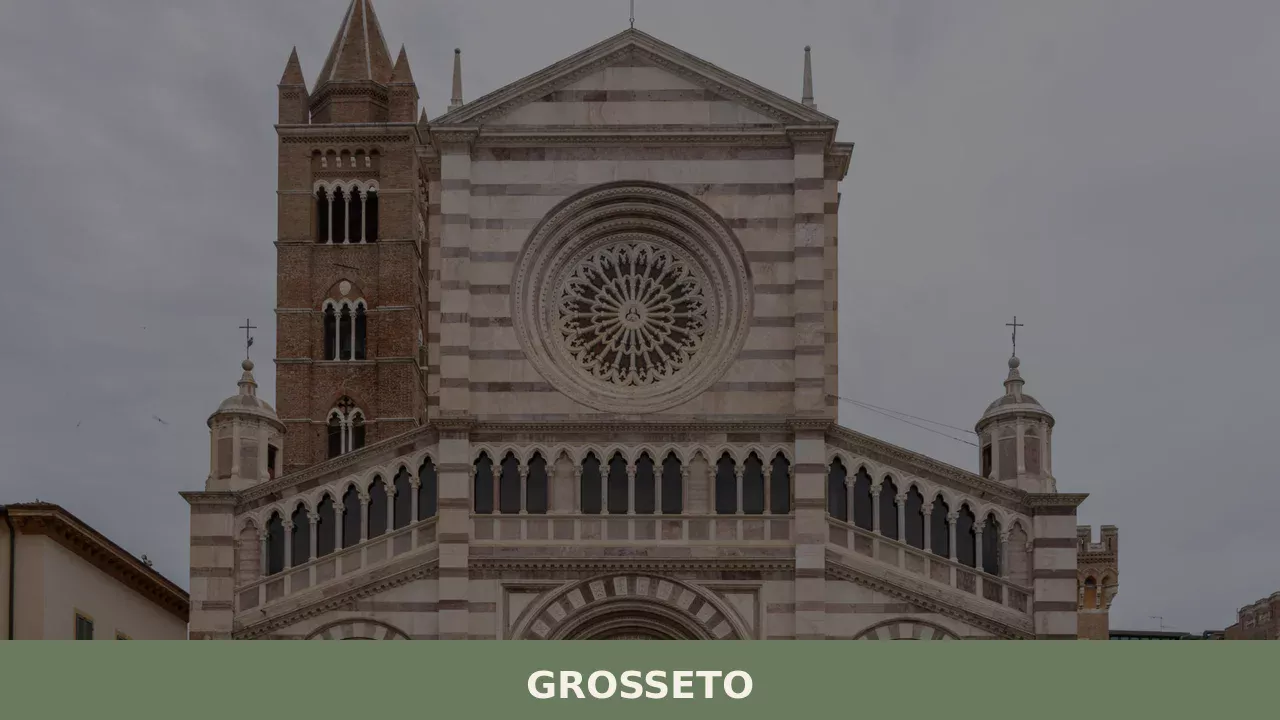
The cathedral dedicated to Saint Lawrence, patron of the city, stands on the main square of the historic centre and ranks among the most significant religious monuments in the Tuscan Maremma.
The original construction dates to the thirteenth century, when it was begun to a design by Sozzo di Rustichino, though the building underwent modifications and additions in subsequent centuries.
The façade, in white and grey marble, displays decorative elements in the Gothic-Sienese style, most notably in the large central rose window.
The interior contains notable works of art, including a Madonna delle Grazie attributed to Matteo di Giovanni, a Sienese painter of the fifteenth century.
Archaeological and Art Museum of the Maremma
The Archaeological and Art Museum of the Maremma holds one of the most comprehensive collections in the region, with artefacts spanning a chronological range from prehistory to the modern age.
The sections devoted to Etruscan civilisation and the Roman period are particularly extensive, drawing on materials from excavations at Roselle and other sites across the province.
The museum also houses a medieval section and a picture gallery with works from the Sienese school, making a visit a coherent journey through the different historical phases of this territory.
Maremma Natural Park
A short distance from Grosseto lies the Maremma Natural Park, established in 1975 and also known as the Parco dell’Uccellina.
The park protects a stretch of coastline and inland territory of exceptional natural interest, with dunes, pine forests, Mediterranean scrub and sections of undeveloped shoreline.
Within the park’s boundaries stand the ruins of the Torre dell’Uccellina and the remains of the Abbey of San Rabano, which dates to the medieval period.
Visitors to the area in spring can observe a varied range of wildlife, with documented sightings of herons, falcons and wild boar.
Piazza Dante and the Historic Centre
Piazza Dante is the focal point of Grosseto’s historic centre, a compact urban space arranged around the cathedral, the bishop’s palace and the provincial government building.
The architectural ensemble displays a strong stylistic coherence, with buildings of exposed brick or light-coloured render fronting the square.
During the summer months the square hosts cultural events and public gatherings. Walking the streets of the historic centre — from Corso Carducci to the side streets running parallel to the walls — allows visitors to appreciate the urban layout of the medieval city, still legible despite the changes it has undergone over time.
Local Cuisine and Food Products of Grosseto
The cuisine of the Grosseto Maremma reflects the history of a territory that was long isolated and poor, where survival depended on what the countryside, the woodland and the sea could provide.
Extensive livestock farming, shepherding and coastal fishing all shaped a gastronomic tradition built on simple ingredients and long cooking methods.
The influence of the Tuscan peasant tradition is clear, but Grosseto and its province have their own distinctive character, rooted in the presence of Mediterranean scrub, wetlands and an inland hillside terrain that produces quality cereals, pulses and vegetables.
Among the dishes most firmly rooted in local tradition is acquacotta, a frugal soup made from seasonal vegetables, stale bread, eggs and pecorino cheese, originally the meal of the butteri — the cattle herders — and agricultural labourers.
Equally widespread is ribollita maremmana, the local variant of the classic Tuscan vegetable soup, prepared with black kale, beans and unsalted Tuscan bread.
Wild boar meat features prominently in ragùs and stews that appear regularly on menus in restaurants throughout the historic centre and the inland areas.
Fish — particularly eel, grey mullet and sea bass — enters the cuisine through recipes tied to the lagoons and coastal zones, such as the well-known anguilla alla maremmana, prepared on a spit or braised with wild aromatic herbs.
On the subject of cheese, Maremma pecorino is a widely documented product found throughout the province of Grosseto, made from whole sheep’s milk and aged in forms that range from 20 to 90 days or more.
It does not carry a specific DOP certification on the site in question, but its production has been established in the territory for centuries and continues on farms across the Maremma.
Cured meats — in particular finocchiona, Tuscan salami and aged ham — complete a range of local products worth exploring in the markets and specialist shops of the centre.
Visitors to Grosseto in search of local produce will find numerous outlets stocking local goods along the main street and in the surrounding lanes.
Wine is a significant chapter in the province’s food and agriculture economy: the area around Scansano, in the Grosseto hinterland, is known for Morellino di Scansano DOCG, produced predominantly from Sangiovese grapes.
Although Scansano is a separate municipality, its wines are closely associated with the culinary identity of the Grosseto area and can be found in wine shops and restaurants throughout the provincial capital.
The months of October and November, coinciding with the grape harvest, bring cellars across the province to life with tastings and guided visits.
Festivals, Events and Traditions of Grosseto
The patron saint’s feast day of Grosseto falls on 10 August, the day dedicated to Saint Lawrence, to whom the city’s cathedral is consecrated.
The occasion is marked by solemn religious ceremonies in the cathedral, attended by civil authorities and the local community. Historically, the feast of Saint Lawrence coincides with the night of the shooting stars, and this coincidence has given the celebration a popular dimension alongside its religious one.
Throughout the day, and often in the days immediately preceding it, the historic centre hosts public events, concerts and community gatherings that draw in both residents and visitors.
Grosseto also takes part in the tradition of summer and autumn food festivals that characterise the Tuscan Maremma as a whole.
In the inland areas of the province, events dedicated to local products such as wild boar, pecorino and pulses take place across a calendar concentrated between July and October.
The city also has a well-established tradition of cultural events related to the Etruscan and medieval history of the territory, often organised in collaboration with the civic museums and provincial institutions.
For up-to-date information on the events calendar, the official website of the Municipality of Grosseto is a useful resource.
When to Visit Grosseto and How to Get There
Spring, between April and June, is the most suitable time to visit Grosseto and the surrounding Maremma territory.
Temperatures are mild, the Maremma Natural Park can be explored without the summer heat, and the historic centres are less busy than in July and August. Autumn, from September to November, offers another favourable window: the sea remains warm in the early weeks, the countryside takes on deep colours, and the food calendar fills with festivals dedicated to seasonal produce.
Those seeking quieter conditions can opt for winter, when the historic centre empties of tourists and the city settles into its everyday rhythms.
Grosseto is accessible by car via the A1 motorway, exiting at Orvieto or Chiusi and continuing along the SS2 Cassia, or via the SS1 Aurelia along the Tyrrhenian coast.
From Rome the distance is approximately 170 kilometres. Grosseto railway station lies on the Rome–Pisa line, with direct services operated by Trenitalia to Roma Termini, Florence and Pisa.
From northern Italy the city can be reached by train with a change at Pisa or Florence.
The nearest international airport is Pisa, approximately 160 kilometres away, followed by Rome Fiumicino, around 180 kilometres distant.
For those combining the trip with villages in the Lunigiana area, such as Fivizzano, Grosseto can serve as the final stop on an itinerary that runs the full length of Tuscany from north to south.
Where to Stay in Grosseto
Grosseto’s accommodation offer covers a range of categories, distributed between the historic centre and the surrounding urban fringe. Within the Medici walls, hotels and bed and breakfasts allow visitors to explore the city entirely on foot.
In the surrounding countryside, towards the Maremma and the Parco dell’Uccellina, there are numerous agriturismi offering accommodation in rural settings, often with on-site dining based on local produce.
Those who prefer proximity to the sea can look towards the facilities at Marina di Grosseto and Castiglione della Pescaia, less than 30 kilometres from the provincial capital.
Visitors who have time to extend their stay in the area might also consider nearby villages that offer a different kind of experience: Mulazzo, in the Lunigiana, and Fosdinovo, with its medieval castle, make worthwhile stops on a broader Tuscan itinerary.
Those who prefer to remain in the inland part of Tuscany might consider Comano, in the Garfagnana area, as a further point of interest on a route that takes in very different landscapes and histories — all as deserving of attention as what to see in Grosseto.
Frequently asked questions about Grosseto
What is the best time to visit Grosseto?
Spring (April–June) and early autumn (September–October) offer the most pleasant conditions: mild temperatures, uncrowded streets and a lively events calendar. Summer is ideal for combining the historic centre with the beaches of the Maremma coast, though August can be hot and busy. The feast of Saint Lawrence on 10 August brings religious ceremonies, concerts and public gatherings to the historic centre — a good occasion to experience local tradition. October coincides with the grape harvest in the Morellino di Scansano zone, with cellar visits and tastings available across the province.
What are the historical origins of Grosseto?
Grosseto grew from the decline of Roselle, an ancient Etruscan and Roman city a few kilometres to the north-east. As Roselle suffered repeated sackings in the early Middle Ages, its population relocated near the Ombrone river. The name appears in documents from the tenth century. In 1138 Grosseto became a bishopric; in 1336 it was absorbed by Siena; and in 1559, with the fall of the Sienese Republic, it passed to the Medici Grand Duchy of Tuscany, which commissioned the hexagonal walls still defining the city today.
What to see in Grosseto? Main monuments and landmarks
The Medici Walls are the city's defining symbol — a hexagonal, six-bastioned sixteenth-century fortification whose walkway can be explored on foot at any time. The Cathedral of San Lorenzo on Piazza Dante features a Gothic-Sienese marble façade and houses a Madonna delle Grazie attributed to Matteo di Giovanni. The Archaeological and Art Museum of the Maremma presents Etruscan, Roman and medieval collections plus a Sienese picture gallery. Piazza Dante itself, framed by the cathedral, bishop's palace and provincial building, is the architectural heart of the compact historic centre.
What are the main natural or scenic attractions near Grosseto?
The Maremma Natural Park (Parco dell'Uccellina), established in 1975, lies a short distance from the city and protects dunes, Mediterranean scrub, pine forests and undeveloped coastline. Within its boundaries stand the ruins of the Torre dell'Uccellina and the medieval Abbey of San Rabano. The park is a documented habitat for herons, falcons and wild boar and is best visited in spring for wildlife observation. Access is managed through the park visitor centre, with marked trails of varying difficulty.
Where to take the best photos in Grosseto?
The walkway along the top of the Medici Walls provides an elevated view over the red-brick historic centre and the green areas surrounding the fortifications — particularly striking in the golden light of early morning or late afternoon. Piazza Dante, with the cathedral façade and the surrounding brick buildings, offers a coherent architectural composition ideal for photography. For wider landscape shots, the elevated terrain at the edges of the Maremma Natural Park frames the coastline and the Uccellina hills against the Tyrrhenian Sea.
Are there museums or historic buildings worth visiting in Grosseto?
The Archaeological and Art Museum of the Maremma is the city's principal museum, with collections ranging from Etruscan and Roman artefacts (largely from excavations at Roselle) through medieval objects and a picture gallery of the Sienese school. The Cathedral of San Lorenzo, begun in the thirteenth century, holds works including the Madonna delle Grazie attributed to Matteo di Giovanni. For current opening hours and admission prices, check directly with the museum or the Comune di Grosseto, as schedules vary seasonally.
What can you do in Grosseto? Activities and experiences
Walking the full perimeter of the Medici Walls is a relaxed activity suitable for all ages. The Maremma Natural Park offers guided and self-guided hiking trails through coastal scrub and woodland. The province's wine route extends towards Scansano for Morellino di Scansano DOCG tastings. Food markets and specialist shops along Corso Carducci and the surrounding lanes stock local pecorino, cured meats and preserved goods. In August, the feast of Saint Lawrence animates the historic centre with concerts and public events centred on Piazza Dante.
Who is Grosseto suitable for? Families, couples, hikers, solo travellers?
Grosseto suits a wide range of visitors. Families benefit from the flat, walkable historic centre, the engaging museum collections and the beaches and wildlife of the nearby Maremma Natural Park. Couples and cultural travellers will appreciate the medieval architecture, the cathedral and the Sienese art holdings. Hikers and nature enthusiasts are well served by the Parco dell'Uccellina trails. Food and wine lovers can explore local pecorino, acquacotta, wild boar dishes and Morellino di Scansano. The city works equally well as a day destination or a base for exploring the broader Maremma territory.
What to eat in Grosseto? Local products and specialties
Acquacotta — a vegetable and stale-bread soup finished with egg and pecorino, historically associated with the Maremma cattle herders — is the area's most emblematic dish. Wild boar ragù and stews are fixtures on local menus. Anguilla alla maremmana (eel braised with wild herbs) reflects the coastal lagoon tradition. Maremma pecorino, made from whole sheep's milk and aged to varying degrees, is found throughout the city's markets and specialist shops. Morellino di Scansano DOCG, a Sangiovese-based red from the Grosseto hinterland, is the natural accompaniment and widely available in city wine bars and restaurants.
Nearby Villages near Grosseto
In Tuscany More villages to discover
Arezzo
 Hills
Hills
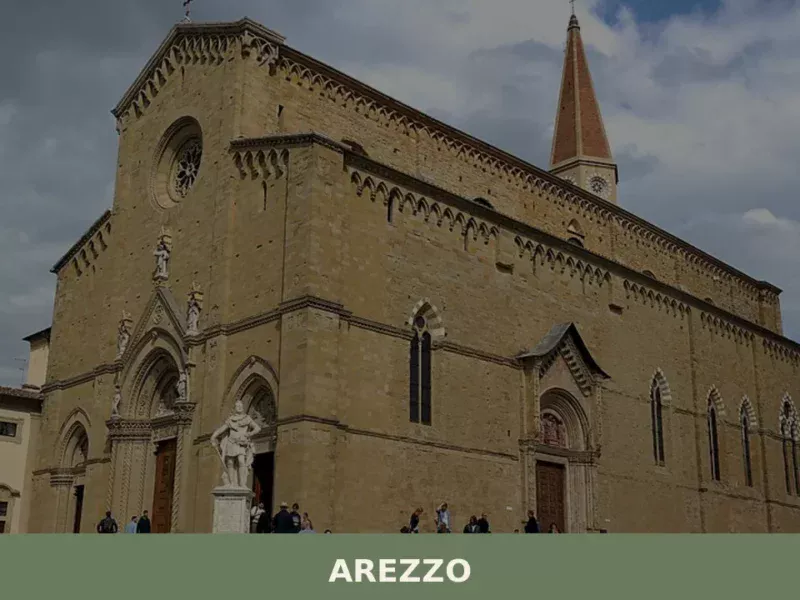
Discover Arezzo, a charming village in Tuscany, Italy. Explore its rich history, stunning architecture, and vibrant culture nestled in the heart of Toscana.
Coreglia Antelminelli
Hills
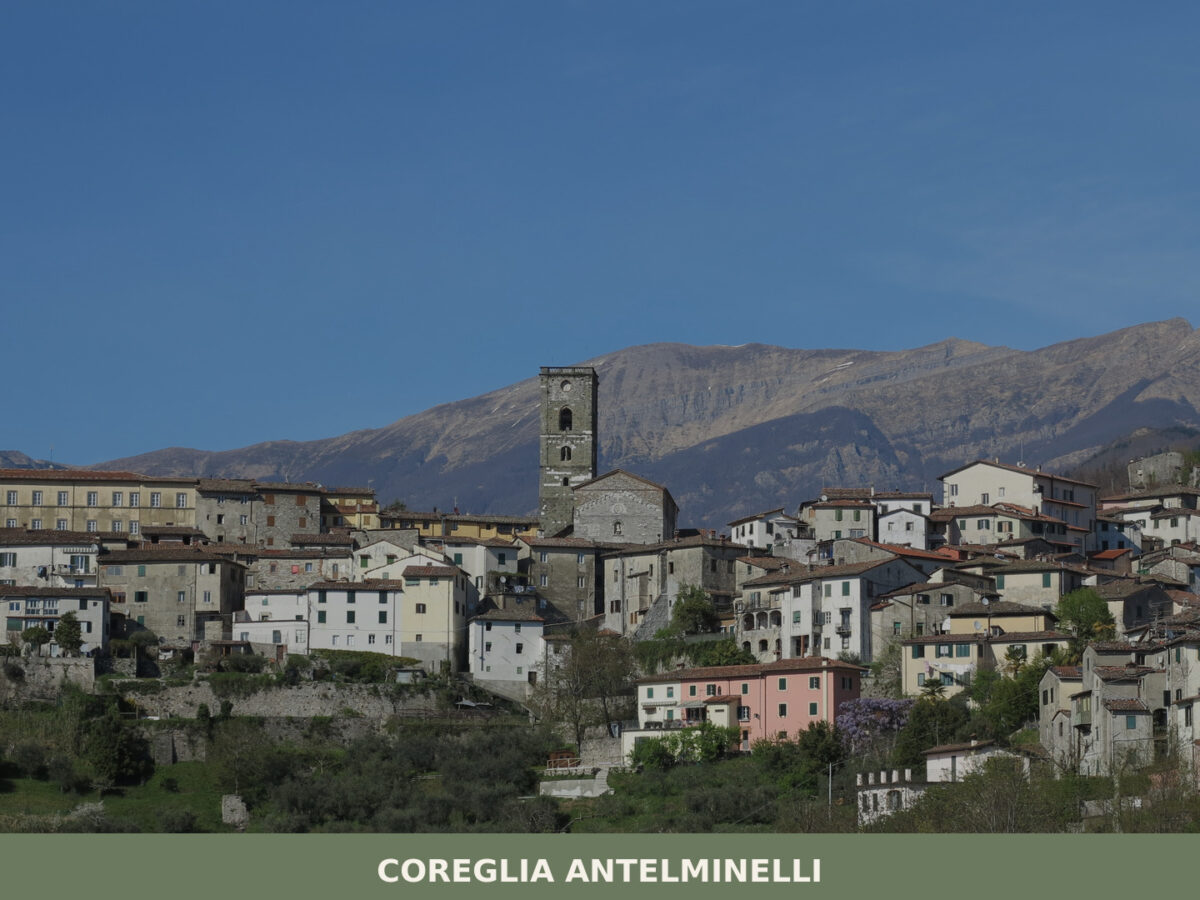
What to see in Coreglia Antelminelli, Italy: 3 Romanesque churches, a painted crucifix by Berlinghieri, and a village at 595 m. Explore the full guide.
Borgo San Lorenzo
 Plains
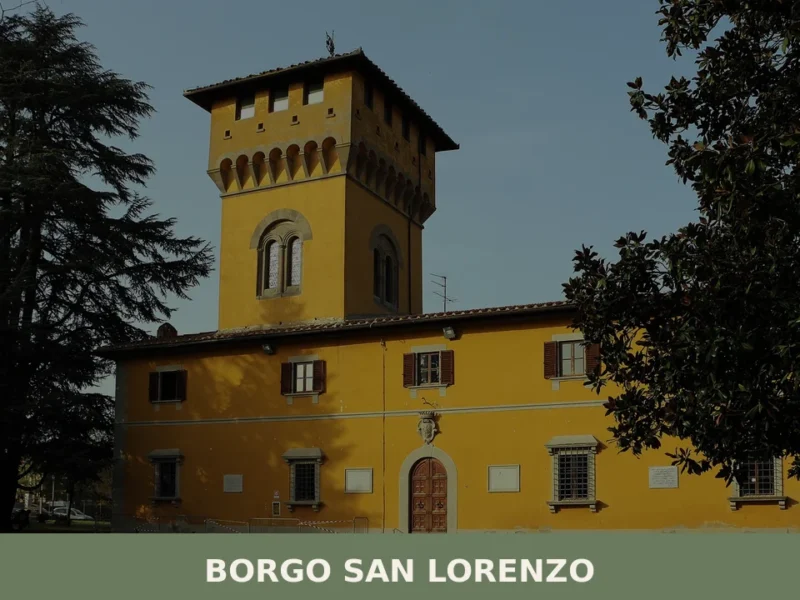
What to see in Borgo San Lorenzo, Italy: top attractions, local food, and how to get there. 20 km from Florence, 193 m altitude. Discover the Mugello valley.
Siena
Hills
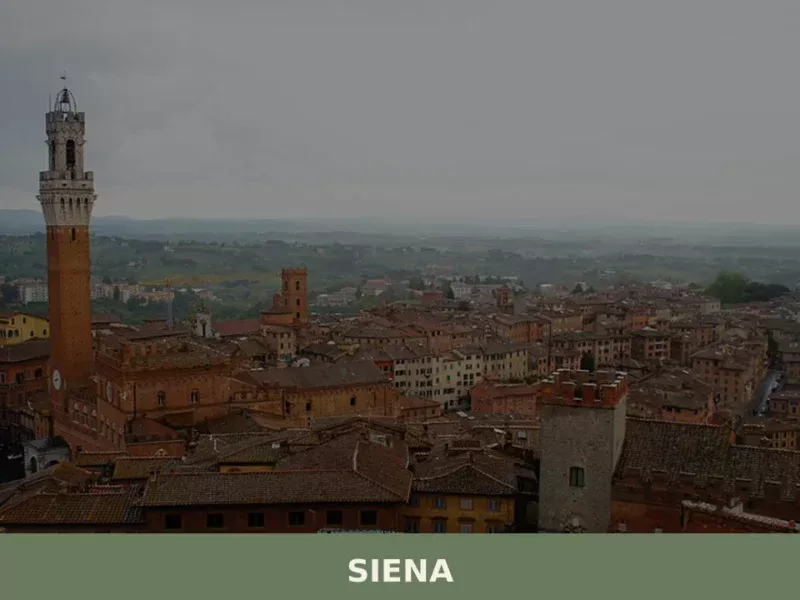
What to see in Siena: UNESCO centre at 322 m, population 52,883. Explore Piazza del Campo, the Cathedral, the Palio, and local foods like panforte and pici. Plan your visit.
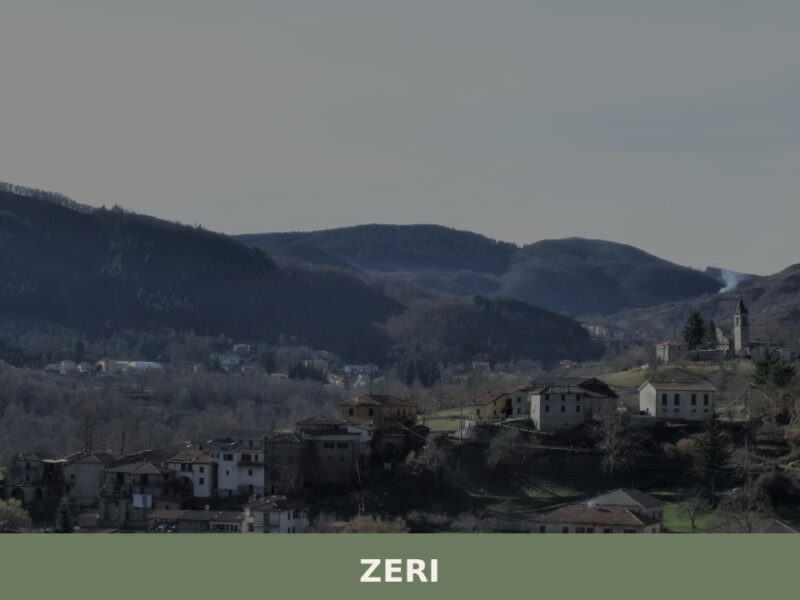
Zeri
 Mountain
Morning mist lifts slowly from the Lunigiana valley floor, revealing a scattering of stone hamlets across green ridgelines that roll toward the Ligurian border. The air carries wood smoke and the distant sound of cowbells — the famed Zerasca breed still grazes these highlands. Zeri, a municipality of 1,166 inhabitants in the province of Massa […]
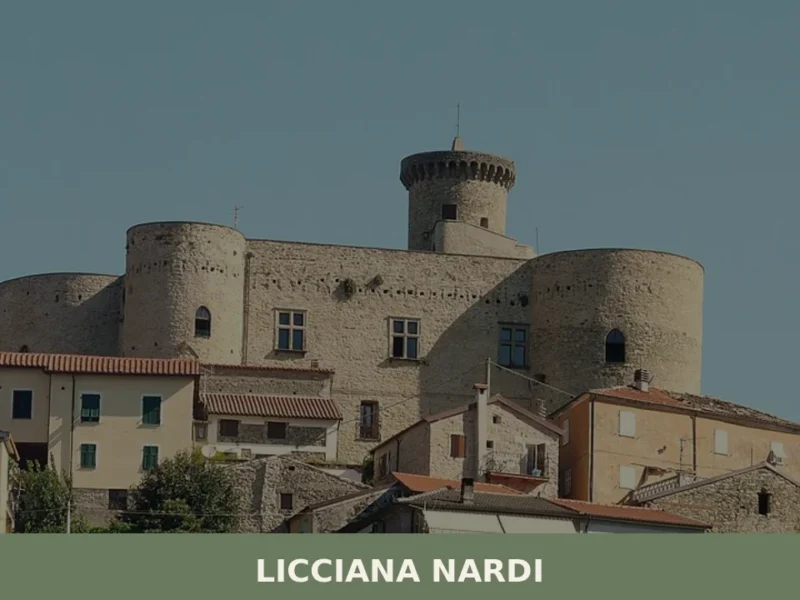
Licciana Nardi
Hills
The territory of Licciana Nardi includes six castles spread between the valley floor and the Apennine slopes, a concentration of defensive structures that documents the strategic role of this stretch of Lunigiana in controlling the routes between the Po Plain and the Tyrrhenian coast. With its 4,894 inhabitants distributed across 55 square kilometres at an […]
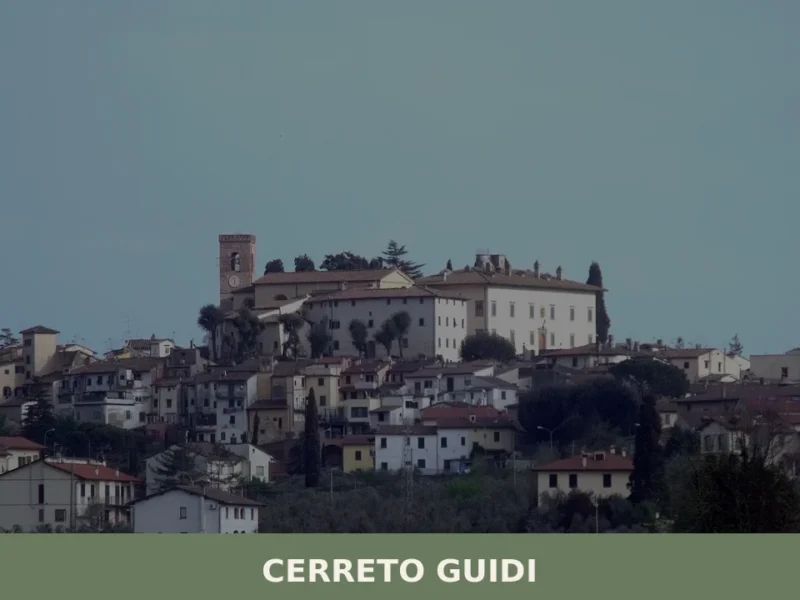
Cerreto Guidi
Plains
A low plain spreads west of Florence, and at 30 kilometres (19 mi) from the city the land rises just enough — to 123 metres (404 feet) above sea level — for a cluster of terracotta rooftops to stand out against the Tuscan sky. The municipality borders Empoli, Fucecchio, Vinci, and Lamporecchio, placing it at […]

Vicchio
Hills
A Florentine village of 8,000 souls in the Mugello Valley, Vicchio gave the world two painters who transformed Italian art. Medieval towers, sacred art museums and Etruscan archaeology define its landscape.
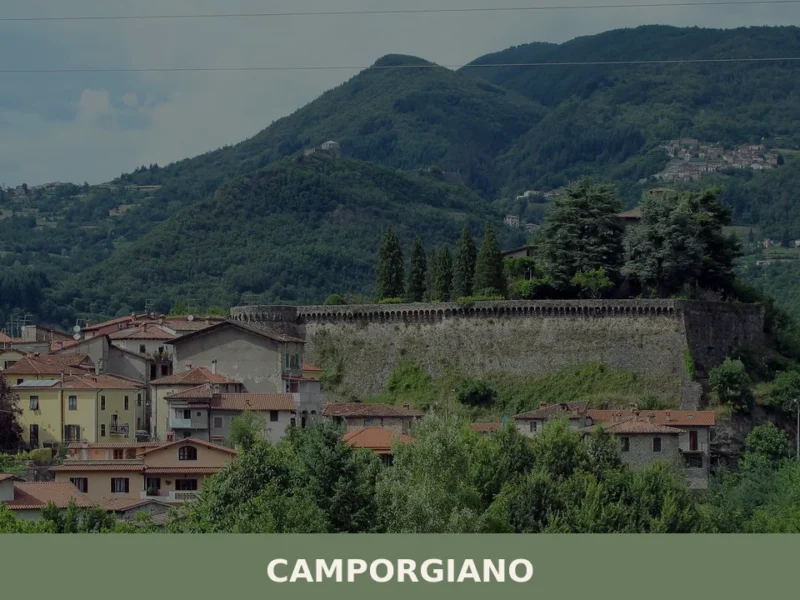
Camporgiano
Hills
What to see in Camporgiano, Italy: a hilltop comune at 475 m in Garfagnana, Toscana. Discover the fortress, San Iacopo feast and local chestnut traditions.
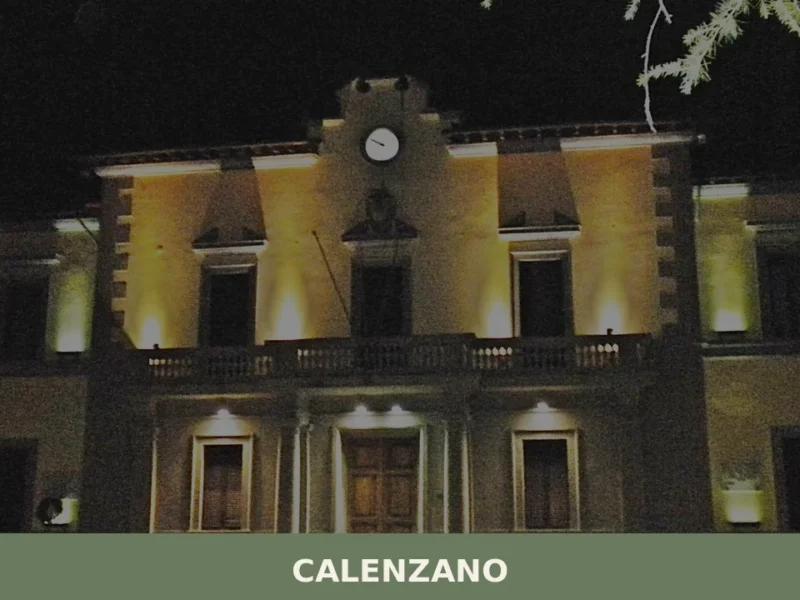
Calenzano
Plains
What to see in Calenzano, Italy: 5 top attractions, medieval churches, Renaissance art, and practical tips. 11 km from Florence. Discover Calenzano, Toscana.

🏡 Know Grosseto better than we do?
If you’re a local or have been there, your knowledge matters: add what’s missing or fix a detail on this page.