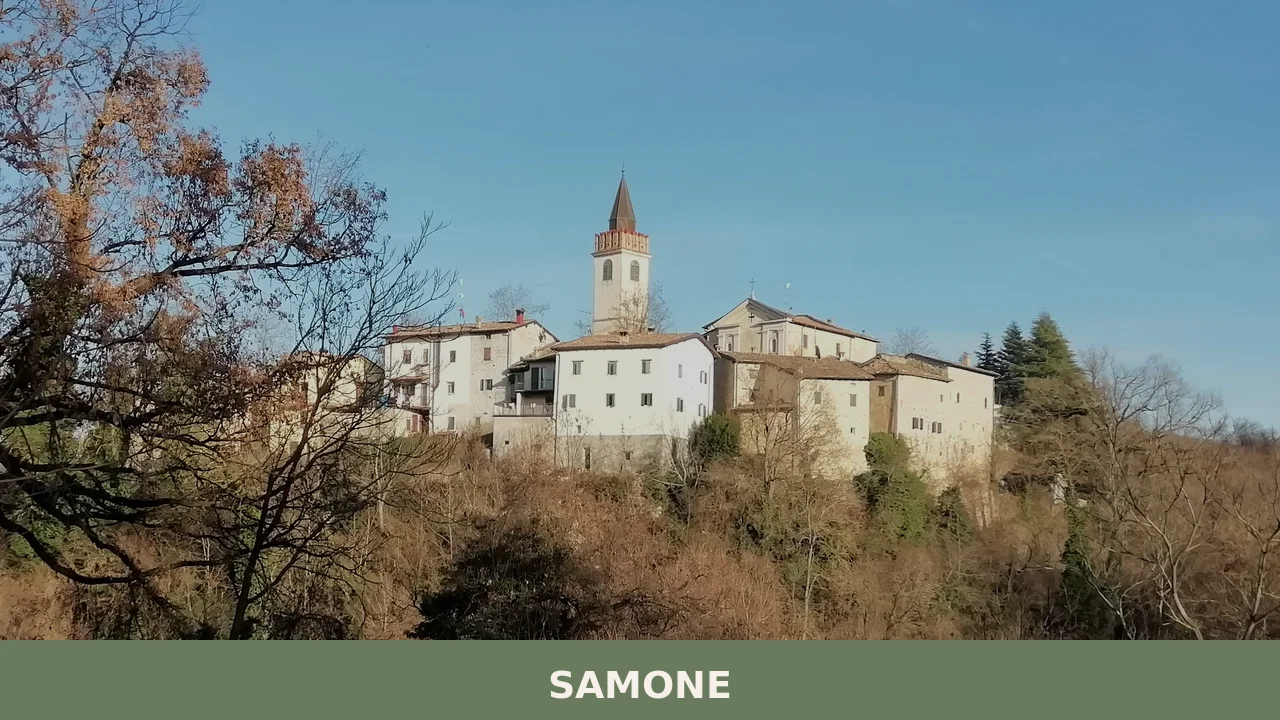
Low hills roll beneath fields of maize and scattered farms around Samone, a modest village that sits at 247 metres above sea level in the province of Turin. The main street carries the rhythm of a working town: shuttered shops alternate with modest houses, the church spire rises above red-tile roofs, and conversation in the local Piedmontese dialect still echoes in the piazza. Few visitors stop here by chance; those who do find not a postcard backdrop but a living settlement shaped by real labour.
Samone village in Piedmont emerges from a longer historical memory than its modest present might suggest. Medieval documents anchor it to the year 955, when it first appears in a diploma issued by Berengar; centuries later, in 1278, it negotiated its own exemption from military levies in a pact between Ivrea and the Marquises of Monferrato. The village’s identity crystallised around the Church of San Rocco, its patron, and was fully transformed during the twentieth century when industrial expansion—particularly the rise of Olivetti—brought migrant families first from the Veneto and Friuli, then from southern Italy, fundamentally altering the demographic and cultural fabric of what had been a small farming settlement.
In 1278, Samone and certain nearby lands were recorded as exempt from “any army, passage, cavalry or other taxation”—a rare moment when a small agricultural settlement negotiated its own legal standing with regional powers.
A Thousand Years of Fragmented Authority
The earliest documentary reference to Samone dates to 955, when it appears in a diploma as one of the villages belonging to the Pedagna, a territorial jurisdiction. This entry does not detail the settlement’s form, population or function, but confirms its existence as a recognised place within an administrative framework. Medieval Samone was not autonomous; it existed within overlapping spheres of influence that shifted with the rise and fall of regional powers.
By 1278, Samone had gained enough local significance to feature in a formal agreement. The pact, stipulated between the city of Ivrea and the Marquises of Monferrato, included a clause protecting Samone from military passage and fiscal impositions—a clause that suggests the village held enough economic or strategic value to warrant negotiation. This was not a grand event, but it reveals a moment when a small settlement could claim status enough to be named in a legal instrument.
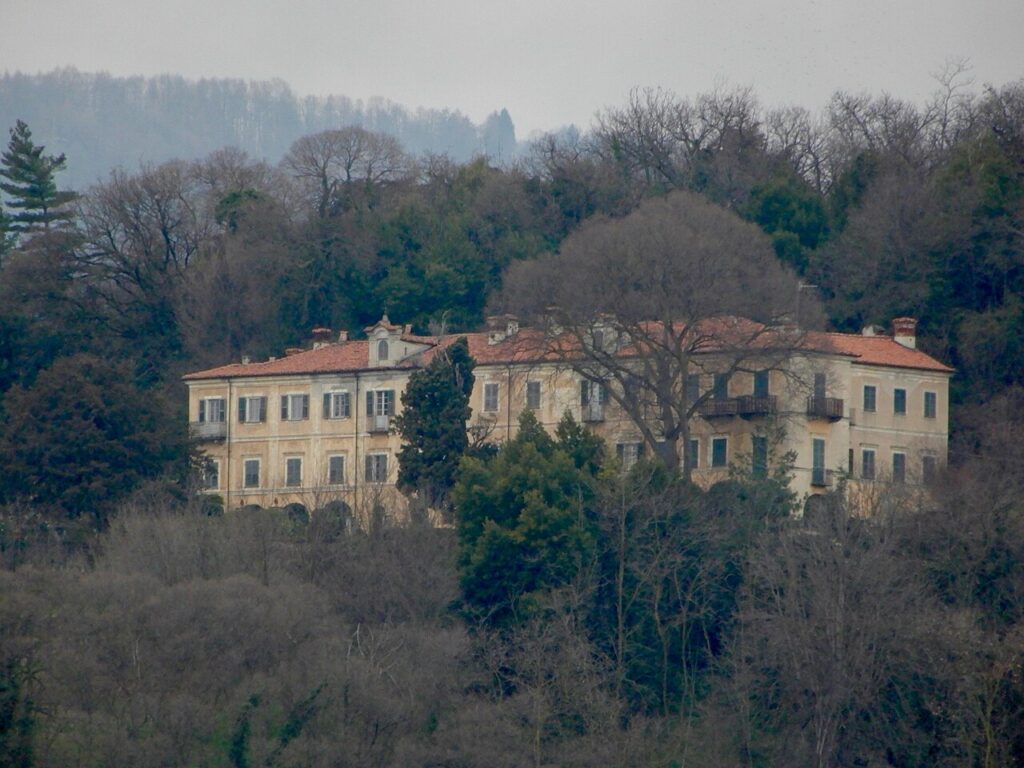
In 1619, the duchy of Savoy granted the fief of Samone, together with the villages of Banchette and Salerano, to Francesco di Damas, a nobleman of French lineage. The fief subsequently passed, with comital rank, to the Bruno family of Cuneo, patriarcians who held it until their extinction in the mid-nineteenth century. From that point until 1912, the title of Count of Samone belonged to the Morri family of Castelmagno. This long succession of lordships left little architectural or cultural mark; Samone remained primarily agricultural, its structure dependent on the seasons and the soil.
The Baroque Church and Late Ecclesiastical Organisation
Religious life in Samone moved slowly toward institutional form. Before 1787, the village possessed no resident parish priest; the sacraments were administered in a small chapel, the oldest core of what would become the parochial church. From 1787 onward, Samone could claim its own clergy, a sign of growing population or administrative recognition by the diocesan authorities.
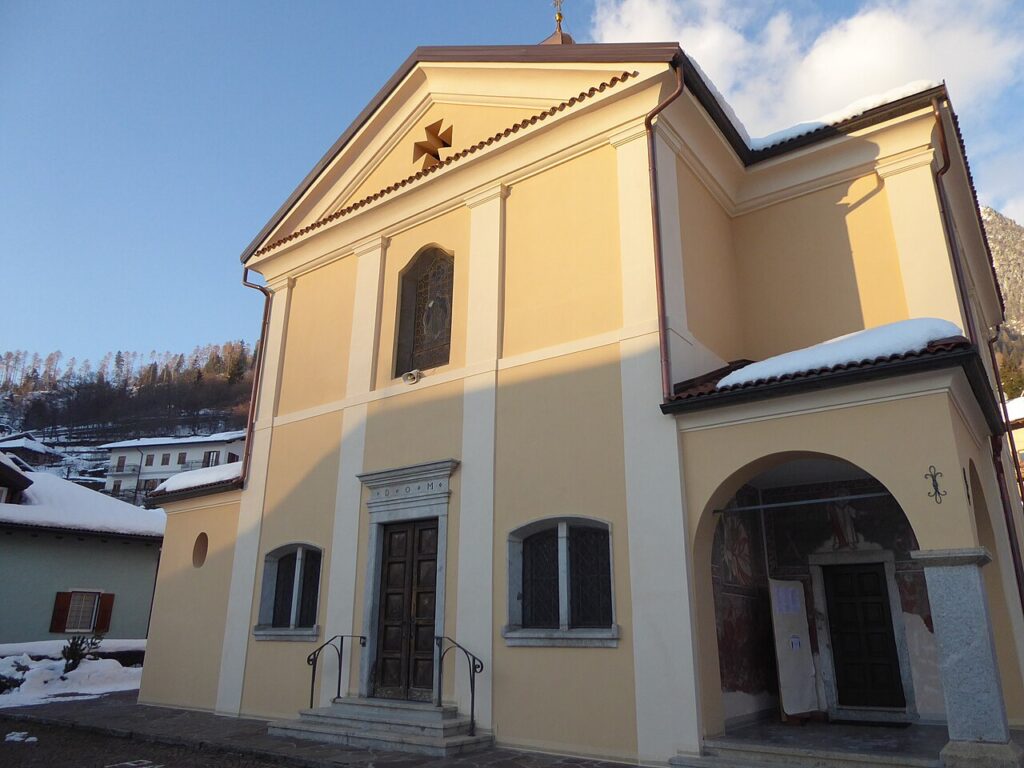
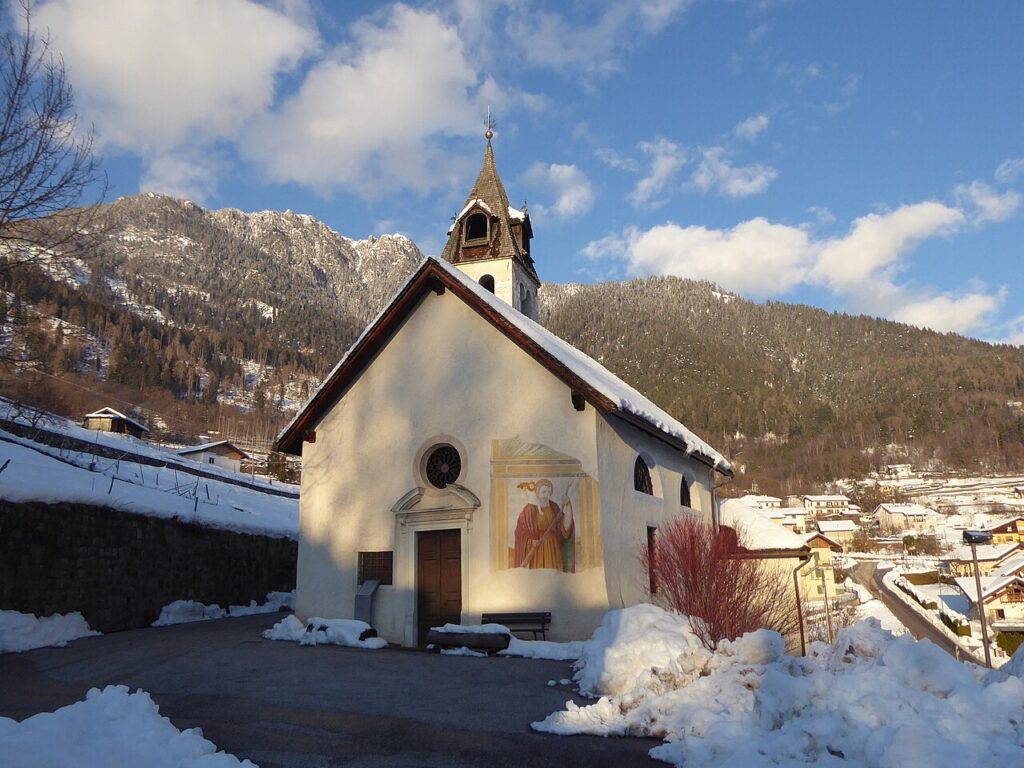
The Church of San Rocco, erected toward the end of the eighteenth century in baroque style, replaced that modest chapel as the village’s spiritual focus. Built with a single nave, it reflects neither wealth nor architectural ambition but rather the practical devotion of a rural community. San Rocco remains the village’s patron saint, his feast celebrated on 16 August. The church still stands at the centre of Samone’s modest piazza, its weathered façade a tangible reminder of late-eighteenth-century rural piety.
Industrial Growth and Demographic Upheaval
The twentieth century fractured Samone’s rural continuity. From the 1930s onward, industrial development—especially the expansion of Olivetti’s manufacturing operations in the Turin metropolitan area—drew migrant families to the province. Veneto and Friuli workers arrived first, establishing themselves in the 1930s and 1940s. In subsequent decades, families from southern Italy migrated northward, seeking employment and wage stability. This movement was not unique to Samone; it reshaped the entire lower Po Valley, but its impact on a village of 1,536 abitanti was profound and rapid.
The old peasant identity, with its dialect, customs and land-bound rhythms, persisted but no longer defined the majority. Industrial wages replaced agricultural income. Housing stock expanded to accommodate newcomers. Schools and local institutions absorbed speakers of different regional dialects and values. By the late twentieth century, Samone bore little resemblance to the village of the 1920s, yet retained its administrative identity and the architecture of its core—a common condition among small Piedmontese comuni that became dormitory suburbs without losing their municipal autonomy.
Places That Anchor Samone’s Identity
Church of San Rocco
The parochial church dominates Samone’s piazza and serves as the visual anchor of the village. Its late-eighteenth-century baroque exterior, rendered in modest proportions and unadorned stone, reflects the practical piety of rural Piedmont rather than artistic grandeur. Inside, the single nave structure focuses devotion toward the altar without spatial ostentation. The oldest section—a small chapel—predates the current building and carries the religious memory of the centuries when Samone had no resident priest. The church remains in active use and open to visitors during daylight hours.
Castello di Samone
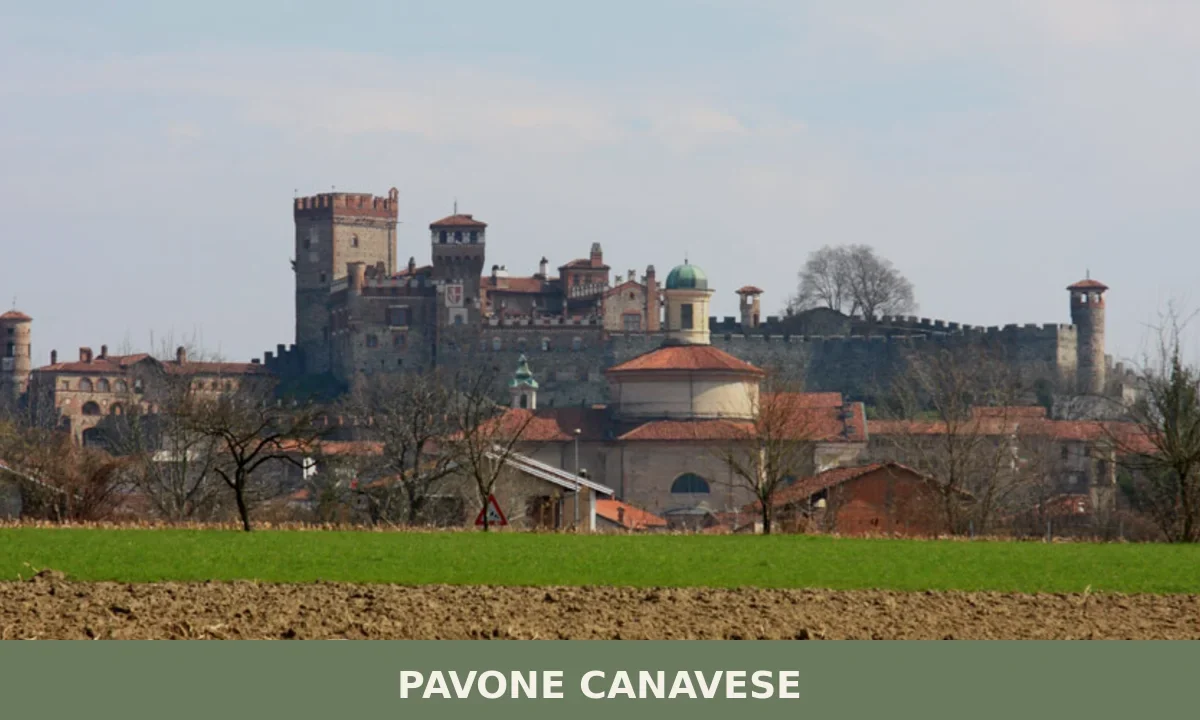
The Castle of Samone stands as a physical reminder of feudal lordship, though records of its original construction and modifications remain sparse. The structure has been adapted and repurposed over the centuries, reflecting the succession of families who held comital rank here. Today it represents one of the few non-religious monuments within the village’s administrative territory, though access and visibility from public spaces may be limited. Its presence underscores Samone’s status as a fief worthy of defensive architecture, however modest by regional standards.
The Piedmontese Table
Samone occupies territory within the province of Turin, a region celebrated for its protected food products and traditional preparations. The province holds thirteen designations of origin: among them the Nocciola del Piemonte (hazelnut), Toma Piemontese (cheese), and Salame Piemonte. These products reflect the agricultural inheritance of the lower Po Valley and the labour of both traditional farmers and modern cooperatives that process and distribute them under strict standards.
Local tables still acknowledge seasonal production: fresh vegetables from market gardens, meat prepared according to long-standing recipes, cheese and preserved goods that connect each family to the broader food culture of Piedmont. The industrial migrants who arrived in the twentieth century brought their own culinary traditions, gradually blending them with local practice. Food remains a point of continuity even as the social base of the village transformed.
Visiting Samone: Access and Timing
Samone lies in the province of Turin northeast of the city centre. The comune is easily accessible by car via regional roads; public transport connects it to Turin and nearby towns including Banchette and Parella. The flat terrain and modest size make it suitable for a brief visit or as part of a tour of the lower Turin province. The village centre is walkable; the piazza and church require only minutes to explore.
| Departure Point | Distance | Journey Time |
|---|---|---|
| Turin city centre | approximately 35 km | 45 minutes by car |
| Ivrea | 12 km | 20 minutes by car |
| Turin Caselle Airport | 55 km | 55 minutes by car |
Spring and early autumn offer the most pleasant conditions for a visit. Summer afternoons can be warm; winter mornings bring mist across the lowlands. The Church of San Rocco observes standard opening hours during daylight; visitors should check locally for special closures or feast days. The feast of the patron saint, San Rocco, falls on 16 August and may draw local gatherings, though Samone does not market itself as a festival destination. The village sustains itself through the presence of families, local commerce and the administrative services of a functioning comune; it does not exist for tourism and makes no effort to disguise that fact. This directness is itself part of its identity—a place where daily life continues without staging or embellishment.
 Mountain