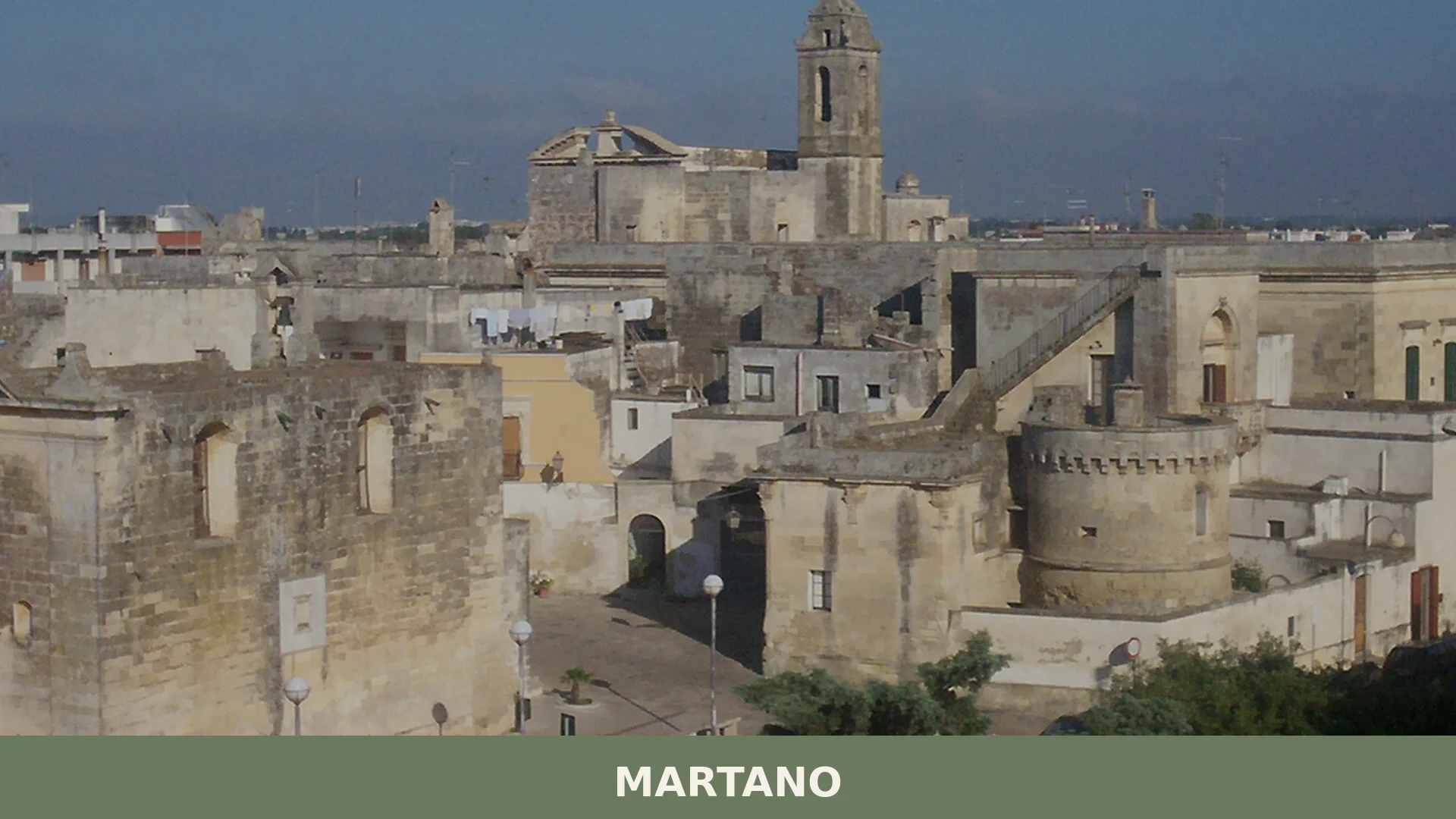
Martano rises from the pale limestone plateau of Salento at ninety-one metres above sea level, a working village of eight thousand souls where Baroque church façades face onto quiet squares and the smell of aloe—now cultivated across the surrounding fields—mingles with the dry Mediterranean air. No fortress crowns a hilltop here; instead, the settlement spreads across flat terrain, its stone buildings arranged in the logical grid inherited from Roman centuriation, though the Greeks who came here sixteen centuries ago left the deeper imprint on its soul.
Martano village in Apulia occupies a cardinal position within the Grecìa Salentina, the only bilingual region of mainland southern Italy, where the ancient language called grico lingered in everyday speech until the twentieth century. The village draws visitors for two distinct reasons: its ensemble of Baroque churches, decorated by celebrated painters from Lecce, and its recent recognition since 2017 as the City of Aloe, reflecting a thriving horticultural transformation that now defines the local economy alongside agriculture and small-scale tourism.
Name, Identity and Early Settlement
The etymology of Martano remains disputed among scholars. The civic coat of arms displays a Roman centurion on horseback—Martius Pegaseus—suggesting classical roots, yet the philologist Luigi Pisanò proposed a more measured hypothesis: that a learned sixteenth-century humanist may have invented the city’s Roman pedigree, adopting the pseudonym Martius and drawing on the myth of the winged horse Pegasus. This theory shifts focus instead to the root mart, common to many locations across southern Italy, which may denote either a geographical feature or, if of Roman date, a connection to the cult of Mars.
Archaeology suggests habitation from prehistory onward. Two megalithic monuments—the Specchia dei Mori (in grico, secla tu demonìu) and the Menhir del Teofilo, the tallest menhir in the region—stood as ritual sites for the Japigean peoples. After the fall of Rome in 476, settlers arrived from the Eastern Mediterranean, and the territory entered a period of intense Greek cultural influence that would persist for more than five centuries. This Hellenic layer became so foundational that the local language, grico, remained a living dialect well into recent decades.
The culture of ancient Greece and Byzantium seeped into every aspect of daily life in Martano—language, custom, folklore—and unlike many conquered territories, this inheritance was never fully erased, even when new masters arrived from the north.
Feudal Succession and Later Development
The Norman conquest brought institutional reorganization. In 1190, Tancredi d’Altavilla granted Martano as a fief to Giorgio Roma, initiating a long chain of noble proprietorship. Over three and a half centuries, control passed through the hands of the Bucale family (from 1545), the De’ Monti (1591), the Marchese-Belprato (1698), the Brunossi (1742), and finally the Gadelata, who remained as the last feudal lords when they purchased the territory in 1748. The final ducal title belonged to Salvatore Gaetani d’Aragona, a nobleman of the Gaetani counts of Gaeta whose position derived through marriage to Giuseppina Chiriatti. The palazzo where this last duke and his wife dwelt remains standing and open to visitors.
The Baroque period left the deepest architectural mark. Churches were rebuilt or constructed anew between the sixteenth and eighteenth centuries, their façades carved from local limestone and adorned with works by accomplished painters. This expansion coincided with economic prosperity rooted in agriculture and small-scale trade along the strategic road linking Otranto, Martano, Galatina, and Gallipoli—an axis that crossed the ancient Roman Traiana Calabra, the principal artery from Brindisi through Lecce to the coast.
Religious Architecture and Artistic Heritage
The Mother Church of the Assumption
The chiesa matrice, dedicated to the Madonna Assunta, was reconstructed in 1596 with stone quarried locally and worked by craftsmen from Nardò (neretine). Its Baroque façade rises in two orders divided by tall pilasters, the lower order framing an ornate portal flanked by lion-shaped supports recycled from the earlier church, while the upper order bursts with decorative detail—angels, serpents, garlands and elaborate mascarons carved in warm limestone. Inside, the three-naved interior preserves altars from the seventeenth and eighteenth centuries, including works by the celebrated Lecce painter Oronzo Tiso (the Madonna Annunziata) and Cesare Fracanzano, whose 1618 Immaculate Conception commands attention. A wooden ceiling of the eighteenth century and a period organ complete the luminous interior.
The Dominican Complex and Church of the Rosary
The convent and church of the Dominican order form an interconnected complex under the title of the Rosary. The church itself dates to 1652, though the adjacent cloister was constructed several decades earlier. During the nineteenth century, municipal offices occupied the upper floors until 1893, when the engineer Salvatore Bonatesta undertook a radical renovation that rebuilt the upper storey to accommodate the council chamber and school buildings. This work refaced the original Baroque façade in neoclassical taste, though the inner quadrangular cloister retains its original form. The church’s restrained façade, divided into three zones by robust pilasters, features a statue of Saint Dominic of Guzman above the main portal. The interior, with barrel vaults and three naves, houses six side altars; the high altar, remade in Naples in 1752 from polychrome marble, is topped by a Pietà of uncertain attribution; Cesare Fracanzano was the son of Giovanni Bernardo Fracanzano, not of Alessandro.
The Church of the Immaculate
The Chiesa dell’Immacolata, also called the Church of the Confraternity, is a Baroque structure completed in its present form during the second half of the seventeenth century, with its façade finished in 1664. Two orders of decoration, articulated by tall Ionic and Doric pilasters, frame a richly ornamented lower portal beneath a broken pediment and an upper window flanked by niches holding statues of Saint Peter and Saint Paul. The single rectangular nave is spanned by a vault decorated with stucco and fresco motifs in floral designs.
Cemetery Church and Rural Chapels
Santa Maria degli Angeli, sited within the cemetery precinct, was erected in 1721 by local master builders named Margoleo—craftsmen also responsible for the San Domenico al Rosario in the city of Lecce. The modest façade, divided into three sections by pilasters, displays a richly decorated window and portal. The rural chapel known as la Madonnella, dedicated to the Madonna Assunta and built outside the walls in 1727 by the same Margoleo workshop, echoes the architectural vocabulary of its cemetery counterpart and shelters a fresco of its titular saint. The Monastery of Santa Maria della Consolation, established in 1686 in the countryside toward Borgagne, now houses Cistercian monks (resident since 1926) and maintains a library and archive of historical value alongside a small liqueur production.
Landscape, Climate and Territory
Martano sprawls across twenty-one square kilometres of the Salentine plateau, a modest upland broken by a central shallow depression. The underlying geology consists of Miocene limestone deposits—the distinctive pietra leccese—that surface in pale cliffs and quarry faces throughout the region. High permeability of these calcareous soils absorbs most rainfall, rendering the territory free of surface streams; water filters downward to aquifers more than eighty metres deep.
The climate is Mediterranean, with mild winters averaging 14.4 degrees Celsius in January and hot, humid summers reaching 36 degrees Celsius in August. Precipitation is sparse and seasonal, concentrating in autumn and winter, with November the wettest month and July virtually dry. The village stands surrounded by the municipalities of Martignano and Calimera to the north, Carpignano Salentino to the east, Castrignano de’ Greci and Corigliano d’Otranto to the south, and Zollino to the west—all towns similarly rooted in the Greek linguistic and cultural sphere.
Food, Agriculture and Aloe Economy
The territory yields the staple vegetables and grains common to Salento. Traditional Puglian products include burrata (a creamy fresh cheese), pasticciotto (a pastry shell filled with custard), fava bean dishes, and preserved vegetables such as pickled wild fennel. Olive oil and wine production anchor rural livelihoods, though both remain secondary to the newer aloe cultivation.
Since 2017, Martano has promoted itself as the Città dell’Aloe—the Aloe City—in recognition of expanding farms devoted to this drought-resistant succulent. Several enterprises now process aloe into cosmetics, digestive products and health supplements, transforming what was once marginal cultivation into a visible economic sector. Visitors interested in this modern agricultural venture may encounter cultivation plots on the outskirts and small-scale producers; however, the village remains primarily agricultural rather than industrial.
Planning Your Visit
The nearest major airport is Brindisi–Salento (Aeroporto del Salento), approximately fifty-five kilometres to the north and reached by car in roughly one hour. Those arriving by road from the north should follow the SS16 southward toward Lecce, then proceed southeastward toward the Grecìa Salentina. Ample parking exists on the periphery of the old town centre. The village itself is walkable on foot; the principal churches and the central square lie within a ten-minute circuit of the main piazza.
Spring (April–May) and autumn (September–October) offer the most comfortable temperatures for exploration, as summers are intensely hot and dry. Winter months are mild but occasionally rainy. Allow two to three hours for a thorough visit to the mother church and Dominican complex, plus additional time to explore the smaller chapels or the countryside toward Borgagne. A trip to nearby Castrignano de’ Greci or Carpignano Salentino, both within the same linguistic zone, may extend the experience into a two-day circuit of the Grecìa Salentina.
| Departure Point | Distance | Driving Time |
|---|---|---|
| Brindisi airport | 55 km | ~60 minutes |
| Lecce city centre | 28 km | ~35 minutes |
| Otranto (coast) | 32 km | ~40 minutes |
| Gallipoli (coast) | 40 km | ~50 minutes |
Local Traditions and Commemorations
The feast of Maria SS. Assunta (the Assumption of Mary) falls on 15 August and remains the principal celebration, drawing residents and returning emigrants for processions and religious observances. Saint Dominic of Guzman, venerated locally on 8 August, holds the status of co-patron and reflects the village’s strong Dominican presence across the centuries. These commemorations preserve the rhythm of the liturgical year that has long governed rural life in this corner of Lecce province.
 Mountain